10-Inch Cake Pans: Batter, Bake Time and Servings

Standard 10-inch cake pans are 10 inches across the inside of the top rim and 2 inches deep. They hold 11 cups of water to the rim, which means 7 cups of batter once you leave the correct third of headroom, and two layers stacked and frosted feed 16 to 20 people at dessert-slice size.
The deep version, 10 by 3 inches, is a different pan entirely: 15 cups to the rim and about 10 cups of batter. Ten-inch springforms usually run shallower than that, closer to 12 cups.
Bake 10-inch layers at 350°F for 30 to 38 minutes, or drop to 325°F and add 15 to 25 minutes if you are using the deep pan.
Running a swap right now? Our free cake pan converter does the area math and batter volume for any two pans.
Updated September 2026
What 10-inch cake pans actually hold
Ten inches is measured across the inside of the top rim, not the outside of the pan and not the base. Sloped sides mean the base of a "10 inch" pan is often 9 1/2 inches, and that quarter inch on each side costs you about 8 percent of the floor area.
| Format | Depth | Floor area | Volume to rim | Batter at 2/3 fill | Typical use |
|---|---|---|---|---|---|
| 10 inch round, standard | 2 in | 78.5 sq in | 11 cups | 7 cups | Layer cakes, base tier |
| 10 inch round, deep | 3 in | 78.5 sq in | 15 cups | 10 cups | Tall single layers, torting into 3 |
| 10 inch springform | 2 3/4 to 3 in | 78.5 sq in | 12 cups | 8 cups | Cheesecake, mousse, ice cream cake |
| 10 inch push-pan | 3 in | 78.5 sq in | 14 to 15 cups | 9 1/2 cups | Cheesecake with no leaky seam |
| 10 inch square | 2 in | 100 sq in | 14 cups | 9 1/2 cups | Bar cakes, sheet-style bakes |
| 10 inch tube or angel food | 4 in | 78.5 sq in less the tube | 16 cups | 12 cups | Chiffon, angel food, bundt-style |
In metric, a 10-inch round is a 25 cm tin, and the standard 2-inch depth is 5 cm. A 10x3 is 25 by 7.5 cm.
Two honest caveats. Pan brands differ by up to a cup at the same nominal size, mostly because of how sharply the sides slope. And springform capacity is the least predictable of the lot, because the ring depth varies more than solid pans do.
The fix costs thirty seconds. Fill your own pan from a measuring cup, count the cups, and write the number on masking tape stuck underneath. You never guess again.
Why 10 inches is bigger than it looks
Area grows with the square of the diameter, so going from 9 inches to 10 is not an 11 percent step up.
| Pan | Floor area | Compared to a 10 inch |
|---|---|---|
| 6 inch round | 28.3 sq in | 64% smaller |
| 8 inch round | 50.3 sq in | 36% smaller |
| 9 inch round | 63.6 sq in | 19% smaller |
| 10 inch round | 78.5 sq in | Baseline |
| 12 inch round | 113.1 sq in | 44% larger |
| 10 inch square | 100 sq in | 27% larger |
| 9x13 rectangle | 117 sq in | 49% larger |
A 10-inch pan has 23 percent more floor than a 9-inch. That is the number that decides everything else. Pour a two-layer 9-inch batter into two 10-inch pans and the layers come out about a fifth shallower, so they bake faster, dome less, and can turn out dry if you follow the original clock.
The reverse is worse. A two-layer 10-inch batter is about 14 cups. Split between two 9-inch pans that is 7 cups each, into pans that hold 8 cups to the rim. That batter goes over the edge and onto the oven floor.
Our full round cake pan sizes chart has every size side by side if you need to compare more than two.
Scaling factors to and from 10-inch cake pans
Multiply every ingredient by the factor in the table. These are pure area ratios, so they hold for any two-inch-deep round pan.
| From | To 10 inch | Factor |
|---|---|---|
| 6 inch | 10 inch | 2.77x |
| 7 inch | 10 inch | 2.04x |
| 8 inch | 10 inch | 1.56x |
| 9 inch | 10 inch | 1.23x |
| 12 inch | 10 inch | 0.69x |
| 9x13 | 10 inch | 0.67x |
| From 10 inch | To | Factor |
|---|---|---|
| 10 inch | 6 inch | 0.36x |
| 10 inch | 8 inch | 0.64x |
| 10 inch | 9 inch | 0.81x |
| 10 inch | 12 inch | 1.44x |
| 10 inch | 9x13 | 1.49x |
Three ingredients do not scale cleanly and need a hand:
Leavening. Baking powder and baking soda scale sublinearly. Take the mathematical answer and shade it down by roughly 10 percent on any factor above about 1.5. The house figure is 4 g, or 1 teaspoon, of baking powder per cup of flour, and our guide to baking soda vs baking powder covers why more is not better.
Salt and spice. Scale to about 85 percent of the arithmetic. Both read stronger in a bigger volume.
Eggs. Never round to a whole egg on a big scale-up. Weigh instead. A large egg is about 50 g shelled, so beat one more than you need and weigh out the target.
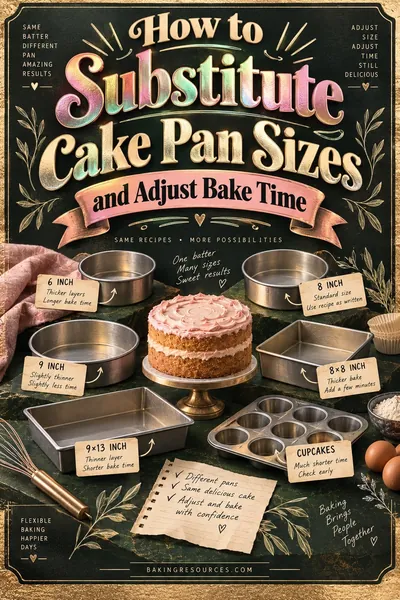
The full method, including bake time adjustment, is in our guide to substituting cake pan sizes, and our recipe scaler does the multiplication for you.
How many servings does a 10-inch cake give?
Most arguments about this number are really arguments about slice width.
| Cake build | Party slices | Wedding slices | Notes |
|---|---|---|---|
| Single 10 inch layer, 2 in deep | 10 to 12 | 20 | A dessert, not a celebration cake |
| Two 10 inch layers | 16 to 20 | 38 | The standard 10-inch cake |
| Three 10 inch layers | 20 to 24 | 38 to 42 | Tall, needs a center dowel |
| 10 inch cheesecake, 3 in deep | 12 to 16 | 20 to 24 | Rich, so slices run narrow |
| 10 inch square, two layers | 20 to 25 | 50 | 27 percent more floor than the round |
The published wedding-serving figure for a 10-inch round is 38, and that is the number professional charts use. A 6 plus 8 plus 10 stacked tier comes to roughly 80 wedding servings, which is where the classic three-tier count comes from.
Our cake servings calculator draws the actual cut pattern, which is far more convincing than a number when you are trying to work out whether one cake covers the room.
Bake time for 10-inch layers
Bake time follows batter depth, not pan width. A 10-inch layer and a 6-inch layer filled to the same depth finish within a couple of minutes of each other.
| Batter depth | Batter volume in a 10 in pan | At 350°F | Notes |
|---|---|---|---|
| 3/4 in | 4 cups | 20 to 26 min | Thin torte layers, check early |
| 1 1/3 in | 7 cups | 30 to 38 min | Standard 2 in pan, filled right |
| 2 in | 10 cups | 50 to 65 min | Deep 10x3 pan. Drop to 325°F |
| 2 1/2 in or more | 12+ cups | 65 to 85 min | 325°F plus a bake-even strip |
Doneness beats arithmetic. A butter cake is finished at 205 to 210°F in the center whatever pan it came from. A skewer with a few moist crumbs says the same thing less precisely. Our baking time calculator adjusts for depth if you are between sizes.
Ten-inch pans have one specific problem the smaller sizes do not: edge-to-center lag. Five inches from the rim to the middle is a long way for heat to travel, so the outside can be dry and dark while the center is still wet. Three fixes, in order of how much they help:
- Wrap a bake-even strip. A damp strip of old towel or a commercial insulated band around the outside slows the edges and flattens the dome. This is the single biggest improvement on a 10-inch layer.
- Drop the oven 25°F and add 8 to 12 minutes. Slower heat travels further before the outside sets.
- Use a heating core for anything above 2 inches deep. A metal cone in the middle conducts heat into the center and cuts 10 to 15 minutes off a deep bake.
A dark or nonstick 10-inch pan absorbs heat and browns hard. Drop 25°F and start checking 5 minutes early or you get a dark ring around a pale middle. Our guide on which oven rack to use matters more at this size too: middle rack, nothing above it.
How full to fill, and what overfilling costs
Two thirds full, measured by depth. In a 2-inch pan, that is batter sitting about 1 1/3 inches deep and two thirds of an inch of clear wall above it.
| Fill level | Batter in a 10x2 pan | Result |
|---|---|---|
| Half | 5 1/2 cups | Flat, fast, fine for thin stacked layers |
| Two thirds | 7 cups | The target. Even bake, gentle dome |
| Three quarters | 8 1/4 cups | Safe only for cheesecake and pound cake |
| To the rim | 11 cups | Overflow, sunken middle, burnt smell |
Batters with a lot of chemical leavening need the full third of headroom. Cheesecake, flourless chocolate cake, and dense pound cake barely rise, so three quarters is safe there.
Leftover batter should become cupcakes, not a crowded pan. A standard cupcake well takes 1/4 cup, so a spare cup of batter is 4 cupcakes and they finish in 18 to 22 minutes while the big layer is still going.
Cheesecake in a 10-inch springform
A 10-inch springform changes three numbers at once.
Capacity. About 12 cups to the rim on a typical 2 3/4 inch ring, less than the 15 cups a solid 10x3 holds. Cheesecake barely rises, so fill to three quarters rather than two thirds: roughly 9 cups of batter plus crust.
Scaling from a 9-inch recipe. A 9-inch springform is about 10 cups. Multiply everything by 1.23, the area ratio, and round to something you can weigh. Going the other way, from 10-inch down to 9-inch, use 0.81.
Crust. Crumb crusts scale by floor area plus whatever wall you climb. Base only, use the straight 1.23 factor from a 9-inch. Pressing the crust up the sides, use about 1.18, because the wall of a wider pan is proportionally smaller relative to its floor. To turn that into a package count, how many Oreos make a cup of crumbs has the weights.
Bake time. Barely changes. The batter in a 10-inch springform is often shallower than in a 9-inch, so expect the same time or 5 minutes less, not more. Pull it at 150°F in the center with a jiggle about the size of a silver dollar still in the middle.
Water bath. A 10-inch springform is too wide for most cake pans to nest inside, so the practical approach is a double layer of heavy foil wrapped up the outside, set in a roasting pan. Check that your roasting pan is genuinely wider than 10 inches before you commit. Our springform pan substitute guide covers what to do if it is not.
Worked example: a 9-inch recipe scaled up to 10-inch cake pans
What you have: a recipe written for two 9-inch rounds, and two 10-inch pans.
Step 1. The ratio. A 10-inch pan is 78.5 square inches. A 9-inch is 63.6. That gives 1.23, so scale every ingredient up by 23 percent.
Step 2. The arithmetic. Say the recipe lists 350 g all-purpose flour, 400 g granulated sugar, 4 large eggs, 227 g butter (two sticks), 300 ml milk, and 3 teaspoons of baking powder.
- Flour: 350 x 1.23 = 431 g, which is about 3 1/2 cups at 125 g per cup
- Sugar: 400 x 1.23 = 492 g
- Butter: 227 x 1.23 = 279 g, which is 2 sticks plus 4 1/2 tablespoons, since one stick is 113 g
- Milk: 300 x 1.23 = 369 ml
- Eggs: 4 large eggs are about 200 g shelled, so 200 x 1.23 = 246 g of beaten egg, which is five large eggs less a tablespoon
- Baking powder: 3 tsp x 1.23 = 3.7 tsp, shaded down to 3 1/2 tsp
Step 3. Why the egg line matters. Cracking "five eggs, near enough" adds 4 g of extra egg, which is nothing. Cracking four and hoping is a 23 percent protein shortfall, and that is a cake that will not hold its structure. Beat five, weigh out 246 g, keep the rest.
Step 4. Check the fill. That batter comes to roughly 1,800 g, or about 13 1/2 cups. Split between two 10-inch pans, that is 6 3/4 cups each. The two-thirds line for a 10-inch pan is 7 cups. You are just under target, which is exactly where you want to be.
Step 5. Confirm the depth. One cup is 14.4 cubic inches, so 6.75 cups is 97 cubic inches sitting on 78.5 square inches of floor. That is 1.24 inches deep, against the 1.33-inch two-thirds line. Slightly shallower than a filled 9-inch layer, so the bake runs a touch faster.
Step 6. The bake. Same 350°F. Start checking at 30 minutes instead of 35, and pull at 205°F in the center. Wrap bake-even strips around both pans, because 10 inches is wide enough for the edges to run ahead.
Worked example: skipping the scaling entirely
Here is the shortcut that avoids arithmetic altogether.
A two-layer 9-inch recipe makes about 10 1/2 cups of batter. A 10-inch pan takes 7 cups at the two-thirds line. So that same batter fills one 10-inch layer with 3 1/2 cups left over, which is 14 standard cupcakes.
Better: bake one 10-inch layer 1 1/2 inches deep with 9 cups, then torte it horizontally into two thin layers with a serrated knife. You get a two-layer 10-inch cake out of a 9-inch recipe with no scaling at all. Drop the oven to 325°F for that deeper single layer and give it 45 to 55 minutes.
A standard box mix yields about 4 1/2 cups, which is nowhere near enough for a proper 10-inch layer. Two boxes give you 9 cups, enough for one well-filled layer or two thin ones.
Frosting, lining and finishing a 10-inch cake
Buttercream for a filled and frosted 10-inch cake, crumb coat plus final coat:
| Build | Frosting needed |
|---|---|
| Two 10 inch layers | 6 to 7 cups |
| Three 10 inch layers | 7 1/2 to 8 1/2 cups |
| Two layers plus a piped border | Add 1 cup |
| Full rosette coverage | Add 2 to 2 1/2 cups |
Our frosting calculator gives the batch weight for the style you are piping, and how to frost a cake covers the crumb-coat sequence that matters more at this width, since a 10-inch top is a large flat surface with nowhere to hide a ridge.
For parchment, cut a circle to the exact inside diameter. A collar strip for clean vertical sides needs the circumference, which is pi times the diameter: 31.4 inches for a 10-inch pan. Round up an inch for the overlap. How to line a cake pan has the folding trick that gets you a circle without tracing.
One structural note specific to this size. A 10-inch layer is wide, heavy, and fragile while warm, and it will crack if you try to lift it unsupported. Cool it 10 minutes in the pan, invert onto a rack, and move it on a cake board or the removable base of a springform, never on your hands. Chill the layers for 20 minutes before stacking and they behave.
Frequently asked questions
How much batter does a 10 inch cake pan hold?
Seven cups at the correct two-thirds fill, in a standard 2-inch-deep pan that holds 11 cups to the rim. A deep 10x3 pan holds 15 cups to the rim and takes about 10 cups of batter. Cheesecake and pound cake can go to three quarters full, since neither rises much.
How many people does a 10 inch cake feed?
Sixteen to 20 at normal dessert-slice size for two frosted layers, or 38 at wedding-slice size. A single unstacked layer feeds 10 to 12. Cheesecakes get cut narrower because they are rich, so a 10-inch cheesecake serves 12 to 16 generously or up to 24 at party size.
Can I use a 10 inch pan instead of a 9 inch?
Yes, with an adjustment. A 10-inch pan has 23 percent more floor area, so the same batter sits about a fifth shallower. It will bake 5 to 8 minutes faster and come out flatter and drier if you follow the original time. Either scale the recipe up by 1.23 or start checking early.
What is a 10 inch cake pan in cm?
Twenty-five centimeters. European, British and Australian recipes list it as a 25 cm round tin, and the standard 2-inch depth is 5 cm. A deep 10x3 inch pan is 25 by 7.5 cm.
How long do you bake a 10 inch cake at 350°F?
Thirty to 38 minutes for a standard layer filled to 1 1/3 inches deep. A deep 10x3 pan filled to 2 inches needs 50 to 65 minutes at 325°F instead. Check the internal temperature rather than the clock: 205 to 210°F in the center means done for any butter cake.
Why does my 10 inch cake dome and crack?
The edges are setting far ahead of the center, which is the classic wide-pan problem. Wrap a damp bake-even strip around the outside of the pan, drop the oven to 325°F, and add 8 to 12 minutes. Both fixes slow the rim so the middle catches up.
Do I need a heating core for a 10 inch pan?
Not for a standard 2-inch layer. For anything 3 inches deep or more, a heating core cuts 10 to 15 minutes off the bake and prevents the wet center that plagues deep wide pans. A metal flower nail set upside down in the middle of the pan does most of the same job.
How many 10 inch layers can I torte from one deep pan?
Two comfortably, three with care. A 10x3 pan filled with 10 cups of batter bakes to roughly 2 1/4 inches tall, which splits into two clean 1-inch layers or three thin ones. Chill the baked layer for an hour before you cut it, since a cold crumb slices without tearing.
Related guides: Round cake pan sizes | How to substitute cake pan sizes | Cake mold 6 inch | Cake servings calculator | Cake pan converter