Jumbo, Standard and Mini Cupcake Pan Sizes

Jumbo, standard and mini cupcake pan sizes come down to three batter amounts: 1/2 cup, 1/4 cup and 1 tablespoon. A jumbo well is about 3 1/2 inches across and 1 3/4 inches deep, a standard well is 2 3/4 inches across and 1 1/4 inches deep, and a mini well is 1 3/4 inches across and 3/4 inch deep.
That means one jumbo equals two standards, and one standard equals about four minis. A batter written for 12 standard cupcakes fills 6 jumbo wells or 44 to 48 mini wells.
Bake times run 22 to 28 minutes for jumbo, 18 to 22 for standard, and 10 to 14 for mini, all at 350°F.
Swapping a recipe between pans? Our free cake pan converter does the area and volume math for any two pans.
Updated September 2026
The full size chart
Pan makers do not agree on much, so treat these as the center of a range rather than a spec sheet. Every number below is the inside measurement at the top rim, which is where the volume actually lives.
| Pan | Wells | Top diameter | Depth | Volume to rim | Batter per well | Bake at 350°F |
|---|---|---|---|---|---|---|
| Mini | 24 or 48 | 1 3/4 in | 3/4 in | 2 tbsp (1 fl oz) | 1 to 1 1/2 tbsp | 10 to 14 min |
| Standard | 12 or 24 | 2 3/4 in | 1 1/4 to 1 3/8 in | 1/2 cup (4 fl oz) | 1/4 cup | 18 to 22 min |
| Jumbo (Texas) | 6 | 3 1/2 in | 1 3/4 to 2 in | 1 cup (8 fl oz) | 1/2 to 2/3 cup | 22 to 28 min |
| Mega or gigantic | 4 | 4 in | 2 1/4 in | 1 1/2 cups | 1 cup | 30 to 38 min |
| Tulip or crown | 6 | 3 in | 2 in | 3/4 cup | 1/2 cup | 20 to 26 min |
The metric version, since most pans sold outside the US are labeled this way:
| Pan | Top diameter | Depth | Volume to rim |
|---|---|---|---|
| Mini | 4.5 cm | 2 cm | 30 ml |
| Standard | 7 cm | 3 to 3.5 cm | 120 ml |
| Jumbo | 9 cm | 4.5 to 5 cm | 240 ml |
| Mega | 10 cm | 5.7 cm | 355 ml |
Two things worth knowing before you trust any of this.
Your pan is probably not exactly average. Standard wells sold as 1/2 cup range from about 3 1/2 to 4 1/2 fl oz depending on brand and how much the sides taper. Jumbo pans vary more, from about 6 to 9 fl oz. Thirty seconds with a measuring cup and some water settles it permanently. Fill one well to the rim, note the number, write it on masking tape stuck to the pan's underside.
"Muffin pan" and "cupcake pan" are the same object. There is no manufacturing difference. The two names describe what people put in them, not the tin.
Jumbo, standard and mini cupcake pan sizes: what changes besides the number
The sizes are not simply scaled copies of each other. Three physical facts shift as the well grows, and they explain almost every problem people run into.
Surface-to-volume ratio. A mini well has a lot of hot metal touching a small amount of batter, so heat reaches the center almost instantly. A jumbo well has proportionally less wall per unit of batter, so the middle takes far longer. This is why a jumbo is not simply "double the time" of a standard.
| Pan | Batter volume | Approximate wall + floor area | Area per fl oz of batter |
|---|---|---|---|
| Mini | 0.5 fl oz | 4.5 sq in | 9.0 sq in |
| Standard | 2 fl oz | 13 sq in | 6.5 sq in |
| Jumbo | 4.5 fl oz | 24 sq in | 5.3 sq in |
Nearly twice as much hot surface per ounce of batter in a mini as in a jumbo. That single ratio drives the bake time differences.
Dome height. A dome forms because the edges set first and the still-liquid center has nowhere to go but up. Bigger wells set their edges relatively later, so jumbo cupcakes dome less dramatically and often crack across the top instead.
Structural load. A jumbo cupcake is heavy enough that a weak batter sinks in the middle. Batters with a lot of chemical leavening or a lot of sugar are the usual sinkers, and the same batter can be perfectly stable in a standard well. Our guide on why a cake sinks covers the mechanism.
How much batter per well, and how full to fill
Fill level is where most cupcakes go wrong, and the right answer depends on what you are baking, not on the pan.
| Fill | Standard well | Jumbo well | Mini well | Result |
|---|---|---|---|---|
| Half | 2 tbsp | 1/4 cup | 1 1/2 tsp | Flat top. Good for cupcakes you will frost heavily |
| Two thirds | 3 tbsp | 1/3 cup | 2 tsp | The safe default. Level or gently rounded top |
| Three quarters | 1/4 cup | 1/2 cup | 1 tbsp | Full dome. The bakery look, and the standard for muffins |
| To the rim | 1/2 cup | 1 cup | 2 tbsp | Overflow, flat mushroom tops fused together |
The rule of thumb. Two thirds for cupcakes you plan to frost, because you want a flat surface. Three quarters for muffins, where the big domed top is the whole point.
The exception. Batters with a lot of leavening, like anything using a full tablespoon of baking powder per cup of flour, need the extra headroom. Our baking powder substitute guide has the standard ratio of 4 g, or 1 teaspoon, per cup of flour, and anything well above that will climb.
A scoop makes this repeatable in a way spoons never do. A #16 disher holds 1/4 cup and portions standard cupcakes perfectly. A #40 holds about 1 1/2 tablespoons for minis. A #8 holds 1/2 cup for jumbos. Equal portions bake in equal time, which is the entire reason bakeries use them.
Yield conversions between the three sizes
This is the number most people actually want: I have a batter for 12 standard cupcakes, how many of the other sizes does it make?
A 12-cupcake batter is about 3 cups of batter total at 1/4 cup per well.
| Batter volume | Mini (1 1/2 tbsp) | Standard (1/4 cup) | Jumbo (1/2 cup) | Mega (1 cup) |
|---|---|---|---|---|
| 1 1/2 cups | 16 | 6 | 3 | 1 to 2 |
| 3 cups (standard batch) | 32 | 12 | 6 | 3 |
| 4 1/2 cups | 48 | 18 | 9 | 4 |
| 6 cups (double batch) | 64 | 24 | 12 | 6 |
At the leaner 1 tablespoon per mini well, the counts go higher: a standard batch stretches to 48 minis instead of 32. Both are correct, they just make different-sized minis.
The quick mental version:
- 1 jumbo = 2 standard = 8 minis
- 1 standard = 4 minis at 1 tablespoon each, or 2 2/3 minis at 1 1/2 tablespoons
- A 2-layer 8-inch cake batter runs about 5 cups, so 20 standard cupcakes or 10 jumbos
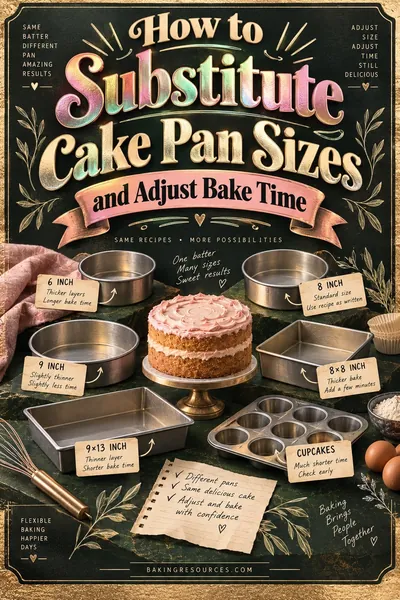
If you are converting from a cake pan rather than between cupcake pans, our guide to substituting cake pan sizes has the area method that makes it exact.
Bake times and temperatures for each size
Bake time follows batter depth and volume, not just pan width, so the three sizes need genuinely different handling.
| Pan | Temperature | Time | Doneness target |
|---|---|---|---|
| Mini | 350°F | 10 to 14 min | 200 to 205°F internal |
| Standard | 350°F | 18 to 22 min | 205 to 210°F internal |
| Jumbo | 350°F | 22 to 28 min | 205 to 210°F internal |
| Jumbo, muffin style | 400°F for 5 min, then 350°F | 5 + 18 to 22 min | 205 to 210°F internal |
| Mega | 325°F | 30 to 38 min | 205 to 210°F internal |
Minis are unforgiving. The window between done and dry is about 90 seconds. Set a timer for 10 minutes and check, every time. They also carry over more than larger cupcakes, so pull them a hair early.
Jumbos need patience, not heat. The instinct when a jumbo is raw in the middle at 25 minutes is to raise the oven. Do the opposite: drop to 325°F and give it 5 to 8 more minutes. A hotter oven sets the outside faster and makes the gap worse.
The high-heat start is a muffin trick, not a cupcake one. Five minutes at 400°F drives a burst of steam and gas that lifts the dome hard before the crumb sets, then dropping to 350°F lets the inside finish. It gives you the tall, cracked bakery top. Do not use it on a cupcake you intend to frost flat.
Our baking time calculator adjusts times for the pan and batter depth if you are working between sizes.
Liners, and why they are not interchangeable
Liner sizing catches people out, because the names do not always match the pans.
| Liner | Base diameter | Wall height | Fits |
|---|---|---|---|
| Mini | 1 1/4 in | 3/4 in | Mini pan |
| Standard | 2 in | 1 1/4 in | Standard pan |
| Jumbo or Texas | 2 1/2 in | 1 3/4 to 2 in | Jumbo pan |
| Tulip, standard | 2 in | 3 1/4 in tall, unfolded | Standard pan, tall wrap |
| Tulip, jumbo | 2 1/2 in | 4 in | Jumbo pan |
Standard liners in a jumbo pan is the classic mistake. They sit loose, the batter runs down the outside, and you get a fused mess. Jumbo liners crammed into a standard pan pleat and buckle, and the cupcake bakes with a wrinkled, oily side.
If you are out of the right liner, greasing and flouring the wells works fine for both jumbo and standard. Skip liners entirely for minis if you like: a light coat of pan spray and a 5-minute rest before you twist them out is usually enough. Our guide to lining a cake pan covers the parchment approach for anything sticky.
Worked example: taking a 12-cupcake batter to jumbo
The situation. A batter listing 190 g all-purpose flour, 200 g sugar, 113 g butter (one stick), 2 large eggs, 120 ml milk, and 2 teaspoons of baking powder, written for 12 standard cupcakes. You own one 6-well jumbo pan.
Step 1. How much batter is there? Twelve wells at 1/4 cup each is 3 cups, or 24 fl oz.
Step 2. How many jumbos does that fill? At 1/2 cup per jumbo well, 3 cups divided by 1/2 cup is exactly 6 jumbo cupcakes. One pan, no leftovers, no second batch. This is the tidiest conversion in baking.
Step 3. Check the fill level. A jumbo well holds 1 cup to the rim. Half a cup is a 50 percent fill, which gives you a flat to gently rounded top. If you want a real dome, use 2/3 cup per well and you get 4 1/2 jumbos out of the batch, so scale the recipe up by 1.35 to fill all six.
Step 4. Scale it if you want six full domes. Multiply everything by 1.35:
- Flour: 190 x 1.35 = 257 g (about 2 cups at 125 g per cup)
- Sugar: 200 x 1.35 = 270 g
- Butter: 113 x 1.35 = 153 g, which is 1 stick plus 3 1/2 tablespoons
- Milk: 120 x 1.35 = 162 ml
- Baking powder: 2 tsp x 1.35 = 2.7 tsp, so 2 1/2 tsp and no more
Leavening does not scale linearly. Round it down, never up, because the larger well already gives the gas more room to expand into. Our recipe scaler handles the rest of the multiplication.
- Eggs: two large eggs weigh about 100 g shelled. 100 x 1.35 = 135 g of beaten egg, which is two large eggs plus about 2 tablespoons of a third. Beat three, weigh out 135 g.
Step 5. Bake it. Same 350°F, but 24 to 28 minutes instead of 20. Check at 22. Pull at 205°F in the center, or when a skewer comes out with a couple of moist crumbs.
Step 6. Cool it properly. A jumbo cupcake holds a lot of heat and steams itself soggy sitting in the pan. Five minutes in the pan, then onto a rack. Our guide to cooling a cake explains the timing.
Frosting each size
Buttercream needed per cupcake, for a generous swirl rather than a thin spread:
| Size | Frosting per cupcake | For a full pan |
|---|---|---|
| Mini | 1 to 1 1/2 tsp | About 1/2 cup for 24 |
| Standard | 2 to 3 tbsp | 2 to 2 1/4 cups for 12 |
| Jumbo | 1/4 to 1/3 cup | 1 1/2 to 2 cups for 6 |
| Mega | 1/2 cup | 2 cups for 4 |
A flat spread uses about half those amounts. A tall piped swirl with a large open star tip uses closer to the top of each range, and a jumbo cupcake with a bakery-height swirl can take a full 1/3 cup on its own.
Our frosting calculator gives batch weights for the style you are piping, and how to make buttercream covers the ratios that hold a swirl without slumping.
Frequently asked questions
How much batter goes in a jumbo cupcake pan?
Half a cup per well for a flat to gently domed top, or 2/3 cup for a full bakery dome. A jumbo well holds about 1 cup to the rim, so half a cup is a 50 percent fill and 2/3 cup is two thirds. Never fill to the rim: the batter runs over and the tops fuse together.
How many mini cupcakes does a standard recipe make?
Thirty-two at 1 1/2 tablespoons per well, or 44 to 48 at 1 tablespoon. A batter written for 12 standard cupcakes is about 3 cups, so divide by whichever portion size you use. Both fills work, they just give you different sized minis.
Is a jumbo muffin pan the same as a Texas muffin pan?
Yes. Jumbo, Texas and Texas-size are three names for the same 6-well pan with wells about 3 1/2 inches across and 1 3/4 to 2 inches deep, holding roughly 1 cup to the rim. Liners for them are sold under all three names too.
How do I convert a standard cupcake recipe to jumbo?
Use the same batter and portion it at 1/2 cup per well instead of 1/4 cup, which halves the yield: 12 standard becomes 6 jumbo. Keep the oven at 350°F and add 4 to 8 minutes, checking for 205°F in the center rather than trusting the clock.
Why are my jumbo cupcakes raw in the middle?
The oven is too hot, not too cool. A jumbo well has less hot surface per ounce of batter than a standard one, so the outside sets long before the center warms through. Drop to 325°F and add 5 to 8 minutes, and check the internal temperature instead of the top.
What size is a standard cupcake pan well?
About 2 3/4 inches across the top and 1 1/4 to 1 3/8 inches deep, holding 1/2 cup, or 4 fl oz, of water to the rim. Brands vary between roughly 3 1/2 and 4 1/2 fl oz, so measure your own pan once with water if you want an exact number.
Can I bake mini and standard cupcakes at the same time?
Only if you can pull them separately. Minis finish in 10 to 14 minutes and standards need 18 to 22, so put them on the same rack, set two timers, and take the minis out when they are done. Opening the oven at 12 minutes will not hurt the standards.
Do I need to fill empty cupcake wells with water?
No, though it does no harm. The old advice about warping applies to thin, low-quality pans, and half a cup of water in a spare well takes energy the pan would otherwise use. If you have a good heavy pan, just leave the empty wells alone and expect the cupcakes nearest them to bake a minute faster.
Related guides
- Cake Pan Converter for the area math between any two pans
- How to Substitute Cake Pan Sizes for the full scaling method
- Baking 4 Inch Cake Layers for the small round pan equivalents
- Why Are My Muffins Dry for overbaked domes and cracked tops
- Frosting Calculator for how much buttercream a batch needs