How Many Cake Pops From One Cake Mix?

One standard box mix gives you about 900 g of cake pop dough, which is 36 standard pops at 25 g each. Scoop them smaller at 17 g and you get about 53. Scoop them big at 40 g and you get 22. That's the whole answer to how many cake pops from one cake mix: it's a weight problem, not a recipe problem.
The number moves because "one cake pop" isn't a fixed size. A 1 inch mini and a 1.65 inch monster come out of the same bowl, and the count between them varies by a factor of four. So the useful thing to know is the dough weight, then divide.
Planning a whole dessert table off one cake? Our free cake servings calculator tells you how many portions any pan really gives, which is the same arithmetic in a different shape.
Updated September 2026
Where the 900 g comes from
You can check every step of this on a kitchen scale, which is the point. Nothing here is a guess.
A standard box of cake mix is 15.25 oz, or 432 g of dry mix. Add what the box asks for and weigh the bowl before it goes in the oven:
| What goes in | Weight |
|---|---|
| Dry mix | 432 g |
| 3 large eggs | 150 g |
| Water | 236 g |
| Oil | 109 g |
| Total batter | 927 g |
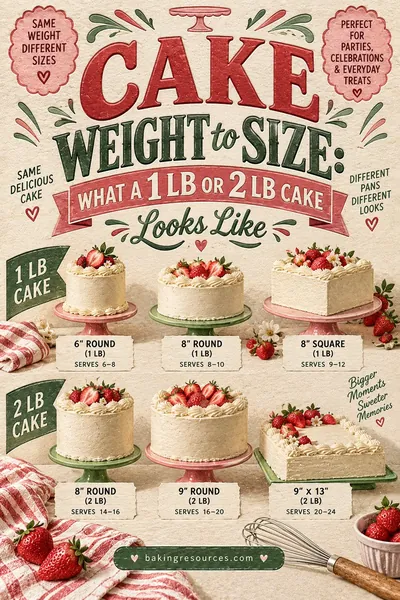
Baking drives off steam. A cake loses 8 to 12 percent of its weight in the oven, so 927 g of batter comes out as roughly 835 g of baked cake. That figure matches our cake weight to size chart, and it holds whether you baked it in a 9x13, in two 8 inch rounds, or in a square pan.
Then you add the binder. Crumbled cake on its own won't hold a ball, so a few tablespoons of frosting glue it together. American buttercream runs about 247 g per cup, so a tablespoon is roughly 15 g. Four tablespoons is 62 g.
835 g of cake plus 62 g of frosting is 897 g of dough. Call it 900 g.
If you trim the browned crust and the domed top off first, which gives a paler, softer pop, you lose 10 to 15 percent of the cake and land closer to 760 g of dough. That's four or five pops fewer. Worth knowing before you promise someone a count.
One warning about boxes. Not every mix on the shelf is 15.25 oz. Plenty of lines run 13.25 oz, which is about 13 percent less mix, and your dough will come in near 780 g instead of 900 g. Check the net weight printed on the box before you trust any chart, including this one.
How many cake pops from one cake mix, size by size
Packed cake pop dough is dense. Once you've squeezed the air out and rolled it, it works out close to 1 g per milliliter, which is a handy accident: the volume of your scoop in milliliters is very nearly the weight of the ball in grams.
Scoop numbers are just the count that fits in a quart. A #40 scoop means 40 level scoops fill a quart, so each one holds 946 divided by 40, which is 23.7 ml. That's why the numbers below look strange but line up perfectly.
| Disher | Scoop volume | Dough per ball | Finished ball | Pops from 900 g |
|---|---|---|---|---|
| #100 | 9.5 ml (2 tsp) | 10 g | 1.0 in | 90 |
| #60 | 15.8 ml (1 tbsp) | 17 g | 1.25 in | 53 |
| #50 | 18.9 ml | 20 g | 1.3 in | 45 |
| #40 | 23.7 ml (1 1/2 tbsp) | 25 g | 1.4 in | 36 |
| #30 | 31.5 ml (2 tbsp) | 33 g | 1.55 in | 27 |
| #24 | 39.4 ml | 41 g | 1.65 in | 22 |
The #40 scoop is the standard cake pop size and the one most tutorials assume without saying so. A 25 g ball comes out at about 1.4 inches across, which is one comfortable bite and a half, and it's light enough that the stick holds it.
Go bigger than 40 g and physics starts working against you. A 1.65 inch ball is heavy, the coating layer stays the same thickness, and the ball wants to slide down the stick while the coating is still wet. If you want a showpiece size, chill harder and use a thicker stick, or accept some casualties.
The diameter math, if you want to check a size
Ball diameter isn't guesswork either. A sphere's volume is weight divided by density, and the diameter falls out of that.
A 25 g ball at 1.05 g per ml is 23.8 cubic centimeters. Work back through the sphere formula and the radius is 1.78 cm, so the diameter is 3.57 cm, or 1.4 inches. That's why the same 25 g always looks the same size no matter whose kitchen it's in.
How much frosting to use as binder
Less than you think. The single most common cake pop failure is too much frosting, and it shows up as a heavy, greasy, oddly wet pop that sags off the stick an hour later.
The classic instruction is "one can of frosting per cake." A 16 oz can is 450 g. Against 835 g of cake that's a 54 percent binder ratio, and it makes something closer to a truffle paste than a cake pop.
Here's the useful range instead:
| Frosting added to 835 g of cake | Ratio | Result |
|---|---|---|
| 2 tbsp (31 g) | 4% | Crumbly. Balls crack while rolling |
| 4 tbsp (62 g) | 7% | The sweet spot. Holds a smooth ball, still tastes like cake |
| 6 tbsp (93 g) | 11% | Softer, easier to roll, slightly dense |
| 8 tbsp (124 g) | 15% | Getting heavy. Chill hard before dipping |
| 1 can (450 g) | 54% | Truffle paste. Will slide off the stick |
Start with 3 tablespoons, mix, and squeeze a test ball in your palm. If it holds its shape without cracking at the edges, stop. Add one more tablespoon at a time after that, never two.
A drier cake needs more. A very moist mix, or one baked with sour cream or pudding in it, may need only 2 tablespoons. If you're making your own binder rather than using a tub, our buttercream guide has the ratios, and the same 247 g per cup applies.
Sticks: how many, and how long
One stick per pop, which sounds obvious until you're 30 pops in with 28 sticks. Buy in packs of 50 or 100, and plan on 20 percent more sticks than pops. Some snap, some go in crooked, and some get pulled back out and can't be reused because there's coating dried on them.
| Pop size | Stick length | Why |
|---|---|---|
| 1.0 to 1.25 in | 4 in (10 cm) | Short and stable. Fits a shallow display |
| 1.4 in (standard) | 4 in or 6 in | 4 in for a flat tray, 6 in if they stand in a block |
| 1.55 in and up | 6 in (15 cm) | You need the extra length buried in the ball |
Push the stick in halfway, not a third and not all the way through. Halfway on a 1.4 inch ball means about 0.7 inches of stick inside the dough, which is enough surface for the coating anchor to grip.
The anchor is the step people skip: dip the tip of the stick in melted coating first, then push it into the chilled ball. That drop of coating sets inside the ball like glue. Skip it and the pop rotates on the stick during dipping and eventually falls.
How much candy coating per batch
A 1.4 inch ball has a surface area of about 40 square centimeters. A finished coating layer is roughly 1 mm thick, which is 4 cubic centimeters of coating, or about 4 to 5 g of actual coating per pop.
That's the amount that ends up on the pop. It is not the amount you need to buy, and the gap between those two numbers is where people run out mid-batch.
You have to melt a deep pool, because you dip and swirl in one motion rather than painting the ball. A tall narrow cup is the trick: a 2.5 inch wide container holds a 12 oz bag (340 g) at nearly 4 inches deep, which is exactly the depth you want. Any wider and the same bag gives you a puddle you can't dip in.
Plan on 12 g per pop of coating purchased. That covers the 4 to 5 g on the pop, the film left in the cup, the bit that thickens and seizes at the end, and the pops you re-dip.
| Pops | Coating on the pops | Coating to buy | Bags (12 oz / 340 g) |
|---|---|---|---|
| 12 | 55 g | 145 g | 1 |
| 24 | 110 g | 290 g | 1 |
| 36 (one box mix) | 165 g | 430 g | 2 |
| 53 (small pops) | 240 g | 640 g | 2 |
| 72 (two box mixes) | 330 g | 865 g | 3 |
Real chocolate behaves differently from candy melts. Candy melts contain no cocoa butter, so they set hard at room temperature with no work. Real chocolate has to be tempered or it dries dull, soft and streaky. Our guides to melting chocolate and tempering chocolate cover which one you're dealing with and how to hold it in the right window.
Chill the balls, don't freeze them. Fifteen to twenty minutes in the fridge firms them enough to dip. A frozen ball drops below the dew point, pulls condensation out of the air, and the water under the coating makes it crack as the pop warms up. That crack is almost always frozen balls, not bad coating.
Worked example: 60 cake pops for a party
You need 60 standard pops. Here's the whole shopping list from arithmetic alone.
Step 1. Dough needed. 60 pops at 25 g each is 1,500 g of dough.
Step 2. Cake needed. Dough is cake plus about 7 percent binder, so cake equals 1,500 divided by 1.07, which is 1,400 g of baked cake.
Step 3. Boxes. Each box gives 835 g of baked cake. 1,400 divided by 835 is 1.68, so you need 2 boxes.
Step 4. Check the real yield. Two boxes give 1,670 g of cake plus 124 g of frosting, which is 1,794 g of dough. At 25 g a ball that's 71 pops, so you're covered with 11 spare. Good, because you will lose some.
Step 5. Pans. Two boxes is 9 cups of batter. That's one 13x18 half sheet, or two 9x13s, or four 8 inch rounds. Our cake mix per pan size chart has the capacity for every pan, and the pan converter will tell you if the pan you own actually holds it.
Step 6. Sticks. 60 pops, plus 20 percent, is 72. Buy 100.
Step 7. Coating. 60 at 12 g each is 720 g, so three 12 oz bags. If you're doing two colors, buy two bags of each rather than splitting one, because a half bag won't give you dipping depth.
Step 8. Frosting. 124 g, which is half a cup. One small tub is plenty.
That's a full plan with no guessing anywhere in it.
Cake pops from other pans and other cakes
None of this depends on the pan. What matters is baked cake weight, and that's fixed by the batter, not the shape.
| Cake baked | Baked weight | Dough | Pops at 25 g |
|---|---|---|---|
| 1 box mix, any pan | 835 g | 900 g | 36 |
| Two 8 inch round layers (from 1 box) | 835 g | 900 g | 36 |
| One 9x13 (from 1 box) | 835 g | 900 g | 36 |
| 2 box mixes | 1,670 g | 1,794 g | 71 |
| One 13x18 half sheet (2 boxes) | 1,670 g | 1,794 g | 71 |
| Leftover half of an 8 inch layer cake | about 250 g | 270 g | 10 |
That last row is the real reason to know this math. Cake pops are the best use for cake offcuts, leveling trim and the half cake nobody finished. Weigh what you have, add 7 percent, divide by 25.
Frozen cake works fine too, and it actually crumbles more evenly than fresh. Thaw it wrapped so it doesn't dry out, and see how to freeze cake for the wrapping method.
The mistakes that change your count
Crumbing by hand instead of by machine. Hand-crumbled cake has pea-sized lumps that leave a bumpy surface, and bumpy pops need more coating to look smooth. A food processor or a stand mixer on low gives you a fine, even crumb and a coating layer that stays at 1 mm.
Rolling by eye. Eyeballed balls range from 18 g to 34 g in the same batch, which means the small ones over-bake in the coating window and the big ones sag. Weighing the first five teaches your hand the size, then you can go by feel.
Not chilling between steps. Roll, chill 20 minutes, stick, chill 10 minutes, dip. Every one of those chills is doing structural work.
Warm coating. Coating held too hot goes thin, runs off, and pools at the base. Coating held too cool gets thick and drags the ball off the stick. Somewhere around 100°F is where it flows and still coats.
FAQ
How many cake pops does one box of cake mix make?
About 36 at the standard 1.4 inch size, which is a 25 g ball from a #40 scoop. You get roughly 53 at 17 g and 22 at 41 g. The box gives 835 g of baked cake, and adding a few tablespoons of frosting brings the dough to about 900 g, so divide 900 by your ball weight.
How much frosting do I need for cake pops?
Four tablespoons, about 62 g, per box mix. That's a 7 percent binder ratio and it's the sweet spot. The old advice to use a whole 16 oz can is more than seven times too much and it turns the dough into a paste that slides off the stick.
What size scoop should I use for cake pops?
A #40 disher, which holds 23.7 ml and gives a 25 g ball around 1.4 inches across. A #30 at 33 g makes a large pop, and a #60 at 17 g makes the small ones you see on dessert tables. Scoop numbers are scoops per quart, so higher number means smaller scoop.
How many bags of candy melts do I need?
Two 12 oz bags for a full box mix of 36 pops. Only 4 to 5 g of coating actually ends up on each pop, but you have to melt a pool deep enough to dip in, so budget 12 g per pop when you're buying. Use a tall narrow container so one bag gives you nearly 4 inches of depth.
Why do my cake pops fall off the stick?
Almost always too much frosting in the dough, or no coating anchor on the stick. Dip the stick tip in melted coating before you push it into the chilled ball, push it in halfway rather than a third, and keep the binder at or below 11 percent of the cake weight.
Can I make cake pops from leftover cake?
Yes, and it's the best use for offcuts and leveling trim. Weigh what you have, add about 7 percent of that weight in frosting, and divide the total by 25 g for standard pops. Half an 8 inch layer, roughly 250 g, makes about 10.
Do cake pops need to be frozen before dipping?
No, chilled is better. Twenty minutes in the fridge firms them enough. Frozen balls pull condensation out of the air once dipped, and that trapped moisture is what cracks the coating as the pop comes back to room temperature.
How far ahead can I make them?
Roll and chill the balls up to two days ahead, or freeze the undipped balls for up to a month. Dipped pops hold well for two to three days at cool room temperature. Refrigerating a finished pop is what causes the sweating and the dull, spotted coating.