Oven to Air Fryer Conversion

The oven to air fryer conversion is two adjustments: drop the temperature by about 25°F and cut the time by about 20 percent. Then check it early, because most air fryers beat that estimate.
A 400°F oven recipe that takes 25 minutes becomes 375°F for about 20 minutes in the basket. That's the whole formula. The reason it works is simple: an air fryer is a small convection oven with a strong fan and very little air to heat, so it cooks faster and browns harder than the oven the recipe was written for.
Updated August 2026
Want the exact converted temperature without the mental math? Punch your recipe's number into our free oven temperature converter and it'll hand you the air fryer setting.
The oven to air fryer conversion chart
Start here, then adjust for your own machine. The time multiplier is applied to the original oven time.
| Oven temp | Air fryer temp | Time multiplier | Example: 30 min in the oven | First check at |
|---|---|---|---|---|
| 250°F | 225°F | x 0.8 | 24 min | 18 min |
| 275°F | 250°F | x 0.8 | 24 min | 18 min |
| 300°F | 275°F | x 0.8 | 24 min | 18 min |
| 325°F | 300°F | x 0.8 | 24 min | 17 min |
| 350°F | 325°F | x 0.8 | 24 min | 17 min |
| 375°F | 350°F | x 0.8 | 24 min | 16 min |
| 400°F | 375°F | x 0.75 | 22 min | 15 min |
| 425°F | 400°F | x 0.75 | 22 min | 14 min |
| 450°F | 425°F | x 0.7 | 21 min | 13 min |
| 475°F | 450°F | x 0.7 | 21 min | 13 min |
Two things about that chart.
The multiplier tightens as the temperature climbs. At 350°F the difference between an oven and a basket is mostly airflow. At 450°F the basket's small cavity and reflective walls pile on radiant heat too, so food browns much faster than the fan alone would explain.
The "first check" column is the one that saves dinner. Open the basket at roughly 60 to 70 percent of the converted time and look. Nothing bad happens when you open an air fryer. It reheats in seconds, unlike an oven that dumps 50°F of heat every time the door swings.
If you're already juggling a time change and a pan change, the baking time calculator handles the arithmetic for both at once.
Why an air fryer cooks faster than an oven
An air fryer is not a fryer. It's a countertop convection oven with an aggressive fan sitting a few inches from your food.
Three things make it faster:
Small cavity. A typical basket is 4 to 6 quarts of space against 60 to 90 quarts in a wall oven. Less air to heat means it reaches temperature in 2 to 3 minutes instead of 15, and it recovers instantly after you open it.
High airflow. The fan moves air far faster than a convection oven's does. Moving air strips away the cool, humid layer that clings to the surface of food, which is the layer that slows browning. That's the whole trick behind crisping.
Close radiant heat. The element sits right above the basket, and the metal walls are close on every side. Food gets direct radiant heat on top of the forced convection.
Add those up and the surface of your food is cooking dramatically faster than the inside. That is great news for a chicken wing and terrible news for a cake, which brings us to the honest part.
What converts badly to an air fryer
Most conversion articles stop at the chart. Here's what they leave out.
Wet batters. Anything pourable is a problem. The fan blows across the surface of a loose batter and pushes it up the side of the pan, and the top skins over before the middle knows what happened. Pancake batter, crepe batter, thin cake batter, and pourable brownie batter all misbehave.
Anything that has to rise while it sets. This is the big one. Cakes, quick breads, muffins, souffles, popovers, and cream puffs all need a slow, even climb where the structure sets at the same rate the gas expands. An air fryer sets the outside long before the inside has finished rising. You get a dark, domed, cracked top over a dense wet middle.
A layer cake is a bad air fryer project. Say it plainly. A 9-inch layer cake needs even heat, a gentle rise, and 30 minutes of undisturbed setting. The basket gives it a blast furnace on top, no room on the sides, and a fan aimed straight at the surface. You can technically bake one. It will be worse than the same batter in your oven, every time, and there's no adjustment that fixes it. Bake cakes in the oven.
Large volumes. A 9x13 casserole does not fit, and if you split it into two basket loads you've spent more time than the oven would have. Anything over about 4 cups of finished food is oven territory. Our pan size converter will tell you whether the smaller pan you'd need still holds the recipe.
Loose crumbs and toppings. The fan blows them off. Breadcrumb coatings that aren't pressed on, streusel, loose cheese, dry herb rubs, parchment that isn't weighted down, and anything with a light topping will end up redistributed across the heating element. Loose parchment against the element is also a genuine fire risk, so weight it with the food before you turn the machine on.
Delicate custards and anything with a set that depends on gentle heat. Cheesecake, flan, and pot de creme want a low, humid, still environment. The air fryer offers none of the three.
Anything that needs a water bath. No room, no stable water level, and the fan will splash it.
What converts well
The flip side is a genuinely useful list.
Reheating. This is the air fryer's single best trick. Leftover pizza, fries, fried chicken, egg rolls, roasted potatoes, and yesterday's pastry all come back crisp instead of soggy. Use 325 to 350°F for 3 to 6 minutes. A microwave can't do this at any setting.
Roasting vegetables. Broccoli, brussels sprouts, cauliflower, carrots, potatoes, and green beans roast beautifully at 375 to 400°F in 12 to 20 minutes. The dry, fast heat gives you more browning than a sheet pan does in twice the time.
Small batches of cookies. Six cookies at a time, on a perforated liner, at 25°F below the recipe and 60 percent of the time. They spread a little less and brown a little more. It works, and it's genuinely handy when you want three cookies and not thirty.
Hand pies, turnovers, and puff pastry. Laminated dough loves fast heat. The layers steam apart quickly and the outside crisps. 350 to 375°F, 10 to 14 minutes, and they come out better than the oven version.
Toasting nuts and coconut. 300 to 325°F, 3 to 6 minutes, shaking every 2 minutes. Faster than the oven and easier to watch. Set a timer, because they go from golden to burnt in under a minute.
Crisping and finishing. Bacon, croutons, chickpeas, tortilla strips, and reheated bread crusts. Anything where the goal is a dry, browned surface.
Toasting a crumb topping separately. If a recipe wants a streusel top, bake the base in the oven and crisp the topping in the air fryer for the last few minutes, weighted or contained. That's the workaround for the crumb problem.
Basket size and the overcrowding mistake
Overcrowding is the number one reason an air fryer recipe disappoints, and it's the easiest thing to fix.
Air fryers cook by moving hot air across every surface. Pile food in and the pieces block each other. The moisture coming out of the food has nowhere to go, so it hangs around the pieces in the middle and steams them. You end up with pale, soft, slightly damp food and you blame the machine.
The rule: single layer, with gaps you can see between the pieces. If you can't see basket floor between items, take some out.
Rough capacity by basket size, for something like cubed potatoes or brussels sprouts:
| Basket size | Realistic single-layer load | Feeds |
|---|---|---|
| 2 to 3 qt | About 2 cups | 1 person |
| 4 qt | About 3 cups | 1 to 2 people |
| 5 to 6 qt | About 4 to 5 cups | 2 to 3 people |
| 8 qt or dual basket | About 8 cups across both | 4 people |
Two smaller batches beat one crowded one on both quality and time, because a crowded basket needs 40 to 50 percent longer and still comes out uneven. If you're routinely cooking for four, the oven is the right tool and the air fryer is for the crisping step.
Preheating, shaking, and flipping
Preheating. Yes, for anything where the surface matters: proteins, breaded food, cookies, pastry. Run it empty at your target temperature for 3 minutes. Food dropped into a cold basket sits there while the machine climbs, and that lag is why the first batch is often the worst one. For slow roasting of vegetables it matters much less.
Shaking. Every 5 to 8 minutes for anything loose. The basket has hot spots near the element, and shaking rotates the pieces through them. Set a timer for the halfway point and shake, then again at three quarters if the batch is dense.
Flipping. Anything flat and single-layer, like chicken pieces, hand pies, or thick vegetable slices, gets flipped once at the halfway mark. Cookies and pastries don't get flipped, obviously, but rotating the basket or the liner 180 degrees helps if your machine browns unevenly.
The parchment rule. Only use perforated air fryer parchment, only with food on top of it, and never during a preheat. Loose paper flies into the element.
Why the manufacturer's chart beats a generic one
Every conversion on this page is a starting point, and the honest reason is that air fryers vary more than ovens do.
Wattage runs from about 800 to 1,800. Basket geometry differs, so a deep round basket and a shallow square one cook differently at the same setting. Fan speed is not standardized. Some models overshoot their set temperature by 20°F and some undershoot it. A few run their element at full power regardless of the dial and control temperature purely by cycling it.
The manual that came with your machine was written against tests on that specific model. When its chart and this one disagree, the manual wins.
Two things worth doing once:
Calibrate it. Set it to 350°F, preheat 5 minutes, and put an oven thermometer in the basket. Whatever the gap is, that's your permanent offset. Plenty of machines run 15 to 25°F off.
Keep a note. After each conversion, write down the food, the setting, and the actual time on your phone. Three or four entries and you'll know your machine's habits better than any chart could.
Worked example 1: sheet pan vegetables
The recipe: brussels sprouts, halved, tossed with oil, roasted at 425°F for 30 minutes on a sheet pan, stirred once.
Convert the temperature. 425°F minus 25 gives 400°F.
Convert the time. At 425°F the multiplier is 0.75, so 30 x 0.75 = 22 minutes.
Set the first check. 70 percent of 22 is about 15 minutes.
Check the load. Two pounds of brussels sprouts is roughly 8 cups halved. In a 5-quart basket that's nearly double a single layer, so split it into two batches of 4 cups.
Run it. Preheat 3 minutes. First batch in, shake at 8 minutes, check at 15. Expect done at 16 to 20 minutes with deeply browned edges. Second batch runs 1 to 2 minutes faster in an already-hot machine.
The outcome: two batches of 18 minutes each is 36 minutes of cooking against the oven's 30 plus a 15 minute preheat. Roughly a wash on time, better browning, and you didn't heat the kitchen.
Worked example 2: drop cookies
The recipe: chocolate chip cookies, 350°F for 12 minutes, makes 24.
Convert. 350°F minus 25 gives 325°F. 12 x 0.8 = 9.6 minutes, call it 9 to 10.
First check at 7 minutes, because cookies go from soft to crisp fast and the air fryer browns the tops harder than a sheet pan does.
The batch problem. A 5-quart basket holds 5 or 6 cookies with proper spread room. Twenty-four cookies is four or five rounds of 9 minutes, so about 45 minutes of babysitting against 24 minutes of oven time in two sheet pans.
Verdict: convert cookies when you want a few, not when you want the batch. Chill the dough first, because the fan dries the surface of soft dough and the cookies spread less than they would in the oven. Bake them on perforated parchment with the edges tucked under the dough so nothing lifts.
One adjustment worth knowing: if the tops brown before the centers set, drop another 25°F to 300°F and add 2 minutes. That's the same fix as a deep pan in a regular oven.
Frequently asked questions
Do I always subtract 25 degrees for an air fryer?
Nearly always, and it's the safest default. The exception is food that's already thin and fast, like reheating a slice of pizza, where you can use the original temperature and just cut the time. If your machine tests hot on an oven thermometer, subtract 50°F instead and check early.
How much time do I cut when converting an oven recipe to an air fryer?
Start at 20 percent off, so a 30 minute recipe becomes 24. Above 400°F, cut 25 to 30 percent because the small cavity browns faster at high heat. Then check at 60 to 70 percent of the converted time, since opening an air fryer costs you nothing and overcooking costs you dinner.
Can I bake a cake in an air fryer?
A small single-layer cake in a 6 or 7 inch pan can work at 300 to 310°F for 25 to 35 minutes, covered loosely with foil for the first two thirds. A regular layer cake cannot. The fan sets and browns the top long before the crumb has finished rising, and no temperature drop fully solves it. Use the oven for cake.
Why is my air fryer food soggy instead of crispy?
Almost always overcrowding. Piled food traps its own steam, and steam is the opposite of crisping. Cook in a single layer with visible gaps, pat wet food dry before it goes in, use a light coat of oil, and shake halfway through. Two small batches beat one full basket every time.
Do I need to preheat an air fryer?
For anything where the surface matters, yes, and 3 minutes is enough. Breaded food, proteins, cookies, and pastry all suffer if they sit in a cold basket while it warms up. For slow-roasting vegetables you can skip it and just add a couple of minutes.
Is an air fryer the same as convection?
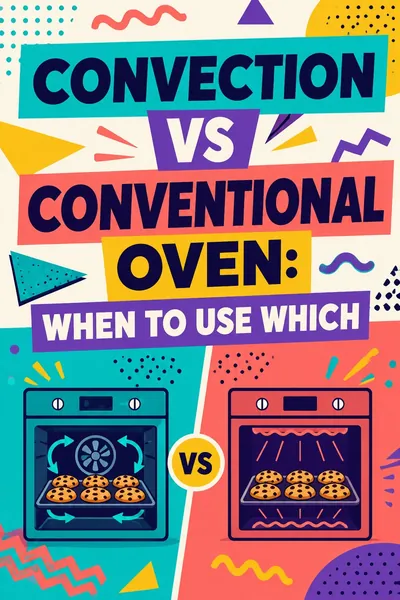
Functionally, yes. An air fryer is a small convection oven with a faster fan and a much smaller cavity. If your oven has a convection setting, the same conversion applies to it: drop 25°F and cut the time by about 20 percent. The air fryer is more extreme in both directions because there's less air and the element is closer.
Can I use regular parchment paper or foil in an air fryer?
Only under food, never during preheating, and perforated air fryer parchment is much safer than a plain sheet. Loose paper gets sucked up into the heating element, and that's a real fire, not a theoretical one. Foil is fine weighted down but it blocks airflow from below, which costs you the crisp bottom you turned the machine on for.
Why does my air fryer cook differently than the recipe says?
Because wattage, fan speed, and basket shape aren't standardized, and plenty of machines run 15 to 25°F off their dial. Test yours once with an oven thermometer at 350°F and note the gap. Your manufacturer's own chart was tested on your model, so when it disagrees with a generic chart, follow the manual.
Where to go next
Temperature and time are the two levers on every bake, air fryer or not.
Use the oven temperature converter to move between Fahrenheit, Celsius, gas mark, and convection settings, and the baking time calculator when a pan change is stacked on top of a temperature change.
If you're moving a recipe into a smaller pan to fit the basket, check the volume first with the pan size converter, and read our 9x13 pan substitute guide for the two-thirds fill rule that keeps batter from climbing where it shouldn't.