How to Get Even Baking in Your Oven

An oven that bakes unevenly is almost never broken. Here is how to get even baking in your oven in the order that fixes the most: check what temperature it is truly running with a standalone thermometer, preheat 20 to 30 minutes past the beep so the walls and racks catch up, leave 1 inch of air between the pan and every oven wall, and rotate the pan 180 degrees at the halfway mark.
Those four moves handle the large majority of lopsided bakes. Everything after that is about pan material, pan crowding, and how long you stand there with the door open.
Updated September 2026
Start with the dial you are trusting. Our free oven temperature converter gives you Fahrenheit, Celsius and gas mark equivalents plus the convection adjustment, so you know what number you are aiming for before you start chasing hot spots.
How to get even baking in your oven: the five-step routine
Work through these in order. Each one removes a variable, and skipping to step four while step one is broken wastes an afternoon.
| Step | What you do | Time it takes | What it fixes |
|---|---|---|---|
| 1 | Hang a standalone oven thermometer in the center | 2 minutes plus one preheat | The dial lying to you by 25 to 50°F |
| 2 | Preheat 20 to 30 minutes, not to the beep | 20 minutes of waiting | Cold walls and cold racks stealing heat |
| 3 | Map the hot spot with the bread test | 6 minutes | Knowing which corner burns |
| 4 | Space the pans: 1 inch from walls, 2 inches apart | 10 seconds | Blocked airflow and one cold face |
| 5 | Rotate 180 degrees at the halfway point | 8 seconds | Whatever is left after steps 1 to 4 |
Steps 1 and 2 are one-time setup for your oven. Steps 3 through 5 become habit within a week.
Step 1: find out what temperature your oven is actually running
Home ovens drift, and they drift a lot. A cavity reading 25 to 50°F off the dial is common rather than unusual, and the built-in sensor is the last thing that will tell you, because it sits in one spot near a wall and reports the air right next to itself.
Buy a cheap standalone oven thermometer and hang it from the middle rack, roughly in the center of the cavity. Set the oven to 350°F, wait a full 30 minutes, and read it. Then read it again 10 minutes later, because ovens cycle.
You are looking for two numbers:
The average. If the thermometer settles around 325°F when the dial says 350°F, your oven runs 25°F cool. Either set the dial 25°F higher forever, or use your oven's calibration offset if it has one. Most digital ovens do, usually buried in a settings menu that the manual explains.
The swing. Watch the thermometer over 10 minutes. A conventional home oven cycling between about 340 and 365°F on a 350°F setting is normal. A swing wider than roughly 50°F means a worn thermostat or a door gasket that is leaking, and that one really does need a repair.
A single thermometer in the center is enough to start. If you want the full picture, run three at once, one on the top rack, one in the middle and one on the bottom. In a conventional oven with no fan, hot air stacks, so the top commonly reads 15 to 30°F warmer than the bottom.
Step 2: preheat like you mean it
The beep is not the finish line. Home ovens signal "preheated" when the air sensor hits the target, and at that moment the steel walls, the racks and the oven floor are still well behind. Those surfaces are what deliver radiant heat, and radiant heat is what browns bottoms and sets edges.
Give the oven 20 minutes past the beep for cookies and cakes, and 30 minutes for bread, pizza, or anything sitting on a stone or steel. If you are preheating a baking stone, budget 45 to 60 minutes, because thick ceramic and steel are slow.
Two things this fixes immediately:
- The first batch that comes out different from all the others. That is a cold-oven batch, not a recipe problem.
- Pale, flat cookie bottoms on the first sheet. The pan was sitting on a rack that had not caught up yet.
Thermal mass helps here in general. An oven with a stone, a steel, or even a heavy sheet pan left on a lower rack holds temperature far better every time you open the door. The tradeoff is a longer preheat and stronger bottom heat, so pull the stone out for delicate cookies. Our guide to cookies burnt on the bottom covers exactly when that extra bottom heat turns against you.
Step 3: map your oven's hot spot with six slices of bread
Every oven has a hot spot, and knowing where yours is beats every general rule about rack position.
- Heat the oven to 350°F and give it a full 25 to 30 minutes.
- Cover a half sheet pan with six slices of plain white bread, edge to edge, no gaps.
- Put the pan on the middle rack, centered.
- Bake 6 minutes, then pull it out and look at the toasting pattern without moving the slices.
- Photograph it or sketch it on a sticky note taped inside a cabinet door.
The darkest slice sits over your hot spot. Most ovens toast unevenly back to front, because the back of the cavity is closer to the element and farther from the door, which leaks. Some toast unevenly left to right, which usually means the fan or the burner is off center.
Now you know two useful things: which direction to rotate, and which corner never to trust with a delicate bake. If the back right corner runs hottest, put your thinnest cookies front left and rotate at halfway so nothing lives back right for the whole bake.
Run this test again after any oven repair, and once a year otherwise. Hot spots move as elements age.
Step 4: pan spacing, the fix people skip
Air has to move around a pan for any of this to work. Two measurements handle it:
- 1 inch minimum between the pan and every oven wall.
- 2 inches minimum between two pans on the same rack.
A pan that fills the rack wall to wall turns your oven into a two-zone box, with hot air forced around the ends and a stagnant pocket in the middle. That is the single most common cause of a cake browned on one side while the other side stays pale.
Practical translations:
| Situation | What fits | What to do instead |
|---|---|---|
| Two 9-inch rounds, standard 30-inch range | Yes, side by side with room | Rotate and swap left for right at halfway |
| Three 8-inch rounds on one rack | No | Bake two, hold the third batter, or use two racks |
| Two half sheet pans on one rack | No, they touch the walls | Use the upper third and lower third |
| One 9x13 pan | Yes, centered | Turn 180 degrees at halfway |
| A jelly roll pan sideways | Usually no, it touches both walls | Turn it the other way, or size down |
If you are moving a recipe into a pan that actually fits your oven, our cake pan converter does the volume match and the bake time adjustment together, so you are not guessing at both.
Step 5: rotate once, at the halfway point
One rotation at halfway is the whole protocol. Not three, not every 10 minutes.
Turn the pan 180 degrees. Front becomes back. That evens out the back-to-front gradient every oven has.
If you are running two racks, swap them too. The lower pan goes up, the upper pan comes down, and both get turned 180 degrees. That is one trip to the oven and it cancels both the vertical gap and the horizontal one.
Do it fast. Opening the door drops the cavity by roughly 25 to 50°F, and the oven takes a minute or more to recover. A 12-second swap is fine. A 40-second one, with you rearranging pans while the door hangs open, costs you real bake time.
Do not rotate too early. Anything with a liquid batter needs its structure to set first. For cakes, muffins and quick breads, wait until at least two thirds of the bake time has passed before opening the door at all. Soufflés and delicate cakes stay in the box, undisturbed, no matter what your oven does.
For cakes specifically, rotation only fixes the hot-spot half of the problem. A cake taller on one side is usually a level problem instead, which our page on why a cake bakes unevenly walks through with the shim fix.
Worked example: a lopsided 9x13 sheet cake
Here is the whole routine on one real bake. The cake is a 9x13 sheet, recipe written for 350°F, 32 to 38 minutes, and the last two came out with a dark, dry right rear corner and a wet center.
Diagnosis. Two symptoms, two causes. The dark corner is a hot spot. The wet center says the oven is running cool overall, since the edges finished long before the middle set.
Thermometer check. Standalone thermometer on the middle rack, 30-minute preheat, dial at 350°F. It reads 330°F, cycling between 322 and 341°F. The oven runs about 20°F cool.
Correction 1. Set the dial to 370°F to land near a true 350°F, and confirm with the thermometer before the batter goes in.
Bread test. Six slices, 6 minutes, middle rack. The back right two slices are noticeably darker. Hot spot confirmed, back right.
Correction 2. Center the 9x13 with at least 1 inch clear on every side. In a standard 30-inch range that leaves roughly 2 to 3 inches at each end of a 13-inch pan, which is plenty.
Correction 3. Bake 22 minutes untouched, which is about two thirds of the 32 to 38 minute window and well past the point where the crumb sets. Then open, turn 180 degrees so the back right corner comes to the front left, and close within 10 seconds.
Result. Total time lands near 34 minutes instead of 38, because the oven is now actually at 350°F instead of 330°F. The corner that used to burn spent only half the bake in the hot spot. The center sets on schedule.
Net change: one thermometer, one 20-degree dial offset, one 8-second turn. Nothing about the recipe changed.
Pan material and color change everything downstream
Two identical batters in two different pans are two different bakes. This matters more than most people expect, and it stacks with hot spots rather than canceling them.
| Pan type | Heat behavior | Effect on evenness | Adjustment |
|---|---|---|---|
| Light aluminum | Reflects, heats fast, cools fast | Best all-around evenness | None, this is the baseline |
| Dark or nonstick metal | Absorbs radiant heat, browns hard | Bottoms and edges run ahead | Drop 25°F, or move up one rack slot |
| Glass | Slow to heat, holds heat long | Edges overbake while the center lags | Drop 25°F, check 5 minutes early |
| Ceramic and stoneware | Slowest of all, very steady once hot | Very even, but slow to start | Add 5 to 10 minutes |
| Insulated cookie sheets | Two layers with an air gap | Extremely even, very little browning | Add 2 to 4 minutes, expect pale bottoms |
| Thin disposable foil | Almost no thermal mass, buckles | Wildly uneven, warps mid-bake | Set it on a preheated sheet pan |
The color rule is the one to remember. A dark pan can put the surface of a bake 25°F ahead of what the air temperature suggests, which is why a recipe tested in light aluminum burns in a dark nonstick pan even with a perfectly calibrated oven.
Lining helps too. A parchment-lined pan gives a slightly gentler, more even bottom than bare metal, and it stops the batter from gripping one side and pulling. Our guide to lining a cake pan has the sling method for square and rectangular pans.
What convection changes, and what it does not
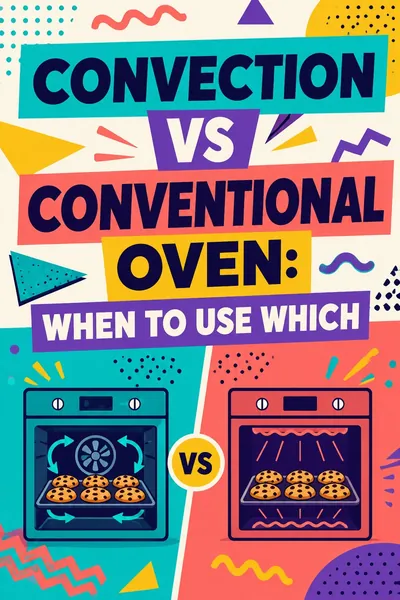
A true convection oven, one with its own third heating element around the fan, mostly erases the top-to-bottom temperature gap. That is the strongest single upgrade to oven evenness available, and it is why three racks of cookies at once is realistic in convection and a bad idea without it.
What it does not do:
- It does not fix a miscalibrated oven. Wrong temperature, evenly distributed, is still wrong.
- It does not fix crowding. A fan needs somewhere to push the air. Pans jammed edge to edge block it just as thoroughly.
- It does not help delicate batters. Moving air skins the surface of soufflés, popovers, angel food cake and choux before they finish rising.
The adjustment stays the same: drop the temperature about 25°F or cut the time about 25 percent, never both. Our full comparison of convection and conventional ovens covers which bakes gain and which ones suffer.
Oven habits that quietly cost you evenness
Opening the door to look. Every peek dumps 25 to 50°F. Use the light, and if the window is too dirty to see through, clean it rather than opening the door.
Baking on the top and bottom rack at once. Adjacent racks block airflow and the top and bottom slots sit closest to the elements. Use the upper third and lower third instead. Our page on which oven rack to use has the slot numbers by oven layout.
Foil on the oven floor. It blocks the bottom vents and reflects heat back at the element, which confuses the thermostat and can damage the enamel. Catch drips with a sheet pan on the rack below instead.
Reusing a hot pan. A hot cookie sheet melts the fat in the dough before the oven can set it, which spreads the cookies and leaves the second batch thinner and darker than the first. Run three pans in rotation and let each cool to room temperature.
Starting a bake while the oven is still recovering. If you just pulled a tray out and slid a new one in, the cavity may be 40°F down. Wait for the element to cycle off once.
Trusting the timer over the bake. Every one of these corrections shifts the finish line by a few minutes. Our baking time calculator helps you re-time a recipe after a temperature or pan change, and our guide to telling when cookies are done covers the visual cues that beat any clock.
A quick maintenance list for a more even oven
- Replace the standalone thermometer every couple of years. They drift too.
- Check the door gasket by closing the door on a dollar bill. If it slides out with no resistance, the seal is leaking heat.
- Keep the oven racks clean and level. A warped rack tilts a pan enough to pool batter on one side.
- Level the oven itself with a spirit level on the middle rack, front to back and side to side. Most ranges have adjustable feet.
- Run the bread test again after any repair, any move, or any new element.
Frequently asked questions
Why does my oven bake unevenly on one side?
Almost always a hot spot from the element layout, or a pan sitting too close to one wall. Run the six-slice bread test at 350°F for 6 minutes to find the direction, then center the pan with at least 1 inch of clearance on every side and rotate it 180 degrees at the halfway point. If the pattern is severe and sudden, check whether one element is failing.
How often should I rotate a pan in the oven?
Once, at the halfway mark. More rotations mean more door openings, and each one drops the cavity 25 to 50°F. For cakes, muffins and quick breads, do not open the door at all until at least two thirds of the bake time has passed, since the structure needs to set before it can survive a temperature drop.
Do I need an oven thermometer if my oven is new?
Yes. New ovens drift too, and factory calibration is a starting point rather than a guarantee. A standalone thermometer costs less than a bag of good chocolate and it is the only way to know whether the number on the dial is the number in the cavity. Check it once a season and after any repair.
Should I preheat with the pan inside the oven?
Only for pizza, free-form bread, and anything that wants a burst of conducted bottom heat from a stone or steel. For cookies, cakes and muffins, keep the pan out and let it stay at room temperature, because a hot pan starts melting fat before the batter can set.
How long should I really preheat my oven?
Add 20 minutes past the beep for cookies and cakes, 30 minutes for bread, and 45 to 60 minutes if you are heating a stone or a steel. The beep fires when the air sensor hits the target, well before the walls and racks catch up, and those surfaces do the browning.
Does opening the oven door ruin a bake?
It costs you 25 to 50°F and a minute or two of recovery, which is survivable for most things and fatal for a few. Cakes, soufflés, popovers and cheesecakes can collapse if the door opens before the structure sets. Cookies, bread and roasted items handle a quick 8-second rotation with no trouble.
Will a convection oven fix uneven baking?
It fixes the top-to-bottom part, which is the biggest single source of unevenness in a conventional oven. It does not fix a miscalibrated thermostat, crowded pans, or a dark pan browning ahead of schedule. Treat the fan as one tool in the routine, not a replacement for it.
Why is my second batch different from the first?
Two reasons, and they push in the same direction. The oven has had longer to fully saturate with heat, so it now runs closer to its true setting, and your pan is probably still warm from the first batch. Cool the pan to room temperature between batches and expect the first batch to be the outlier, not the standard.
Where to go next
Evenness, temperature and timing are three views of the same problem, so fix them together.
- Oven Temperature Converter for Fahrenheit, Celsius, gas mark and the convection adjustment
- Which Oven Rack to Use for slot-by-slot placement once your oven is calibrated
- Convection vs Conventional Oven for the 25-degree rule and what the fan ruins
- Why Did My Cake Bake Unevenly? for the level check and the batter-weighing fix
- Baking Time Calculator for re-timing a recipe after any of these corrections