Which Oven Rack to Use for Baking

The middle rack is the right answer roughly eight times out of ten, because it sits farthest from both heating elements and gets the most even air on every side of the pan. Move down to the lower third when you need a crisp, set bottom, like a pie shell or a free loaf. Move up to the upper third when you want color and browning on the surface.
That is the whole decision in three lines. Everything below explains how to count rack positions the same way each time, what the temperature difference between racks actually measures out to, and how to fix the specific problems that come from getting it wrong.
Updated September 2026
Not sure your oven is running the temperature it claims? Rack position only matters once the dial is honest, so start with our free oven temperature converter for Fahrenheit, Celsius and gas mark equivalents, then check the real number with a standalone thermometer.
Which oven rack to use for baking, item by item
Here is the working chart. Positions assume a five-slot oven counted from the bottom, which is the most common home layout.
| What is in the pan | Rack position | Why that spot | Watch for |
|---|---|---|---|
| Layer cakes, sheet cakes | Middle (3 of 5) | Even air on all sides, no direct element heat | Domed centers mean the oven is too hot, not the rack |
| Cupcakes and muffins | Middle (3 of 5) | Same reason, plus room for the tops to rise | Pale tops on the bottom rack |
| Drop cookies, one sheet | Middle (3 of 5) | Bottoms and tops finish together | Dark bottoms mean move up one |
| Drop cookies, two sheets | Upper third and lower third | Splits the oven into two usable zones | Swap and rotate at the halfway mark |
| Pies with a raw bottom crust | Lower third (2 of 5) | Bottom heat sets the pastry before the filling soaks it | Rim browns fast, shield it with foil |
| Fruit crisps and cobblers | Middle to upper third | The topping needs to color, the fruit is already wet | Foil tent if the topping darkens early |
| Yeast bread in a pan | Lower middle (2 or 3) | Bottom heat drives oven spring in the first 10 minutes | Move up for the last third to color the top |
| Free-form loaves on a stone or steel | Lower third | The stone needs the strongest heat it can get | Preheat the stone 45 to 60 minutes |
| Pizza | Lower third or the floor | You are chasing a crisp base, not a browned top | Cheese burns before the base sets if you go high |
| Cheesecake in a water bath | Middle or lower middle | Gentle, indirect, no top browning | Leave room for the roasting pan |
| Custards, flans, bread pudding | Middle or lower middle | Same gentle logic | Never the top rack |
| Meringues and pavlova | Middle | It is drying, not baking | Low oven, long time, no drafts |
| Biscuits and scones | Upper third | You want a tall rise and a browned top | Bottoms burn on the lowest rack |
| Anything you want to brown at the end | Upper third | Closer to radiant heat from above | Two to four minutes, do not walk away |
| Broiling, browning a top | Top rack, 3 to 4 inches from the element | Direct radiant heat | Stay in the kitchen for all of it |
The pattern behind all of it is simple. Ask which surface needs the most heat. If it is the bottom of the food, go low. If it is the top, go high. If the answer is "both equally," you want the middle.
How to count rack positions so the advice matches your oven
Most rack advice fails because two people counting slots do not always agree. Fix that first.
Count the slots, not the racks. A five-slot oven counted from the bottom gives you 1 at the floor and 5 at the ceiling, so the middle is slot 3. A six-slot oven has no true middle, and slot 3 is the one to use, since slot 4 sits closer to the top element than you want.
Then measure. Pull out the racks, take a tape measure, and write the numbers on a sticky note inside a cabinet door. In a standard 30-inch range the usable cavity is about 16 to 18 inches tall, so the slots land roughly 2.5 to 3 inches apart.
| Oven layout | Slot count | "Middle rack" is | Approx. height off the floor |
|---|---|---|---|
| Compact or apartment range | 4 | Slot 2 | About 6 in |
| Standard electric range | 5 | Slot 3 | About 8 to 9 in |
| Standard gas range | 5 to 6 | Slot 3 | About 8 in |
| Wall oven, tall cavity | 6 to 7 | Slot 3 or 4 | About 9 to 10 in |
| Countertop or toaster oven | 2 to 3 | The lower of two | About 3 in |
Two more measurements matter as much as the slot number. Leave at least 1 inch between the pan and the oven walls, and at least 2 inches between two pans on the same rack. Air has to move around the pan for the rack position to mean anything. A pan that fills the rack wall to wall turns your oven into a two-zone oven whether you planned it or not.
Why the racks are not the same temperature
Set an oven to 350°F and put an oven thermometer on the top rack, another on the middle, and a third on the bottom. They will not read the same number, and the gap is usually larger than people expect.
Hot air rises. In a conventional oven with no fan, that alone stacks the heat, and the top of the cavity commonly runs 15 to 30°F warmer than the bottom once things settle. The bottom element or burner adds a second effect: while it is firing, the floor of the oven and anything sitting low is getting strong radiant heat straight off the element, not just hot air.
So the bottom rack swings. It reads cooler than the top on average, but it delivers sharp bursts of bottom heat every time the element cycles on. That is exactly what a pie crust wants and exactly what a cookie bottom does not.
The top rack is steadier and hotter, and in most electric ovens it also sees some radiant heat from the upper element during preheat and during any recovery cycle. That is why cookie tops can go from pale to dark in 90 seconds up there.
The middle is the compromise: far from both elements, sitting in air that has already mixed, with the smallest swing between the element firing and resting. Nothing about it is magic. It is just the least dramatic place in the box.
Rack position problems and what they look like
You can usually read the rack position off the finished bake. Match your symptom to the fix.
| What went wrong | Likely rack problem | The fix |
|---|---|---|
| Cookie bottoms dark, tops pale | Too low, or a dark sheet on a low rack | Move up one slot, use a light sheet, check at 9 minutes |
| Cookie tops dark, bottoms raw | Too high | Move down one slot |
| Cake domed and cracked | Not a rack issue, the oven is too hot | Drop 25°F, keep the middle rack |
| Cake browned on one side only | Pan too close to a wall, or a hot spot | Center the pan, rotate at the halfway point |
| Soggy pie bottom | Too high, or no preheated surface underneath | Lower third, and preheat a sheet pan on that rack |
| Pie rim burned, filling still loose | Too high, or too hot | Lower third, foil ring on the rim, add 10 minutes |
| Bread pale on the bottom | Too high, or no thermal mass below | Lower middle, and preheat a stone or a heavy sheet |
| Muffin tops flat and pale | Too low | Middle, and get the oven fully preheated first |
| Cheesecake cracked with a browned top | Too high | Lower middle, water bath, and never open the door early |
| Two trays, one perfect and one raw | Racks too close together, or no swap | Upper third and lower third, swap at halfway |
Two of those rows are not rack problems at all, and that is deliberate. A domed, cracked cake and a one-sided bake come from oven temperature and hot spots, not from slot choice. Moving the rack will not fix either one. If your cakes always come out domed, the cause is almost always an oven running hot, which our guide on why a cake sinks or domes walks through in detail.
Baking on two racks at once
Two racks doubles your output and costs you evenness. It is worth doing, as long as you set it up correctly.
Use the upper third and the lower third, not two adjacent slots. In a five-slot oven that means slots 2 and 4. Adjacent racks block airflow between the pans and give you one tray that bakes and one that steams.
Swap and rotate at the halfway point. The top tray goes to the bottom, the bottom tray goes to the top, and both get turned 180 degrees. One motion, and it evens out both the vertical temperature gap and any left-to-right hot spot.
Stagger the pans front to back if they are small. Two half sheets fill a rack completely. Two 8-inch rounds do not, so offset them so neither sits directly above the other.
Add 2 to 5 minutes to the total time. Two cold pans pull more heat out of the cavity than one, and the oven spends longer recovering.
Do not do it for cakes you care about. Layer cakes bake unevenly across two racks even with a swap, because the swap itself lets the structure set at two different rates. If you have three layers and one oven, bake two on the middle rack side by side and the third on its own.
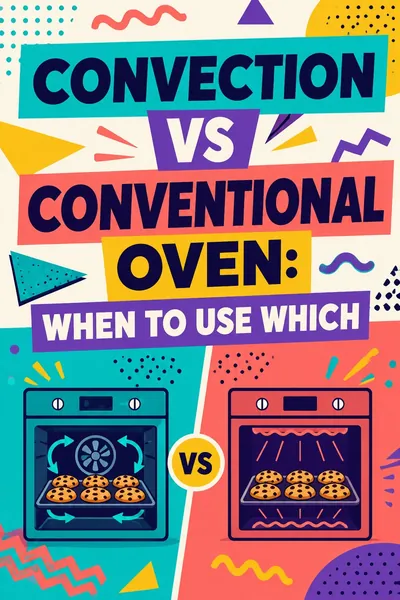
If your oven has a true convection setting, this is where it earns its keep. A fan flattens the vertical temperature gap enough to bake three racks at once, which is covered in our comparison of convection vs conventional ovens.
Convection changes the rack rules
With the fan running, the air in the cavity mixes constantly, so the 15 to 30°F top-to-bottom gap mostly disappears. Three practical changes follow.
The middle rack stops being special. Any rack works, which is the point of buying a convection oven.
Multi-rack baking becomes reliable. Three sheets of cookies at once is normal in convection, with a swap partway through only for insurance.
Direct-bottom-heat tricks weaken. A fan-driven oven browns pie bottoms less aggressively than a bottom element blasting a low rack, so a preheated steel or stone matters more, not less.
Remember the temperature rule that goes with it: drop the oven 25°F or cut the time by about 25 percent, never both at once.
Worked example: two sheets of cookies in a five-slot electric oven
Say you have two half sheet pans of drop cookies and a recipe written for 375°F, 10 to 12 minutes, one sheet on the middle rack.
Step 1, set the racks. Slots 2 and 4. Not 3 and 4, and not 1 and 5. Slot 1 puts a pan within a couple of inches of the element and slot 5 puts one right under the top element.
Step 2, preheat properly. Give it 20 minutes past the beep. Home ovens signal "preheated" when the air hits temperature, but the walls and racks are still cold, and a cold rack under a cookie sheet is a real heat sink. In practice that early beep runs 25 to 50°F optimistic on cavity readings taken with a separate thermometer.
Step 3, adjust the total time. Base time is 10 to 12 minutes. Two pans instead of one adds 2 to 3 minutes, so plan on 12 to 15 and start looking at 10.
Step 4, swap at the halfway mark. At 6 minutes, pull both pans, put the lower one on slot 4 and the upper one on slot 2, and turn each one 180 degrees. The whole move takes about 12 seconds, which costs you roughly 25°F of cavity temperature that the oven gets back in a minute.
Step 5, judge by the edges. Pull when the edges are set and the centers still look slightly underdone. Cookies keep baking on a hot sheet for another 2 to 3 minutes, which is covered in our guide to telling when cookies are done.
Step 6, for the second batch, reuse cool pans. A hot sheet pan spreads the dough before the oven sets it, which is one of the most common causes of cookies spreading too much. Run three pans in rotation and let each cool to room temperature.
Net result: two dozen instead of one dozen, about 3 extra minutes, and one 12-second swap.
Pan material and pan color change the rack you should pick
Rack position and pan material push in the same direction, so they stack.
A dark or nonstick pan absorbs radiant heat and browns hard. On a low rack, near the element, that effect doubles up. Move a dark pan one slot higher than you would put a light aluminum one, or drop the oven 25°F.
Glass and ceramic are slow to heat and then hold that heat. They do well on a lower rack for pies and casseroles, since the extra bottom exposure helps them come up to temperature, but they keep cooking after you pull them out.
Thin, flimsy foil pans have almost no thermal mass and buckle. Set them on a preheated sheet pan on the rack you have chosen, which gives them an even base and makes them liftable.
A preheated baking stone or steel is a rack position all on its own. Sitting on the lower third, it gives you a burst of conducted bottom heat that no rack slot can match, which is why it matters so much for pizza and free-form loaves. Our pizza oven temperature guide covers the preheat times that make it work.
The one thing that beats every rack rule
Learn your own oven's hot spot. Every oven has one, and it moves the result more than the slot number does.
Here is the test, and it takes about 12 minutes. Cover a sheet pan with slices of plain white bread, edge to edge. Bake at 350°F on the middle rack for 8 to 12 minutes, then look at the pattern of toasting. Wherever the bread is darkest is your hot spot. Write the pattern down.
Now you know two things. First, whether to rotate at the halfway point, which you should do anyway. Second, which corner to keep a delicate bake out of.
Pair that with a standalone oven thermometer. Built-in sensors sit in one spot and read the air near that spot, and a home oven being 25 to 50°F off its dial is common rather than unusual. If the whole cavity is running hot, no rack position saves the bake. Our baking time calculator helps you adjust the clock once you know the real temperature you are working with.
Rack position for reheating and finishing
Not everything on a rack is raw batter. Two finishing jobs come up constantly.
Browning a top that stayed pale. Move the pan to the upper third for the last 3 to 5 minutes of the bake. This is gentler than the broiler and much harder to ruin.
Broiling. Top rack, 3 to 4 inches below the element, door cracked open if your manual says to, and eyes on it the entire time. Broilers go from perfect to black in under a minute, and no timer is fast enough to save you.
Reheating a baked good works better lower and slower: middle rack at 300 to 325°F, loosely tented with foil, until the center is warm. Our notes on storing baked goods cover what reheats well and what does not.
Frequently asked questions
Is the middle rack always the best rack for baking?
It is the best default, not a universal rule. The middle rack keeps the pan away from both elements and gives the most even air, so it suits cakes, cupcakes, cookies and custards. Pies, pizza and free-form bread all do better in the lower third, and biscuits and anything you want browned on top do better in the upper third.
What number is the middle rack in a 5 slot oven?
Slot 3, counting from the bottom. In a 6 slot oven use slot 3 as well, because slot 4 sits close enough to the top element to brown tops early. In a 4 slot oven, slot 2 is the practical middle. Measuring once with a tape measure settles it faster than counting ever will.
Which rack should I use for cookies?
Middle for one sheet. For two sheets, use the upper third and lower third and swap them at the halfway point, turning each pan 180 degrees. If your cookie bottoms come out dark on the middle rack, your sheet is probably dark or nonstick, so switch to light aluminum before you change racks.
Why is my pie crust soggy on the bottom?
Almost always because the pie sat too high, or because nothing hot was underneath it. Move it to the lower third and preheat a sheet pan or a stone on that rack for at least 20 minutes first, so the pie lands on a hot surface. Blind baking the shell first solves the rest, and our guide to blind baking a pie crust has the weights and timings.
Can I bake two cakes on the same rack?
Yes, if the pans leave at least 2 inches between them and 1 inch from each oven wall. Two 8-inch or 9-inch rounds fit side by side on a middle rack in most 30-inch ranges. Rotate the pans and swap their left and right positions once, at the halfway point, since almost no oven is even side to side.
Does rack position change the bake time?
Yes, by a few minutes, not by a lot. A low rack tends to set bottoms faster and finish tops slower, while a high rack does the reverse, so the total time shifts by roughly 2 to 5 minutes in either direction. Adding a second rack of pans adds 2 to 5 minutes on its own, because the extra cold metal pulls heat out of the cavity.
Should the rack be different for a convection oven?
Much less than it matters in a conventional oven. The fan mixes the air, so the top-to-bottom temperature gap mostly closes and any rack works for most bakes. Keep using the lower third for pizza and free-form bread, since those depend on conducted heat from a preheated stone rather than on air temperature.
How far should the pan be from the oven wall?
At least 1 inch on every side, and 2 inches between pans. Anything tighter blocks the air from circulating around the pan, which creates a cold face on the side nearest the obstruction. This single spacing rule fixes more uneven bakes than switching racks does.
Where to go next
Rack position, oven temperature and bake time are one problem in three parts, and fixing only one of them rarely works.
Start with the real temperature: our oven temperature converter handles Fahrenheit, Celsius and gas mark, and a standalone thermometer tells you what your oven is truly doing. Then set the clock with the baking time calculator. If you are also moving the recipe into a different pan, the pan size converter gives you the volume match and the time adjustment together.