How to Store Baked Goods

Store most baked goods airtight at room temperature for two to three days, and freeze anything you won't eat in that window. Skip the refrigerator. Cold speeds up the chemical process that makes bread and cake go stale, so a loaf in the fridge goes dry several times faster than the same loaf sitting on your counter.
The exceptions are safety exceptions, not freshness ones. Anything with cream cheese frosting, custard, whipped cream or a cooked egg filling has to be refrigerated no matter what it does to the texture.
Everything else is a wrapping question: keep moisture in for soft things, keep moisture out for crisp things, and never store the two together.
Planning a bake around a party or a shipping date? Our free baking time calculator helps you work backward from when you actually need it, so nothing sits around going stale.
Updated August 2026
Why the refrigerator is the worst place for most baked goods
This is the part almost nobody is told, and it flips most people's storage habits.
Staling is not drying out. It's a separate process called starch retrogradation. When you bake, starch granules absorb water and swell into a soft gel. As the item cools, those starch molecules slowly reorganize themselves back into a rigid crystalline structure and squeeze the water out of the crumb. The bread gets firm, crumbly and dull-tasting even inside a sealed bag, because the water is still there, just no longer held in the starch.
Here's the catch. That reorganization happens fastest a little above freezing. It runs quickest around 32 to 40°F, which is exactly your refrigerator. It slows down at room temperature. And below about 0°F it essentially stops, because the water is locked as ice and the starch molecules can't move.
So the ranking, from worst to best for a loaf of bread:
- Refrigerator (35 to 40°F) is the fastest staling zone. A day in the fridge does roughly what several days on the counter would.
- Room temperature (68 to 72°F) is slower. Two to three days of decent quality.
- Freezer (0°F or below) puts staling on pause almost completely. Weeks to months.
The freezer is not the compromise option. For bread it's the good option, and the counter is the short-term one. The fridge is the one to skip.
There is one thing the fridge does well, which is slow mold. That matters in a humid kitchen in August, and it matters for anything containing dairy or eggs. But for a plain loaf you're eating in three days, the mold risk is smaller than the staling cost.
How to store baked goods: the full storage table
Times below assume the item is completely cool before it's wrapped. Wrapping anything warm traps steam, and steam turns crisp into soggy and soft into moldy.
| Item | Room temp | Fridge | Freezer | How to wrap |
|---|---|---|---|---|
| Yeast bread, crusty | 1 to 2 days | Never | 3 months | Paper bag day one, then plastic or freezer bag |
| Yeast bread, soft sandwich loaf | 3 to 4 days | Never | 3 months | Airtight plastic bag, slice before freezing |
| Quick bread (banana, zucchini) | 3 to 4 days | 1 week if humid | 3 months | Plastic wrap, then foil |
| Muffins | 2 to 3 days | Not ideal | 2 months | Airtight container lined with paper towel |
| Cookies, crisp | 1 week | Never | 3 months | Airtight tin or jar, nothing soft inside |
| Cookies, chewy or soft | 3 to 5 days | Never | 3 months | Airtight container, add a bread slice |
| Brownies | 3 to 4 days | 1 week | 3 months | Whole slab uncut, plastic wrap plus foil |
| Layer cake, unfrosted | 2 days | Not ideal | 3 months | Wrap each layer in plastic, then foil |
| Layer cake, buttercream frosted | 2 to 3 days | 5 days | 2 months | Cake dome, or freeze uncovered then wrap |
| Cake with cream cheese frosting | 2 hours max | Required, 5 days | 1 month | Covered container, fridge |
| Cheesecake | 2 hours max | Required, 5 days | 2 months | Wrap tightly once fully chilled |
| Fruit pie | 2 days | 3 to 4 days after | 4 months | Loose foil at room temp, airtight to freeze |
| Custard or pumpkin pie | 2 hours max | Required, 3 days | Not recommended | Loose cover, fridge |
| Cream pie, whipped topping | 2 hours max | Required, 2 to 3 days | Not recommended | Loose cover, fridge |
| Cupcakes, unfrosted | 2 days | Not ideal | 2 months | Airtight container |
| Cupcakes, buttercream frosted | 2 days | 3 days | 1 month | Single layer, tall container, no wrap touching |
The federal cold-storage guidance at FoodSafety.gov is the reference for the "required" rows. Those aren't preferences.
The items that must be refrigerated for safety
Four ingredients move an item out of the counter category permanently:
- Cream cheese frosting. Cream cheese is a fresh dairy product with enough moisture and low enough acidity to grow bacteria. A carrot cake or red velvet with cream cheese frosting goes in the fridge, full stop.
- Custard or pastry cream. Milk and eggs cooked into a soft set. Pumpkin pie counts here, and so does any pie with a stirred custard filling.
- Whipped cream. Real dairy whipped cream is unstable at room temperature within a couple of hours. Stabilized versions last longer but still belong in the fridge.
- Cooked egg fillings. Anything with a set egg base, including quiche-style savory bakes and lemon curd fillings that contain whole egg.
The working rule is the two-hour rule: perishable items shouldn't sit between 40°F and 140°F for more than two hours total, or one hour if the room is above 90°F. That clock is cumulative. A cheesecake that sat out for 90 minutes at a party and then went back in the fridge has already used most of its budget.
Buttercream made only from butter and powdered sugar is different. It's mostly fat and sugar with very little free water, which is why a plain American buttercream cake is fine on the counter for a couple of days. Swiss and Italian meringue buttercreams use cooked egg white and sugar syrup, and most bakers treat one day at room temperature as the limit.
Cookies: why crisp and chewy can never share a container
Put a batch of crisp gingersnaps in the same tin as soft chocolate chip cookies and within a day you'll have two batches of mediocre cookies.
Moisture moves. In a sealed container, water vapor travels from the item with more available moisture to the item with less until they even out. The chewy cookies give up water and turn firm. The crisp cookies absorb it and go limp. Nobody wins.
So separate them, and store each one for what it needs:
- Crisp cookies need moisture kept out. A truly airtight tin or a glass jar with a gasket lid. Not a loosely covered plate, and not a zip bag with air squeezed against the cookies.
- Chewy cookies need moisture kept in. Airtight container plus one slice of plain sandwich bread. The bread has more free moisture than the cookies, so it slowly hands water over and keeps them soft. Swap the bread when it goes hard, usually every two days.
That bread trick is the same physics that ruins the mixed tin, just aimed on purpose.
Frosted or filled cookies need one more step: freeze or chill them uncovered for 20 minutes so the surface sets, then layer them between sheets of parchment so nothing sticks. It is the same trick that gets holiday cookies that freeze well out of the freezer looking new.
Freezing baked goods properly
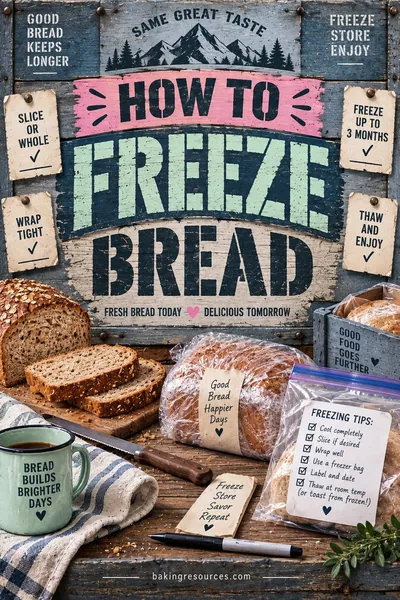
Freezing is the only storage method that actually preserves quality rather than just slowing the decline. Almost everything on the table above freezes well. What ruins frozen baked goods is never the cold, it's air and condensation.
Wrap in two layers. Plastic wrap pressed directly onto the surface with no air gaps, then a layer of foil or a freezer bag. The inner layer stops moisture leaving the crumb. The outer layer stops the freezer's dry air and stray odors getting in. Single-wrapped items get freezer burn, which is just sublimated ice leaving dry gray patches behind.
Freeze in portions you'll actually use. Slice a sandwich loaf before freezing so you can pull two slices out. Cut brownies into squares, wrap in pairs. A whole frozen block you have to thaw entirely is a block you'll end up throwing half of away.
Chill frosted items solid first. Put the frosted cake or cupcakes on a tray, uncovered, in the freezer for one hour until the frosting is hard. Then wrap. Wrapping soft buttercream just prints the plastic into it.
Label with the date. Three months in, everything looks like a beige brick.
Thawing without soggy tops
Here's the step people miss, and it's the one that decides whether a thawed cake tastes fresh or damp.
Thaw everything in its wrapping, at room temperature. As the item warms, the surrounding air deposits condensation on the coldest surface it meets. If the item is wrapped, that surface is the wrap, and the water beads on the plastic instead of soaking into the crust. Unwrap only once the item is fully at room temperature.
Rough timings:
- Cookies and single cupcakes: 20 to 30 minutes
- Muffins, brownie squares, single slices: 30 to 45 minutes
- Sliced bread: toast straight from frozen, no thaw
- Whole loaf: 2 to 3 hours
- 8-inch cake layer: 2 to 3 hours wrapped, then unwrap to fill and frost
- Whole frosted cake: overnight in the fridge, still wrapped, then 2 hours on the counter
For a whole frosted cake, the fridge is the right first stage even though it's a staling zone. A few hours of cold costs less quality than a fast thaw that leaves the frosting sweating.
Reheating frozen items works too, and it's better than thawing for anything with a crust. Straight from the freezer, unwrapped, into a 325 to 350°F oven. Our oven temperature converter handles the conversion if your recipe is in Celsius or gas marks.
A worked example: baking Friday for a Sunday party
Say you're making a two-layer 8-inch birthday cake, two dozen chocolate chip cookies and a fruit pie for a Sunday afternoon party, and you want to bake on Friday evening.
Cake layers. Bake Friday. Cool completely, about 2 hours. Wrap each layer in plastic, then foil, and freeze. Saturday evening, move them to the counter still wrapped. Sunday morning they're at room temperature and, because frozen layers are firm, they're actually easier to level and fill than fresh ones. Frost Sunday morning. Total quality loss: none.
Cookies. Bake Friday. Cool fully, about 40 minutes. Airtight container with one slice of sandwich bread. They'll still be soft Sunday, day three of their three to five day window. Do not put them in the fridge, and do not add them to the cake's container.
Fruit pie. Bake Saturday, not Friday. Fruit pie holds two days at room temperature loosely covered with foil, and the crust bottom softens a little more each hour it's stored. Saturday morning bake means Sunday afternoon serving on day two.
If that party had been a cheesecake instead, the plan changes entirely: bake Friday, chill overnight uncovered so the top dries, wrap Saturday, keep refrigerated until 30 minutes before serving.
How to revive stale bread (and why it works only once)
A stale loaf isn't dry, it's crystallized. Heat can reverse that, because starch retrogradation is partly undone above about 140°F. The starch re-absorbs the water still sitting in the crumb and the bread turns soft again.
The method:
- Run the whole loaf briefly under the tap, or spritz it all over. You want the crust damp, not soaked. A second or two of running water per side is plenty.
- Put it directly on the oven rack in a fully preheated 350°F oven.
- Bake 8 to 12 minutes for a standard loaf, 5 to 6 for a baguette, 3 to 4 for a roll.
- Serve within the hour.
The water turns to steam inside the crust and drives the moisture back into the crumb while the outside re-crisps.
Why it's a one-shot fix. Each pass drives real water out of the loaf permanently. The starch softens again, but the total moisture is lower than before, so the bread re-stales faster and harder. By the second revival there isn't enough water left in the crumb for the trick to work, and you get a hot, crisp, genuinely dry loaf. Revive the amount you're about to eat, not the whole loaf you'll pick at for two days.
Anything past reviving still has jobs: croutons, bread crumbs, French toast, panzanella, bread pudding. Stale bread is better than fresh for all four because it soaks up liquid without collapsing.
Container choices that actually matter
- Airtight beats pretty. A gasket-sealed container outperforms a cake dome for anything you want to stay soft. Domes are for one day.
- Paper bags for crusty bread, day one only. Paper lets moisture escape so the crust stays shattering. By day two the whole loaf is dry, so switch to plastic or freeze it.
- Never plastic wrap on a crusty loaf you care about. The crust absorbs the crumb's moisture and goes leathery within hours.
- Bread boxes work because they hold humidity around 60 to 70%, high enough to slow drying and low enough to slow mold. They're a real tool, not a decoration.
- Cake carriers with a tall dome keep frosting from smearing. Put a wedge of paper towel under one edge if condensation builds.
- Skip the fridge for the container itself. Chilling a container and then filling it with room-temperature baked goods condenses water on everything.
Frequently asked questions
How do you keep bread fresh longer without a fridge?
Keep it cut side down on a board for day one, then move it to a plastic bag or bread box. For anything past two days, freeze it sliced and toast slices straight from frozen. The freezer stops staling almost entirely while the fridge accelerates it, so freezing is the real answer to keeping bread fresh.
Can you freeze cake with frosting on it?
Yes. Freeze the cake uncovered on a tray for about an hour until the frosting is firm, then wrap it in plastic and foil. Buttercream freezes well for up to two months, cream cheese frosting for about one. Thaw overnight in the fridge with the wrap still on, then two hours at room temperature before you unwrap it.
How long do homemade cookies last at room temperature?
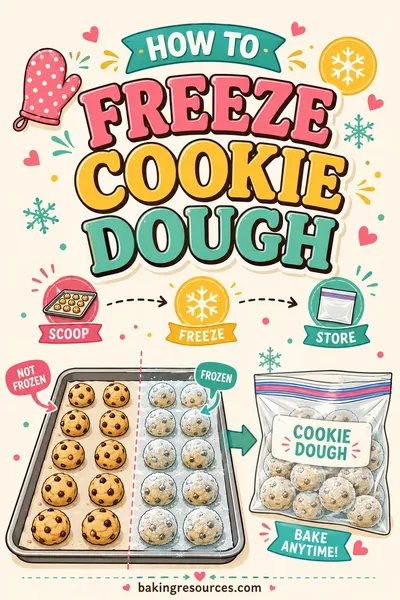
Crisp cookies keep about a week in an airtight tin, and soft or chewy cookies keep three to five days. Cookies with cream cheese, custard or fresh fruit fillings are perishable and belong in the fridge. Freeze anything you want past that window, either baked or as portioned raw dough.
Does apple pie need to be refrigerated?
A fruit pie is fine at room temperature for up to two days, loosely covered. After that, refrigerate it for another three to four days. Custard, pumpkin and cream pies are different and must go in the fridge within two hours of baking, because their egg and dairy fillings are perishable.
Why did my muffins get sticky tops overnight?
You covered them before they were completely cool, so steam condensed inside the container and settled on the tops. Cool muffins on a rack until they're room temperature all the way through, then store them in a container lined with a paper towel and a second towel laid over the top to absorb the small amount of moisture they still release.
Should brownies be stored cut or uncut?
Uncut. Every cut face is a surface that dries out, so leaving the slab whole and covering the pan with plastic wrap keeps the interior fudgy for three to four days. Cut only what you're serving. For freezing, cut into squares first and wrap them in pairs so you can thaw a portion at a time.
Can I store cookies and brownies in the same container?
No, for the same reason crisp and chewy cookies can't share. Brownies carry a lot of moisture and will hand it to whatever else is in the container, softening crisp cookies and making everything taste vaguely like everything else. Separate containers, always.
How do I know if a baked good has gone bad rather than just stale?
Stale is firm, dry and dull but perfectly safe. Spoiled shows visible fuzzy or colored mold, a sour or alcoholic smell, or a slimy surface, and any of those means the whole item goes in the trash rather than just the moldy corner. Mold in soft, high-moisture baked goods sends threads well beyond what you can see.
Related guides: How to tell when bread is done | Baking time calculator | Oven temperature converter | Cake servings calculator | Baking conversion chart