How to Freeze Pie Dough

Flatten the dough into a disc about 3/4 inch thick, wrap it tight in plastic, then put the wrapped disc in a freezer bag or a second layer of foil. It keeps its quality for about 3 months and thaws overnight in the fridge.
Never freeze pie dough as a ball. A 3/4-inch disc thaws in roughly 4 hours in the refrigerator. The same weight of dough rolled into a ball takes 10 to 12 hours, and the outside goes soft and greasy long before the middle gives up.
Pie dough freezes better than almost anything else you bake with, because the fat is already cold and solid and the flour is barely hydrated. Freezing does not undo anything you did.
Working out how much butter your dough needs in sticks, cups, or grams? Our free butter converter handles all three, including the tablespoon markings on the wrapper.
Updated September 2026
Why the shape you freeze in matters more than anything else
Freezing and thawing are both governed by thickness, not weight. Heat moves in from the surface, so a thin shape has a short distance to travel and a thick one does not.
That single fact drives the whole method. A disc has a huge surface area for its volume, so it freezes solid quickly and thaws evenly. A ball has the worst possible ratio, so the outer half warms to a soft, workable state while the center is still frozen hard. Roll that and the outside smears while the middle cracks.
There is a second reason to flatten before freezing. Cold dough is easier to roll if it is already close to its final shape. A disc only needs to be pushed outward, while a ball has to be flattened first, and flattening cold dough means pressing hard, and pressing hard warms the butter and develops gluten. That is a straight path to a tough crust, which our guide to why is my pie crust tough covers in more detail.
Make the disc slightly wider than you think. Something around 5 to 6 inches across for a single crust portion is right. Wider means thinner, and thinner means faster thawing.
Three ways to freeze pie dough, and when to use each
| Format | How to wrap it | Freezer quality | Thaw time | Best for |
|---|---|---|---|---|
| Flat disc, unrolled | Plastic wrap pressed to the surface, then a freezer bag | 3 months | 4 hours in the fridge | Most cases, maximum flexibility |
| Rolled sheet between parchment | Stack sheets, roll the stack loosely, then bag it | 2 months | 20 to 30 minutes at room temperature | Getting ahead on a busy bake day |
| Shaped shell in the pan | Freeze uncovered 1 hour, then wrap the whole pan twice | 2 to 3 months | None, bake from frozen | Blind baking, custard pies |
| Cut lattice strips or cutouts | Freeze flat on a tray, then stack with parchment between | 1 month | 10 minutes at room temperature | Decorative tops |
The disc is the default for a reason. It takes the least freezer space, it is the least fragile, and you have not committed to a pan size yet.
The shaped shell is the format people underuse. A crust frozen right in its pan is more useful than a disc if you know you want a pie, because you skip rolling entirely and, importantly, a frozen shell shrinks far less during blind baking. The fat has no chance to melt and slump before the structure sets. Our guide to how to blind bake a pie crust covers the weights and timings.
The rolled sheet is a real time saver but the most fragile of the three. Frozen rolled dough snaps if you bend it, so store the roll where nothing will fall on it, and stand it upright if you can.
How to freeze pie dough as a flat disc
The whole process takes about three minutes of actual work.
- Divide before you wrap. One disc per crust. Splitting a frozen block later is impossible without thawing the whole thing.
- Flatten to 3/4 inch. Press it down with your palm, then square up the edges with the side of your hand so it is a rounded disc rather than a lumpy blob. Cracked edges are fine and will not matter.
- Wrap in plastic, pressed to the surface. Air is what causes freezer burn, so the plastic needs to touch the dough everywhere with no trapped pockets.
- Add a second barrier. A freezer bag with the air squeezed out, or a layer of foil. Plastic wrap alone is not much of a moisture barrier over months.
- Label with the date and what it is. All-butter and shortening doughs look identical when frozen, and they do not behave identically when thawed.
- Freeze it flat, not leaning. A disc that freezes at an angle keeps that shape permanently.
Freezing goes faster if the dough starts cold, so if the dough was just made and the butter has warmed up, give it 30 minutes in the fridge first. Slow freezing grows bigger ice crystals, and bigger crystals cut more of the gluten and starch structure they form in.
Worked example: the thaw math on a real crust
A dough for a 9-inch single crust usually weighs around 340 g. A 9-inch double crust runs closer to 650 g, split into two unequal discs, with the larger one for the bottom.
Take that 340 g of dough and shape it two ways.
As a disc: 5 1/2 inches across, 3/4 inch thick. In a 38°F refrigerator the whole thing reaches a workable temperature in about 4 hours, and the center is never more than about 3/8 inch from a cold surface.
As a ball: roughly 2 3/4 inches across. The center is now 1 3/8 inches from the surface, so the distance heat has to travel is close to four times greater. That takes 10 to 12 hours in the fridge, and at the 5-hour mark you have a soft, sticky outer shell around a frozen core.
An all-butter dough at that weight contains something in the range of 130 to 160 g of butter, since a typical pie dough runs close to one part fat to two parts flour by weight. Butter is 16 to 18 percent water, so there is roughly 25 g of water locked inside the fat alone, on top of whatever liquid went into the dough. All of that has to freeze and thaw, and all of it moves at the speed thickness allows.
The practical version of all that arithmetic: a disc pulled from the freezer after dinner is ready to roll at breakfast. A ball is not.
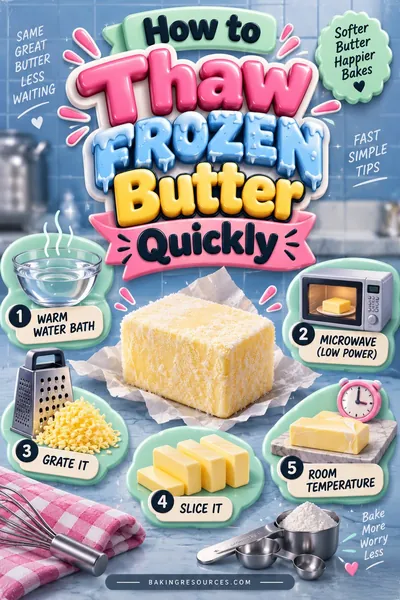
If you have forgotten to plan ahead, a frozen disc left on the counter at 70°F is rollable in 45 to 60 minutes, but watch it. Once the surface passes about 60°F the butter starts smearing into the flour and you lose flakiness. Our guide on how to thaw frozen butter explains the same temperature limits for butter on its own.
Wrapping, and what freezer burn actually is
Freezer burn is not burning and it is not spoilage. It is sublimation: ice on the surface turns straight into vapor without melting, leaving dried, discolored patches behind. The vapor then refreezes elsewhere as those frost crystals you see inside the bag.
Two things drive it. Exposure to air, and temperature swings. A freezer door opened twenty times a day cycles the contents through small thaw and refreeze events, and each one moves a little more moisture out of your dough.
What that means in practice:
- Double wrap always. One layer against the dough to exclude air, one layer around that to slow moisture loss.
- Store at the back, low down. The door is the warmest and most variable spot in the freezer, and the shelf nearest it is second.
- Keep the freezer at 0°F or below. The USDA notes that food held at 0°F stays safe indefinitely, and that what declines over time is quality, not safety. Their food safety guidance on freezing is the plain-language source on this.
- Do not wrap while warm. Warm dough sweats inside the wrap and that condensation becomes surface ice.
Dough with mild freezer burn is still usable. The dried edges will be slightly tougher and will not brown the same way, so trim the worst quarter inch off the rim before rolling, or plan to trim it after you fit the crust to the pan. Badly burned dough, meaning gray patches and a dry papery surface across most of the disc, is not worth the pie.
Different fats freeze differently
The fat you used changes how the dough behaves after a long freeze.
| Fat | Water content | How it freezes | What to watch |
|---|---|---|---|
| All butter | 16 to 18 percent | Very well, best flavor | Water forms ice crystals, so quality drops faster past 3 months |
| European style butter | 12 to 15 percent | Slightly better than standard | Higher fat means a softer disc, so it thaws faster than you expect |
| All shortening | Near zero | Excellent, 6 months and up | No water to crystallize, but the crust is less flavorful |
| Butter and shortening blend | 8 to 10 percent | Excellent, the most forgiving | The usual best of both, freezes 4 months easily |
| Lard | 0 to 1 percent | Excellent | Can pick up freezer odors more than butter, so double wrap matters |
| Cream cheese dough | 50 percent plus | Poorly past a month | High water and high dairy solids, expect texture loss |
The pattern is simple: water is what suffers in the freezer, and fat does not. That is why an all-shortening crust can sit for half a year and an all-butter one is best used within three months.
None of this changes how you handle the dough. It changes how long you can leave it. Whatever fat you used, the goal at mixing time is the same, which is discrete pieces of cold fat still visible in the flour rather than a uniform paste. Our guide to how to cut butter into flour covers the sizes to aim for.
Baking straight from frozen
For a shaped shell, skip thawing entirely. This is not a shortcut, it is actually the better method.
A frozen crust holds its shape while the oven does its work. The fat cannot melt and slump down the sides before the flour and egg proteins set, which is the whole mechanism behind crusts that shrink away from the rim. Start it hot, at 425°F, and give it 15 to 20 minutes with pie weights before you check.
Rules for baking from frozen:
- Do not thaw a shaped shell first. A thawed shell in a metal pan slumps more, not less.
- Use a metal pan, or preheat a glass one carefully. Glass and ceramic can crack from thermal shock when a frozen pan meets a hot oven, so let those temper on the counter for 15 minutes first, or use metal from the start.
- Dock the base before freezing, not after. Poking holes in frozen dough cracks it.
- Add 5 to 10 minutes to whatever bake time you would use for a chilled crust.
A filled fruit pie also bakes well from frozen, unbaked, but that is a different job with different timings, and it needs a longer bake at a lower temperature after the first blast of heat.
How long it really keeps
| Format and fat | Best quality | Still fine | Noticeably worse after |
|---|---|---|---|
| All-butter disc | 3 months | 4 to 5 months | 6 months |
| Blended fat disc | 4 months | 6 months | 8 months |
| Shortening disc | 6 months | 9 months | 12 months |
| Rolled sheet, any fat | 2 months | 3 months | 4 months |
| Shaped shell in pan | 2 to 3 months | 4 months | 5 months |
| Cut lattice strips | 1 month | 6 weeks | 2 months |
Safety and quality are separate questions here. Dough held continuously at 0°F stays safe far longer than any of these numbers. What you lose over time is moisture and flavor, and the loss is gradual rather than sudden.
Rolled and cut formats have shorter windows purely because of surface area. More exposed surface means more places for moisture to leave.
Mistakes that cost you a crust
Freezing in a ball. Covered above, and it is the most common one by a wide margin.
Using regular sandwich bags. They are thinner than freezer bags and let moisture through much faster. If it is all you have, use two of them.
Refreezing thawed dough. You can do it once without disaster, but each cycle grows new ice crystals that cut the structure a little more, and the crust gets progressively less flaky. If you thawed two discs and only need one, roll the spare, fit it into a pan, and freeze it as a shell rather than refreezing the lump.
Thawing on the counter and getting distracted. Forty minutes is fine. Two hours gives you greasy, sticky dough with butter smeared through it, and that dough will bake into a hard, cracker-like crust rather than a flaky one.
Skipping the label. Three unmarked discs in a bag will eventually become a guessing game about which is the sweet dough and which is the savory one.
Storing it next to strong-smelling food. Fat absorbs odors. A poorly wrapped disc stored beside onions or fish will taste like it, and there is no fixing that after the fact. The same principle applies to baked pies, which our guide to how to store baked goods covers.
Frequently asked questions
How long can you freeze pie dough?
Three months for all-butter dough with no real quality loss, and up to six months if it was made with shortening or a butter and shortening blend. Held at a steady 0°F it stays safe well beyond that, but the texture and flavor keep slipping, so treat those numbers as quality windows rather than safety limits.
Can you freeze pie dough that already has been refrigerated?
Yes. Chilled dough is actually the ideal candidate, since it is already cold and will freeze faster, which means smaller ice crystals. Just make sure it goes in within a couple of days of being made, because the small amount of water in the dough slowly hydrates the flour and develops gluten even in the fridge.
Should you thaw pie dough in the fridge or on the counter?
The fridge, for anything you have planned in advance. Overnight at 38°F gives you dough that is evenly cold all the way through and rolls beautifully. A counter thaw at 70°F takes 45 to 60 minutes and works in a pinch, but the outside warms faster than the middle and the butter can start smearing.
Can you freeze an unbaked pie shell in the pan?
Yes, and it is the best format for blind baking. Freeze the shaped shell uncovered for an hour so the surface firms up, then wrap the whole pan twice. Bake it straight from frozen at 425°F, with weights, and it will shrink much less than a chilled shell would.
Does frozen pie dough need to be rolled thinner?
No. Roll it to the same thickness you always would, usually about 1/8 inch, once it has thawed to a workable state. Dough that fights back and springs open when you roll is too cold, not too thick. Give it another 15 minutes and try again.
Why is my thawed pie dough crumbly?
Almost always moisture loss in the freezer, from wrapping that let air reach the dough. A little extra ice water worked in gently will bring it back together, though the crust will be slightly less tender than it would have been. Double wrapping next time prevents it entirely.
Can you freeze store-bought refrigerated pie crust?
Yes, in its own packaging, inside a freezer bag for the second layer. Those rolled crusts are usually made with shortening or a blend, so they hold up well, and two to three months is a comfortable window. Thaw them in the fridge, since the rolled sheets crack if you unroll them cold.
Is freezing pie dough different from freezing cookie dough?
The principles are the same, meaning flat shapes, double wrapping, and 0°F storage, but the timelines differ. Cookie dough carries more sugar, which holds water and slows ice formation, so it generally lasts longer in the freezer. Our guide to how to freeze cookie dough has the portioning method for baking straight from frozen.
The short version
Divide the dough first, flatten each portion into a 3/4-inch disc, wrap it twice, and label it. Three months for butter, longer for shortening.
Thaw overnight in the fridge for discs, and do not thaw shaped shells at all, since baking them frozen at 425°F is what stops them shrinking. Flat shapes and tight wrapping solve almost every problem people have with frozen pie dough.