What Does Butter Do in Baking?

Butter does four jobs at the same time: its fat tenderizes by cutting gluten short, its water turns to steam and creates lift, the air you beat into it makes crumb, and its milk solids brown for flavor. That is why swapping butter for oil or shortening never behaves like a simple trade.
A US stick is about 80 percent fat, 16 to 18 percent water and 1 to 2 percent milk solids. Those three parts pull in different directions, and the temperature of the butter when it hits the bowl decides which one wins.
Need the numbers first? Our free butter converter turns sticks into grams, tablespoons and cups, including the 250 g blocks that have no marks on the wrapper.
Updated September 2026
What does butter do in baking? The four jobs, side by side
Here is the whole thing in one table. Every section below is one row expanded.
| The job | Which part of the butter does it | What you see in the finished bake | What breaks it |
|---|---|---|---|
| Tenderizing | The fat, roughly 80% | Short, crumbly, soft texture. Cake that melts instead of chewing | Too little fat, or overmixing after the flour goes in |
| Lift from steam | The water, roughly 16 to 18% | Puff pastry layers, flaky pie crust, biscuit height | Butter that melted into the flour before it baked |
| Lift from air | The fat again, whipped | Fine, even crumb in cake and creamed cookies | Butter too cold to whip, or too warm to hold bubbles |
| Browning and flavor | The milk solids, 1 to 2% | Golden crust, nutty smell, deeper color | Clarified butter or ghee, which has the solids removed |
| Moisture and mouthfeel | Fat and water together | Bakes that stay soft on day two | Substituting oil without adjusting the liquid |
Butter is the only common baking fat that does all five of those. Oil has no water and no solids. Shortening has no water and no solids. Ghee has fat only. Once you know which job you are asking butter to do, most butter questions answer themselves.
Job 1: fat tenderizes by getting in the way of gluten
Flour plus water makes gluten, and gluten makes chew. Fat coats flour particles and physically blocks water from reaching some of the protein, so the network that forms is shorter and weaker.
That is the whole reason fat is called shortening in old cookbooks. It shortens gluten strands.
More fat means more tenderness, up to a point. A shortbread at roughly 1 part sugar, 2 parts butter and 3 parts flour by weight is so tender it barely holds together. Pull the butter down and the same dough turns into a cracker.
The practical version:
- Cakes and shortbread want the fat spread evenly through the flour, so the tenderizing is uniform.
- Pie crust and biscuits want the opposite: fat left in visible pieces, so some parts of the dough are tender and others hold structure. That contrast is what flakiness is. Our guide to cutting butter into flour covers the technique in detail.
- Bread uses small amounts of butter to soften the crumb without killing the gluten it needs. A brioche gets away with far more because it also gets a long, careful development.
A useful rule of thumb: in a dough where you want tenderness, the fat should be soft enough to smear. In a dough where you want flakiness, the fat should be cold enough to stay in chunks. Same ingredient, opposite handling.
Job 2: the water in butter turns to steam
This is the part most bakers never think about, and it explains puff pastry entirely.
A 113 g stick of butter contains roughly 18 to 20 g of water. In the oven that water flashes to steam and expands violently, pushing layers of dough apart from the inside.
Run the numbers on a laminated dough:
- 1 cup of butter = 227 g
- At about 16 percent water, that is roughly 36 g of water
- 36 g of water becomes about 60 liters of steam at oven temperature, and all of it is trying to escape through the dough
That is why a croissant rises without any chemical leavening and why a pie crust made with all shortening tastes fine but never gets quite as flaky. Shortening is 100 percent fat and brings no water at all.
The catch is timing. Steam only lifts if the butter is still in sheets or lumps when the heat hits it. If your butter melted into the flour on a warm counter, the water gets absorbed into the dough, no layers exist, and you get a greasy, tough crust instead of a flaky one. Cold butter and a cold work surface are not fussiness, they are the mechanism.
Job 3: creamed butter traps the air that makes crumb
Butter at the right temperature holds air like a sponge. Beating it with sugar drags the sharp sugar crystals through the fat, and each crystal cuts a tiny pocket that fills with air.
Those pockets are the seed bubbles. Baking soda and baking powder do not create new bubbles, they inflate the ones that are already there. No creaming, no bubbles to inflate, flat and dense cake.
Temperature is the entire game here. Butter that is too cold is a brick and will not open up. Butter that is too warm is a liquid and cannot hold a bubble wall.
| Butter temperature | How it behaves | What it is right for |
|---|---|---|
| 35 to 40°F, straight from the fridge | Hard, snaps when bent | Pie crust, biscuits, scones, laminated dough |
| 60 to 65°F | Cool and pliable, holds a fingerprint, does not smear | Creaming for cakes and cookies. This is the sweet spot |
| 68 to 72°F | Soft, shiny, starting to smear | Already too warm for creaming. Cookies will spread |
| 90 to 95°F and up | Melted, separated | Chewy cookies, quick breads, brownies |
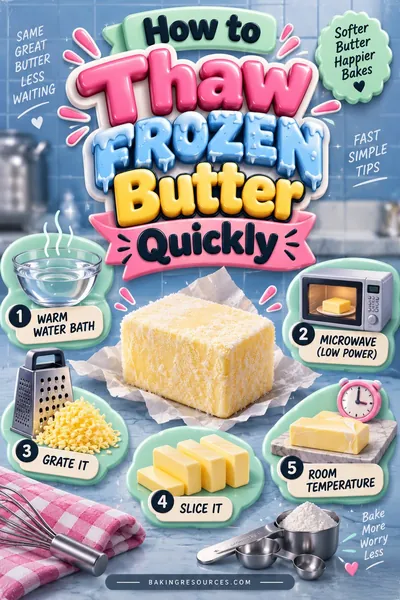
The band that recipes call "room temperature" is far narrower than a real room. A 75°F kitchen makes butter too soft for creaming within about 30 minutes. How to soften butter has seven methods ranked by speed and risk, and how to cream butter and sugar covers what pale and fluffy actually looks like.
Melted butter is not a mistake, it is a different recipe. Melted butter cannot hold air, so it produces a denser, chewier result. That is exactly what you want in a brownie or a chewy cookie, and exactly wrong in a butter cake. If your cookies are coming out thin and lacy, warm butter is the first thing to check, and why are my cookies flat works through the rest.
Job 4: milk solids brown and carry flavor
The 1 to 2 percent of butter that is neither fat nor water is milk solids: protein and milk sugar. They are the reason butter smells like butter when it hits a hot pan.
Heat those solids past about 250°F and they go through the Maillard reaction, turning golden and then deep brown while throwing off a nutty aroma. That is browned butter, and it is the cheapest flavor upgrade in baking.
Two things follow from this:
- Clarified butter and ghee have the solids removed, so they take much higher heat without burning but bring almost no butter flavor. Great for frying, weak in a cookie.
- Browned butter has lost water, typically 15 to 25 percent of its starting weight, which changes the recipe. Brown 113 g of butter and you may be left with 90 g. Weigh it after browning and top the difference back up, or the dough will run dry.
Flavor is also why butter beats a technically similar fat in anything where you taste the crumb. Shortening makes a taller cookie and a whiter frosting, and it tastes like nothing.
Butter vs oil vs shortening: the swap math
These are not interchangeable cup for cup, because only butter carries water.
| Fat | Fat content | Water | Melting point | Best at |
|---|---|---|---|---|
| US butter | 80 to 82% | 16 to 18% | 90 to 95°F | Flavor, browning, steam lift, creaming |
| European style butter | 82 to 86% | 12 to 16% | 90 to 95°F | Laminated dough, richer crumb |
| Vegetable shortening | 100% | 0% | 115 to 120°F | Tall cookies, stable frosting, no flavor |
| Vegetable oil | 100% | 0% | Liquid | Moist quick breads and muffins, no structure |
| Ghee or clarified butter | ~100% | 0% | Liquid when warm | High heat, not for creaming |
Worked example: replacing 1 cup of butter with oil
Say a muffin recipe calls for 1 cup of butter (227 g) and you only have oil.
- Find the actual fat. 227 g × 80% = 182 g of fat.
- Match that with oil. Oil is 100 percent fat, and 1 cup of vegetable oil weighs about 218 g. So 182 ÷ 218 = 0.83 cups, which is 3/4 cup plus 1 tablespoon.
- Replace the missing water. The butter was also carrying 227 g × 16% = 36 g of water, which is about 2 tablespoons. Add 2 tablespoons of milk or water to the batter.
- Accept the trade. You will get a moister, softer crumb that stays soft longer, and you will lose the butter flavor and any lift that came from creaming.
Skipping step 3 is the usual reason an oil swap bakes up dry. Skipping step 1 is why it bakes up greasy.
For dairy free versions of this swap, including the plant butters that are formulated to match butter's water content, see dairy free baking substitutions.
Butterfat percentage: does European style butter matter?
Sometimes, and it depends entirely on which job you are asking butter to do.
US butter must legally contain at least 80 percent milkfat. Most standard brands sit right at 80 to 81 percent. European style butters run 82 to 86 percent, which means less water and more fat per gram. Composition figures for butter are published in the USDA's FoodData Central database if you want to check a specific product.
Where the difference shows up:
- Laminated dough (croissants, puff pastry, danish): a real improvement. Higher fat butter is more pliable when cold and less likely to crack or leak into the layers.
- Buttercream and frosting: noticeable. Less water means a firmer, richer, less prone to splitting frosting. How to make buttercream covers the ratios.
- Cookies: slightly less spread, because there is less water to loosen the dough.
- Cakes and quick breads: honestly hard to detect. Save your money here.
One warning on the swap. If you replace 227 g of 80 percent butter with 227 g of 84 percent butter, you have added 9 g of fat and removed 9 g of water. In a fussy recipe that is enough to shift the texture. In most home baking it is not.
Salted vs unsalted butter, and why recipes specify
Recipes call for unsalted butter for two reasons: control and freshness.
Salt content varies by brand. Salted butter typically runs 1.5 to 2 percent salt, which works out to roughly 1.7 to 2.3 g per 113 g stick. That is somewhere between a generous 1/4 teaspoon and a scant 1/2 teaspoon of table salt, and the brands do not agree with each other.
If a cookie recipe calls for 1 teaspoon of salt and you use 2 sticks of salted butter, you have quietly added another 1/2 to 3/4 teaspoon without knowing which.
The practical fix: if all you have is salted butter, reduce the added salt by about 1/4 teaspoon per stick and taste-check anything where the batter is safe to taste. In a bread dough or a savory scone, salted butter is usually fine as is. In shortbread, where butter is most of the recipe, it matters a lot.
The freshness angle: salt is a preservative, so salted butter sits on shelves longer and can carry more of that stale, slightly cheesy note. Unsalted turns over faster in most stores.
Butter measurements: sticks, cups, grams and unmarked blocks
This trips people up constantly, and the error is bigger than it looks.
| Amount | Grams | Ounces | Tablespoons |
|---|---|---|---|
| 1 tablespoon | 14 g | 0.5 oz | 1 |
| 1/2 stick | 57 g | 2 oz | 4 |
| 1 stick | 113 g | 4 oz | 8 |
| 1 cup (2 sticks) | 227 g | 8 oz | 16 |
| 1 lb box (4 sticks) | 454 g | 16 oz | 32 |
The trap: a 250 g block is not 2 sticks. Two sticks are 227 g. Halving a 250 g block to get "one stick" hands you 125 g instead of 113 g, which is 11 percent too much fat. In a pie crust or shortbread that is enough to notice in the texture.
If your butter came as a plain block with nothing printed on the wrapper, the butter converter tells you exactly what proportion to cut and where the line falls. For every other ingredient, ingredient weights and the grams to cups converter do the same job.
Worked example: scaling butter for a half batch
A recipe calls for 1 1/2 sticks of butter and you want to halve everything.
- 1 1/2 sticks = 1.5 × 113 = 170 g
- Half of that = 85 g
- 85 g ÷ 14 g per tablespoon = 6 tablespoons, which is 3/4 of a stick
Cutting "three quarters of a stick" by eye usually lands within a tablespoon either way. On a 6 tablespoon measurement, being one tablespoon off is a 17 percent error in your fat. Weigh it, or cut on the wrapper marks.
How butter changes the texture of specific bakes
Same ingredient, four completely different outcomes, driven by how you handle it.
Cookies. Cold butter makes thick cookies that barely spread. Cool creamed butter makes cakey, risen cookies. Melted butter makes flat, chewy cookies with crisp edges. None of these is wrong, they are three different cookies. Chewy vs crispy cookies breaks down the full set of levers.
Cake. Creaming is doing structural work, not just mixing. Butter at 60 to 65°F, beaten 3 to 5 minutes with sugar, is what gives a butter cake its fine even crumb. Warm butter here gives you a greasy, tight cake that sinks.
Pie crust and biscuits. Butter must stay in visible pieces. Pea sized pieces give a tender, sandy crust. Flat sheets and shingles give flaky layers. Both are correct, and both die if the butter warms up.
Bread. Butter is added after the gluten has started to develop, because adding it too early slows development. It softens the crumb and extends shelf life. A sandwich loaf with 5 percent butter by flour weight stays soft a full day longer than the same loaf without.
Frosting. Butter is the structure, not an add-in. Temperature governs everything: too cold and the frosting is lumpy, too warm and it soups. 65 to 68°F is the workable window.
Frequently asked questions
Can I use melted butter instead of softened butter?
Only if the recipe does not depend on creaming. Melted butter cannot hold air, so a cake or a creamed cookie will bake up dense and flat. In brownies, quick breads, muffins and deliberately chewy cookies, melted butter is often better than softened. If you melt it by accident, chill it back to a cool, pliable solid rather than using it warm.
Why does my recipe specify unsalted butter?
For control. Salted butter carries roughly 1.7 to 2.3 g of salt per stick, and brands vary enough that the recipe author cannot predict it. Using unsalted lets the recipe set the exact salt level. If you only have salted, cut the added salt by about 1/4 teaspoon per stick and you will land close.
Does butter make cookies spread more than shortening?
Yes. Butter melts at 90 to 95°F while shortening holds until 115 to 120°F, so butter dough starts flowing much earlier in the bake, before the structure has set. Shortening cookies stay taller and rounder. Many bakers use half of each: butter for flavor, shortening for height.
How much water is in butter?
US butter is 16 to 18 percent water by weight, so a 113 g stick holds roughly 18 to 20 g of it. European style butters carry less, usually 12 to 16 percent, because their fat content is higher. That water is what makes steam in the oven, which is why butter creates flaky layers and oil never does.
Is European style butter worth the extra cost?
For laminated dough and buttercream, yes, the difference is visible. For cakes, muffins and most cookies, it is hard to detect and not worth the price. If you buy one premium block a year, spend it on croissants or puff pastry, where the higher fat and better pliability actually change what the dough can do.
What happens if I use too much butter in a recipe?
The bake gets greasy and spreads. Extra fat means less gluten structure and a dough too soft to hold its shape, so cookies pool into one sheet, cakes sink in the middle, and crusts leak fat into the pan. Extra butter also adds water, which can turn a stiff dough slack. Weigh the butter rather than guessing at a stick.
Can I substitute oil for butter one for one?
Not without adjusting. Butter is only 80 percent fat, so 1 cup of butter equals about 3/4 cup plus 1 tablespoon of oil, plus 2 tablespoons of extra liquid to replace the water you removed. Swapping one for one gives you 25 percent more fat than intended and a greasy result. You also lose creaming, so do not try this in a butter cake.
Should butter be cold or soft for pie crust?
Cold, ideally under 40°F, and some bakers freeze it for 15 minutes first. The whole point is that the butter pieces survive the mixing intact so they can steam apart into layers in the oven. If the butter smears into the flour, you get a tough, greasy crust with no flakiness at all.
Related guides: How to soften butter | How to cream butter and sugar | How to cut butter into flour | How to brown butter | Butter converter