How to Cream Butter and Sugar

Beat softened butter and sugar together on medium speed with a paddle attachment for 3 to 5 minutes, scraping the bowl twice, until the mixture turns visibly paler and climbs the sides of the bowl. It should look like thick ivory frosting, not yellow paste.
Most people stop at 60 to 90 seconds, when the mixture first looks smooth. That's about a third of the way there. Undercreaming is the single most common cause of dense cookies and flat, heavy cakes, and it's invisible until the pan comes out of the oven.
The butter needs to be at 65 to 67°F. Colder won't aerate, warmer won't hold the air, and melted butter can't cream at all.
Need your butter measurements sorted first? Our free butter converter turns sticks into cups, tablespoons and grams instantly (1 stick = 113 g = 8 tbsp = 1/2 cup).
Updated August 2026
The 60-second version
- Butter at 65 to 67°F, cool to the touch, dents under your finger but doesn't smear.
- Cut it into tablespoon-size pieces so it breaks down evenly.
- Beat the butter alone for 30 seconds to smooth it out.
- Add the sugar all at once.
- Beat on medium (not high) for 3 to 5 minutes in a stand mixer, 5 to 7 with a hand mixer.
- Scrape the bowl and the paddle at 90 seconds and again at 3 minutes.
- Stop when it's pale ivory, matte, and holds a ridge when you lift the paddle.
How to cream butter and sugar: what's actually happening
This is the part almost no recipe explains, and it changes how you do every step.
You are not dissolving the sugar. You are using it as a cutting tool.
Granulated sugar crystals are hard, sharp and irregular. Semi-solid butter is a fat matrix that holds its shape but yields under pressure. When the paddle drags thousands of sugar crystals through that butter, every crystal edge tears a tiny hole, and air rushes in behind it. Do that for four minutes and you've cut millions of microscopic air pockets into the fat.
Those air pockets are the leavening. Not the baking powder, not the baking soda. Those chemicals only inflate bubbles that already exist. They cannot create a bubble in a batter that has none.
Once you understand that, the rest follows:
- Butter temperature matters because the fat has to be soft enough to yield around a crystal but firm enough to keep the hole open afterward.
- Melted butter can't cream because liquid fat closes back over every hole instantly. There's nothing to hold.
- Cold butter can't cream because the crystals skid across a hard surface instead of cutting into it.
- Time matters because each crystal only cuts a few pockets per pass, and it takes minutes of passes to build enough of them.
- Sugar type matters because a rounder, softer, or smaller crystal cuts differently.
Why 65 to 67°F is the number
Butter is a crystalline fat, and its structure changes fast across a narrow band:
| Butter temperature | State | What creaming does |
|---|---|---|
| Below 60°F | Firm, cold | Crystals skid, mixture stays in chunks, almost no air |
| 62 to 64°F | Cool, slightly stiff | Works, but slowly. Add 1 to 2 minutes |
| 65 to 67°F | Plastic, cool to the touch | Best aeration. This is the target |
| 68 to 70°F | Soft, slightly shiny | Aerates, then starts losing air as you keep going |
| Above 72°F | Greasy, glossy, sagging | Pockets collapse as fast as they form |
| Melted | Liquid | No aeration at all, ever |
The tell without a thermometer: press the butter with a fingertip. It should dent cleanly and hold the dent, with no give underneath and no grease on your finger. If your finger sinks straight through, it's too warm. If it barely marks, it's too cold.
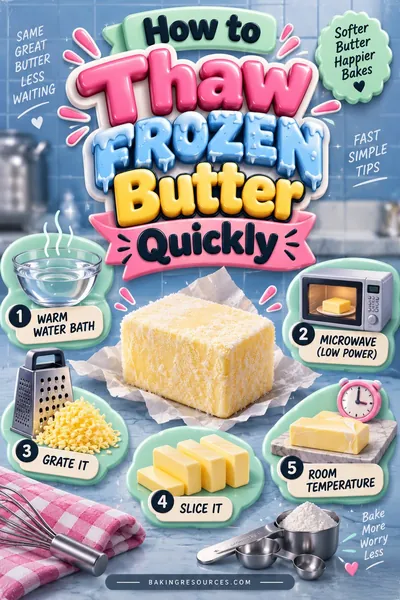
For the fastest safe ways to hit that window, see how to soften butter. The microwave shortcut is where most creaming failures actually begin, because a melted edge on an otherwise cold stick never recovers.
What pale and fluffy actually looks like
"Light and fluffy" is the least useful instruction in baking, because it describes an endpoint nobody has seen next to a starting point. Here's the whole progression, with a stand mixer on medium.
| Elapsed time | Color | Texture | Bowl behavior |
|---|---|---|---|
| 0:00 | Deep butter yellow | Chunks with loose sugar around them | Sugar rattles |
| 0:30 | Deep yellow | Wet sand, clumping onto the paddle | Clings in one lump |
| 1:00 to 1:30 | Yellow, slightly lighter | Smooth, dense paste. Most people stop here | Sits in the bottom |
| 2:00 | Light yellow | Softening, starting to look aerated | Begins climbing the sides |
| 3:00 | Pale, edging to cream | Visibly fluffy, matte surface | Coats the lower bowl |
| 4:00 to 5:00 | Pale ivory, nearly white | Holds peaks and ridges, looks like buttercream | Rides up the sides, needs scraping |
| 6:00 to 8:00 | Ivory, slightly translucent | Very soft, loosening, may look wet | Slumps back down |
Three checks that beat any clock:
- Color. Compare against a fresh stick of butter on the counter. Creamed properly, the mixture is one to two full shades lighter. If it's the same yellow, it's not done.
- Ridges. Lift the paddle. A finished mixture holds the ridge it leaves for a few seconds. An undercreamed one flattens immediately.
- Feel. Rub a pinch between finger and thumb. You'll still feel sugar grains (that's normal, they don't dissolve in fat), but the mixture around them should feel light and greaseless, not heavy and slick.
Volume: the check you can actually measure
Creaming adds real, measurable volume. Scrape the mixture into a large liquid measuring cup, level it lightly, and read it.
Take 227 g of butter (1 cup, 2 sticks) and 200 g granulated sugar (1 cup). Uncreamed, mashed together, that fills roughly 2 cups. Properly creamed, the same mass fills about 2 1/2 to 2 3/4 cups. That's a 25 to 35% volume gain, and it's all air.
If yours reads 2 1/4 cups, keep going. You're not finished.
Timings by method
| Method | Speed setting | Time | Notes |
|---|---|---|---|
| Stand mixer, paddle | Medium (4 of 10, or KitchenAid 4) | 3 to 5 min | The benchmark. Scrape twice |
| Stand mixer, whisk | Medium | Not recommended | Stiff butter jams the wires and the whisk can't reach the bowl edge |
| Hand mixer | Medium-high | 5 to 7 min | Less torque. Move the beaters around the bowl constantly |
| Wooden spoon, by hand | Steady, firm | 8 to 12 min | Real work. Use a warm bowl and a stiff spoon |
| Stiff spatula, small batch | Firm pressing | 6 to 10 min | Press and smear against the bowl, don't stir |
| Food processor | Any | Not recommended | Blades cut and warm the fat instead of folding air in |
Why medium and not high: high speed generates friction heat, and it throws the mixture up onto the sides of the bowl where the paddle never touches it again. You end up with warm butter and half the batch uncreamed. Medium keeps the mixture in the paddle's path and the temperature under control.
Kitchens run cool and warm, so treat the times as a range, not a rule. In a 78°F kitchen the butter softens as you work and you'll finish at the short end. In a 64°F kitchen, add a minute or two.
Can you overcream butter and sugar?
Yes, but it's much rarer than the internet suggests, and it looks nothing like undercreaming.
Overcreaming happens two ways:
- Too long on high speed, where friction warms the butter past about 72°F and the pockets collapse faster than they form.
- Butter that started too warm, so you were never building structure in the first place.
What overcreamed looks like: the mixture stops climbing the bowl and slumps back down. It goes from matte to slightly shiny. It may look wet, loose, or faintly curdled. Ridges won't hold at all.
What it does to your bake: cookies spread thin and greasy, cakes rise fast then sink in the middle, because the air structure was too weak to set before the crumb did.
The fix: chill the bowl for 10 to 15 minutes in the fridge until the mixture firms up, then beat for 30 to 60 seconds more on medium. You'll recover most of it. You cannot recover butter that actually melted, though. Start over with fresh butter for that.
For anyone chasing a specific failure, why are my cookies flat walks through the difference between a spread caused by warm butter and a spread caused by undercreaming, which is a distinction that changes the fix entirely.
Does sugar type change the result? Yes, a lot
The crystal is the tool, so the crystal shape sets the ceiling on how much air you get.
| Sugar | Grams per cup | Aeration | Why |
|---|---|---|---|
| Granulated (white) | 200 g | Best | Hard, sharp, irregular crystals. The default for a reason |
| Superfine / caster | ~200 g | Very good, faster | More crystals per cup, more cuts per pass. Finishes 30 to 60 sec sooner |
| Packed light brown | 213 g | Moderate | Molasses coats and softens the crystal edges, and adds moisture |
| Packed dark brown | 213 g | Lower still | More molasses, softer edges, less cutting |
| Powdered (confectioners') | 120 g | Almost none | Ground to dust plus cornstarch. Nothing left to cut with |
| Turbinado / coarse | ~200 g | Poor | Few, very large crystals. Not enough of them |
| Liquid (honey, syrup) | Honey 340 g | None | No crystals at all |
What to do about it in practice:
- All brown sugar recipe? Add 1 to 2 minutes to the creaming time and expect a denser, chewier result. That's usually the point of the recipe, so don't fight it.
- Half and half? Cream on the normal 3 to 5 minute schedule. The granulated half carries the work.
- Powdered sugar recipe? It isn't relying on creaming for lift, so beat only until smooth (about 1 to 2 minutes). Longer does nothing useful. American buttercream works this way.
- Reduced sugar version? You lose leavening along with sweetness. Cutting a cup of sugar to 3/4 cup costs you real rise, and no amount of extra beating replaces it.
Brown sugar's moisture is a second variable on top of the crystal shape, since packed brown sugar carries a few percent water that granulated doesn't. That water softens the butter as you cream, which is why heavily brown-sugared doughs feel looser at the end.
Why the recipe order exists
Creaming, then eggs, then alternating dry and wet is not tradition. Each step protects the one before it.
1. Cream the butter and sugar first
You're building the air structure. It has to happen while the fat is the only thing in the bowl, because flour and liquid both stop the process cold.
2. Add eggs one at a time
Eggs are about 75% water, and water and fat don't mix on their own. Dumping in three eggs at once floods the fat, the emulsion breaks, and the mixture curdles. Every curdle is air escaping.
One egg at a time gives the lecithin in the yolk time to bind that water into the fat. Beat 20 to 30 seconds between eggs, just until it looks uniform, then add the next.
If it curdles anyway: add a tablespoon of the recipe's flour and beat 15 seconds. It absorbs the free water and pulls the emulsion back together. Cold eggs are the usual culprit, so set them out with the butter.
3. Alternate dry and wet, starting and ending with dry
Once flour meets water, gluten starts forming, and gluten is what makes cake tough. Alternating limits how much free water any batch of flour ever meets at once.
The standard split is dry in three additions, wet in two: dry, wet, dry, wet, dry. Starting with dry protects the emulsion from a sudden hit of liquid. Ending with dry means the last thing you do is the gentlest.
Mix on low, and stop as soon as the flour disappears. Every extra rotation past that point builds gluten and knocks out air you spent five minutes putting in. This is the same over-mixing that shows up in why did my cake sink.
Worked example: a standard creamed cookie dough
Here's the whole sequence with real numbers, using the site's standard weights.
What goes in:
- Butter: 227 g (1 cup, 2 sticks), at 66°F
- Granulated sugar: 200 g (1 cup)
- Packed light brown sugar: 213 g (1 cup)
- Eggs: 2 large, at room temperature
- All-purpose flour: 375 g (3 cups at 125 g per cup, spoon and level)
The timeline:
| Time | Step | Checkpoint |
|---|---|---|
| 0:00 | Butter alone, medium, cut into 16 pieces | Smooth, no lumps |
| 0:30 | Add both sugars, all at once | Wet sand |
| 1:30 | Scrape bowl and paddle | Smooth yellow paste |
| 3:00 | Scrape again | Noticeably lighter, climbing bowl |
| 4:30 | Stop creaming | Pale ivory, holds ridges, ~2 3/4 cups volume |
| 5:00 | Egg 1, beat 25 sec | Uniform, no slick patches |
| 5:30 | Egg 2, beat 25 sec | Uniform |
| 6:00 | Flour in 2 additions, low speed | Stop the second the flour vanishes |
Total mixer time: about six and a half minutes, of which 4.5 minutes is creaming. Compare that to the 90 seconds most people give it, and you can see where three quarters of the missing air went.
The brown sugar in this ratio is why the range says 4 to 5 minutes rather than 3 to 4. Half the sugar is the soft, moist kind that doesn't cut as well.
Troubleshooting
| What you see | What went wrong | Fix |
|---|---|---|
| Mixture stays yellow after 5 min | Butter too cold, or speed too low | Let it warm 10 min, beat again |
| Greasy, slumping, won't lighten | Butter too warm or partly melted | Chill 15 min, re-beat 60 sec |
| Grainy but that's it | Normal. Sugar doesn't dissolve in fat | Judge by color and volume, not grit |
| Curdled after adding eggs | Cold eggs, or added too fast | 1 tbsp flour, beat 15 sec |
| Dense, heavy cookies | Undercreamed | Full 4 to 5 min next time |
| Cookies spread thin and greasy | Overcreamed or warm butter | Chill dough 30 min before baking |
| Cake domed then sank | Over-mixed after the flour | Mix on low, stop at "just combined" |
| Sugar clinging to bowl sides | Not scraping | Scrape at 90 sec and 3 min |
For the weights behind any of this, the ingredient weights chart has the full pantry, and the grams to cups converter handles anything the chart doesn't list.
Frequently asked questions
How long should you cream butter and sugar?
Three to five minutes on medium speed with a stand mixer paddle, five to seven minutes with a hand mixer, and eight to twelve minutes by hand with a wooden spoon. Judge by appearance rather than the clock: the mixture should be one to two shades paler than fresh butter and hold a ridge when you lift the beater. Recipes heavy on brown sugar need the longer end of every range.
What does properly creamed butter and sugar look like?
Pale ivory, close to off-white, with a matte rather than shiny surface. It holds peaks and ridges, climbs the sides of the bowl, and has grown roughly 25 to 35% in volume. If it's still butter-yellow and sitting flat in the bottom of the bowl, it needs two or three more minutes.
Can you overcream butter and sugar?
Yes, though it takes real effort at medium speed. Overcreamed mixture stops climbing the bowl, slumps, turns slightly shiny and may look wet or curdled, and it happens because friction warmed the butter past about 72°F. Chill the bowl for 10 to 15 minutes and beat for another 30 to 60 seconds to recover most of the structure.
Why won't my butter and sugar cream properly?
The butter is almost always the reason, and it's usually too cold. At under 60°F the sugar crystals skid across the fat instead of cutting into it, so no air pockets form. The other common cause is a partly melted stick from the microwave, since liquid fat closes over every pocket as fast as it forms and can't be brought back.
Can you cream melted butter and sugar?
No. Creaming works because sugar crystals cut air pockets into semi-solid fat and the fat holds them open, and melted butter simply flows back over every hole. Recipes built on melted butter (most brownies, many chewy cookies) rely on chemical leaveners and eggs instead, and they're written to expect a denser result.
Does brown sugar cream the same as white sugar?
Not quite. Brown sugar's crystals are coated in molasses, which softens their edges and adds moisture, so they cut fewer air pockets. Add one to two minutes to the creaming time for an all-brown-sugar recipe and expect a denser, chewier bake, which is generally what the recipe wants anyway.
Do I need a stand mixer to cream butter and sugar?
No. A hand mixer gets there in five to seven minutes and a wooden spoon in eight to twelve, pressing and smearing the mixture against the side of the bowl rather than stirring it. A food processor is the one tool to skip, because the blade cuts and warms the fat instead of folding air into it.
What temperature should butter be for creaming?
65 to 67°F, which is cooler than most kitchens call "room temperature." The butter should dent under a fingertip and hold the dent, with no give underneath and no grease left on your finger. Above about 72°F the air pockets collapse as fast as they form, and below 60°F they never open at all.
Related guides: Butter converter | How to soften butter | Why are my cookies flat | Why did my cake sink | Ingredient weights chart | Grams to cups converter