Christmas Cookies That Freeze Well

Dense, buttery, low-moisture cookies freeze beautifully: shortbread, gingerbread, sugar cookies, biscotti, snowballs, spritz and thumbprints all come out of a 3 month freeze tasting fresh. The ones that fail are anything built on trapped air or high moisture, so meringues, pizzelle, cream-filled sandwiches and cookies with fresh dairy fillings should be baked close to the day instead.
The list of christmas cookies that freeze well is really a list of cookies with a high fat to water ratio. Fat does not form ice crystals. Water does, and those crystals are what wreck texture, so the drier and butterier the cookie, the better it survives.
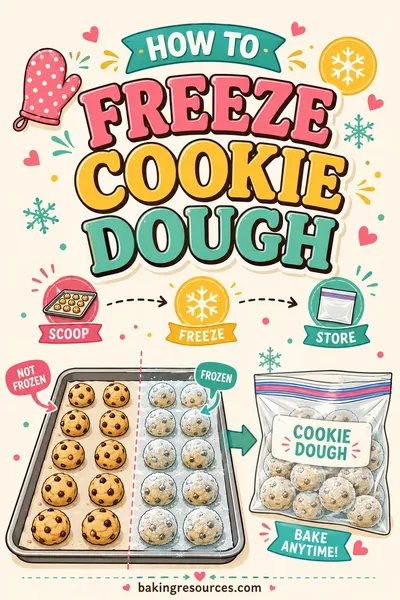
This guide is about baked cookies. If you want to freeze the dough instead and bake fresh in December, our separate guide on how to freeze cookie dough covers the flash freeze method and the bake-from-frozen times.
Refreshing a batch from the freezer? Our free baking time calculator works out the reheat window for your cookie size and oven temperature.
Updated September 2026
Christmas cookies that freeze well, ranked
| Cookie type | Freezes | Best window | Notes |
|---|---|---|---|
| Shortbread | Excellent | 3 months | Almost no water in it, thaws perfectly |
| Gingerbread and molasses | Excellent | 3 months | Spices actually deepen in the freezer |
| Biscotti | Excellent | 3 months | Already dried twice, nothing left to lose |
| Sugar cookies, undecorated | Excellent | 3 months | The safest cut-out to freeze |
| Snowballs and Russian tea cakes | Very good | 3 months | Freeze undusted, coat after thawing |
| Chocolate chip | Very good | 3 months | Refresh at 300°F to bring back the chew |
| Spritz and butter cookies | Very good | 2 to 3 months | Fragile, so pack rigid |
| Thumbprints with jam | Good | 2 months | Jam weeps a little on thawing |
| Peppermint bark and bars | Good | 2 months | Cut after thawing, not before |
| Royal icing decorated | Good with care | 1 to 2 months | Must be fully cured first |
| Buttercream frosted | Fair | 1 month | Flash freeze uncovered first |
| Pizzelle and krumkake | Poor | Not worth it | Go soft and leathery |
| Meringues and macaroons | Poor | Not worth it | Absorb moisture, turn sticky |
| Cream cheese filled | Poor | Not worth it | Filling splits and weeps |
| Custard or cream filled | No | Bake fresh | The filling breaks completely |
Two patterns run through that table. High fat plus low water equals a good freezer cookie. Trapped air plus sugar that attracts moisture equals a bad one.
Why some cookies survive the freezer and others do not
Freezing damage comes from two things, and neither one is the cold itself.
The first is ice crystal formation. Water inside the cookie freezes into crystals that puncture the crumb structure. When it thaws, the water is released in the wrong place and you get a soggy, dense patch. Cookies with very little free water, like shortbread at roughly 30 percent butter by weight, barely have enough water to form crystals in the first place.
The second is moisture migration. A freezer is a drying environment, and any exposed surface loses water to the air over weeks, which is freezer burn. Meanwhile, every time the package moves through a temperature swing, moisture inside redistributes and settles as frost.
That is why meringues fail so completely. A meringue is a sugar foam with a huge surface area and sugar that pulls in moisture from any air it meets. It comes out of the freezer tacky on the outside and chewy inside, and there is no fix.
It is also why biscotti are the single most freezer-proof cookie in the list. They have already been baked twice specifically to remove water, so there is essentially nothing left to freeze.
Our comparison of chewy versus crispy cookies explains the same moisture math from the other direction, and it is the best predictor of freezer performance you will find: a cookie that goes stale by drying out will freeze well, and a cookie that goes stale by absorbing moisture will not.
Cool completely, and mean it
This is the step that ruins more frozen cookies than any other.
A cookie that is even slightly warm when it goes into a sealed container releases steam. That steam condenses on the container walls, refreezes as frost, and lands back on the cookies during thawing. You get soft tops, spotted surfaces, and cookies stuck to each other.
Give them a full 2 hours on a wire rack. Not 30 minutes, and not until they feel cool on top, since the base of a thick cookie holds heat far longer than the surface suggests. If your kitchen is warm, 3 hours is safer.
The test is simple: press the underside of a cookie against your wrist. If you can feel any warmth at all, wait.
How to wrap baked cookies for the freezer
Three layers, in this order.
- A rigid container, not a bag. Cookies break under their own weight in a bag, and every broken cookie exposes fresh surface to freezer air. A hard-sided container is the whole difference between cookies and crumbs in February.
- Parchment between every layer. Cookies bond to each other as they freeze, and prying them apart snaps them. One sheet between layers solves it entirely.
- Air removed, then sealed. Press a sheet of plastic wrap down onto the top layer before you put the lid on. That fills the headspace so there is less air inside to carry moisture around.
Label with the type and the date. Three months is the quality window, and after that they are still safe but the butter starts tasting flat and the cookies pick up freezer odors.
Flash freeze first for anything decorated or fragile. Spread the cookies in a single layer on a sheet pan, freeze uncovered for 1 to 2 hours until solid, then pack them. Frozen solid, they can be stacked without the surface taking a dent.
Do not mix cookie types in one container. Strong flavors travel in a freezer, and gingerbread will find its way into shortbread over a month. Mint is the worst offender by a wide margin.
Worked example: a 6 dozen holiday box, built in November
Here is how a real freeze-ahead plan lays out for 72 cookies across four types.
- Week 1, Saturday. Bake 24 shortbread and 24 gingerbread. Cool 2 hours. Pack each type in its own rigid container, parchment between three layers of 8. Freeze.
- Week 2, Saturday. Bake 24 sugar cookie cut-outs. Cool 2 hours. Freeze them undecorated, since undecorated cut-outs are far more robust than iced ones.
- Week 3. Nothing. This is the point of freezing.
- December, 2 days before. Move all three containers to the counter, still sealed. Thaw 3 hours.
- Same day. Decorate the sugar cookies. Royal icing needs a full day to cure before it is stackable, so this has to happen 24 hours before packing. Our guide on how long royal icing takes to dry has the stage-by-stage timings.
- Day of. Refresh the shortbread and gingerbread at 300°F for 4 minutes, cool, and box.
Total oven time in December: about 15 minutes. That is the payoff.
The alternative order, decorating in November and freezing the finished cookies, works too but carries more risk, since royal icing can bloom or bleed if condensation lands on it during the thaw. Freezing plain and decorating late is the version that goes wrong least often.
Thawing without condensation
The single rule: thaw them sealed.
A frozen cookie is colder than the room. Warm air touching a cold surface drops its moisture right there, which is why a cold glass sweats on a summer day. Open the container in the kitchen and every cookie in it gets a film of water on its surface. Iced cookies go blotchy, crisp cookies go soft, and sugar coatings dissolve.
Leave the lid on and let the whole container come to room temperature. The condensation then forms on the outside of the container instead, where it does no harm.
| Package | Thaw time at room temperature |
|---|---|
| Single cookie | 15 to 20 minutes |
| Small container, 1 to 2 dozen | 1.5 to 2 hours |
| Large container, 4 to 6 dozen | 3 to 4 hours |
| Decorated cookies, single layer | 2 hours, sealed, undisturbed |
Do not thaw in the refrigerator. A fridge is humid and slow, which is the worst combination for a cookie surface. Room temperature on the counter is both faster and drier.
Do not thaw with the lid cracked to "let moisture out" either. That defeats the entire mechanism.
Refreshing frozen cookies back to just-baked
Thawing gets the cookie back to edible. A short oven pass gets it back to good.
| Cookie type | Oven | Time | What it does |
|---|---|---|---|
| Crisp cookies, shortbread, biscotti | 300°F | 4 to 5 min | Drives off absorbed moisture, restores snap |
| Chewy cookies, chocolate chip | 300°F | 3 min | Softens the butter, brings back the pull |
| Thick soft cookies | 300°F | 5 min | Warms through without drying the edge |
| Decorated cookies | Do not reheat | The icing softens and slumps | |
| Bars and brownies | 300°F | 5 to 7 min | Cut after warming, not before |
Three hundred degrees is the right number for all of them. Higher and you start baking the cookie further, which pushes crisp cookies toward hard and dries chewy ones out. Our guide on telling when cookies are done covers the visual cues, and the same ones apply to a refresh: pull them the moment the surface looks alive again.
Cool refreshed cookies for 10 minutes before serving. Straight out of the oven they are floppy, and they firm up as the sugar cools.
The microwave works for exactly one job: a single chewy cookie, 8 to 10 seconds, eaten immediately. It goes tough within a minute or two after that, so do not microwave a batch.
Freezing decorated cookies specifically
This is the question that comes up most often in December, and the answer is a qualified yes.
Royal icing decorated cookies freeze if you follow four rules:
- Cure the icing fully first. Twenty four hours minimum after flooding. Freezing icing that is only touch dry traps moisture in the soft interior and it never sets properly.
- Flash freeze in a single layer, uncovered, for 1 to 2 hours. This hardens the surface so nothing can dent it.
- Pack in a single layer if you can, two at most, with parchment between. Stacking pressure on frozen icing chips it.
- Thaw sealed and undisturbed for at least 2 hours. Do not open the container to check. This is where color bleed happens.
Buttercream frosted cookies are more fragile. The frosting itself freezes fine, but it dents at the slightest touch until it is solid, so flash freezing is mandatory rather than optional, and 1 month is a more realistic window than 3.
Powdered sugar coatings should never go into the freezer. The sugar absorbs moisture during the thaw and turns into a wet paste. Freeze snowballs and crescents bare, then roll them in powdered sugar after they have thawed and dried.
What to do instead with the cookies that do not freeze
Meringues, pizzelle and cream-filled cookies are not lost causes, they just need a different plan.
- Meringues keep for 2 weeks at room temperature in a truly airtight container with a desiccant packet. That is longer than most people expect, and it makes freezing unnecessary.
- Pizzelle and krumkake stay crisp for about a week sealed, and they re-crisp at 300°F for 3 minutes if they soften.
- Sandwich cookies freeze well as separate halves. Freeze the plain cookies, then fill on the day.
- Cream cheese or custard fillings should always be made fresh. Freeze the cookie shells and nothing else.
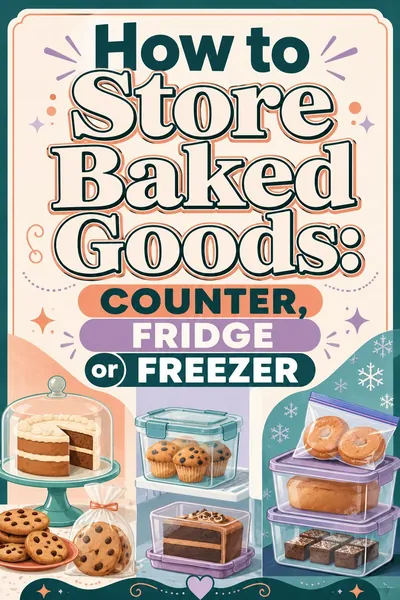
Our guide on storing baked goods has the room temperature and refrigerator windows for everything that is better off out of the freezer.
For anything larger than a cookie, the same logic scales up, and the method is in our guide on how to freeze cake.
Frequently asked questions
How long do baked cookies last in the freezer?
Three months for good quality, and they stay safe well beyond that at 0°F. What degrades is the butter, which slowly picks up a stale note, and the surface, which loses moisture to freezer air. Rigid containers and a layer of plastic wrap pressed onto the top layer both stretch that window closer to the full three months.
Is it better to freeze cookie dough or baked cookies?
Dough, if you want the best possible texture, since a cookie baked fresh always beats one thawed. Baked cookies, if you want to remove work from December entirely. Most people doing a big holiday box use both: dough for the cookies they want warm and fresh, baked and frozen for everything going into gift boxes.
Can you freeze cookies with icing on them?
Yes, as long as the icing has cured for a full 24 hours first, and as long as you flash freeze them in a single layer before packing. The real risk is not the freezing, it is the thaw, where condensation on a cold iced surface causes color bleed and a dull finish. Thawing sealed and untouched avoids it.
Why did my frozen cookies taste stale?
Either they were in there past about 3 months, or air was reaching them. Butter oxidizes slowly even at freezer temperatures, and exposed surfaces dry out. Bags are the usual culprit, since they hold a lot of air even when squeezed. A rigid container with the headspace filled solves most of it.
Should I thaw cookies in the refrigerator?
No. A refrigerator is both humid and slow, so the cookie sits at a condensation-friendly temperature for hours. Counter thawing in a sealed container is faster and gives a drier surface. The only cookies that belong in a fridge at all are ones with a perishable filling, and those should not have been frozen anyway.
Can I refreeze cookies that thawed?
Once, if they never got warm and the container stayed sealed, though the texture takes a small hit each cycle. If they sat out open, or if condensation formed on the surface, eat them within a few days instead. Refreezing a wet surface just locks that water into the crumb.
Do decorated cookies need to be at room temperature before I bag them?
Yes, completely, and then some. A cookie that is still cool in the middle will keep releasing moisture inside a sealed bag, and that moisture goes straight back into the icing and softens it. Give a thawed decorated cookie an extra hour out of the container before bagging or heat sealing.