Baking Conversion Chart

One cup of all-purpose flour is 125 g. One cup of butter is 227 g. One cup of honey is 340 g. Same cup, three completely different weights, because weight per cup depends on what's in the cup.
That's the thing generic charts get wrong. The line "1 cup = 240 g" is printed on thousands of kitchen magnets and it's accurate for exactly one ingredient: water. Use it for flour and you're off by 92%.
So this chart is built the useful way: volume conversions are universal, weight conversions are per ingredient. Everything below matches the calculators on this site, so nothing here will contradict a tool you use next.
Skip the lookup entirely with our free grams to cups converter, which handles any ingredient and any amount.
Updated August 2026
Why every generic baking conversion chart is wrong
A cup measures space, not mass. What fills that space varies enormously.
- Flour is mostly air, and how you fill the cup changes the weight by 26%.
- Butter is dense and packs with no air gaps at all.
- Honey is heavier than water.
- Powdered sugar is ground almost to dust, so it traps huge amounts of air.
Look at the spread on one identical cup:
| One cup of... | Weighs | vs. the "240 g" myth |
|---|---|---|
| Powdered sugar | 120 g | 50% of it |
| All-purpose flour | 125 g | 52% |
| Granulated sugar | 200 g | 83% |
| Butter | 227 g | 95% |
| Water | 236 g | 98% |
| Milk | 240 g | 100%, the one that fits |
| Honey | 340 g | 142% |
A cup of honey weighs nearly three times what a cup of powdered sugar does. Any chart that gives you a single gram figure for "1 cup" is telling you about water and nothing else.
The rule to take away: convert volume to volume freely (cups, tablespoons, milliliters all behave). Convert volume to weight only with the specific ingredient in hand.
Cups to grams by ingredient
These are the site standards, used by every calculator here.
Flours
| Ingredient | 1 cup | 1/2 cup | 1/3 cup | 1/4 cup | 1 tbsp |
|---|---|---|---|---|---|
| AP flour, spoon and level | 125 g | 63 g | 42 g | 31 g | 8 g |
| AP flour, scoop and sweep | 145 g | 73 g | 48 g | 36 g | 9 g |
| AP flour, sifted | 115 g | 58 g | 38 g | 29 g | 7 g |
| Bread flour | 127 g | 64 g | 42 g | 32 g | 8 g |
| Cake flour | 114 g | 57 g | 38 g | 29 g | 7 g |
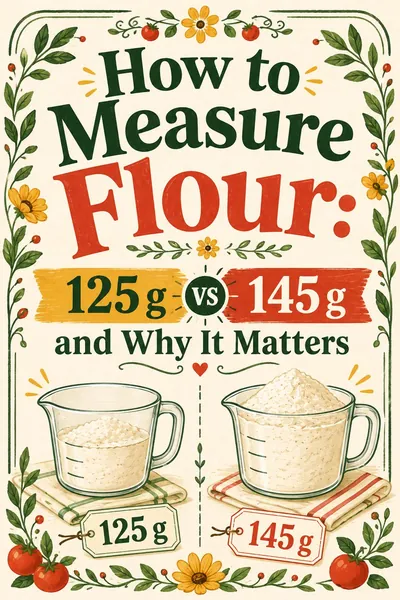
Note the top three rows. Same flour, same cup, three different weights depending only on how you filled it. That 30 g gap between spoon-and-level and scoop-and-sweep is the most common hidden error in home baking, and how to measure flour covers the fix.
Sugars
| Ingredient | 1 cup | 1/2 cup | 1/3 cup | 1/4 cup | 1 tbsp |
|---|---|---|---|---|---|
| Granulated sugar | 200 g | 100 g | 67 g | 50 g | 13 g |
| Brown sugar, packed | 213 g | 107 g | 71 g | 53 g | 13 g |
| Powdered sugar | 120 g | 60 g | 40 g | 30 g | 8 g |
Brown sugar is the only one of the three that's measured packed, meaning pressed firmly into the cup so it holds the shape when turned out. Unpacked, it runs closer to 145 g and your recipe loses sweetness and moisture at the same time.
Fats
| Ingredient | 1 cup | 1/2 cup | 1/3 cup | 1/4 cup | 1 tbsp |
|---|---|---|---|---|---|
| Butter | 227 g | 113 g | 76 g | 57 g | 14 g |
Butter has its own arithmetic because of the stick:
| Butter measure | Grams | Tablespoons | Cups |
|---|---|---|---|
| 1 stick | 113 g | 8 tbsp | 1/2 cup |
| 2 sticks | 227 g | 16 tbsp | 1 cup |
| 4 sticks (1 lb) | 454 g | 32 tbsp | 2 cups |
| 1/2 stick | 57 g | 4 tbsp | 1/4 cup |
| 1 tbsp | 14 g | 1 tbsp | 1/16 cup |
The wrappers on US sticks are printed with tablespoon marks, so for anything under a full stick you can cut on the line. The butter converter does the rest.
Dairy and liquids
| Ingredient | 1 cup | 1/2 cup | 1/3 cup | 1/4 cup | 1 tbsp |
|---|---|---|---|---|---|
| Milk | 240 g | 120 g | 80 g | 60 g | 15 g |
| Buttermilk | 245 g | 123 g | 82 g | 61 g | 15 g |
| Sour cream | 240 g | 120 g | 80 g | 60 g | 15 g |
| Yogurt | 245 g | 123 g | 82 g | 61 g | 15 g |
| Heavy cream | 238 g | 119 g | 79 g | 60 g | 15 g |
| Honey | 340 g | 170 g | 113 g | 85 g | 21 g |
| Water | 236 g | 118 g | 79 g | 59 g | 15 g |
Honey is the outlier worth remembering. At 340 g per cup it's 44% heavier than water, so a recipe that swaps honey for sugar by volume is changing the weight far more than the cook expects.
Dry pantry
| Ingredient | 1 cup | 1/2 cup | 1/3 cup | 1/4 cup | 1 tbsp |
|---|---|---|---|---|---|
| Cocoa powder | 85 g | 43 g | 28 g | 21 g | 5 g |
| Cornstarch | 128 g | 64 g | 43 g | 32 g | 8 g |
Cocoa at 85 g per cup is the lightest thing in most pantries, and it's why "1 cup cocoa" recipes vary so wildly between bakers. The full ingredient weights chart has everything not listed here.
Volume conversions (these work for everything)
Cups, tablespoons, teaspoons and milliliters are all measures of space, so these hold no matter what you're measuring.
| Cups | Tablespoons | Teaspoons | Fluid ounces | Milliliters |
|---|---|---|---|---|
| 1/16 cup | 1 tbsp | 3 tsp | 0.5 fl oz | 15 ml |
| 1/8 cup | 2 tbsp | 6 tsp | 1 fl oz | 30 ml |
| 1/4 cup | 4 tbsp | 12 tsp | 2 fl oz | 59 ml |
| 1/3 cup | 5 tbsp + 1 tsp | 16 tsp | 2.7 fl oz | 79 ml |
| 1/2 cup | 8 tbsp | 24 tsp | 4 fl oz | 118 ml |
| 2/3 cup | 10 tbsp + 2 tsp | 32 tsp | 5.3 fl oz | 158 ml |
| 3/4 cup | 12 tbsp | 36 tsp | 6 fl oz | 177 ml |
| 1 cup | 16 tbsp | 48 tsp | 8 fl oz | 237 ml |
| 1 1/2 cups | 24 tbsp | 72 tsp | 12 fl oz | 355 ml |
| 2 cups (1 pint) | 32 tbsp | 96 tsp | 16 fl oz | 473 ml |
| 4 cups (1 quart) | 64 tbsp | 192 tsp | 32 fl oz | 946 ml |
Small units:
| Measure | Equals | Milliliters |
|---|---|---|
| 1 tsp | 1/3 tbsp | 5 ml |
| 1/2 tsp | 2.5 ml | |
| 1/4 tsp | 1.25 ml | |
| 1/8 tsp (a pinch) | 0.6 ml | |
| 1 tbsp | 3 tsp | 15 ml |
For anything in between, the cups to ml converter and the cups to tablespoons converter handle odd numbers without the mental arithmetic.
Halving and thirding a recipe
The awkward fractions, solved once.
| Original | Half | Third |
|---|---|---|
| 1 cup | 1/2 cup | 1/3 cup |
| 3/4 cup | 6 tbsp | 1/4 cup |
| 2/3 cup | 1/3 cup | 3 tbsp + 1 1/2 tsp |
| 1/2 cup | 1/4 cup | 2 tbsp + 2 tsp |
| 1/3 cup | 2 tbsp + 2 tsp | 1 tbsp + 1 1/4 tsp |
| 1/4 cup | 2 tbsp | 1 tbsp + 1 tsp |
| 1 tbsp | 1 1/2 tsp | 1 tsp |
| 1 tsp | 1/2 tsp | scant 1/3 tsp |
| 3/4 tsp | scant 1/2 tsp | 1/4 tsp |
| 1/2 tsp | 1/4 tsp | scant 1/8 tsp |
| 1/4 tsp | 1/8 tsp | a pinch |
| 1 large egg | Beat it, use 25 g | Beat it, use 17 g |
Eggs are the reason halving gets messy. A large egg is about 50 g out of the shell, so crack it, whisk it, and weigh out what you need. Guessing at half an egg by eye is how a halved cake turns out dry. The recipe scaler does the whole ingredient list at once.
Weight conversions
| Grams | Ounces | Pounds |
|---|---|---|
| 25 g | 0.9 oz | |
| 28 g | 1 oz | |
| 50 g | 1.8 oz | |
| 100 g | 3.5 oz | |
| 113 g | 4 oz | 1/4 lb |
| 200 g | 7.1 oz | |
| 227 g | 8 oz | 1/2 lb |
| 250 g | 8.8 oz | |
| 340 g | 12 oz | 3/4 lb |
| 454 g | 16 oz | 1 lb |
| 500 g | 17.6 oz | 1.1 lb |
| 1000 g (1 kg) | 35.3 oz | 2.2 lb |
The conversion factors: 1 oz = 28.35 g and 1 lb = 453.6 g.
The trap: ounces and fluid ounces are different things. An ounce is weight, a fluid ounce is volume. They match for water and nothing else. "8 oz of flour" means 227 g, which is about 1 3/4 cups. "8 fl oz of flour" means 1 cup, which is 125 g. If a recipe says "oz" without saying which, look at whether the ingredient is wet or dry and whether the recipe is American or British.
Oven temperature chart
| Fahrenheit | Celsius | Fan / convection °C | Gas mark | Common use |
|---|---|---|---|---|
| 225°F | 110°C | 90°C | 1/4 | Meringues, drying |
| 250°F | 120°C | 100°C | 1/2 | Slow drying |
| 275°F | 140°C | 120°C | 1 | Very slow |
| 300°F | 150°C | 130°C | 2 | Slow, custards |
| 325°F | 160°C | 140°C | 3 | Rich cakes, cheesecake |
| 350°F | 180°C | 160°C | 4 | The default for most baking |
| 375°F | 190°C | 170°C | 5 | Cookies, muffins |
| 400°F | 200°C | 180°C | 6 | Pastry, scones |
| 425°F | 220°C | 200°C | 7 | Puff pastry, roasting |
| 450°F | 230°C | 210°C | 8 | Bread, pizza |
| 475°F | 240°C | 220°C | 9 | Hot bread bakes |
| 500°F | 260°C | 240°C | 10 | Pizza stone |
Two rules that matter more than the table:
- Fan and convection ovens run hotter than the dial. Drop the temperature by 25°F (about 20°C) from any conventional recipe, and start checking 5 to 10 minutes early.
- Home ovens are often off by 25°F or more, and the dial won't tell you. A separate oven thermometer settles it.
The exact math is °C = (°F minus 32) x 5/9, but the table above uses the rounded numbers ovens actually have on their dials. The oven temperature converter handles anything in between.
Cup sizes are not the same worldwide
This is the conversion most people never realize they're getting wrong.
| Cup standard | Volume | Where |
|---|---|---|
| US customary cup | 236.588 ml | United States, and almost all US recipe sites |
| US legal cup (nutrition labels) | 240 ml | US food packaging only |
| Metric cup | 250 ml | Australia, New Zealand, Canada, much of Europe |
| Imperial cup | 284.13 ml | Older British recipes, pre-metric |
An Australian cup is 5.7% bigger than a US cup. An old imperial cup is 20% bigger. Tablespoons split too:
| Tablespoon standard | Volume | Teaspoons |
|---|---|---|
| US tablespoon | 14.79 ml (call it 15) | 3 tsp |
| UK / metric tablespoon | 15 ml | 3 tsp |
| Australian tablespoon | 20 ml | 4 tsp |
The Australian 20 ml tablespoon is the one that bites. Four teaspoons of baking powder where the recipe wanted three is a 33% overdose, and that's enough to give a cake a bitter, soapy taste and a collapsed center.
How to tell which standard a recipe uses: if it lists grams alongside cups, use the grams and stop worrying. If it's from a .com.au or .co.nz site, assume 250 ml cups and 20 ml tablespoons. If it's American, assume 236.588 ml and 14.79 ml. If it's a British cookbook from before about 1970, assume imperial.
Pan volume chart
Swapping pans is really a volume question, not a dimension question.
| Pan | Volume | Metric |
|---|---|---|
| 8 x 1.5 in round | 4 cups | 950 ml |
| 8 x 2 in round | 6 cups | 1.4 L |
| 9 x 1.5 in round | 6 cups | 1.4 L |
| 9 x 2 in round | 8 cups | 1.9 L |
| 8 x 8 x 2 in square | 8 cups | 1.9 L |
| 9 x 9 x 2 in square | 10 cups | 2.4 L |
| 9 x 13 x 2 in rectangle | 14 cups | 3.3 L |
| 8.5 x 4.5 in loaf | 6 cups | 1.4 L |
| 9 x 5 in loaf | 8 cups | 1.9 L |
| 9 in springform | 10 cups | 2.4 L |
| 10 in bundt | 12 cups | 2.8 L |
| 10 in tube / angel food | 16 cups | 3.8 L |
| 9 in pie plate | 4 cups | 950 ml |
| 12-cup muffin tin (1/2 cup each) | 6 cups | 1.4 L |
Matching pans by volume: two 8 x 2 in rounds hold 12 cups, close enough to a 9 x 13's 14 cups that the swap works with a small time adjustment. Two 9 x 2 in rounds hold 16 cups, which overshoots. Depth changes bake time, so a batter spread thinner bakes faster and a deeper one slower. The pan converter does the arithmetic and the time adjustment together, and 9x13 pan substitutes works through the most common swap in detail.
Worked example: a US recipe converted to grams
A basic butter cake, converted properly and then converted badly, so you can see the size of the error.
The recipe as written:
- 2 cups all-purpose flour
- 1 cup granulated sugar
- 1/2 cup butter
- 1 cup milk
- 1/4 cup cocoa powder
- 350°F for 30 minutes
Converted correctly, ingredient by ingredient:
| Ingredient | Volume | Per cup | Weight |
|---|---|---|---|
| AP flour | 2 cups | 125 g | 250 g |
| Granulated sugar | 1 cup | 200 g | 200 g |
| Butter | 1/2 cup | 227 g | 113 g (1 stick) |
| Milk | 1 cup | 240 g | 240 g |
| Cocoa powder | 1/4 cup | 85 g | 21 g |
| Oven | 350°F | 180°C, or 160°C fan |
Converted with a generic "1 cup = 240 g" chart:
| Ingredient | Wrong weight | Correct | Error |
|---|---|---|---|
| AP flour | 480 g | 250 g | +92% |
| Granulated sugar | 240 g | 200 g | +20% |
| Butter | 120 g | 113 g | +6% |
| Milk | 240 g | 240 g | correct |
| Cocoa powder | 60 g | 21 g | +186% |
Nearly twice the flour and almost three times the cocoa. That isn't a cake with a slight texture problem, it's a dry brick. Milk is the only line the generic chart gets right, because milk is basically water.
Frequently asked questions
How many grams is 1 cup?
It depends entirely on the ingredient. All-purpose flour is 125 g per cup, granulated sugar 200 g, butter 227 g, milk 240 g, and honey 340 g. The only ingredient a generic "1 cup = 240 g" figure fits is water, which is why converting by ingredient is the only approach that works.
How many tablespoons are in a cup?
16 tablespoons in a US cup, which is also 48 teaspoons or 8 fluid ounces. Half a cup is 8 tablespoons, a third is 5 tablespoons plus 1 teaspoon, and a quarter is 4 tablespoons. These hold for every ingredient because they're all measures of volume.
Is a US cup the same as a metric cup?
No. A US customary cup is 236.588 ml, a metric cup used in Australia, New Zealand and Canada is 250 ml, and an old imperial cup is 284.13 ml. The Australian tablespoon is also 20 ml rather than 15, which is four teaspoons instead of three and a real problem for leavening amounts.
What is 350°F in Celsius?
350°F is 180°C in a conventional oven, or 160°C in a fan or convection oven, which is gas mark 4. Fan ovens circulate hot air and bake faster, so drop 25°F or about 20°C from any conventional recipe and check 5 to 10 minutes early.
How much does a stick of butter weigh?
113 g, which is 8 tablespoons, 1/2 cup, or 4 ounces. Two sticks make 227 g or a full cup, and a one-pound box of four sticks is 454 g. The tablespoon marks printed on the wrapper let you cut smaller amounts without measuring.
Are ounces and fluid ounces the same thing?
No. An ounce measures weight (28.35 g) and a fluid ounce measures volume (about 30 ml), and they only coincide for water. Eight ounces of flour is 227 g, roughly 1 3/4 cups, while eight fluid ounces of flour is one cup, which is 125 g.
How do I halve a recipe that calls for 3/4 cup?
Half of 3/4 cup is 6 tablespoons, since a cup is 16 tablespoons. Half of 2/3 cup is 1/3 cup, and half of 1/3 cup is 2 tablespoons plus 2 teaspoons. For eggs, beat one large egg and weigh out 25 g, because guessing half an egg by eye throws off the liquid balance.
Why does my cup of flour weigh a different amount every time?
Because the way you fill the cup changes how much air is in it. Spooning flour in and leveling gives 125 g, dipping the cup into the bag compacts it to 145 g, and sifting first drops it to 115 g. That 26% spread across three methods is the reason a kitchen scale is the single best accuracy upgrade in baking.
Related guides: Grams to cups converter | Ingredient weights chart | Oven temperature converter | Cups to ml | Cups to tablespoons | Pan converter | Recipe scaler | How to measure flour