How to Sift Flour

Hold a fine mesh sieve over a bowl, pour the flour in, and tap the rim or stir with a spoon until the flour falls through. That's it. Sifting breaks up lumps and adds air, and the flour that lands in the bowl takes up more room than the flour you started with.
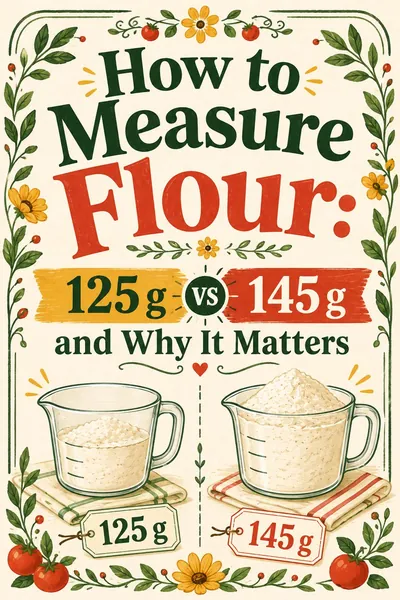
That last part is the whole reason sifting still matters. It isn't about cleanliness, and modern flour doesn't need straining. Sifted all-purpose flour weighs about 115 g per cup. The same flour spooned and leveled weighs 125 g, and scooped straight from the bag it weighs 145 g. So a recipe built on sifted volume is asking for a different amount of flour than one that isn't.
Get your exact number with our free grams to cups converter and the sifting question stops mattering entirely.
Updated September 2026
What sifting actually does
Sifting does three things, and only three:
- It breaks up lumps. Flour compacts in the bag and clumps when it picks up moisture. Cocoa and powdered sugar clump much worse.
- It adds air. Flour falling through a screen separates into loose particles instead of packed ones. That's why a cup of it weighs less.
- It mixes. If you sift flour, baking powder, salt and cocoa together, the screen distributes them far better than a few stirs would.
What sifting does not do is remove anything. A hundred years ago, flour came home with bits of chaff, husk and the occasional insect in it, and the sieve caught them. Commercial flour today is milled and screened before it's bagged. You will not find anything in the sieve except lumps of flour.
So when a vintage recipe says "sift the flour," it was solving two problems at once. Only one of them still exists.
Why sifting changes how much flour you use
This is the part that ruins cakes, and it has nothing to do with texture.
Air takes up space. When you sift flour, you have the same number of flour particles spread across more volume. Scoop a cup out of it and you get fewer particles than you would from an unsifted bag.
| How the flour was handled | Weight of 1 cup, AP flour | Difference vs 125 g |
|---|---|---|
| Sifted, then spooned into the cup | 115 g | 8% less |
| Spooned into the cup and leveled | 125 g | baseline, site default |
| Scooped straight from the bag | 145 g | 16% more |
| Packed or tapped down | 160 g and up | 28% and up |
From lightest to heaviest that's a 26% spread on the exact same measuring cup. In a cake that's the difference between tender and dry, because you have changed the flour to liquid ratio without changing a single number in the recipe.
Our full ingredient weights chart has the same figures for bread flour, cake flour, cocoa and sugar, all in one place.
"1 cup sifted flour" versus "1 cup flour, sifted"
These look like the same instruction. They are not, and the difference is about 10 g per cup.
"1 cup sifted flour" means sift first, then measure. The word "sifted" is describing the flour before it goes in the cup. You end up with 115 g.
"1 cup flour, sifted" means measure first, then sift. The comma turns "sifted" into something you do afterward. You end up with 125 g of flour that has been aerated.
The rule is simple: whatever comes before the comma is what you measure. In older American cookbooks this convention was strict and the authors relied on it. Recipes from that era that call for sifted flour and give no weights were tested with 115 g cups, and if you measure 125 g into them the result will be dry and tight.
If a recipe gives grams, ignore all of this and use the grams. That's the number the author actually measured.
How to sift flour: four methods compared
You do not need a dedicated sifter. Here's what each option is actually good for.
| Method | Lump removal | Aeration | Effort | Best for |
|---|---|---|---|---|
| Rotary or crank sifter | Excellent | Excellent | Medium, and it's another thing to wash | Cake recipes built on sifted volume |
| Fine mesh sieve | Excellent | Excellent | Low | Everything, the one tool worth owning |
| Whisking in the bowl | Poor on hard lumps | Good | Very low | Combining dry ingredients, most recipes |
| Fork, stirred in the bowl | Poor | Fair | Very low | A quick fluff before scooping |
The fine mesh sieve wins. It sifts as well as a crank sifter, it costs less, it washes in seconds, and it also drains pasta, strains custard and dusts powdered sugar over a finished cake. A rotary sifter does one job.
How to sift with a sieve, step by step
- Set the sieve over a large bowl. Wider than you think, because sifted flour spreads.
- Add flour to the sieve, no more than half full so it has room to move.
- Tap the side of the sieve with your palm, or stir the flour with a spoon to push it through.
- Don't press or grind it. You'll force lumps through instead of breaking them up.
- If a recipe says to sift the dry ingredients together, add everything to the sieve at once.
How to sift flour without a sifter
If you have no sieve at all, a balloon whisk in a bowl is the practical answer. Add the flour to a bowl at least twice its volume and whisk in loose circles for 20 to 30 seconds. Lift the whisk out and back in a few times as you go.
That gets you most of the aeration and most of the mixing. What it does not do is break up hard lumps, because there's no screen forcing the flour through anything. A whisk pushes a lump around the bowl. If your flour has visible clumps, pinch them out with your fingers first or press them against the side of the bowl with the back of a spoon.
Whisked flour lands at roughly 118 to 122 g per cup in our own kitchen tests, so somewhere between sifted and spoon-and-level. If a recipe is genuinely built on 115 g sifted cups, whisking is not a full substitute.
When sifting actually matters
Sift when one of these is true:
- The recipe says "sifted flour" and gives no weights. You're being asked for 115 g cups. Sift.
- You're making an angel food, chiffon or genoise cake. These are foam cakes with almost no fat and no chemical leavening to rescue them. Lumps do not dissolve and heavy flour deflates the eggs. Sift, and sift more than once if the recipe says so.
- You're using cake flour. Cake flour is milled finer and clumps harder than all-purpose. A cup of it runs about 114 g. If you're mixing your own from all-purpose and cornstarch, sifting is what actually combines the two. See our cake flour substitute guide for the ratio.
- Cocoa powder is involved. Cocoa clumps worse than any other common baking ingredient, and a cocoa lump in a batter shows up as a bitter dry pocket in the finished cake. A cup of cocoa weighs about 85 g. Always sift it.
- Powdered sugar is involved. It's about 120 g per cup and it sets into rocks in the box. Unsifted powdered sugar gives you gritty buttercream and lumpy glaze, and no amount of beating fixes it.
- The bag has visible lumps. Flour that has sat in a humid pantry compacts. If you can see clumps, sift.
When you can skip it
Most of the time, honestly.
- Cookies. The dough is stiff and heavily mixed. Lumps get broken up mechanically, and cookie recipes have enough fat and sugar to tolerate a small flour swing.
- Muffins and quick breads. These want minimal mixing, so whisking the dry ingredients together in the bowl is both faster and better.
- Bread. Kneading destroys lumps completely, and bread doughs are usually built on weight or on baker's percentages anyway. Bread flour runs 127 g per cup.
- Anything where the recipe gives grams. Weight is weight. Aeration doesn't change it.
If the recipe just says "1 cup flour" with no further instruction and you're not making a foam cake, whisk it in the bowl and move on.
The underrated reason to sift: leavening distribution
Here's the argument for sifting that almost nobody makes, and it's the strongest one.
A batch of muffins might call for 2 teaspoons of baking powder against 2 cups of flour. That's roughly 8 g of leavener against 250 g of flour, and it has to end up evenly spread through every part of the batter.
Stirring dry ingredients with a spoon does not do that well. Baking powder is denser than flour and it settles into pockets. Those pockets show up as a bitter metallic taste in one bite, and a flat dense patch somewhere else in the pan. Baking soda is worse, because it's stronger per gram and it leaves a soapy taste when concentrated.
Pushing everything through a sieve together forces the leavener to disperse. So does 30 seconds of proper whisking. Either is fine. Doing neither is where the problem starts.
The same argument applies to salt, spices and cocoa. Anything used in small amounts against a large volume of flour needs real distribution, not a token stir.
Worked example: a cake recipe that goes wrong
A recipe from a 1960s cookbook calls for 2 cups sifted cake flour, 1 cup sugar, 1/2 cup butter and 3/4 cup milk. No weights given.
Done correctly: sift the cake flour, then spoon it into the cup twice. 2 x 114 g rounded down for aeration, call it around 210 g of flour.
Done the common wrong way: dip the measuring cup into the cake flour bag twice. Scooped cake flour runs about 130 g per cup, so you get 260 g.
That's 50 g of extra flour, a 24% overshoot, against a fixed 3/4 cup of milk at 180 g. The flour to liquid ratio moves from 1.17:1 to 1.44:1. The cake bakes up dry, tight and pale on top, and nothing else in the recipe changed.
Now do the same recipe with a scale. 210 g of cake flour goes in the bowl. It comes out right on the first try and every try after that, and whether you sifted becomes a texture decision instead of a measurement gamble.
Weighing makes the whole question go away
Everything above exists because volume measuring is sensitive to how packed the flour is. A scale is not.
100 g of flour is 100 g whether it's sifted, scooped, packed or fresh from the mill. Once you're weighing, sifting becomes a purely functional choice: do it when you need lumps gone or leavening distributed, skip it when you don't.
Two things to know when you switch:
- Convert the recipe once, then write the grams on it. Use our grams to cups converter or the ingredient weights chart, and decide up front which cup weight the recipe assumed. Our full walkthrough is in how to measure flour.
- Different flours have different weights. All-purpose is 125 g spoon-and-level, bread flour 127 g, cake flour 114 g. If you're swapping one for another, see types of flour before you assume the cups transfer.
Frequently asked questions
Do you really need to sift flour?
Usually no. Modern flour has nothing in it that needs straining, and for cookies, muffins and bread a good whisk in the bowl does everything sifting would. Sift when a recipe calls for sifted flour and gives no weights, when you're making a foam cake, or when cocoa or powdered sugar is involved.
How much does 1 cup of sifted flour weigh?
About 115 g for all-purpose flour, against 125 g spoon-and-level and 145 g scooped. Cake flour sifted comes in a little lighter, around 105 to 110 g, since it starts at 114 g unsifted.
What's the difference between "1 cup sifted flour" and "1 cup flour, sifted"?
Word order tells you when to sift. "1 cup sifted flour" means sift first then measure, giving about 115 g. "1 cup flour, sifted" means measure first then sift, giving about 125 g. The gap is roughly 8%, which is enough to dry out a cake.
Can I use a whisk instead of a sifter?
Yes for aeration and mixing, no for lumps. Whisking flour in a bowl for 20 to 30 seconds loosens it and distributes leavening well, but a whisk pushes lumps around instead of breaking them. Pinch out any visible clumps first.
Does sifting flour twice do anything?
For most baking, no. For angel food and chiffon cakes it does, because those recipes have no chemical leavening and depend on the flour being as light as possible so it folds into the egg foam without deflating it. If a recipe says sift twice, it means it.
Should I sift flour before or after measuring?
Follow the recipe's word order. If there's no signal at all and the recipe gives grams, weigh it and sift afterward if you want the lumps gone. If it gives only cups and it's a cake, sifting first is the safer read of the author's intent.
Do I need to sift bread flour?
No. Kneading breaks up every lump, and bread recipes are usually written by weight anyway. Bread flour is 127 g per cup if you do need to convert. Sifting it also undoes itself the moment the dough comes together.
Does sifting flour make cakes lighter?
Slightly, and less than people think. Most of the lift in a cake comes from creamed butter, whipped eggs or chemical leavening. What sifting reliably does is stop you from packing 20% extra flour into the bowl, and that is what was making the cake heavy in the first place.