Types of Flour, Sorted by the One Number That Matters

Every flour on the shelf can be sorted by protein, and protein is what predicts your result. Protein makes gluten, gluten makes structure, and structure decides whether you get a tender crumb or a chewy one. Cake flour sits at 7 to 9% protein and gives you softness. Bread flour sits at 12 to 14% and gives you chew. All-purpose sits between them at 10 to 12%, which is why it works acceptably for almost everything and perfectly for almost nothing.
Learn the protein number for each flour and you can predict any swap before you make it.
Every flour also weighs something different per cup, and that's where most substitutions actually go wrong. Check the real gram weight with our free ingredient weight chart before you swap anything.
Updated August 2026
Why protein is the only flour number worth memorizing
Wheat contains two proteins, glutenin and gliadin. Dry, they do nothing. Add water and they hydrate. Stir, knead, or fold, and they link into an elastic web called gluten.
That web traps gas. Yeast makes carbon dioxide, baking soda and powder make carbon dioxide, and water turns to steam in the oven. A strong web catches those bubbles and rises with them, then sets. A weak web lets them slip out, so the bake stays flatter and softer.
The chain is short:
protein → gluten → gas retention → structure and chew
More protein pushes every link up. That's exactly what you want in a bagel and exactly what ruins a chiffon cake.
Two things modify this. First, gluten only develops when flour is hydrated and worked, so high-protein flour in a barely-stirred muffin batter behaves much milder than the same flour kneaded ten minutes. Second, higher-protein flour drinks more water, roughly 5% more, which is why a straight swap can leave a dough stiff and tight.
All the types of flour, ranked by protein
Here's the whole shelf in one table. Weights marked with an asterisk are the values our calculators use; the rest are typical figures that vary more by brand.
| Flour | Protein | Grams per cup | Best for | Weak at |
|---|---|---|---|---|
| Cake flour | 7-9% | 114 g* | Layer cakes, chiffon, angel food, sponge | Anything needing chew or structure |
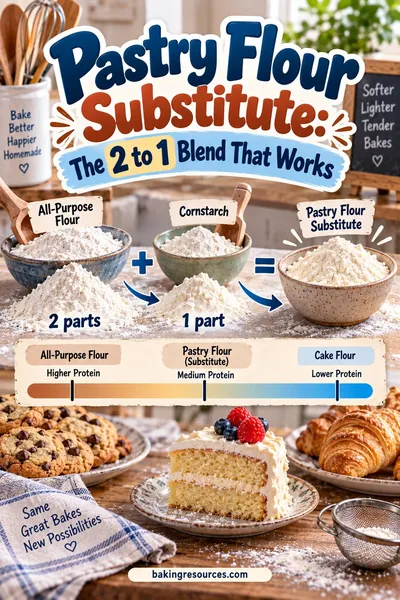
| Pastry flour | 8-9% | ~120 g | Pie crust, biscuits, scones, tender cookies | Yeast bread |
| Self-rising flour | 8.5-10.5% | ~125 g | Southern biscuits, quick breads, pancakes | Anything with its own leavening |
| 00 flour | 8-12% | ~120 g | Neapolitan pizza, fresh pasta | Sandwich loaves, high-hydration boules |
| Rye flour (medium) | 8-11% | ~100 g | Rye and pumpernickel breads, crackers | Being used alone at high percentages |
| All-purpose flour | 10-12% | 125 g* | Cookies, muffins, quick breads, most everything | Extremes at either end |
| Bread flour | 12-14% | 127 g* | Sandwich loaves, pizza, rolls, cinnamon buns | Tender cakes and delicate pastry |
| Semolina | 12-13% | ~167 g | Dried pasta, couscous, dusting peels | Cakes and soft breads |
| White whole wheat | 13-14% | 120 g* | Everyday baking with more fiber | Very light, airy bakes |
| Whole wheat flour | 13-14% | 120 g* | Hearty loaves, muffins, pancakes | Anything that needs to be delicate |
| High-gluten flour | 14-15% | ~130 g | Bagels, pretzels, thin-crust pizza | Almost everything else |
| Almond flour | ~21% (no gluten) | ~96 g | Macarons, financiers, keto bakes | Standing in for wheat 1:1 |
| Coconut flour | ~19% (no gluten) | ~115 g | Small percentages in GF blends | Any 1:1 substitution, ever |
| White rice flour | ~6% (no gluten) | ~158 g | The base of most GF blends | Working alone, gritty and dry |
| Oat flour | ~15% (no gluten) | ~92 g | Soft cookies, muffins, GF blends | Structure and rise |
That protein column for the nut and seed flours is a trap worth naming now. Almond flour is about 21% protein and forms zero gluten, because gluten needs wheat proteins specifically. Protein percentage only predicts texture within wheat.
Our grams to cups converter handles the wheat flours above with the exact numbers our charts use.
The soft flours: cake and pastry
Cake flour, 7 to 9% protein, 114 g per cup. This is the lowest-protein wheat flour you'll find in a US supermarket. It's milled from soft winter wheat, ground very fine, and usually chlorinated, which matters more than the protein number alone. Chlorinated cake flour absorbs liquid faster and sets earlier in the oven, so it can carry more sugar and fat without collapsing. That's the real reason a bakery white cake is so plush.
Use it for layer cakes, angel food, chiffon, and sponge. Skip it for cookies, where the low protein gives you a puddle.
Pastry flour, 8 to 9% protein, about 120 g per cup. Cake flour's unbleached cousin, ground slightly coarser. It has just enough structure to hold a pie crust together while staying tender enough to flake. Southern-style biscuits and scones love it.
If you can't find either, our cake flour substitute guide has the cornstarch swap with exact gram amounts.
All-purpose flour: 10 to 12%, and your brand matters more than you think
All-purpose is a blend of hard and soft wheat, aimed at the middle. The label rarely tells you where in the range it lands, and the spread is genuinely wide.
- National brands like Gold Medal and Pillsbury sit around 10.5%
- King Arthur all-purpose runs about 11.7%, close to some bread flours
- Southern brands like White Lily run around 8 to 9%, milled from soft red winter wheat
That last one explains a lot. Southern biscuit recipes work spectacularly in the South and disappointingly everywhere else, and the flour is why. A biscuit made with White Lily at 9% protein is cottony and tall. The same recipe with King Arthur at 11.7% comes out tougher and shorter, because you've just added almost 3 percentage points of protein without changing anything else.
If your biscuits are tough and you've been blaming your hands, blame your flour first. Swap in pastry flour, or replace 2 tablespoons per cup of all-purpose with cornstarch to soften it.
Weight per cup for all-purpose depends entirely on how you fill the cup:
| Method | Grams per cup | Difference vs standard |
|---|---|---|
| Sifted, spooned | 115 g | 8% light |
| Spoon and level (our standard) | 125 g | baseline |
| Scoop and sweep | 145 g | 16% heavy |
That 30 gram spread across three cups of flour is nearly a quarter cup of extra flour. It's the single most common reason a cake bakes dry. Our how to measure flour guide walks through the fix.
Bread flour and high-gluten flour
Bread flour, 12 to 14% protein, 127 g per cup. Hard red or hard white wheat, strong and elastic. It holds gas through a long rise, browns deeper, and gives you the pull-apart shreds in a sandwich loaf. It also absorbs about 5% more water than all-purpose, so a straight swap leaves your dough drier than the recipe intended. Add a tablespoon or two of water per cup of flour.
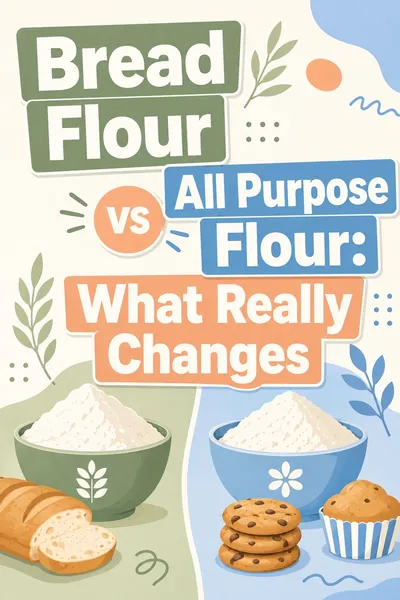
The full comparison lives in bread flour vs all purpose flour, including which way each swap fails.
High-gluten flour, 14 to 15% protein, about 130 g per cup. Mostly a professional ingredient. It's what makes a real New York bagel chewy enough to fight you, and what keeps a thin pizza crust from tearing when you stretch it. At home you'll rarely need it, and using it in place of bread flour in a soft roll recipe gives you something closer to a bread bagel.
Whole wheat and white whole wheat
Whole wheat flour contains the whole kernel: bran, germ, and endosperm. It tests at 13 to 14% protein, which sounds like bread flour, but it behaves weaker. The bran particles physically cut through developing gluten strands like tiny blades, and the germ's oils interfere too. So you get high protein and mediocre structure at the same time.
Whole wheat also drinks a lot more water, and it keeps drinking it during the rest. Give whole wheat dough an extra 10 to 15% water and a 20 to 30 minute autolyse before kneading, and the crumb improves dramatically.
White whole wheat is the same idea milled from hard white wheat instead of hard red. Same fiber, same germ, same 120 g per cup, but the bran is paler and much milder in flavor. There's no bitterness and no gray color. It's the easiest way to sneak whole grain into family baking without a fight.
A safe starting point for either: replace 25 to 50% of the white flour in a recipe, add a little extra liquid, and expect a slightly denser result.
Self-rising flour
Self-rising flour is all-purpose or pastry flour with baking powder and salt already blended in. Typical proportions per cup: about 1 1/2 teaspoons of baking powder and 1/4 to 1/2 teaspoon of salt.
Two rules keep you out of trouble. Never use it in a recipe that already calls for baking powder or salt unless you subtract them, and never use it in yeast bread. Also check the date. The baking powder inside it goes stale on the shelf, and a six-month-old bag of self-rising flour is just flour with a faint salty taste.
To make your own: 1 cup all-purpose flour (125 g) plus 1 1/2 teaspoons baking powder plus 1/4 teaspoon fine salt. Whisk thoroughly, because uneven leavening is worse than none.
00 flour, semolina, and rye
00 flour describes grind fineness, not strength. The Italian scale runs 2, 1, 0, 00, from coarse to talcum-fine. Protein varies by product from about 8% for pasta grades up to 12% or more for pizza grades, so read the bag rather than trusting the number. 00 pizza flour is designed for very hot ovens, 800°F and up, where it browns beautifully and stays soft. In a home oven at 500°F it can bake pale and papery, which surprises people who paid extra for it.
Semolina is coarse-ground durum wheat, golden yellow, 12 to 13% protein. Its gluten is strong but not stretchy, which is exactly right for extruded dried pasta and wrong for bread. It's also heavy, roughly 167 g per cup, so volume measuring goes badly. A small amount, 10 to 20%, adds nice chew and color to a pizza dough.
Rye flour tests around 8 to 11% protein, but it barely forms gluten at all. Rye is loaded with pentosans, gums that grab water and make dough sticky and slack rather than elastic. That's why 100% rye loaves are dense and why rye sourdough exists in the first place: the acidity keeps rye's own enzymes from turning the crumb gummy. For an easy rye flavor, use 20 to 30% rye and let bread flour carry the structure.
Gluten-free flours and the honest part
Almond, coconut, rice, and oat flours are not substitutes for wheat flour. They're different ingredients that happen to be powders. None of them form gluten, so none of them build a stretchy web that traps gas.
You cannot swap them 1:1 into a wheat recipe and get a similar result. Anyone who tells you otherwise is selling something.
| GF flour | Grams per cup | Liquid behavior | How to use it |
|---|---|---|---|
| Almond flour | ~96 g | Adds fat and moisture, absorbs little | Up to 25-30% of a blend, or in recipes built for it |
| Coconut flour | ~115 g | Extremely absorbent, soaks up 3-4x its weight | Never more than 20-25% of a blend, add eggs and liquid |
| White rice flour | ~158 g | Absorbs moderately, gritty if coarse | The neutral base, 40-60% of most blends |
| Oat flour | ~92 g | Soft, slightly sweet, holds moisture | 20-30% for softness, use certified GF oats |
Gluten-free baking needs a binder to replace the missing web. Xanthan gum is the standard. Rough starting amounts:
- Cookies and quick breads: 1/4 teaspoon xanthan gum per cup of GF flour
- Cakes and muffins: 1/2 teaspoon per cup
- Yeast breads and pizza: 1 to 1 1/2 teaspoons per cup
Psyllium husk powder works too, and does a better job in yeast breads, at about 1 tablespoon per cup of flour with extra water. Too much of either gives you a gummy, heavy result, so start low.
A commercial cup-for-cup blend already contains the binder. Adding more on top is a common mistake.
Bleached vs unbleached flour: what bleaching actually does
Freshly milled flour is faintly yellow from carotenoid pigments and bakes poorly. Left alone for a few weeks, it oxidizes naturally, whitens, and its gluten strengthens. Bleaching does that in hours instead of weeks, and the agent used changes what else happens.
Benzoyl peroxide whitens the pigment and does very little else. Protein and starch come out essentially unchanged. Most bleached all-purpose flour is treated this way, and it behaves almost identically to unbleached.
Chlorine gas is a different tool, used mainly on cake flour. It whitens, but it also lowers the flour's pH to around 4.8, nicks the gluten proteins so they form a weaker network, and damages the surface of starch granules so they absorb more liquid and gelatinize at a lower temperature. The batter sets sooner and holds more sugar and fat. That's the actual mechanism behind a high-ratio cake.
So: bleached vs unbleached all-purpose is close to a coin flip, use whichever you have. Bleached vs unbleached cake flour is a real difference, and a recipe written for chlorinated cake flour may not hold up with unbleached.
Chlorine treatment of flour isn't permitted in the EU or UK, which is why British cake recipes are built differently and why converting them straight across can disappoint.
Worked example: one cookie recipe, four flours
Take a standard drop cookie: 2 cups flour, 1 cup butter, 3/4 cup granulated sugar, 3/4 cup packed brown sugar, 1 egg, 1 teaspoon baking soda.
In grams, using our chart values: butter 227 g, granulated sugar 150 g, packed brown sugar 160 g. Now watch the flour move.
| Flour used | 2 cups weighs | Result |
|---|---|---|
| Cake flour | 228 g | Spreads badly, thin and crisp at the edges, sandy bite |
| All-purpose (spoon and level) | 250 g | The intended cookie, chewy center, set edge |
| All-purpose (scooped) | 290 g | Cakey, domed, dry by day two |
| Bread flour | 254 g | Thicker, taller, genuinely chewy, slightly tough |
The gap between the second and third rows is the same flour. Only the scoop changed. That 40 gram difference is bigger than the difference between all-purpose and bread flour, which tells you how much measurement outranks flour choice for everyday baking.
If your cookies keep coming out flat, this guide covers the other four causes.
How to store flour so it doesn't go rancid
White flour is shelf-stable because the germ and its oils were milled out. Whole grain flours keep the germ, and germ oil oxidizes. Rancid flour smells like old crayons or oil paint, and it makes everything you bake taste faintly bitter.
| Flour type | Pantry, sealed | Refrigerator | Freezer |
|---|---|---|---|
| White (AP, bread, cake, pastry) | 6-12 months | 1 year | 2 years |
| Whole wheat, white whole wheat | 1-3 months | 6 months | 12 months |
| Rye, oat, other whole grain | 1-3 months | 6 months | 12 months |
| Almond and other nut flours | 1-2 months | 6 months | 12 months |
Practical rules that actually help:
- Move flour out of the paper bag into an airtight container the day you buy it. Paper lets in air, odors, and pantry pests.
- Refrigerate or freeze anything whole grain if you bake less than weekly.
- Freezing new flour for 48 hours kills weevil eggs before they hatch.
- Let cold flour warm to room temperature before baking, or your butter will seize and your yeast will stall.
- Smell the flour before a big project. It takes two seconds and saves an afternoon.
One safety note: raw flour is a raw agricultural product and has been linked to E. coli and Salmonella outbreaks. The FDA's guidance on handling flour safely is worth two minutes if you have kids who lick the beaters.
FAQ
What are the main types of flour used in baking?
The six you'll actually reach for are cake flour at 7 to 9% protein, pastry flour at 8 to 9%, all-purpose at 10 to 12%, bread flour at 12 to 14%, whole wheat at 13 to 14%, and self-rising, which is all-purpose with baking powder and salt mixed in. Everything else is a specialty flour for a specific job.
Which flour has the most protein?
Among wheat flours, high-gluten flour tops out around 14 to 15%, followed by whole wheat and bread flour at 12 to 14%. Almond flour tests higher at about 21% protein, but that protein forms no gluten, so it adds no structure at all.
Can I substitute one type of flour for another?
Between wheat flours, usually yes, with adjustments. Bread flour for all-purpose needs about a tablespoon more water per cup. All-purpose for cake flour makes a tougher crumb, so replace 2 tablespoons per cup with cornstarch. Whole wheat swaps in comfortably at 25 to 50%. Gluten-free flours don't substitute for wheat at all without a rebuilt recipe.
Why does the same recipe work differently with a different brand of flour?
Because US all-purpose flour spans roughly 10 to 12% protein by brand. King Arthur at about 11.7% and White Lily at about 9% are practically different products. Softer Southern flours are exactly why Southern biscuits are so tender, and why the recipe travels poorly.
Is bleached or unbleached flour better?
For all-purpose, it barely matters, since benzoyl peroxide bleaching mostly changes color. For cake flour it matters a lot, because chlorine treatment weakens the gluten and damages the starch so the batter sets earlier and carries more sugar. Use whichever the recipe assumes.
How much does a cup of flour weigh?
All-purpose is 125 g per cup spoon-and-leveled, 145 g scooped straight from the bag, and 115 g sifted. Bread flour is 127 g, cake flour 114 g, and whole wheat 120 g. That scoop-versus-spoon gap is the most common hidden cause of a dry bake.
Do gluten-free flours really need xanthan gum?
In most recipes, yes. Without gluten there's nothing holding gas or binding the crumb, so bakes turn out crumbly and short. Use about 1/4 teaspoon per cup for cookies, 1/2 teaspoon for cakes, and 1 to 1 1/2 teaspoons for yeast breads. Skip it if your blend already includes a binder.
Why does whole wheat flour go bad faster than white flour?
Whole wheat keeps the germ, and the germ contains oil. That oil oxidizes and turns rancid within a couple of months at room temperature, giving the flour a bitter, crayon-like smell. Refrigerate it for up to six months or freeze it for up to a year.
Related guides
- Bread Flour vs All Purpose Flour for the swap that comes up most
- Cake Flour Substitute for the cornstarch method with exact grams
- How to Measure Flour because measurement beats flour choice most days
- Ingredient Weight Chart for gram weights on every flour above
- Grams to Cups Converter to convert a recipe in either direction