Gluten Free Flour in Grams: Rice, Tapioca and Starch Weights

Here is gluten free flour in grams per cup, spooned into the cup and leveled: white rice flour 150 g, brown rice flour 145 g, sweet rice flour 150 g, tapioca starch 115 g, potato starch 150 g, arrowroot 120 g, chickpea flour 92 g, sorghum flour 120 g, corn flour 122 g and masa harina 110 g. A typical 1:1 gluten free blend is about 130 g. Scoop the cup straight into the bag instead and every one of those runs about 15 percent heavier.
That spread matters more than it looks. A cup of potato starch weighs about 60 percent more than a cup of chickpea flour, so a recipe written in cups hides very different amounts of flour behind the same word.
The chart below gives each flour per cup, per 1/4 cup and per tablespoon, spooned and scooped.
Converting a whole recipe? Our free grams to cups converter handles wheat flours, almond flour, coconut flour and cornstarch, and the figures on this page cover the gluten free flours and starches it does not list.
Updated September 2026
Gluten free flour in grams: the full chart
All weights are for US cups and spoons. "Spooned" means the flour was stirred, spooned lightly into a dry measuring cup and leveled with a straight edge. "Scooped" means the cup was dipped into the bag and swept level.
| Flour or starch | 1 cup, spooned | 1 cup, scooped | 1/4 cup, spooned | 1 tbsp, spooned |
|---|---|---|---|---|
| White rice flour | 150 g | 172 g | 38 g | 9.4 g |
| Brown rice flour | 145 g | 167 g | 36 g | 9.1 g |
| Sweet (glutinous) rice flour, mochiko | 150 g | 172 g | 38 g | 9.4 g |
| Tapioca starch (tapioca flour) | 115 g | 132 g | 29 g | 7.2 g |
| Potato starch | 150 g | 172 g | 38 g | 9.4 g |
| Arrowroot | 120 g | 138 g | 30 g | 7.5 g |
| Chickpea flour (besan, garbanzo flour) | 92 g | 106 g | 23 g | 5.8 g |
| Sorghum flour | 120 g | 138 g | 30 g | 7.5 g |
| Corn flour, finely milled whole corn | 122 g | 140 g | 31 g | 7.6 g |
| Masa harina | 110 g | 127 g | 28 g | 6.9 g |
| Typical 1:1 gluten free blend | 130 g | 150 g | 33 g | 8.1 g |
How the columns relate: 1/4 cup is the cup weight divided by 4, and a tablespoon is the cup weight divided by 16, the same arithmetic our ingredient weights chart uses for every ingredient. A teaspoon is a third of the tablespoon figure, so white rice flour is about 3.1 g per teaspoon and tapioca starch about 2.4 g.
Treat these as typical figures rather than lab constants. Grind size varies from mill to mill, and a superfine rice flour can weigh 10 g less per cup than a standard grind. If your bag lists a serving weight, the worked example further down shows how to check your own flour against this chart in about a minute.
The weights our tools already list
A handful of gluten free ingredients are already on the site's converters. Use these figures rather than any other number you find, so every page here agrees with every other page.
| Ingredient | 1 cup, spooned | 1 cup, scooped | 1/4 cup | 1 tbsp |
|---|---|---|---|---|
| Cornstarch | 128 g | Not charted | 32 g | 8.0 g |
| Almond flour, blanched | 96 g | 110 g | 24 g | 6.0 g |
| Coconut flour | 112 g | 128 g | 28 g | 7.0 g |
| Oat flour, certified gluten free | 90 g | 104 g | 23 g | 5.6 g |
| All-purpose wheat flour, for comparison | 125 g | 145 g | 31 g | 7.8 g |
The scooped figures for almond, coconut and oat flour come straight from the grams to cups converter, and they are where the 15 percent rule on this page comes from. Almond flour gains 14 g per cup when scooped, coconut flour 16 g, oat flour 14 g and all-purpose flour 20 g. The flours in the main chart follow the same pattern. Cornstarch is charted at a single figure, because starch is almost always measured by the spoon rather than by the scooped cup.
Coconut flour is the one to respect. It weighs a fairly ordinary 112 g per cup, but it absorbs several times its weight in liquid, so its cup weight tells you nothing about how it behaves in a batter.
Why gluten free flours weigh so differently
Wheat flours sit in a narrow band. Cake flour, all-purpose and bread flour all land between 114 and 127 g per cup on our converter. Gluten free flours spread from about 90 g to 150 g, and there are three reasons.
Starch granules pack tightly. Potato starch has large, smooth, rounded granules that slide into each other and settle with very little air between them. That is why a cup of it is so heavy, and why it squeaks between your fingers. Tapioca starch granules are smaller and less regular, so the powder stays fluffier and lighter per cup.
Rice is hard and dense. Rice kernels are much harder than wheat, and milled rice flour keeps a dense particle even when it is ground fine. Dense particles mean more grams in the same cup.
Legume and nut flours hold air. Chickpea flour is soft and slightly clumpy, and it traps air the way powdered sugar does. Almond flour carries so much fat that its particles cling together loosely rather than packing. Both weigh well under wheat flour per cup.
The practical consequence: never swap one gluten free flour for another by the cup. A cup of chickpea flour used in place of a cup of potato starch is only about 60 percent of the weight. Swap by grams and at least the amount is right, before you even think about how the two flours behave.
Rice flours: white, brown and sweet
White rice flour, 150 g per cup. The most common base flour in gluten free baking. Standard grinds feel sandy, and superfine grinds feel close to wheat flour and weigh a little less, often around 140 g per cup. If a recipe specifies superfine, your cup will come in lighter than the chart, which is one more reason to weigh.
Brown rice flour, 145 g per cup. Milled with the bran, so the particles are slightly coarser and a touch lighter per cup than white. It also carries the rice germ and its oil, which goes rancid far faster than white rice flour does. Store it airtight in the refrigerator or freezer and let it come to room temperature before measuring, since cold flour picks up condensation and clumps.
Sweet rice flour, 150 g per cup. Also sold as glutinous rice flour, and under the Japanese name mochiko. It is milled from short grain sticky rice, which is almost entirely amylopectin, the branched starch that makes mochi chewy and stretchy. In baking it is used in small amounts for chew and binding, and as the main flour in mochi and butter mochi cakes.
The word glutinous does not mean gluten. It describes the glue-like, sticky texture of the cooked rice. Sweet rice flour contains no gluten. That said, a rice flour is only safe for someone with celiac disease when the package is labeled gluten free, and the safety section below explains why.
Do not confuse sweet rice flour with ordinary white rice flour. They weigh about the same per cup, which makes it easy to grab the wrong bag, but they behave completely differently. White rice flour bakes dry and crumbly. Sweet rice flour bakes chewy and elastic. Check the label, not the weight.
The starches: tapioca, potato and arrowroot
These three are pure starch with no protein to speak of, and their cup weights sit much further apart than people expect.
Tapioca starch, 115 g per cup. Tapioca starch and tapioca flour are the same product under two names. It is the lightest of the three per cup, which surprises people because it feels dense and squeaky in the hand. Instant tapioca pearls are a different product and do not measure like the powder.
Potato starch, 150 g per cup. The heaviest starch on the chart, and noticeably heavier than cornstarch at 128 g. That is why a gluten free recipe built by cups with potato starch in it carries more starch than a quick glance suggests. Potato flour is a different product again, made from the whole dried potato, and it does not measure or behave like potato starch. Our potato starch substitute guide covers that trap and the swaps.
Arrowroot, 120 g per cup, or 7.5 g per tablespoon. Arrowroot sits between tapioca and cornstarch. Because it is so often used by the spoonful as a thickener, the tablespoon figure is the one most people need. Arrowroot starch, arrowroot powder and arrowroot flour are the same thing and weigh the same. Our arrowroot substitute guide covers what to use when you are out.
This page gives weights only. When you are replacing one starch with another, the swap ratios live on those two substitute pages, and they are set by how each starch thickens, not only by how much it weighs.
Chickpea, sorghum, corn flour and masa harina
Chickpea flour, 92 g per cup. The lightest flour on the main chart. It is sold as chickpea flour, garbanzo bean flour and besan, and the names are used interchangeably. It forms small hard lumps in the bag, so whisk or sift it before measuring. A cup scooped straight into a lumpy bag can land well above the scooped figure, because the lumps are packed flour.
Sorghum flour, 120 g per cup. Close to wheat flour in both weight and feel, which is part of why it is popular in gluten free cakes and quick breads. It is fairly stable on the shelf and measures consistently from bag to bag.
Corn flour, 122 g per cup. In the US, corn flour is whole corn milled to a fine powder, and it weighs the same per cup as cornmeal on our ingredient weights chart, since it is the same corn at a finer grind. In the UK and many other countries, "cornflour" means cornstarch, which our chart puts at 128 g per cup and which behaves nothing like a flour. If a recipe asks for a couple of tablespoons of cornflour to thicken a filling, it means cornstarch. Our corn flour substitute guide has the full naming breakdown.
Masa harina, 110 g per cup. Corn that has been cooked in an alkaline lime solution, dried and milled. The process leaves the particles fluffier than plain corn flour, so it weighs a little less per cup. Masa harina is designed to absorb a lot of water. A tortilla dough usually takes roughly 1 1/2 times the masa harina's weight in warm water, added gradually until the dough feels like soft modeling clay.
What a 1:1 gluten free blend weighs
Blends sold as 1:1, cup for cup or measure for measure are built to replace wheat flour by volume in ordinary recipes. Their cup weights vary by formula, from roughly 120 g to 140 g spooned, and 130 g is a fair middle figure.
The reason for the range is the recipe inside the bag. A blend heavy in white rice flour and potato starch lands at the top of the range. A blend with more tapioca starch, sorghum or oat flour lands toward the bottom. Two blends can both say 1:1 on the front and differ by 20 g per cup.
Three rules follow from that:
- Check the serving size on your bag. Most list a 1/4 cup serving with a gram weight. Multiply by 4 for a cup weight. The worked example below walks through it.
- If a recipe was written for a specific blend, use that blend's weight, not the 130 g middle figure.
- If you change blends, convert by weight. Swapping a cup of one blend for a cup of another quietly changes the amount of flour in the recipe.
What goes into a blend, and in what proportions, is a separate question covered in our gluten free baking substitutions guide. This page stops at what the finished blend weighs.
Spooned versus scooped, and why it matters more here
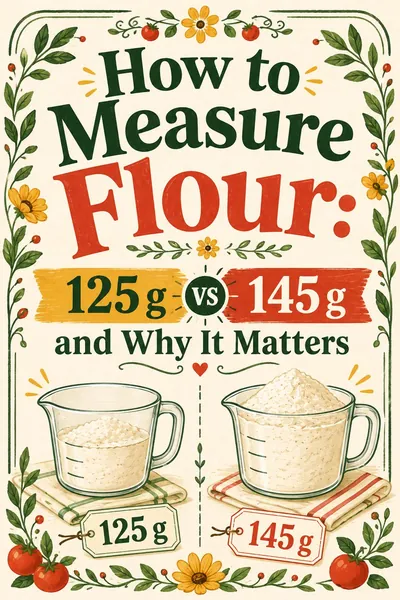
Our how to measure flour guide shows all-purpose flour moving from 125 g to 145 g depending on whether you spoon or scoop. Gluten free flours move by the same 15 percent or so, but three things make the error bigger in practice.
Gluten free recipes use several flours at once. A wheat recipe has one flour to get wrong. A gluten free recipe may have four, each with its own error, and the errors stack rather than cancel.
The flours differ so much from each other. A measuring error in the heavy starches moves more grams than the same error in the light flours. Scooping potato starch adds about 22 g per cup. Scooping chickpea flour adds about 14 g.
Gluten free batters have less margin. Without gluten to hold the structure together, a dough that is 10 percent too dry cracks and crumbles instead of simply baking a little firm.
Sifted flour weighs less again. Sifting drops air into the flour, and our ingredient weights chart treats a sifted cup as about 8 percent under the spooned figure. That puts sifted white rice flour near 138 g per cup and sifted tapioca starch near 106 g.
If you are measuring by cup anyway, stir the flour in its bag or bin first, spoon it in lightly, and level it in one pass. Starches in particular settle hard in the bag between uses, and an unstirred bag gives you a heavier cup than the chart.
A conservative note on celiac disease
Every flour and starch on this page comes from a plant that contains no gluten. That is not the same as being safe for someone with celiac disease.
Only flours labeled gluten free are safe for celiac disease. Naturally gluten free grains, legumes and starches are often grown in rotation with wheat, transported in shared trucks and milled on shared equipment. Cross-contact during milling is common enough that an unlabeled bag of rice flour, sorghum flour, chickpea flour or masa harina cannot be assumed safe. In the US, a product labeled gluten free must contain less than 20 parts per million of gluten.
- Sweet or glutinous rice flour contains no gluten despite its name, but the same labeling rule applies to it. Buy it labeled gluten free.
- Flours sold from bulk bins are a particular risk, because scoops move between bins.
- Corn flour and masa harina are often milled in facilities that also process wheat. Look for the label.
- Oat flour carries the highest cross-contact risk of the common gluten free flours. Use only certified gluten free oat flour.
- Your own kitchen counts. A measuring cup, sifter or scale bowl just used for wheat flour can carry enough gluten to matter. Wash everything first, or keep a separate set.
If you have celiac disease or are baking for someone who does, follow the advice of their doctor or dietitian over any general guidance, including ours.
Worked example: converting a cup-based recipe to grams
A gluten free sandwich bread recipe calls for:
- 1 1/2 cups white rice flour
- 1/2 cup sorghum flour
- 1/2 cup tapioca starch
- 1/4 cup potato starch
Step 1. Weigh each line, spooned.
| Line | Math | Grams |
|---|---|---|
| 1 1/2 cups white rice flour | 1.5 x 150 g | 225 g |
| 1/2 cup sorghum flour | 0.5 x 120 g | 60 g |
| 1/2 cup tapioca starch | 0.5 x 115 g | 58 g |
| 1/4 cup potato starch | 0.25 x 150 g | 38 g |
| Total flour | 381 g |
Step 2. See what scooping would have done. Scooped, the same four lines come to 258 g, 69 g, 66 g and 43 g, for a total of 436 g. That is 55 g more flour, about 14 percent, with nothing else in the recipe changed. The extra flour soaks up liquid the recipe never provided, and the loaf bakes dry and cracked.
Step 3. Compare it with wheat. Those 2 3/4 cups of flour weigh 381 g spooned. The same 2 3/4 cups of all-purpose flour would weigh about 344 g. So this rice-based mix is about 11 percent heavier per cup than wheat flour, which is typical, and it is one reason a wheat recipe converted cup for cup to rice flours often comes out dry.
Step 4. Write the grams in the margin. From now on the recipe is 225 g, 60 g, 58 g and 38 g, and it comes out the same whether the next person spoons or scoops.
Worked example: checking your own bag against the chart
Your bag of 1:1 gluten free blend lists a serving of 1/4 cup (35 g).
Step 1. Multiply to a cup. 35 x 4 = 140 g per cup.
Step 2. Compare with the chart. That sits at the top of the 120 g to 140 g range, 10 g above the 130 g middle figure. Nutrition panels round to the nearest gram, so a label reading 35 g per 1/4 cup could reasonably mean anything from about 34 g to 36 g, or 136 g to 144 g per cup. Panels are also often closer to a scooped cup than a spooned one.
Step 3. Decide which number to use. If the recipe came from the maker of that blend, use 140 g, since that is the figure the recipe was built around. If the recipe came from somewhere else and only says "1 cup gluten free flour," use your own spooned weight. To find it, spoon a cup, level it and weigh it three times, then take the middle result.
The same check works for every flour on this page. It takes a minute, and it turns a typical figure into the real figure for the bag in your cupboard.
Worked example: sweet rice flour for a mochi cake
Butter mochi and similar baked mochi cakes are often written around one 1 lb box of sweet rice flour, and just as often written in cups.
Step 1. Convert the box. A pound is 454 g. At 150 g per cup, the box holds 454 divided by 150, which is about 3 cups spooned. A recipe that says "1 box, or 3 cups" is internally consistent.
Step 2. Convert a recipe written in cups. A version calling for 2 1/2 cups of sweet rice flour wants 2.5 x 150 = 375 g spooned. Scooped, it would be about 430 g, and the cake would come out stiffer and less custardy than intended.
Step 3. Convert the dusting. Mochi is often rolled in sweet rice flour or starch so it does not stick. At 9.4 g per tablespoon, 2 tablespoons of sweet rice flour for dusting is about 19 g. Tapioca starch and potato starch are also used for dusting, at 7.2 g and 9.4 g per tablespoon.
Quick reference: tablespoons and teaspoons
For thickening, dusting and small additions, spoon weights matter more than cup weights.
| Ingredient | 1 tbsp | 1 tsp |
|---|---|---|
| White or sweet rice flour | 9.4 g | 3.1 g |
| Brown rice flour | 9.1 g | 3.0 g |
| Potato starch | 9.4 g | 3.1 g |
| Cornstarch | 8.0 g | 2.7 g |
| Arrowroot | 7.5 g | 2.5 g |
| Tapioca starch | 7.2 g | 2.4 g |
| Corn flour | 7.6 g | 2.5 g |
| Masa harina | 6.9 g | 2.3 g |
| Chickpea flour | 5.8 g | 1.9 g |
Most kitchen scales read in whole grams, so amounts under about 5 g are more reliably measured with spoons, as long as you level the spoon rather than heaping it.
Frequently asked questions
How many grams is a cup of gluten free flour?
It depends entirely on which flour. Spooned and leveled, white rice flour is about 150 g, tapioca starch 115 g, potato starch 150 g, chickpea flour 92 g and a typical 1:1 blend about 130 g. A 1:1 blend can run anywhere from 120 g to 140 g by formula, so check the serving weight on the bag.
How many grams is 1 cup of rice flour?
About 150 g of white rice flour and 145 g of brown rice flour, spooned into the cup and leveled. Scooped straight from the bag, both run about 15 percent heavier, near 170 g. Superfine grinds weigh a little less, often close to 140 g per cup.
Is glutinous rice flour gluten free?
Yes. Glutinous refers to the sticky texture of the cooked rice, not to gluten, and sweet rice flour contains none. For anyone with celiac disease, though, buy only packages labeled gluten free, because rice flours can pick up wheat through shared milling equipment.
How much does a tablespoon of tapioca starch weigh?
About 7.2 g, based on 115 g per cup. Potato starch is heavier at about 9.4 g per tablespoon, arrowroot about 7.5 g, and cornstarch 8 g. Level the spoon rather than heaping it, since a heaped tablespoon of starch can weigh far more than a level one.
Why does a cup of potato starch weigh more than a cup of flour?
Potato starch granules are large and smooth, so they pack tightly with very little air between them. A cup weighs about 150 g, compared with 125 g for all-purpose flour and 128 g for cornstarch. That density difference is why starches should be swapped by weight, not by cup.
Is corn flour the same weight as cornstarch?
No, and they are different ingredients. US corn flour is finely milled whole corn at about 122 g per cup. Cornstarch is the extracted starch at 128 g per cup. In British recipes, "cornflour" means cornstarch, so check which one the recipe intends before you measure.
Should I sift gluten free flour before measuring?
Only if the recipe says to, or if the flour is lumpy. Chickpea flour and some starches clump in the bag and benefit from a quick whisk or sift. A sifted cup weighs about 8 percent less than a spooned cup, so if you sift and then measure by volume, you are using less flour.
Can I swap gluten free flours cup for cup?
Not safely. Cup weights range from about 90 g to 150 g, so one cup can be 60 percent heavier than another. Swap by weight to keep the amount right, then check a substitution guide, because flours that weigh the same can still behave very differently in a batter.
Related guides
- Gluten Free Baking Substitutions for blends and binders
- Potato Starch Substitute for potato starch swaps and the potato flour trap
- Arrowroot Substitute for arrowroot swaps by job
- How to Measure Flour for the spoon and level method
- Corn Flour Substitute for the corn flour and cornstarch naming problem
- Grams to Cups Converter for wheat, almond and coconut flour conversions
- Ingredient Weights Chart for the rest of the pantry