Corn Flour Substitutes

The best corn flour substitutes are finely ground cornmeal run through a blender, masa harina, or white rice flour, all swapped 1:1 by weight. Any of those three will get you through a cornbread, a corn muffin batter or a gluten-free blend without changing the rest of the recipe.
But do one thing before you measure anything: check which corn flour your recipe means. In the US, corn flour is whole corn milled to a soft powder, and it works like a flour. In the UK, Ireland, Australia and much of the rest of the English speaking world, "cornflour" means cornstarch, which is pure starch with the protein and germ removed. They are not interchangeable, and swapping one for the other is how a batter turns to glue.
Sort that out first and the corn flour substitutes below fall into place. The rest of this page tells you how to tell which is which, then gives you the exact swaps for both.
Need the swap scaled to your amount? Our free baking substitutions finder does the arithmetic for any quantity, including odd ones.
Updated September 2026
Which corn flour does your recipe mean?
Read the recipe once with these clues in mind and it usually becomes obvious.
| Clue in the recipe | It means US corn flour (a flour) | It means cornstarch |
|---|---|---|
| Spelled "corn flour" as two words | Likely | Possible |
| Spelled "cornflour" as one word | Unlikely | Very likely |
| Measured in cups, 1/2 cup or more | Yes | Almost never |
| Measured in teaspoons or tablespoons | Rarely | Yes |
| Mixed with baking powder and salt | Yes | No |
| Whisked into cold water to make a slurry | No | Yes |
| Recipe also says "caster sugar", "plain flour" or "double cream" | No | Yes, this is a British recipe |
| The dish is cornbread, corn cake, arepas or tortillas | Yes | No |
| The dish is a pie filling, custard, gravy or a stir fry sauce | No | Yes |
The single most reliable tell is the quantity. Corn flour is a structural ingredient measured in cups. Cornstarch is a thickener measured in spoons. A recipe asking for 2 tablespoons of "cornflour" to set a lemon filling wants cornstarch, every time.
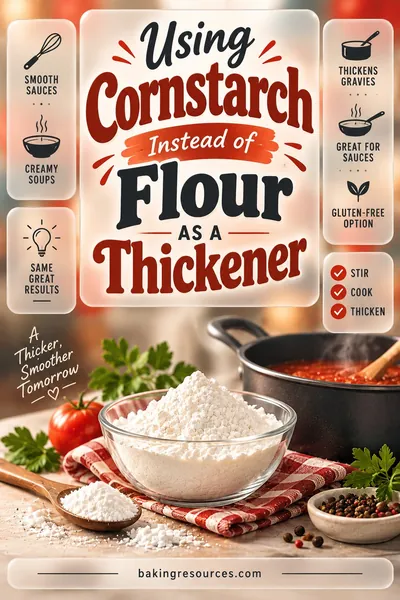
If it turns out you need cornstarch, stop here and use our cornstarch substitute chart instead: the short version is 1 tablespoon of arrowroot or tapioca starch for 1 tablespoon of cornstarch, or 2 tablespoons of all-purpose flour for the same job. The full reasoning behind that doubling is in using cornstarch instead of flour as a thickener.
Corn flour substitutes, ranked by how close they get
Everything below assumes the American meaning: a fine, soft, pale yellow or white flour milled from whole dried corn. All ratios are 1:1 by weight unless noted.
| Substitute | Ratio | Texture result | Flavor result | Best for |
|---|---|---|---|---|
| Cornmeal, reground fine | 1:1 | Nearly identical | Identical | Everything. The closest match by a wide margin |
| Masa harina | 1:1 | Very close, slightly softer | Distinctly different, faintly limed | Corn cakes, tortillas, anything savory |
| Cornmeal, used as it comes | 1:1 | Noticeably gritty | Identical | Rustic cornbread, muffins, toppings |
| White rice flour | 1:1 | Very close, a little drier | Neutral, no corn taste | Gluten-free blends, crisp cookies, dusting |
| All-purpose flour | 1:1 | Softer, more cake like | Loses the corn entirely | Batters where corn was a minor player |
| Polenta, reground fine | 1:1 | Close, depends on your grinder | Identical | Same as cornmeal, it is the same thing coarser |
| Corn grits, reground fine | 1:1 | Close, slightly coarser | Identical | Same idea, coarsest starting point |
| Sorghum flour | 1:1 | Similar softness | Mildly sweet, not corn | Gluten-free baking |
| Millet flour | 1:1 | Slightly drier | Mild and buttery | Gluten-free blends |
| Cornstarch | Not 1:1 | Gluey and pasty | Flat | Do not swap it in as a flour |
That last row deserves its own line. Cornstarch is what is left when you strip the protein, fiber and oil out of corn. Using a cup of it where a cup of corn flour belongs gives you a heavy, gummy, oddly slick crumb, because there is no protein to build structure. In small proportion, up to about a quarter of the flour weight, cornstarch does soften a crumb usefully. Past that it stops behaving like a flour.
Corn flour vs cornmeal: the only real difference is grind
They come from the same kernel. Cornmeal is milled coarse. Corn flour is milled fine. Nothing else changes, which is why the swap is so forgiving.
That means the best substitute for corn flour is sitting in most pantries already, one blender cycle away:
- Measure the cornmeal by weight, not by cup, because grinding changes how it packs. Our ingredient weight chart puts 1 cup of cornmeal at 122 g.
- Put it in a dry blender, spice grinder or food processor. A blender works best.
- Run it in 20 second bursts for 60 to 90 seconds total, shaking the jar between bursts.
- Let the dust settle for a minute before opening the lid.
- Sift it if you want to be thorough. What stays in the sieve goes back in the blender.
You will not get a commercial fine mill at home, and you do not need to. Getting most of the way there is enough for a cornbread or a muffin, and you keep the corn flavor that no other substitute delivers.
Do not grind it in a wet blender or with anything oily in the jar. Corn flour picks up moisture instantly and clumps into a paste that will not come apart.
Worked example: swapping in a cornbread batter
Take a batter built on 1 cup of corn flour and 1 cup of all-purpose flour, plus leavening, salt, sugar, an egg, fat and buttermilk. Here is what each swap does in real numbers.
By weight, 1 cup of corn flour is close to 122 g, the same as cornmeal, since it is the same corn. One cup of all-purpose flour is 125 g. So the flour side of the batter totals about 247 g.
Swap 1: 122 g of reground cornmeal. Nothing else changes. The crumb comes out within a hair of the original, maybe a shade more tender because home grinding leaves a slightly softer particle mix. This is the swap to make.
Swap 2: 122 g of cornmeal, straight from the bag. Also fine, and this is what a lot of old cornbread recipes call for anyway. The crumb is more open and sandier on the tongue. Give the batter 10 minutes to rest before it goes in the pan, so the meal can hydrate. Without that rest it bakes gritty.
Swap 3: 122 g of masa harina. The batter behaves the same. The taste is where the change lands: masa is made from corn cooked in an alkaline solution, which gives it a soft, slightly savory character that reads as tortilla rather than cornbread. Great, just different.
Swap 4: 122 g more all-purpose flour, for 247 g of AP total. Now you have a plain, tender, slightly bland quick bread. It will bake and rise fine because you have not changed the flour weight. What you have lost is the corn, both the flavor and the color. Add a couple of tablespoons of sugar if you want to cover the gap.
Swap 5: 122 g of white rice flour. The structure holds up well and the crumb is crisp at the edges, which some people prefer. There is no corn flavor at all. This is the one to reach for if corn is off the table entirely.
Notice that none of the swaps change the liquid. Corn flour, cornmeal, masa and rice flour all absorb liquid in the same general neighborhood as wheat flour. The exception is coconut flour, which absorbs several times its own weight and is never a 1:1 substitute for anything. More on how the flours differ is in our types of flour guide.
Gluten-free swaps, and where corn flour sits
Corn flour is naturally gluten free, so if you are reaching for a substitute because of a gluten issue, keep the substitute gluten free too. All-purpose wheat flour is off the list.
| Gluten-free substitute | Ratio | What it brings |
|---|---|---|
| Fine cornmeal | 1:1 | Same corn, same everything |
| Masa harina | 1:1 | Corn flavor plus a soft, pliable texture |
| White rice flour | 1:1 | Neutral, slightly sandy, very reliable |
| Sweet rice flour | Use 3/4 the weight | Sticky and binding, use it sparingly |
| Sorghum flour | 1:1 | Softest of the gluten-free grains |
| Millet flour | 1:1 | Mild, a little dry on its own |
| Oat flour | 1:1 | Soft and slightly sweet, must be labeled gluten free |
| Almond flour | Not 1:1 | Different beast entirely, high fat and no starch |
A blend beats any single flour here. Half rice flour and half sorghum, for example, gets closer to corn flour's behavior than either alone. Our gluten-free baking substitutions page covers how to build blends that hold together.
Measuring the swap correctly
This is where most substitution errors actually happen, not in choosing the wrong flour.
Different flours have genuinely different densities, so a cup of one is not a cup of another:
| Flour | Grams per cup, spooned and leveled |
|---|---|
| All-purpose flour | 125 g |
| Cornmeal | 122 g |
| Bread flour | 127 g |
| Cake flour | 114 g |
| Whole wheat flour | 120 g |
| Oat flour | 90 g |
| Almond flour | 96 g |
| Cornstarch | 128 g |
Corn flour and cornmeal sit close enough to all-purpose that a volume swap is safe. Oat flour and almond flour do not, and swapping either one cup for cup will leave you short on flour by a quarter or more. Weigh those, or run the numbers through our grams to cups converter before you start.
One more measuring note. Corn flour compacts in the bag more than wheat flour does, so scooping straight from the bag with the measuring cup packs in noticeably more than spooning it in loosely. Spoon and level, the same way you should be measuring wheat flour.
When a substitute will not save the recipe
Some things are about the corn itself, not just the flour weight.
Arepas and tamales need masa harina specifically. Not corn flour, not cornmeal. Those doughs depend on the nixtamalization process, which changes how the corn starch and protein behave in water. Ordinary corn flour will not hold together in a masa dough no matter what you add.
Anything where the yellow is the point. Corn flour makes a batter golden. Rice flour, sorghum and all-purpose flour will not, and a cornbread that comes out white is going to read as wrong even if it tastes good.
Corn tortillas. Same story as arepas. Masa or nothing.
A recipe leaning on corn flour for crispness. Corn flour dries into a distinctly crisp, sandy surface that wheat flour does not reproduce. Rice flour is the closest stand in there, and it is genuinely good at it.
FAQ
Is corn flour the same as cornstarch?
In the US, no. Corn flour is the whole kernel milled fine, and cornstarch is only the starch, with the protein and germ removed. Outside the US, "cornflour" written as one word almost always does mean cornstarch, which is why so many recipes get misread. Check the quantity: spoons mean cornstarch, cups mean flour.
Can I use cornmeal instead of corn flour?
Yes, 1:1 by weight, and it is the closest substitute there is. The only difference is grind, so the result is sandier unless you run the cornmeal through a blender for a minute first. If you use it as it comes, let the batter rest 10 minutes so the meal can absorb liquid.
What is the best gluten-free substitute for corn flour?
Fine cornmeal, if the issue is availability rather than corn itself. If you need to avoid corn altogether, white rice flour swapped 1:1 is the most reliable single flour, and a half rice, half sorghum blend is better still. Almond and coconut flour are not substitutes here because they behave nothing like a starchy grain flour.
Can I use all-purpose flour instead of corn flour?
Yes, 1:1 by weight, and the bake will work fine. What you lose is the corn flavor, the golden color and the slightly crisp, sandy texture. It is a reasonable swap in a recipe where corn flour was one ingredient among many, and a poor one in cornbread, where corn is the whole point.
How much corn flour equals a cup of cornstarch?
Nothing does, because they do different jobs. Corn flour has protein and fiber and builds structure. Cornstarch is a pure thickener with about twice the thickening power of wheat flour. If a recipe wants a cup of cornstarch, it is either an unusual recipe or a mistranslation, so reread it before swapping anything.
Does masa harina work as a corn flour substitute in sweet bakes?
It works structurally, at 1:1 by weight, but the flavor is noticeably different. Nixtamalized corn has a soft, faintly savory character that suits corn cakes and savory muffins and can sit oddly in a sweet bake. Try it in something small before committing a whole batch.
Can I make corn flour at home from popcorn kernels?
Only with a proper grain mill or a high powered blender with a dry jar. Whole popcorn kernels are hard enough to damage a standard blender blade, and most home machines will give you coarse grit rather than flour. Starting from cornmeal or polenta is far easier, since most of the work is already done.
Will substituting corn flour change my bake time?
Barely, as long as you swap by weight. Corn flour, cornmeal, rice flour and all-purpose flour all absorb similar amounts of liquid and set at similar points, so the time window stays about the same. Check for doneness the usual way rather than trusting the clock, since a quick bread finishes at 200 to 205°F in the center.