Cornstarch Substitute: Exact Swaps for Any Amount

For thickening, use 2 tablespoons of all-purpose flour for every 1 tablespoon of cornstarch, or 1 tablespoon of arrowroot or tapioca starch for a straight 1:1 swap. Those three cover almost every situation.
Which one you should reach for depends on three questions: does the result need to be clear, will it get frozen, and is there acid in it? Cornstarch substitutes are not interchangeable, and picking wrong is how a beautiful cherry pie turns into soup.
Working with an odd amount? Our free substitutions finder scales any of these swaps for you.
Updated August 2026
Pick your substitute in five questions
Most substitute lists hand you a table and wish you luck. The trouble is that these starches behave genuinely differently, and the differences show up hours later when the pie is cut or the sauce comes out of the freezer.
Here are the five axes that actually decide it.
1. Clarity. Cornstarch, arrowroot, tapioca, and potato starch set up glossy and translucent. Flour and rice flour go cloudy and opaque. A fruit pie or a glaze wants clarity. A gravy or a chowder does not care.
2. Acid tolerance. Acid breaks starch molecules down as they cook, which weakens the gel. Cornstarch is the most sensitive of the common thickeners, so a lemon curd, a cherry filling, or anything with a lot of citrus or vinegar will set softer than you expect. Arrowroot and tapioca handle acid much better.
3. Freeze-thaw stability. Cornstarch gels go spongy and weep water after freezing and thawing. That is why a frozen cornstarch-thickened pie often bakes up watery. Tapioca and arrowroot survive the freezer intact.
4. Heat tolerance. Cornstarch has to actually reach a boil to hit full thickening power, and it holds up to a short simmer. Arrowroot is the opposite: it thickens at a lower temperature and then breaks down and thins out if you keep boiling it. Add arrowroot at the end, off or near the end of the heat.
5. Dairy. Arrowroot can turn slimy and slippery with milk and cream. For a dairy-based sauce or pudding, cornstarch, flour, or tapioca is a safer choice.
Here is the same information as a decision table.
| Thickener | Clear? | Freeze-thaw | Acid tolerance | Heat tolerance | Dairy |
|---|---|---|---|---|---|
| Cornstarch | Clear, glossy | Poor, goes spongy and weeps | Weak, thins in acidic fillings | Needs a boil, then keep it brief | Good |
| All-purpose flour | Cloudy, opaque | Fair | Good | Very good, tolerates long cooking | Very good |
| Arrowroot | Very clear, high shine | Very good | Very good | Poor, breaks with prolonged boiling | Can go slimy |
| Tapioca starch | Clear, slightly stringy shine | Excellent | Very good | Good | Good |
| Potato starch | Clear | Fair | Good | Poor, do not boil | Good |
| Rice flour | Cloudy | Good | Good | Good | Good |
| Instant ClearJel | Clear | Excellent | Excellent | No cooking needed | Good |
| Xanthan gum | Clear | Excellent | Excellent | Excellent | Good |
Read that table once and the rest of this page is just details.
Cornstarch substitute chart: every swap and the exact amount
Every row replaces 1 tablespoon of cornstarch, which thickens roughly 1 cup of liquid to a light sauce consistency.
| Substitute | Amount per 1 tbsp cornstarch | Clarity | Freezes well | Acid tolerant | Best for |
|---|---|---|---|---|---|
| All-purpose flour | 2 tbsp | Cloudy | Fair | Yes | Gravy, cream soups, roux-based sauces, cobbler fillings |
| Arrowroot | 1 tbsp | Very clear | Yes | Yes | Fruit glazes, acidic sauces, anything finished off the heat |
| Tapioca starch / tapioca flour | 1 tbsp | Clear | Yes | Yes | Fruit pies, freezer pies, glossy fillings |
| Instant tapioca (pearls, ground) | 2 tbsp, ground fine first | Clear | Yes | Yes | Juicy fruit pies, if you grind it or it stays gritty |
| Potato starch | 1 tbsp | Clear | Fair | Yes | Quick sauces added at the end. Never boil it |
| Rice flour | 2 tbsp | Cloudy | Yes | Yes | Gluten-free gravies and roux, Asian-style sauces |
| Instant ClearJel | 1 tbsp | Very clear | Excellent | Excellent | Pie fillings, especially canned or frozen ones |
| Xanthan gum | 1/4 tsp, start with 1/8 tsp | Clear | Excellent | Excellent | Gluten-free baking, low-carb sauces, small batches |
| Glucomannan (konjac) | 1/4 to 1/2 tsp | Clear | Excellent | Excellent | Very low-carb sauces. Extremely potent |
| Reduction (no starch) | Simmer to reduce volume by 1/4 to 1/3 | Clear | Yes | Yes | Pan sauces, syrups, anything you can afford to concentrate |
A few notes that keep these from going wrong.
Tapioca flour and tapioca starch are the same product under two names. Instant tapioca, the little pearls sold for pudding, is a different thing. It works in a pie, but grind it in a spice grinder first or you'll bite into unmelted beads.
Potato starch is not potato flour. Potato starch is white, fine, and neutral. Potato flour is made from whole cooked potatoes, tastes like potato, and behaves completely differently. Don't grab the wrong bag.
Xanthan gum is where people get burned. It is roughly ten times more powerful than cornstarch by volume, and too much gives a slick, snotty, artificial mouthfeel that you cannot fix. Start at 1/8 teaspoon, whisk hard, wait two full minutes for it to hydrate, and only then decide whether to add more.
Glucomannan is even stronger and clumps instantly. Sprinkle it while whisking, never dump it.
Reduction is the forgotten option. If you're thickening a pan sauce and you have five extra minutes, just simmer it down. The flavor concentrates, which is usually an improvement, and there's no starch texture at all.
Why "maizena" and cornstarch are the same thing
If you're following a recipe from Mexico, Spain, Brazil, or much of Latin America and it calls for maizena, that's cornstarch. Maizena is a long-standing brand name that became the everyday generic word for cornstarch across those regions, the way people say Kleenex for tissue.
So a maizena substitute is a cornstarch substitute. Every ratio on this page applies exactly.
A couple of related label notes, since translated recipes cause a lot of pantry confusion:
- Corn flour in the UK means cornstarch. In the US, corn flour means finely ground cornmeal, which is a completely different ingredient and will not thicken anything smoothly.
- Fécule de maïs in French recipes is also cornstarch.
- Amido de milho in Brazilian Portuguese is cornstarch.
- Masa harina is nixtamalized corn flour for tortillas. It is not a thickener.
The technique that decides whether any of this works
You can pick the perfect starch and still get lumps or a sauce that never sets. Three rules cover nearly every failure.
1. Always make a slurry with cold liquid first.
Dry starch hitting hot liquid gelatinizes on the outside of each clump instantly, sealing the dry powder inside. That's a lump, and no amount of whisking fully fixes it.
Whisk your starch with an equal amount or double the amount of cold water, broth, or juice until it's smooth and looks like thin cream. For 1 tablespoon of cornstarch, use 1 to 2 tablespoons of cold liquid. Then pour the slurry into the hot pot in a thin stream while stirring.
Flour is the exception. It can go in as a slurry, but it's better as a roux, cooked in fat for a minute or two first, which removes the raw flour taste that a slurry leaves behind.
2. Cornstarch has to reach a boil.
This is the number one reason a cornstarch sauce stays thin. Cornstarch starts thickening around 144 to 180°F, but it doesn't reach full power until the liquid actually bubbles. Bring it to a boil, hold it for about 1 minute, then pull it off.
Arrowroot and potato starch are the reverse. Both thicken below boiling and both break down if you keep the heat on. Add them at the very end, stir just until thickened, and take the pan off the burner.
3. Stop stirring once it's thick.
Once a starch gel has formed, continued vigorous stirring physically shears the swollen starch granules apart, and the sauce thins back out. It also won't recover. Stir enough to prevent scorching, then leave it alone.
One more thing that catches people: a starch-thickened sauce looks thinner while hot than it will be at serving temperature. It sets further as it cools. Judge the consistency slightly loose and let it finish on its own.
Cornstarch's other jobs in baking
Almost every substitute article treats cornstarch as a thickener and stops there. In baking, it has three other jobs, and a thickening substitute is not automatically a substitute for these.
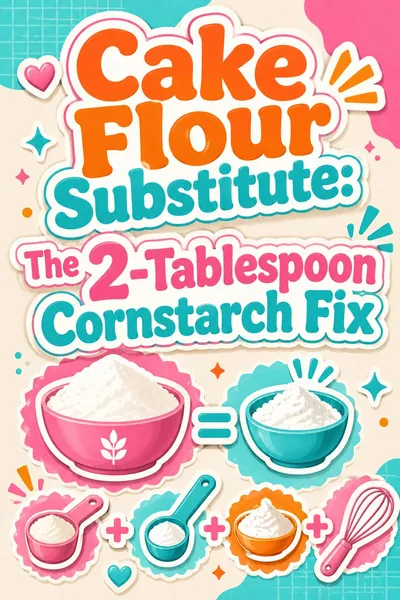
Tenderizing. Cornstarch has no gluten-forming protein, so replacing part of the flour in a recipe dilutes the protein and softens the crumb. That's the entire basis of the homemade cake flour trick: take 1 cup of all-purpose flour, remove 2 tablespoons, add 2 tablespoons of cornstarch, and sift several times. Our cake flour substitute guide covers the full method. For this job, arrowroot and tapioca work fine. Flour obviously does not, since flour is the thing you're diluting.
Preventing clumping. Commercial powdered sugar contains roughly 3% cornstarch as an anticaking agent. If you're grinding your own from granulated sugar, add about 1 tablespoon of cornstarch per cup so it doesn't set into a brick. Tapioca or arrowroot substitute here, at the same amount.
Crisping. Swapping a couple of tablespoons of cornstarch into a shortbread, sugar cookie, or fried coating gives a shorter, sandier, crisper bite. Rice flour is actually better than cornstarch for a crisp fried coating. Arrowroot works. Flour does not, again because it's the ingredient you're diluting.
Stabilizing. A teaspoon or two of cornstarch in a meringue or pavlova keeps the interior soft and marshmallowy and helps prevent weeping. A little in whipped cream slows the weeping too. Here, cornstarch is genuinely hard to replace. Arrowroot can work, but for stabilized whipped cream, gelatin or instant pudding mix does the job better than any starch swap.
If you're troubleshooting a recipe where cornstarch was doing structural work and you also need to sort out the leavening, our baking powder substitute guide covers that side. Cornstarch shows up there too, as the spacer that keeps homemade baking powder from reacting in the jar.
Pie fillings: where the choice really matters
Pie is the one place a wrong starch shows up as an obvious failure, because you don't find out until you cut it.
Acidic fruit fillings. Cherries, cranberries, rhubarb, sour apples, and anything with a big squeeze of lemon are all acidic enough to weaken cornstarch as it bakes. You measure correctly and still get a runny slice. Use tapioca starch or instant ClearJel instead, both at the same amount as the cornstarch, or arrowroot if that's what you have.
Juicy fruit fillings. Peaches, berries, and plums throw a lot of liquid. Tapioca is the traditional choice here because it thickens all that free juice into a glossy, sliceable gel without going cloudy.
Freezer pies. Never use cornstarch in a pie you plan to freeze, baked or unbaked. Cornstarch gels break down on thawing, releasing water and going spongy. Use tapioca or instant ClearJel, both of which are freeze-thaw stable.
Cream pies and puddings. Cornstarch is the right answer, and one of the few places it beats the alternatives. It sets firm, slices clean, and behaves well with dairy. Arrowroot's slimy-with-dairy tendency makes it a poor swap here.
What professionals use. Commercial bakeries and home canners lean heavily on instant ClearJel for fruit pie fillings. It's clear, it's acid-stable, it's freeze-thaw stable, and it thickens without heat, so a filling can be mixed cold and poured straight into a crust. It's the only thickener the USDA's home canning guidance approves for canned pie fillings. Look for the "instant" version if you want no-cook thickening. Regular ClearJel needs heat.
Worked example: a fruit pie calling for 3 tablespoons of cornstarch
Take a standard 9-inch cherry pie filling: about 5 cups of pitted cherries, 3/4 cup sugar, 1 tablespoon lemon juice, and 3 tablespoons of cornstarch. Cherries are acidic, and 3 tablespoons of cornstarch will thicken it, but softer than you'd like.
Here's that same filling converted three ways.
With all-purpose flour: use 6 tablespoons.
That's the 2:1 rule, so 3 tablespoons of cornstarch becomes 6 tablespoons of flour. Whisk it with the sugar before it touches the fruit so it disperses instead of clumping.
Outcome: it will set, and the acid won't bother it. But the filling goes noticeably cloudy and matte instead of glossy and jewel-toned, and six tablespoons of flour adds a faint pasty flavor and a heavier mouthfeel. Fine in a cobbler or a crumble where nobody sees the filling. Disappointing in a lattice-top pie where you do.
With arrowroot: use 3 tablespoons.
Straight 1:1. Whisk it with the sugar, same as above.
Outcome: the clearest, glossiest filling of the three, with a beautiful shine. It handles the lemon juice and the cherry acid without weakening. The catch is heat: arrowroot can break down under a long bake, so if the pie needs 55 minutes at 400°F, the filling may loosen slightly toward the end. And do not freeze leftovers expecting the same texture, even though arrowroot is the more freeze-stable of the two.
With tapioca starch: use 3 tablespoons.
Straight 1:1 again. If you only have instant tapioca pearls, use 6 tablespoons and grind them fine first, then let the filling sit 15 minutes before baking so the tapioca hydrates.
Outcome: the best all-around choice for this pie. Clear, glossy, acid-stable, holds through a long bake, and freezes and thaws without weeping. The texture is a hair more elastic than cornstarch, slightly stretchy when you spoon it, which most people never notice.
The verdict: tapioca for a cherry pie, arrowroot if you want maximum shine and a shorter bake, flour only if the filling is hidden under a crumble.
To scale any of these to a different pan size or a half batch, our cups to tablespoons converter handles the fractions.
Frequently asked questions
What is the best substitute for cornstarch?
It depends on the job. For a clear, glossy result that freezes well, tapioca starch at 1:1 is the best all-around choice. For gravies and cream soups where cloudiness doesn't matter, all-purpose flour at 2 tablespoons per tablespoon of cornstarch works fine and is in every kitchen.
How much flour equals 1 tablespoon of cornstarch?
Two tablespoons of all-purpose flour. Flour has about half the thickening power of cornstarch because it's mostly starch diluted with protein and other components. Cook it for a minute or two so it doesn't taste raw.
Is arrowroot a 1:1 cornstarch replacement?
Yes for the amount, no for the technique. Use the same quantity, but add it at the end of cooking and don't let it boil for long, because arrowroot breaks down with prolonged heat. Also skip it in dairy-based sauces, where it can turn slippery.
Can I use baking powder or baking soda instead of cornstarch?
No. Baking powder and baking soda are leaveners, not thickeners, and they will make a sauce taste soapy and metallic without thickening it. Baking powder does contain a little cornstarch as a filler, but nowhere near enough to matter.
What is a maizena substitute?
The same as a cornstarch substitute, because maizena is cornstarch. It's the common brand and generic name for cornstarch across Latin America and parts of Europe, so any recipe calling for maizena means cornstarch and every ratio on this page applies.
Why did my cornstarch sauce turn out lumpy?
Almost certainly because dry starch went into hot liquid. Whisk the cornstarch with 1 to 2 tablespoons of cold liquid into a smooth slurry first, then stream it into the hot pot while stirring. If you already have lumps, push the sauce through a fine mesh strainer.
Why did my cornstarch-thickened pie get watery in the freezer?
Cornstarch gels are not freeze-thaw stable. Ice crystals break the gel structure, and on thawing the water separates out, leaving a spongy, weeping filling. Use tapioca starch or instant ClearJel for anything headed to the freezer.
Can I substitute cornstarch in the cake flour trick?
Yes. Arrowroot and tapioca starch both work in place of cornstarch for the 1 cup all-purpose minus 2 tablespoons, plus 2 tablespoons starch method. They're gluten-free and equally effective at diluting the flour's protein, which is the whole point of that swap.
Related guides
- Cake Flour Substitute for the cornstarch trick that softens all-purpose flour
- Baking Powder Substitute for the leavening side of pantry emergencies
- Substitutions Finder to look up any swap with exact ratios
- Cups to Tablespoons Converter for scaling thickener amounts up or down