Gluten Free Baking Substitutions

Gluten does two separate jobs, and that is why one-to-one swaps disappoint. It builds structure, the protein scaffold that holds a crumb up, and it provides elasticity, the stretch that lets dough trap gas and rise without tearing. No single gluten free flour does both.
Blends work. Single flours usually do not. A workable blend pairs a base flour for body, a starch for lightness and browning, and a binder such as xanthan gum or psyllium husk to imitate the stretch. A useful starting ratio is 40% base flour, 30% second flour, 20% light starch, 10% heavy starch, plus binder to suit what you are baking.
The one substitution that never scales one to one is coconut flour. It absorbs four to five times its weight in liquid, so it replaces about a quarter of the wheat flour by weight and needs extra eggs and liquid alongside it.
Swapping other ingredients at the same time? Our free baking substitutions chart covers eggs, dairy, leavening and fats, so you can change one thing without accidentally changing three.
Updated August 2026
A serious note on celiac disease and cross-contamination
For anyone with celiac disease, this is a medical matter, not a texture preference. Celiac disease is an autoimmune condition in which gluten damages the lining of the small intestine, and the damage happens whether or not symptoms show up.
The amounts involved are tiny. In the US, the FDA allows a product to be labeled "gluten-free" only if it contains less than 20 parts per million of gluten, and that threshold exists because far smaller quantities than a crumb can cause harm.
Practical points that matter more than any recipe:
- Buy certified gluten-free flours. Naturally gluten free grains are routinely grown, harvested, transported and milled on shared equipment with wheat. "Naturally gluten free" and "certified gluten-free" are not the same claim.
- Oats are the biggest risk of the group. Oats do not contain gluten, but they are so commonly rotated and processed with wheat and barley that untested oats regularly test well above the limit. Buy certified gluten-free oats and oat flour, every time.
- Cross-contamination in your own kitchen is real. A shared toaster, a wooden spoon, a flour-dusted counter, a colander, or a sifter used for wheat flour can all carry enough gluten to matter. Wheat flour dust also stays airborne in a kitchen for hours after baking.
- A small number of people with celiac also react to oat avenin. If certified oats cause symptoms, that is a known possibility worth raising with a doctor.
If you are baking for someone else, tell them exactly what you used and where you baked it. That information is more useful to them than reassurance.
Gluten free baking substitutions: the flour table
Every flour below does one job well and at least one job badly. Read the "best use" column before you read anything else.
| Flour | Protein per 100 g | Liquid absorption | Flavor | Best use and share of a blend |
|---|---|---|---|---|
| White rice flour | About 6 g | Low | Neutral, faintly chalky | The standard base. Gritty unless finely milled, so buy superfine. 30 to 40% of a blend. |
| Brown rice flour | About 7 g | Low to moderate | Mild, nutty, slightly bitter | Base flour with more character and fiber. Goes rancid faster, so refrigerate it. 30 to 40%. |
| Sorghum flour | About 10 g | Moderate | Mild, gently sweet, wheat-like | The best all-round base for cakes and quick breads. 25 to 40%. |
| Oat flour, certified | About 13 g | Moderate to high | Sweet, oaty, comforting | Tenderness and moisture in muffins, cookies, quick breads. 20 to 30%. |
| Almond flour | About 21 g | Very low | Rich, buttery, sweet | Cookies, tortes, macarons, tender cakes. It is about 50% fat, so it adds richness, not structure. Up to 100% in flourless-style recipes, 25 to 30% in a blend. |
| Coconut flour | About 18 g | Extreme, 4 to 5 times its weight | Distinctly coconut, sweet | Never a one-to-one swap. Use 1/4 to 1/3 the weight of the wheat flour plus extra egg and liquid. 10% maximum in a blend. |
| Buckwheat flour | About 13 g | Moderate | Strong, earthy, mineral | Pancakes, crepes, dark quick breads, waffles. Overpowering above about 30% of a blend. |
| Tapioca starch | 0 g | Low | Neutral | Chew, stretch and browning. 15 to 25% of a blend. Gets gummy past 30%. |
| Potato starch | 0 g | High | Neutral | Softness and moisture retention. 10 to 20%. Not the same as potato flour, which is heavy and used at 1 to 2%. |
| Cornstarch | 0 g | Moderate | Neutral | Lightness and a fine crumb in cakes. 10 to 20%. Weighs 128 g per cup. |
Flag coconut flour clearly. It absorbs far more liquid than any other flour on this list, by a wide margin. Swapping it one to one for wheat flour produces something closer to dry sand than batter. Conversion numbers are in the worked example below.
Almond flour is the opposite trap. It absorbs almost nothing, because it is mostly fat and protein rather than starch, so a batter made with too much almond flour spreads and stays greasy. It builds no structure at all.
Why weighing matters even more in gluten free baking
Wheat flour is forgiving because it is fairly consistent. All purpose flour is 125 g per cup measured spoon and level, 145 g scooped straight from the bag, and 115 g sifted. That is a 26% spread between the extremes, which is bad enough.
Gluten free flours are far worse, because they differ enormously from each other in density. A cup of almond flour and a cup of white rice flour differ by more than half in weight, about 96 g against about 150 g. Coconut flour, oat flour and starches all pack differently again, and each brand mills to a different fineness. Per cup weights for each one are listed in gluten free flour in grams.
So a recipe written in cups is asking you to reproduce someone else's scooping technique with a flour whose density you cannot know.
Three consequences worth acting on:
- Convert every gluten free recipe you like into grams the first time you make it well. Weigh what you put in and write it down.
- Build blends by percentage of total flour weight, not by cups. Percentages transfer between recipes and cups do not.
- Do not swap brands of commercial blend by volume. Different blends have different starch fractions and different densities, so a cup of one is not a cup of another.
Our guide to how to measure flour covers the spoon and level method for the cases where you have no scale, and the ingredient weights chart gives the reference weights for the ingredients around the flour.
Binders: xanthan gum, psyllium husk and flax
The binder is what replaces elasticity. Without it, gluten free doughs have no stretch, gas escapes as it forms, and the crumb turns crumbly and dry.
| Baked good | Xanthan gum per cup of GF flour | Psyllium husk (whole) | Ground flax |
|---|---|---|---|
| Cookies and bar cookies | 1/4 teaspoon, or none at all | Not needed | 1 tablespoon if the dough is crumbly |
| Cakes and cupcakes | 1/2 teaspoon | Not recommended, too heavy | 1 tablespoon |
| Muffins and quick breads | 1/2 to 3/4 teaspoon | 1 teaspoon | 1 to 2 tablespoons |
| Pie and tart pastry | 1/2 teaspoon | Not needed | 1 tablespoon |
| Yeast bread | 1 to 1 1/2 teaspoons | 5 to 8% of the flour weight | Not enough on its own |
| Pizza dough | 1 1/2 teaspoons | 6 to 8% of the flour weight | Not enough on its own |
Xanthan gum is a fermented polysaccharide that thickens liquid and creates a viscous, stretchy network. It is the default in commercial blends, and many blends already contain it, so check the ingredient list before adding more.
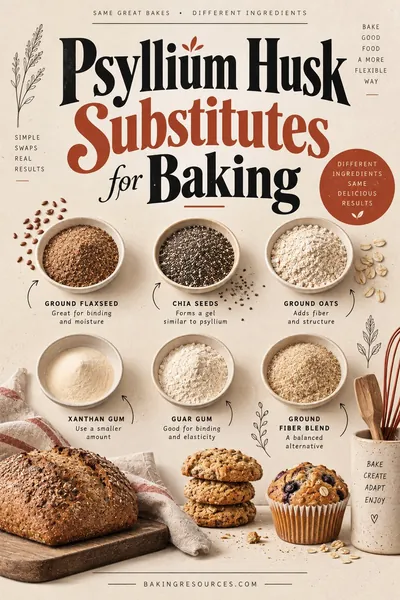
Psyllium husk is soluble fiber that forms a gel with water. It outperforms xanthan in yeast breads specifically, because the gel is strong enough to hold a real rise and it produces a chewier, more bread-like crumb. Use whole husk rather than fine powder unless a recipe says otherwise, and expect it to darken the loaf slightly.
Ground flax works as a mild binder and as an egg replacement (1 tablespoon flax to 3 tablespoons water, rested 10 minutes, per egg). It adds a nutty flavor and does not provide enough elasticity for yeast bread on its own. Our egg substitutes in baking guide has the other options.
The honest warning: too much binder gives a gummy, slimy, heavy texture that no amount of extra baking fixes. Doubling xanthan does not double the structure, it just makes the crumb dense and slightly slippery on the tongue. If a gluten free cake is coming out heavy and a little wet in the center, cut the binder before you touch anything else.
Hydration and rest time
Gluten free batters need more liquid and they need time to take it up.
Starches and fine flours hydrate more slowly than wheat, and until they hydrate they sit in the batter as dry particles that read as grit on the tongue. That is where the "sandy" reputation of gluten free baking comes from, and it is largely a timing problem.
What to do:
- Add 10 to 20% more liquid than the wheat recipe called for. The batter should look wetter than you expect, closer to thick pancake batter than to a stiff cake batter.
- Rest batters 20 to 30 minutes before baking, covered, at room temperature. Muffins, cakes and pancakes all improve.
- Rest doughs 30 minutes to overnight in the fridge. Cookie dough in particular firms up and spreads less.
- Rest yeast doughs during the bulk rise, which does the hydrating for you.
Rice-based blends benefit most from resting, because rice flour is slow to absorb. Almond-based recipes benefit least, since there is little starch to hydrate.
Gluten free batters also brown differently. Less protein means less browning, so many bakes look pale when they are cooked through. Judge doneness by internal temperature rather than color: 200 to 205F for quick breads and 205 to 210F for yeast bread.
What converts easily and what is genuinely hard
Be realistic about this before you start. Some things convert with almost no work and some are a project.
Converts easily:
- Brownies. High fat, high sugar, low flour. Structure was never coming from the gluten anyway. Frequently indistinguishable.
- Cookies. Especially chewy drop cookies. Spread can change, so chill the dough 30 minutes.
- Muffins and quick breads. Chemical leavening does the lifting, so a decent blend plus 1/2 teaspoon of xanthan per cup gets you most of the way.
- Pancakes, waffles, crepes. Thin batters, quick cooking, no structure needed.
- Flourless cakes, tortes, macarons. Already gluten free by design.
Genuinely hard:
- Yeast breads. Gluten is doing the entire job here, trapping gas over a long rise and holding an open crumb. Gluten free bread doughs behave like thick batters, are baked in pans rather than free-form, and rise once rather than twice. Psyllium husk helps more than anything else, but the result is a different kind of bread, not a copy.
- Laminated pastry. Croissants and puff pastry depend on hundreds of continuous gluten sheets holding butter layers apart. Without gluten those sheets tear, and butter leaks out during baking. This is the hardest category in baking, gluten free or not.
- Pizza dough that you can stretch by hand. Press it into the pan instead and par-bake the base.
- Angel food cake. Very low fat and high structure, so it exposes every weakness of a substitute flour.
Naming this honestly saves you a wasted afternoon. Start with brownies or muffins, get a blend you trust, and work up.
Worked example: converting a muffin recipe
Take a standard muffin recipe calling for 2 cups of all purpose flour, 1 cup of milk, 2 eggs, and 2 teaspoons of baking powder.
Step 1: convert the flour to grams. 2 cups of all purpose flour, spoon and level, is 2 times 125, which is 250 g. That is your total flour weight and it does not change.
Step 2: build 250 g of blend by percentage.
| Component | Share | Weight |
|---|---|---|
| White rice flour, superfine | 40% | 100 g |
| Sorghum flour | 30% | 75 g |
| Tapioca starch | 20% | 50 g |
| Potato starch | 10% | 25 g |
| Total | 100% | 250 g |
Step 3: add the binder. Muffins take 1/2 teaspoon of xanthan gum per cup of flour, and this recipe is 2 cups, so 1 teaspoon total. Whisk it into the dry ingredients thoroughly, because it clumps on contact with liquid.
Step 4: raise the liquid by 10 to 15%. 1 cup of milk is 236 g, matching water closely enough for planning. Add 12%, which is about 28 g, or 2 tablespoons. New total: 264 g of milk.
Step 5: consider one extra egg. A large egg out of the shell is about 50 g. Adding one takes the batter from 100 g to 150 g of egg and gives the crumb protein structure it otherwise lacks. Muffins do not always need it. Cakes usually do.
Step 6: rest the batter 25 minutes before scooping, covered, at room temperature. It will thicken visibly as the starches hydrate. Do not thin it back down.
Step 7: bake at the same temperature, add 2 to 4 minutes, and check for 200 to 205F in the center rather than waiting for the tops to brown.
The coconut flour version, to show the difference
Suppose you wanted to use coconut flour for those same 250 g of all purpose flour. You would not use 250 g. You would use roughly 60 to 85 g, which is a quarter to a third of the weight, and then add about 3 extra eggs (150 g) and roughly 240 g more liquid to cover what the coconut flour absorbs.
That is the same recipe rewritten, not a substitution. It is why coconut flour recipes are almost always written from scratch rather than converted, and why swapping it in one to one produces a dry, dense puck.
For a broader look at what each flour is doing in a recipe, wheat included, our guide to types of flour compares protein levels and best uses side by side.
Frequently asked questions
Can I substitute gluten free flour one to one for regular flour?
Only if it is a commercial blend labeled "measure for measure" or "cup for cup", and even then, weigh it rather than scooping. Single gluten free flours such as rice, almond or coconut are never one-to-one swaps, because each one does a different part of the job.
What is the best gluten free flour blend ratio?
A reliable starting point is 40% base flour such as rice or sorghum, 30% of a second flour such as oat or sorghum, 20% tapioca starch, and 10% potato starch. Adjust the starch fraction up for cakes and down for breads. Build it by weight, not by cups.
How much xanthan gum do I need per cup of flour?
Roughly 1/4 teaspoon for cookies, 1/2 teaspoon for cakes and muffins, 3/4 teaspoon for quick breads, and 1 to 1 1/2 teaspoons for yeast bread. Check your blend first, since most commercial blends already contain it and doubling up gives a gummy texture.
Is oat flour gluten free?
Oats contain no gluten, but they are so frequently cross-contaminated with wheat and barley during growing and milling that untested oats often exceed the safe limit. Buy certified gluten-free oat flour if you are baking for anyone with celiac disease.
Why is my gluten free baking gritty?
The starches have not fully hydrated. Rest the batter or dough for 20 to 30 minutes before baking so the flour particles can take up liquid, and buy superfine rice flour rather than standard grind. Adding 10 to 20% more liquid helps too.
Can I substitute almond flour for coconut flour?
No, they are opposites. Almond flour absorbs almost no liquid and is about half fat, while coconut flour absorbs four to five times its weight. Swapping one for the other at the same amount ruins the recipe in either direction.
Why is my gluten free bread dense and gummy?
Usually too much binder, not enough liquid, or pulling it from the oven too early. Cut the xanthan gum back, raise the hydration, and bake to an internal temperature of 205 to 210F rather than judging by crust color, since gluten free loaves brown slowly.
Do I need to change the oven temperature for gluten free baking?
Not usually. Keep the temperature the recipe gives, 350F for most cakes and muffins, which is 177C or gas mark 4, and add 2 to 5 minutes. Gluten free bakes brown less, so use a thermometer instead of color to decide when they are done.
Related guides: Baking substitutions chart | Ingredient weights chart | How to measure flour | Types of flour | Egg substitutes in baking | Cake flour substitute