How to Get a Bundt Cake Out of the Pan

Set a timer for 10 minutes the moment the pan leaves the oven, rest it on a wire rack, then invert it onto the rack in one confident motion. Ten minutes is long enough for the crumb to firm up and short enough that the sugar at the crust has not cooled into glue.
That timing is the whole answer to how to get a bundt cake out of the pan, and it beats every trick people try after the fact. Before you flip, run a thin flexible spatula around the outer rim and around the center tube, tilt the pan, and give it a small rotating shake. If the cake shifts as one piece, it is free.
Not sure your batter suits the pan you used? An overfilled bundt welds at the rim. Our free pan converter matches capacities so you pour the right amount.
Updated September 2026
How to get a bundt cake out of the pan, step by step
Seven steps, about two minutes of actual work.
- Start the timer at the oven door. Not when you remember, not when the cake looks cool. The clock starts the second the pan comes out.
- Put the pan on a wire rack, not the counter. A pan sitting on a solid surface traps steam underneath and keeps cooking the bottom crust.
- At 8 minutes, loosen the two rims. A thin offset spatula or a flexible plastic knife, pressed flat against the metal rather than into the cake. Go around the outer wall and around the center tube. Do not try to reach into the flutes.
- Do the shake test. Hold the pan with both hands, tilt it about 30 degrees and give it a small twist. A released cake slides slightly as a single unit. A stuck cake does not move at all.
- Invert at 10 minutes. Put the rack over the open pan, hold rack and pan together, and turn the whole thing over in one motion. Hesitating halfway is what tears cakes.
- Leave the pan sitting on top for a minute. Gravity plus residual steam does the last of the work. Most cakes drop by themselves with a soft sound.
- Lift the pan straight up. No twisting, no rocking. If it resists, go to the rescue ladder below.
The two loosening passes in step 3 matter more than they look. On a bundt, the outer wall and the center tube are two separate opportunities to stick, and the tube is the one people forget.
The cooling window, minute by minute
A bundt is less forgiving than a layer cake because it has more surface area gripping per cup of cake. The window is real and it is narrow.
| Time in the pan | What is happening |
|---|---|
| 0 to 5 min | Starch is still setting. The cake cannot hold its own weight and will tear |
| 8 to 12 min | The window. Firm enough to lift, warm enough to release |
| 15 to 20 min | Steam is condensing between crust and metal, and the sugar starts setting |
| 25 min and up | The condensed syrup has cooled into a bond. Now it is stuck |
| Fully cool | Welded. Only heat will break it |
The part that feels backwards is that letting it cool fully in the pan makes it harder to remove, not easier. People wait out of caution and create the exact problem they were trying to avoid. Our how to cool a cake guide covers the exceptions, and there is one big one here: an angel food or chiffon cake baked in a tube pan cools upside down in the pan on purpose and comes out cold.
Five rescues, in order, for a cake that is already stuck
Work down this list. Each step is more forceful than the one before it, so stop as soon as the cake moves.
1. The full edge release. Go around both rims again, all the way down to the pan floor, keeping the blade flat against the metal. Roughly half of the bundts that feel stuck are only stuck at the top rim where the batter crusted over.
2. The warm towel. Soak a dish towel in hot tap water, wring it out, and wrap it around the outside and bottom of the pan for 2 minutes. Heat softens the sugar layer holding the crust to the metal. Invert immediately while it is still warm.
3. Back into the oven. Put the pan into a 350F oven for 3 to 5 minutes. This is the same idea with more force: remelt the sugar bond, then turn out at once. Have your rack and a sheet of parchment ready first, because you get about 60 seconds of working time before it cools again.
4. The freezer, which is the bundt specialist's trick. Thirty minutes in the freezer firms the crumb and shrinks the cake very slightly away from the metal. A firmed cake also survives a jolt without tearing, and detailed flutes release far better cold than warm. Use this one when the cake has gone completely cold and the warm towel did nothing.
5. The jolt. Hold the inverted pan and the rack together with both hands, lift a few inches, and bring them down flat onto the counter in one decisive movement. Timid taps do nothing. One firm drop does.
If none of the five works, the cake is bonded to the pan floor and you are going to lose some of the top crust, which is the bottom once it is flipped. Turn it out, peel the stuck layer off the pan with a spatula while it is warm, and press it straight back onto the cake. A glaze hides it completely.
What not to do: never dig down into the cake from above with a knife. That turns a cosmetic problem into a structural one and you will end up serving it in a bowl.
Prep is 90% of it: how to grease a bundt pan
Bundts have more surface area, more angles and more crevices than any other pan. Whatever you use has to reach all of it.
Cake goop is the best of the three. Whisk equal parts by volume of all purpose flour, vegetable oil and vegetable shortening into a smooth paste. Brush a thin coat into every groove with a pastry brush. It keeps in a covered jar in the fridge for months and it releases detail that butter and flour cannot. Bakeries have used it for decades under various names.
Butter and flour by hand is the classic. Soften the butter first, do not melt it, and paint it in with a pastry brush so it stays put in the flutes. Then add a tablespoon or two of flour, tilt and tap and rotate until every surface is dusted, and invert the pan over the sink to knock out the excess. Any bare patch is exactly where it will stick.
Baking spray with flour in it works, plain spray does not. The flour is doing the real work. Plain oil spray pools in the bottom of the pattern, leaves the high points bare, and over dozens of bakes builds a sticky varnish on the pan that is more adhesive than bare metal.
| Method | Release quality | Notes |
|---|---|---|
| Cake goop | Best, including deep detail | Make it once, keep it in the fridge |
| Softened butter and flour | Very good, if you are thorough | Leaves a faint pale film on dark cakes |
| Baking spray with flour | Good, and fast | Reapply for a second bake, do not reuse a hot pan |
| Plain cooking spray | Poor | Pools, misses ridges, builds up over time |
| Butter with no flour | Poor | Grease alone gives the batter something smooth to grip |
| Nothing, on a nonstick pan | Risky | Fine for a plain ring, unreliable in deep flutes |
For a chocolate bundt, dust with cocoa powder instead of flour. Same quantity, same tilt and tap, and no pale coating on the finished cake. The equivalent routine for flat pans is in how to line a cake pan, though parchment is not an option in a fluted pan.
Never grease an angel food or chiffon tube pan. Those batters climb bare metal to rise, and greasing one guarantees a collapse.
How full should a bundt pan be?
Two thirds full, and no more. Overfilling is the second most common cause of a stuck bundt after cooling too long, because the extra batter rises over the top rim, spreads across the flat edge and welds the cake to the pan lip.
The standard sizes:
| Pan | Width | Depth | Capacity | Batter to pour |
|---|---|---|---|---|
| 10 cup bundt | 9.5 in | 3.5 in | 10 cups | About 6 1/2 cups |
| 12 cup bundt | 10 in | 3.75 in | 12 cups | About 8 cups |
| 9 x 3 tube | 9 in | 3 in | 12 cups | About 8 cups |
| 10 x 4 tube | 10 in | 4 in | 16 cups | About 10 1/2 cups |
Bundt and tube pans are sold by their stated cup capacity, which makes them the most reliable pans to plan around. To measure a pan you cannot identify, fill it to the brim with water a cup at a time and count.
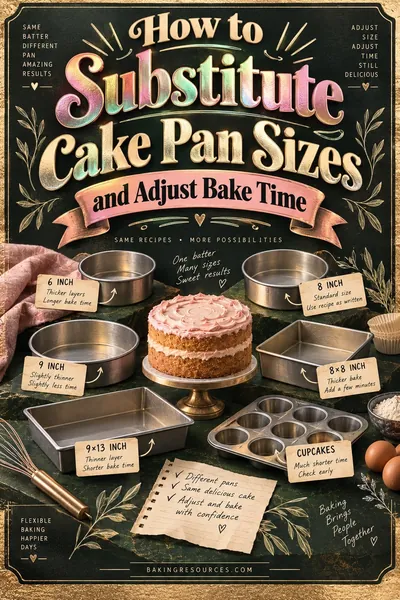
Bake any surplus batter as cupcakes rather than forcing it in. And note that a ring pan bakes faster than its volume suggests, because heat reaches the batter from the inner tube as well as the outside. Moving a bundt recipe into a solid loaf or round is the risky direction, and how to substitute cake pan sizes covers what changes.
Batters that stick more than others
Some cakes are simply harder to release, and knowing which ones tells you when to be extra careful with the prep.
- High sugar batters. Sugar that touches metal directly turns to caramel and welds. Pound cakes and coffee cakes need thorough flouring.
- Fruit and chocolate chips. Heavy pieces sink and sit against the pan wall, where they melt and bond. Toss them in a spoonful of the recipe's flour first so they stay suspended.
- Cinnamon or streusel swirls. Sugar swirls that reach the pan wall behave like caramel. Keep swirls to the middle third of the batter depth.
- Cream cheese fillings. These stay soft and wet longer, which means the cake around them sets later. Give it the full 10 minutes and not a minute more.
- Very moist batters, like an oil based carrot or banana cake. They release well but tear easily, so support the cake as you lift the pan away.
If a recipe is loaded with heavy add ins, a plain ring pan or a loaf is a kinder choice than a deeply fluted pan. The pan converter will find you an equivalent capacity in a simpler shape.
Worked example: a 7 cup batter and a 10 cup pan
You have a recipe that makes about 7 cups of batter, and a 10 cup bundt pan.
Step 1. Check the fill. 7 divided by 10 is 70%, which is just over the two thirds rule. Pour about 6 1/2 cups and bake the last half cup as two cupcakes.
Step 2. Prep the pan properly. Cake goop brushed into every flute, or softened butter and a thorough flour dusting. Reach the center tube, which is the spot people miss.
Step 3. Bake and check the center. A ring pan cooks faster than a solid pan of the same capacity. Test with a thin skewer halfway between the tube and the outer wall, not right at the edge. It should come out with a few dry crumbs.
Step 4. Timer at 10 minutes, pan on a wire rack, loosen both rims at 8 minutes, shake test, invert.
Step 5. If it did not release, work the rescue ladder. Warm towel first, freezer if the cake has already gone cold.
Now suppose the same 7 cups went into a 12 cup pan instead. That is 58% full, which is under the two thirds mark, so the cake sits low, the ridges are shallow and it bakes noticeably faster. Take 10 to 15 minutes off your first check. Underfilling is the safer error, but it is still an error.
After it is out
Let the cake cool completely on the rack before glazing, which takes about an hour for a full size bundt. A warm cake melts a glaze straight off the sides.
If a piece did break away, chill the whole cake for 20 minutes so the crumb firms, press the piece back into place, and glaze over it. The same logic behind a crumb coat in how to frost a cake applies here: sugar covers a great deal.
For storage, a bundt keeps at room temperature under a cover for two to three days, and the high sugar ones keep longer. Slicing exposes crumb, so store it whole and cut as you go.
FAQ
How long should a bundt cake cool before you flip it?
Exactly 10 minutes on a wire rack, timed from the moment it leaves the oven. Less than that and the crumb is too soft to hold together, more than about 15 and condensing steam turns the crust sugar into a bond with the metal.
Why is my bundt cake stuck in the pan?
Usually one of three things: it sat past the 10 minute window, the flutes were not fully greased and floured, or the pan was overfilled and the cake welded to the top rim. Plain cooking spray buildup is a common fourth cause on older pans. The broader diagnosis is in why is my cake stuck to the pan.
How do you get a bundt cake out of the pan when it is already cold?
Heat or cold, not force. Wrap the pan in a hot damp towel for 2 minutes and invert immediately, or put it back into a 350F oven for 3 to 5 minutes. If both fail, freeze the whole pan for 30 minutes, which shrinks the cake away from the metal.
What is cake goop and does it really work?
It is equal parts all purpose flour, vegetable oil and vegetable shortening whisked to a paste and brushed into the pan. It works better than butter and flour on detailed pans because it stays where you brush it and it never leaves a bare patch. It keeps for months in the fridge.
Should I grease a nonstick bundt pan?
Yes. Nonstick coatings handle a plain ring reasonably well and struggle with deep flutes, and the coating wears down long before the pan looks worn. Grease and flour it, or use cake goop, every single time.
How full should you fill a bundt pan?
Two thirds full. A 10 cup pan takes about 6 1/2 cups of batter and a 12 cup pan takes about 8. Batter that rises over the rim spreads across the flat lip of the pan and glues the cake down.
Can I use parchment paper in a bundt pan?
No, the shape makes it impossible. That is exactly why the grease and flour step carries the whole load in a fluted pan, and why it needs to be done more carefully than in a round or square one.
My bundt broke in half coming out. Can I save it?
Yes. Press the pieces back together while the cake is still warm, chill it for 20 minutes so the crumb sets, then glaze generously over the seam. A bundt is the easiest cake to repair because the glaze runs down the ridges and hides the joins.