Why Is My Cake Stuck to the Pan?

The cooling window, almost always. A cake that sits in its pan past about 15 minutes traps steam against hot metal, and the sugar at the crust cools into something close to glue. Take it out at 10 minutes and the same cake drops free.
So the answer to why is my cake stuck to the pan is usually timing rather than grease. The other two causes are bare pan sides with no flour or parchment on them, and a cake that came out of the oven underbaked, so the bottom is still wet enough to cling.
If it is stuck right now, skip to the rescue below. If it is already cool and welded in place, the warm towel trick in that section still works and it works better than force.
Baking in a different pan than the recipe called for? That is a common reason cakes come out underbaked at the bottom. Our free baking time calculator works out the adjusted time when the batter depth changes.
Updated September 2026
Get it out right now: five rescues in order
Try these in this order. Each one is less risky than the one after it.
1. The edge release. Run a thin offset spatula or a paring knife all the way around, pressing the blade flat against the pan wall rather than into the cake. Go all the way to the bottom. Half the cakes that feel stuck are only stuck at the rim.
2. The warm towel. Soak a dish towel in hot tap water, wring it out, and wrap it around the bottom and sides of the pan for 2 minutes. The heat softens the sugar layer holding the crust to the metal. Invert immediately while it is still warm.
3. Back into the oven. Put the pan into a 350F oven for 3 to 5 minutes. This is the strongest version of the same idea: remelt the sugar glue, then turn the cake out while it is warm. Set your rack and a sheet of parchment ready first, because you get about 60 seconds of working time.
4. The freezer. For a bundt or anything with detail, 30 minutes in the freezer firms the crumb and shrinks the cake slightly away from the metal. A frozen cake also survives a firm jolt without tearing.
5. The jolt. Hold the inverted pan and its rack together with both hands, lift a few inches, and bring them down flat onto the counter in one confident motion. Timid does not work. One firm drop does.
If the cake still will not budge after all five, it is stuck to the floor of the pan and you are going to lose the bottom crust. Turn it out, peel the stuck layer off the pan with a spatula while it is warm, and press it back onto the cake. Frosting covers it completely and nobody will ever know, which is the whole point of a crumb coat in how to frost a cake.
Do not fish for it with a knife from the top down. That breaks the cake into pieces and turns a cosmetic problem into a structural one.
Why is my cake stuck to the pan: the eight real causes
| Cause | The tell | The fix next time |
|---|---|---|
| Cooled too long in the pan | Bottom is stuck and slightly wet | Turn out at 10 minutes |
| Turned out too soon | Sides tore, center collapsed | Wait the full 10 minutes |
| No parchment on the bottom | Sides released, floor did not | Cut a parchment circle |
| Greased but not floured | Cake gripped the smooth sides | Grease, parchment, grease, flour |
| Spray buildup on nonstick | Sticky brown film on the pan | Scrub it off, switch to butter and flour |
| Underbaked | Gummy layer left in the pan | Bake to a clean skewer, check the time |
| Sugary or fruity batter | Dark caramel welds at the edge | Parchment on the sides too |
| Worn nonstick coating | Scratches, dull patches | The pan is done, line it fully |
The first two rows contradict each other, and that is the whole difficulty. There is a window, not a rule of "sooner is safer."
The cooling window, which is the actual answer
A cake comes out of the oven at roughly 205 to 210F. At that moment its starch has gelatinized but not set, and it cannot hold its own weight. Give it 10 minutes and the starch firms up. Give it 25 and something else happens.
Here is the sequence, minute by minute:
| Time in the pan | What is happening |
|---|---|
| 0 to 5 min | Starch still setting. The cake will tear if you move it |
| 8 to 12 min | The window. Firm enough to hold, still warm enough to release |
| 15 to 20 min | Steam is condensing between crust and metal. Sugar starts setting |
| 25 min and up | The condensed syrup has cooled into a bond. Now it is stuck |
| Fully cool | Welded. You need heat to break it |
Ten minutes is the working number for most layer cakes. Our full guide on how to cool a cake covers the exceptions, and there are two that matter: angel food and chiffon cool upside down in the pan on purpose, and cheesecakes stay in the springform until they are cold.
The counterintuitive part is that letting a cake cool completely in the pan makes it harder to remove, not easier. Most people learn that the wrong way round.
Cause: the sides had nothing on them
The bottom of a cake gets the credit and the sides do the gripping. As a cake bakes, the batter climbs the pan wall and sets against it, and if that wall is smooth bare metal the crust bonds directly to it.
Parchment on the bottom does not help the sides at all. That is why cakes come out with a clean floor and a torn rim.
The sequence that works is four steps and takes about 90 seconds per pan:
- Grease the bare pan. A thin film. This is glue for the parchment, not the release layer.
- Lay in a parchment circle cut to the pan floor. Press it flat.
- Grease again, over the parchment and up the sides.
- Flour it. Add a tablespoon or two, tilt and tap until every surface is dusted, then invert over the sink and knock the excess out.
That flour layer is the part people skip and it is what the cake actually climbs. Our full walkthrough is in how to line a cake pan, including how to cut a parchment circle in four folds.
For chocolate cakes, dust with cocoa powder instead of flour so you do not get a pale film on the finished cake. Same amount, same technique.
Cause: cooking spray buildup
This one surprises people who have never had a sticking problem until suddenly every cake sticks.
Cooking spray leaves a thin residue of lecithin and propellant that polymerizes on the pan under oven heat. Over dozens of bakes it builds into a sticky brown varnish that is more adhesive than bare metal. It is worst on nonstick pans, and it is not removed by normal washing.
The tell: a tacky, slightly brown film on the pan that feels sticky when the pan is clean and dry.
The fix: scrub it off with a paste of baking soda and a little water and a nylon scrubber, or soak in hot soapy water for an hour first. Then stop using plain spray on that pan.
Baking spray that already contains flour is a different product and it works fine, because the flour is doing the real work. Butter and flour applied by hand works better than either.
Cause: it was underbaked
An underbaked cake has a wet band at the bottom that behaves like paste. It sticks, and then it tears when you try to lift it, because there is nothing structural holding it together down there.
Check for this after the fact: if what stayed behind in the pan is a dense, damp layer rather than a thin crust, it was underbaked.
Underbaking happens most often when someone changes the pan. Depth drives bake time, not volume, and a batter poured deeper than the recipe intended needs a longer bake at a lower temperature. The rule is to add 10 to 15 minutes and drop the oven 25F for every extra half inch of depth. Our baking time calculator does that arithmetic, and how to substitute cake pan sizes covers the ingredient side.
Test in the true center with a thin skewer, not near the edge. An 8 inch layer is done at 200 to 210F internal, and the skewer should come out with a few dry crumbs and no wet batter.
Bundt pans need their own approach
Bundts have more surface area per cup of cake than any other pan, plus fluting, plus a center tube. Everything about them fights you.
Grease every crevice by hand. Softened butter and a pastry brush, not spray. Spray does not reach into the flutes and it pools in the bottom of the pattern.
Then flour it thoroughly. Tilt, tap, rotate, and knock out the excess. Any bare patch is where it will stick.
Cake goop is better than either. Equal parts by volume of all purpose flour, vegetable oil and shortening, whisked into a paste. Brush it into the pan. It keeps in the fridge for months and it releases detail that butter and flour cannot. Bakeries have used it for decades.
Turn out at exactly 10 minutes. Bundts are less forgiving than layers. Set a timer.
Never grease an angel food or chiffon tube pan. Those batters have to climb bare metal to rise, and greasing one guarantees a collapsed cake. Cool them inverted and release with a knife once cold.
If the pattern is very deep, a bundt is a poor match for a heavy batter with fruit or chips in it. Those pieces sit against the wall and weld. Our pan converter will find you an equivalent plain pan with the same capacity.
Worked example: an 8 inch layer that stuck
You baked two 8 inch layers at 350F for 30 minutes. One came out fine and the other left its bottom in the pan.
Step 1. Which pan? Check whether the failed one was the darker pan or the older nonstick. Dark pans run hotter at the edges and worn nonstick has lost its release.
Step 2. How long did it sit? If the good layer came out at 10 minutes and you got distracted before the second one, that is your answer and nothing else needs investigating.
Step 3. Look at what stayed behind. A thin brown crust means a release problem. A thick pale damp layer means it was underbaked.
Step 4. Do the math if it was underbaked. An 8 inch round has 50.3 square inches of floor. If you poured 4 cups of batter into it, that is 4 x 14.44 divided by 50.3, or 1.15 inches of batter depth. A recipe written for 2 1/4 cups gives 0.65 inches. You are half an inch deeper, so you needed roughly 10 to 15 more minutes at 325F rather than 30 minutes at 350F.
Step 5. Fix the pair. Weigh the batter into each pan so both layers are the same depth and finish at the same time. Uneven splitting is also the main cause of the problem in why is my cake uneven.
Which pans stick most
| Pan type | Sticking risk | Notes |
|---|---|---|
| Light aluminum, bare | Low with parchment and flour | The bakery standard for a reason |
| Nonstick, new | Low | Still line the bottom |
| Nonstick, worn or scratched | High | The coating is gone, treat it as bare metal |
| Dark steel | Medium | Bakes hotter at the edges, drop the oven 25F |
| Glass | Medium | Holds heat and keeps baking after it leaves the oven |
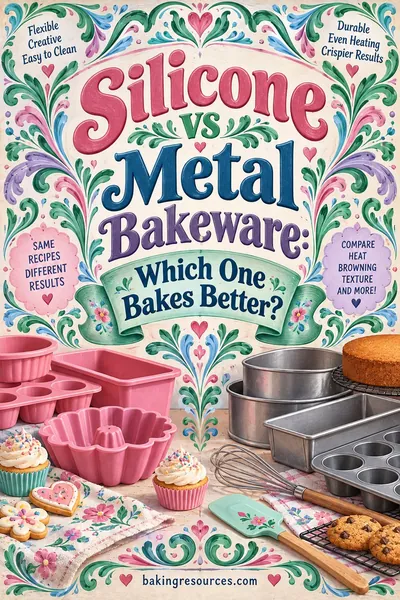
| Silicone | Low, but floppy | Set it on a sheet pan and cool fully before releasing |
| Bundt, fluted | High | Cake goop or hand-brushed butter and flour |
| Springform | Low on the sides | The base is the problem, always line it |
For springforms, line the base and clamp the ring over the parchment so the overhang sticks out. It gives you a handle. Our springform pan substitute guide covers what to do if you do not own one.
Things that quietly cause sticking
- Batter that sat in the pan. Give it more than about 15 minutes on the counter before baking and the sugar dissolves the flour coating you just applied.
- Washing with abrasive pads. Scratches on aluminum and dead spots on nonstick both grip.
- Reusing a hot pan for a second batch without regreasing. The residual heat sets the batter against the wall instantly.
- Skipping the flour on a fruit or caramel cake. Sugar that touches metal directly turns to caramel and welds.
- Cutting the parchment too small. A circle that leaves a rim of bare pan floor sticks in a ring, and the cake tears along it.
FAQ
How long should a cake stay in the pan before turning it out?
Ten minutes for most layer cakes, measured from the moment it leaves the oven, on a wire rack rather than the counter. Bundts get the same 10 minutes. Loaves can take 15. Angel food, chiffon and cheesecake are the exceptions and stay in until cold.
How do you get a cake out of a pan when it is already cold?
Warmth is the only thing that works. Wrap the pan in a hot damp towel for 2 minutes, or put it back into a 350F oven for 3 to 5 minutes to remelt the sugar bond, then run a knife around and invert immediately.
Why did my cake stick even though I greased the pan?
Grease alone gives the batter a smooth surface to grip. It needs flour or parchment on top of the grease so there is a dry, loose layer between cake and metal. Grease, parchment, grease, then flour.
Does parchment paper stop a cake from sticking to the sides?
Only if you line the sides too. A parchment circle protects the floor and nothing else. For sticky batters, cut a collar strip as tall as the pan and stand it around the inside wall over a thin coat of grease.
Can I still use a cake that broke coming out of the pan?
Yes. Press the broken piece back into place while it is warm, chill the cake for 20 minutes so the crumb firms up, then crumb coat it. Frosting hides a great deal. A layer that broke badly works fine as the bottom layer where it carries no visual weight.
Why does my bundt cake always stick?
Bundts have deep flutes that spray cannot reach. Brush softened butter into every groove with a pastry brush, flour it thoroughly and knock out the excess, or use cake goop, which is equal parts flour, oil and shortening. Then turn out at exactly 10 minutes.
Is nonstick spray bad for cake pans?
Plain spray builds up a sticky varnish over time that is more adhesive than the bare pan. Baking spray with flour in it is fine. Butter or shortening applied by hand plus flour is the most reliable of the three.
Does the pan size affect whether a cake sticks?
Indirectly, and it matters more than people expect. Pouring a recipe into a smaller pan makes the batter deeper, and a deeper batter that gets the original bake time comes out underbaked at the bottom, which sticks. Use the pan converter to match capacities before you pour.