What to Use Instead of a Springform Pan

The best answer to what to use instead of a springform pan is a regular round cake pan of the same diameter, lined with a parchment circle on the bottom and a parchment sling running up two sides so you can lift the whole thing out. A loose bottom tart pan or a push pan does the same job with no lining at all. A disposable foil pan works too, because you can cut it away with scissors once the cake is chilled.
The catch is depth, not diameter. A 9-inch springform is usually 2.5 to 3 inches tall, while a standard 9-inch cake pan is only 2 inches tall, so the same batter that fit the springform can overflow the substitute. Match the volume first, then the release method.
Updated September 2026
Need the volume match for a pan you own? Drop both sizes into our free cake pan converter and it gives you the capacity ratio and the bake time adjustment together.
What a springform actually does, and when you need it
A springform is a two-piece pan: a flat base and a hoop with a latch. Open the latch and the hoop expands away from the cake, so the cake never has to be turned upside down.
That is the entire feature. It matters for exactly one category of bake: anything too soft, too wet, or too fragile to invert. Cheesecake, mousse cake, ice cream cake, deep torte, springy sponge with a delicate top, and any layered dessert set in the pan.
Everything else does not need one. Butter cakes, layer cakes, brownies, quick breads and coffee cakes all come out of a solid pan fine, because you can flip them onto a rack without damage. If a recipe calls for a springform out of habit rather than necessity, a plain round pan is already the right answer.
So the question splits in two. Can this cake be inverted? If yes, use any pan. If no, you need a release strategy, and the five below all work.
What to use instead of a springform pan: the five swaps
| Substitute | How it releases | Best for | Watch out for |
|---|---|---|---|
| Round cake pan with a parchment sling | Lift straight up by the paper handles | Cheesecake, torte, anything chilled firm | Needs a fully chilled cake, sling must be wide |
| Loose bottom tart pan or push pan | Push the base up from underneath | Cheesecake, tarts, deep dish anything | Same leak risk as a springform, wrap it |
| Disposable foil pan | Cut the sides away with scissors | Gift bakes, potlucks, one-time bakes | Flimsy, always set it on a sheet pan |
| Cake ring on a lined sheet pan | Slide a knife around, lift the ring | Set desserts, no-bake, mousse | Leaks badly with liquid batter, chill only |
| Any solid pan, fully chilled and warmed | Warm the base, invert, then reinvert | Cheesecake if you are confident | The most likely to end in a crack |
The parchment sling is the one to learn. It costs nothing, uses a pan you already own, and it works whether the cake gets baked or just chilled.
The parchment sling, step by step
This is the technique that replaces the latch, and it takes about two minutes.
Step 1. Cut a circle of parchment for the bottom. Trace the pan base on the paper with a pencil and cut just inside the line, so the circle sits flat instead of curling up the sides.
Step 2. Cut two strips of parchment, each about 3 inches wide and long enough to run up one side, across the bottom, and up the other side with 3 inches hanging over each rim. For a 9-inch pan that is roughly 18 to 20 inches per strip.
Step 3. Grease the pan lightly, lay the two strips in a cross, then press the parchment circle on top of them at the bottom. The grease holds the paper in place while you pour.
Step 4. Grease and flour the exposed sides above the strips, or line the sides with a parchment collar if the cake is very sticky. Our full guide to lining a cake pan covers the collar method and which greases release best.
Step 5. Bake, then chill completely. This is the step people skip and the reason slings fail. A warm cheesecake has no structure and will tear itself apart. Four hours in the fridge is the minimum, overnight is better.
Step 6. Slide a thin knife or an offset spatula around the edge first, then lift both strip ends evenly with two hands. The cake comes up as one piece.
A word on why chilling matters this much: a baked cheesecake sets by protein coagulation while it bakes, then firms much further as the fat cools and solidifies. Pulling on it before the fat is cold is like unmolding butter at room temperature. Our guide to cooling a cake properly covers the timing for the cakes that go into a sling.
Matching the size, since depth is the real problem
Springforms are taller than standard cake pans, and that is where substitutions break. Here is the capacity comparison, measured level to the rim.
| Pan | Dimensions | Volume to rim (cups) | Working capacity at two thirds (cups) |
|---|---|---|---|
| 8-inch springform | 8 x 2.75 in | 9 | 6 |
| 9-inch springform | 9 x 2.75 in | 10 to 12 | 7 to 8 |
| 10-inch springform | 10 x 2.75 in | 12 to 14 | 8 to 9.5 |
| 8-inch round cake pan | 8 x 2 in | 6 | 4 |
| 9-inch round cake pan | 9 x 2 in | 8 | 5.3 |
| 9-inch deep round cake pan | 9 x 3 in | 12 | 8 |
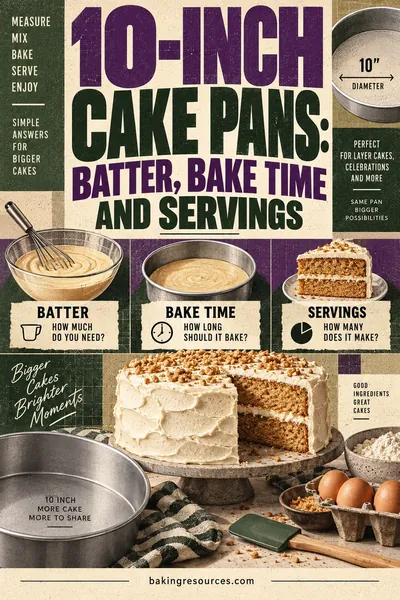
| 10-inch round cake pan | 10 x 2 in | 10 to 11 | 7 |
| 9-inch loose bottom tart pan | 9 x 1 in | 4 | 2.7 |
| 8-inch push pan | 8 x 3 in | 9 | 6 |
| 9x5 loaf pan | 9 x 5 x 3 in | 8 | 5.3 |
| 9x13 pan | 9 x 13 x 2 in | 14.5 | 9.7 |
| 12-well muffin pan | 1/2 cup per well | 6 | 4 |
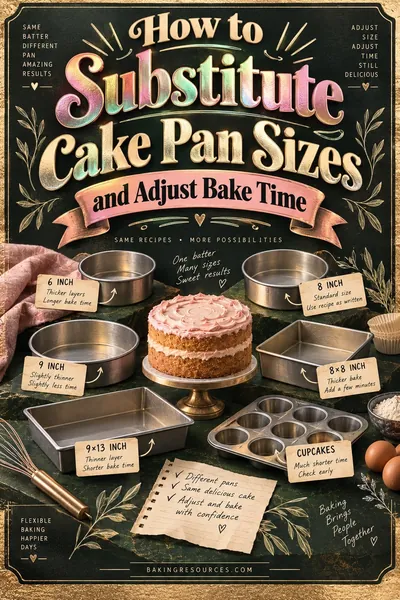
Read that table and the trap jumps out. A 9-inch springform holds 10 to 12 cups. A standard 9-inch cake pan holds 8. Same diameter, and you are short by a quarter of the capacity.
Three ways to solve it. Use a 9x3 deep round, which matches the springform almost exactly. Step up one size to a 10-inch round. Or hold back the extra batter and bake it separately in ramekins or muffin wells.
Standard tart pans are the other trap. They are wide and shallow, usually only 1 inch deep, so a 9-inch tart pan holds 4 cups against the springform's 10 to 12. It is a great release mechanism attached to the wrong volume. Deep loose bottom pans and push pans exist in 2 to 3 inch depths and those are the ones to buy.
For the full round pan lineup and how the diameters compare by area, our round cake pan sizes chart has the complete set.
Worked example: a 9-inch springform cheesecake into pans you own
Take a cheesecake recipe written for a 9-inch springform, producing about 7 cups of filling plus a pressed crumb base, baked at 325°F for 55 to 65 minutes. If the base is cookie rather than graham, how many Oreos make a cup of crumbs gives the count.
Option A, a 9x3 deep round pan.
- Capacity: 12 cups, two-thirds ceiling is 8 cups. Your 7 cups fits.
- Depth: 7 cups x 14.4 cubic inches per cup = 101 cubic inches, divided by the 9-inch pan's 63.6 square inches = 1.59 inches deep.
- The springform version sat at the same 1.59 inches, because the diameter is identical.
- Bake time: unchanged. 325°F for 55 to 65 minutes, pulled at 150°F in the center.
- Release: parchment sling, chilled overnight.
Option B, an 8-inch round, 3 inches deep.
- Capacity: 9 cups, ceiling is 6 cups. Your 7 cups is over the line.
- So bake 6 cups in the pan and put the remaining cup into four small ramekins.
- Depth of the 6 cups: 6 x 14.4 = 86 cubic inches, divided by 50.3 square inches = 1.72 inches. That is 0.13 inches deeper than the original.
- Bake time: add about 5 minutes. Call it 60 to 70 minutes, still at 325°F.
- The ramekins bake alongside for 25 to 30 minutes.
Option C, a 9x13 pan for bar-style.
- Capacity: 14.5 cups, ceiling 9.7 cups. All 7 cups fits easily.
- Depth: 7 x 14.4 = 101 cubic inches, divided by 117 square inches = 0.86 inches. Much shallower.
- Bake time: cut it hard. Start checking at 35 minutes, expect 35 to 45.
- Release: a foil sling across the long direction, chill, lift, cut into squares.
- Servings change from 12 wedges to 24 bars, which our cake servings calculator can size for a specific headcount.
Option C is the one people forget, and it is often the best outcome. Bars travel better, cut cleanly, and skip the release problem entirely. Our guide to 9x13 pan substitutes covers the reverse direction if you need it.
The water bath question
Cheesecake recipes usually ask for a water bath, and this is where a springform is actually the weaker pan. Every springform leaks eventually, because the base sits in a groove rather than sealing against it. Bakers wrap them in two layers of heavy duty foil for exactly this reason, and water still gets in. The bath exists to keep the custard gentle, and keeping a cheesecake surface intact explains what it is actually doing.
A solid cake pan does not have this problem at all. No seam, no leak. That makes a solid pan plus a parchment sling the better setup for any water bath bake, not the compromise.
Set it up like this. Put the filled pan into a larger roasting pan, slide the whole thing onto the middle rack, then pour hot water into the roasting pan until it reaches about halfway up the outside of the cake pan. Pouring after the pans are already in the oven means you are not carrying a sloshing tray across the kitchen.
If your roasting pan is too small, use the towel method instead: set the cake pan on a folded kitchen towel in a rimmed sheet pan and pour in about 1/2 inch of hot water. Less insulation, but far better than a dry oven.
The bake target is a center reading of about 150°F, with the outer 2 inches set and the middle still wobbling like gelatin when you nudge the pan. It firms as it cools, and it will crack if you bake it until the center is firm in the oven.
Cake rings, foil pans and other improvised options
Cake rings are just the hoop with no base. Set one on a parchment-lined sheet pan and it becomes a mold for anything you chill rather than bake, like mousse cakes and icebox desserts. For a baked batter, wrap the outside base in foil and expect a little seepage.
Disposable foil pans deserve more respect than they get. They come in 8-inch and 9-inch rounds, they are cheap, and you can cut them off the finished cake with kitchen shears. The downsides are real: they flex when you carry them and they conduct heat unevenly. Always set one on a preheated sheet pan, which stiffens the base and evens out the bottom heat.
A DIY foil collar turns a shallow pan into a deep one. Fold a long strip of heavy duty foil into a band about 4 inches wide, grease it, and press it against the inside wall of the pan so it stands 1 to 2 inches above the rim. Clip the overlap. It will not hold a very liquid batter, but for a thick cheesecake batter or a dense torte it buys you real height.
Slow cooker inserts and pressure cooker pans are usually 6 or 7 inches across with 3-inch sides, which is a decent scaled-down springform stand-in. Our 6-inch cake pan guide has the batter volumes for that size.
What not to use
A pie plate for cheesecake. Sloped sides and about 1.5 inches of depth. A 9-inch pie plate holds around 4 cups, so a 7-cup filling overflows badly, and the slope means you cannot cut a clean wedge.
A Bundt or tube pan. The center tube changes the bake completely and the crevices grip a soft cake. Fine for a butter cake, wrong for anything a springform was chosen for.
A glass dish with no lining and no sling. Glass grips more than metal and you cannot cut it away. If glass is all you have, use a full foil sling and chill for a long time.
Anything without a rimmed sheet pan underneath. Every substitute here is more leak prone than a factory pan. A sheet pan under it costs nothing and saves an hour of scrubbing the oven floor.
Frequently asked questions
Can I make cheesecake without a springform pan?
Yes, and the setup is often better. Line a 9x3 round cake pan with a parchment circle and two crossed parchment strips, bake as usual in a water bath, chill overnight, then lift the cake out by the paper handles. A solid pan cannot leak the way a springform seam does, so the water bath is actually safer.
What size regular pan replaces a 9 inch springform?
A 9x3 deep round is the exact match, since both hold about 12 cups. A standard 9x2 round only holds 8 cups, so it is about 4 cups short and you would need to hold batter back. A 10-inch round at 2 inches deep is the next best option and holds 10 to 11 cups.
Do I need to change the bake time in a substitute pan?
Only if the batter depth changes. Same diameter and same batter volume means the same time. Going to a smaller diameter makes the batter deeper, so add about 10 to 15 minutes per extra half inch and drop the oven 25°F. Going wider makes it shallower, so cut 8 to 12 minutes per half inch. Our baking time calculator runs that math for you.
How do I get a cake out of a solid pan without flipping it?
Chill it hard, then lift it with a parchment sling. If you did not line the pan, run a thin knife around the edge, set the pan base on a warm damp towel for 30 to 60 seconds to loosen the bottom, then invert onto a plate and immediately reinvert onto a serving plate. The warming step is what breaks the seal.
Is a push pan the same as a springform?
Close, and often better. A push pan has a solid one-piece side with a removable base that you push up from underneath, so there is no hinge or latch to fail. It still has a seam at the base, so wrap it for a water bath, but it is sturdier and easier to clean than a springform.
Can I use a loose bottom tart pan instead of a springform?
Only if the depth matches. Standard tart pans run about 1 inch deep and hold roughly 4 cups at 9 inches across, which is less than half a 9-inch springform. Deep loose bottom pans at 2 to 3 inches do work as a direct swap. Always set a loose bottom pan on a sheet pan, since the base can drop out when you lift it.
My springform leaked into the oven. What do I do differently?
Wrap the outside in two layers of heavy duty foil, wide enough to come all the way up the sides in one piece with no seam below the water line, and set the whole thing on a rimmed sheet pan. Or switch to a solid pan with a parchment sling, which removes the leak path entirely.
How full should I fill a springform or its substitute?
Two thirds of the pan's total volume, same as any pan. Batter expands as leaveners release gas and steam builds, and a cake can gain 40 percent in height before the structure sets. Multiply the pan's cup capacity by 0.67 and bake any extra as ramekins or cupcakes.
Where to go next
Pan swaps are three questions in one: does it fit, how long does it bake, and how does it come out.
Run any two pans through the cake pan converter for the volume ratio and the time adjustment. Get the lining right with our guide to lining a cake pan. And if you are choosing a diameter rather than working around one, the round cake pan sizes chart lays out every common size by area, volume and servings.