Springform Pan Sizes Explained

Here are springform pan sizes explained in one line each: an 8 inch springform holds about 10 cups, a 9 inch holds about 12 cups, and a 10 inch holds about 15 cups when filled level to the rim. The 9 inch is the size most American cheesecake recipes are written for, so if you own one pan, own that one.
The number stamped on the pan is only the diameter. Depth is the half of the measurement nobody prints, and it is the half that decides whether your batter overflows. A 9 inch springform is usually 2.75 inches tall, while a plain 9 inch cake pan is 2 inches tall, so the springform holds 50 percent more even though both say "9 inch."
Updated September 2026
Swapping between two pans you actually own? Put both into our free cake pan converter and it gives you the capacity ratio, the new batter depth and the bake time change in one answer.
Springform pan sizes explained, from 4 inch to 12 inch
Every capacity below is the pan filled level to the rim. You will never actually fill one that high, but rim capacity is the only number that lets you compare two pans honestly.
| Springform size | Usual depth | Holds (level full) | Metric | What it suits |
|---|---|---|---|---|
| 4 inch | 2 in | About 1 3/4 cups | 10 cm | Single-serving cheesecakes, tasting portions |
| 6 inch | 3 in | About 6 cups | 15 cm | Small cheesecake for 6 to 8, tall layer cake |
| 7 inch | 3 in | About 8 cups | 18 cm | The common European size, halfway pan |
| 8 inch | 3 in | About 10 cups | 20 cm | Cheesecake for 10, deep tortes |
| 9 inch | 2.75 in | About 12 cups | 23 cm | The American standard cheesecake pan |
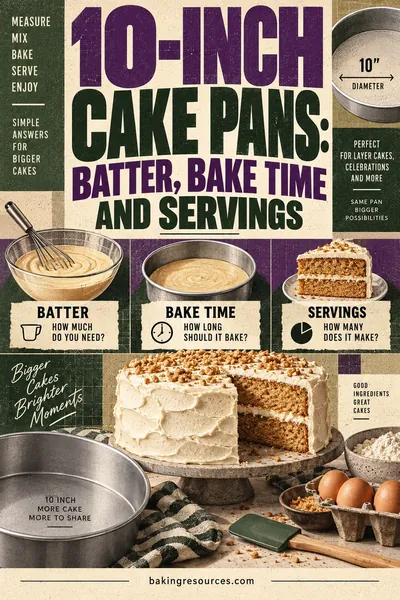
| 10 inch | 2.75 in | About 15 cups | 26 cm | Big cheesecake, party sizes |
| 12 inch | 2.75 in | About 21 1/2 cups | 30 cm | Very large or shallow show cakes |
Two things jump out of that table.
First, capacity climbs much faster than diameter. Going from 8 inch to 9 inch sounds like a small step, but you gain 2 cups. Going from 9 inch to 10 inch gains 3 more. Area grows with the square of the radius, so each extra inch of width costs you more batter than the last one did.
Second, the depth is not consistent across sizes. Most 6, 7 and 8 inch springforms are 3 inches tall, while most 9 and 10 inch pans are 2.75 inches. That is why an 8 inch pan can hold more than you would guess from the width alone.
Why a springform holds more than a cake pan of the same width
This is the trap that ruins the most bakes. Same number on the pan, very different capacity.
| Diameter | Springform capacity | Round cake pan capacity | Difference |
|---|---|---|---|
| 8 inch | About 10 cups | 6 cups | 67 percent more |
| 9 inch | About 12 cups | 8 cups | 50 percent more |
| 10 inch | About 15 cups | 10 1/2 cups | 43 percent more |
So a cheesecake written for a 9 inch springform will not fit in a 9 inch cake pan. Not close. You would be trying to put 12 cups of capacity worth of batter into an 8 cup pan.
Going the other direction is safer but looks odd. A butter cake written for a 9 inch round will sit in a 9 inch springform as a thin disc filling about two thirds of the height, and it will bake faster because the batter is shallower. Start checking it 5 to 10 minutes early.
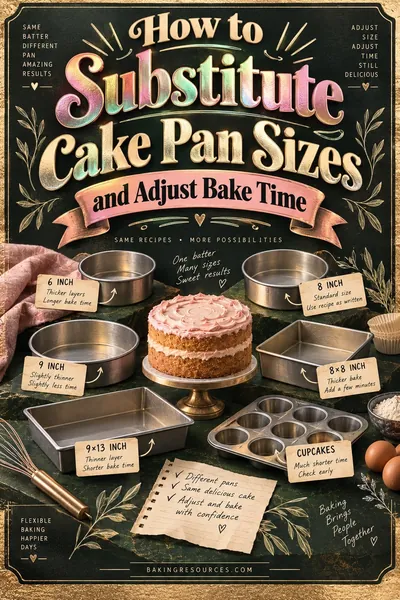
If you are working the swap in the other direction, our guide to substituting cake pan sizes walks through the full ratio method, and the springform substitute guide covers what to do when you have no springform at all.
Worked example: a 10 inch cheesecake in a 9 inch pan
Say the recipe is written for a 10 inch springform and you own a 9 inch. Here is the actual math, step by step.
- Look up both capacities. 10 inch springform is 15 cups. 9 inch springform is 12 cups.
- Divide. 12 divided by 15 is 0.80. Your pan holds 80 percent of what the recipe expects.
- Scale the recipe to 4/5. A filling built on 40 ounces of cream cheese becomes 32 ounces. Four eggs becomes three eggs plus one yolk. Sugar, sour cream and vanilla all drop to 80 percent.
- Leave the crust math alone at first. A crust scaled to 80 percent by weight will be about the right thickness, because the floor of the 9 inch pan is 79 percent of the floor of the 10 inch pan. Those two numbers land close enough that you can just use 4/5 of the crust too.
- Keep the same oven temperature. The batter depth barely changes, so the recipe's own time and temperature hold. Test the center for wobble rather than trusting the clock.
Now the version where you refuse to scale anything. The 10 inch recipe fills its pan to about 2 1/4 inches, which is roughly 12 1/4 cups of batter. Pour all of that into the 9 inch pan and it needs 2.78 inches of depth. The wall is 2.75 inches. It goes over the top, into the oven, and onto the floor of the oven. The three minutes of scaling is worth it.
Worked example: one 9 inch recipe split into two 6 inch pans
People do this for gifting, and the math is friendlier than it looks.
A 9 inch springform has a floor area of about 63.6 square inches. Two 6 inch pans give you 28.3 each, so 56.5 square inches together. That is 89 percent of the 9 inch floor.
So the full 9 inch batch spread across two 6 inch pans sits about 12 percent deeper than it did in the original. That is inside the "a little deeper" band, so add roughly 10 to 20 percent to the bake time and drop the oven 25°F so the outsides do not set before the middles do. Both pans are 3 inches tall, so there is plenty of headroom.
If you would rather not adjust anything, scale the recipe to 7/8 and the depth stays identical.
Metric springform sizes, cm to inches
European recipes and most imported pans are labeled in centimeters, and the conversions are not round numbers. Here is what actually matches what.
| Metric label | True inches | Closest US size | Honest verdict |
|---|---|---|---|
| 15 cm | 5.9 in | 6 inch | Direct match |
| 18 cm | 7.1 in | 7 inch | Direct match |
| 20 cm | 7.9 in | 8 inch | Direct match |
| 22 cm | 8.7 in | 8 or 9 inch | Sits between the two, closer to 9 |
| 23 cm | 9.1 in | 9 inch | Direct match |
| 24 cm | 9.4 in | 9 inch | About 9 percent more capacity than a true 9 inch |
| 26 cm | 10.2 in | 10 inch | Direct match |
| 28 cm | 11.0 in | No US equivalent | Between 10 and 12 inch |
The awkward one is 24 cm, which shows up constantly in German and Austrian recipes. It is roughly 9 percent larger by area than a 9 inch pan. In practice a 24 cm cake baked in a 9 inch pan comes out about 9 percent taller and needs a few extra minutes. That is fine for most cakes and a nuisance for a cheesecake, which is thick enough already.
What size springform pan for cheesecake
For a standard American cheesecake built on four to five blocks of cream cheese, you want a 9 inch springform, 2.75 to 3 inches deep. That is the size the recipe was tested in, and it gives a slice that is tall without being top heavy.
Here is how the sizes map to servings:
| Pan | Typical cheesecake servings | Notes |
|---|---|---|
| 6 inch | 6 to 8 slim slices | Great for two people plus leftovers |
| 7 inch | 8 to 10 | Good compromise size |
| 8 inch | 10 to 12 | Taller slices than a 9 inch, longer bake |
| 9 inch | 12 to 16 | The default. Every recipe assumes this |
| 10 inch | 16 to 20 | Shallower slices unless you scale the filling up |
One thing to watch. If you move a 9 inch cheesecake into an 8 inch pan without scaling, the filling gets about 25 percent deeper. Deep cheesecake needs a lower, longer bake, so drop the oven 25°F and expect to add real time. Pull it when the center still wobbles as one set piece rather than rippling, and read 170 to 180°F in the middle if you are using a thermometer. Baking past that point is the usual reason for a split top, which is why how to prevent cheesecake from cracking starts with doneness.
How to measure a springform pan you already own
Pan labels rub off, and secondhand pans arrive with no label at all. Two measurements settle it.
Diameter. Measure across the top of the pan from inside wall to inside wall, not across the outer rim and not across the base. The latch hardware adds up to half an inch of width that is not capacity.
Depth. Stand a ruler inside the pan on the base and read where the wall ends. Do not measure the outside of the pan, because the base sits proud of the bottom edge on most designs.
If you want the capacity rather than the dimensions, skip the ruler and pour. Set the pan on a plate to catch leaks, then fill it with water one cup at a time until it reaches the rim. The number of cups is your capacity, and it beats any chart because it accounts for your pan's exact shape and any flare in the walls.
Depth, leaks and water baths
Springform pans leak. All of them, eventually, because a two-piece pan cannot seal like a solid one. Depth interacts with that in a way worth knowing.
A shallow batter in a tall pan is low risk. The batter never sits against the seam long enough to find a way out. A pan filled close to the rim puts real pressure on the seam and gives thin batters a much better chance of escaping.
For a water bath, the depth of your springform decides your foil strategy. A 2.75 inch pan needs the foil to reach at least 3 inches up the outside, which means heavy duty foil at least 18 inches wide, or a slow cooker liner style bag, or the pan sitting inside a larger cake pan that keeps water away entirely. Standard 12 inch foil seamed together always fails at the seam.
If the batter is thin and the seam is old, line the base with a parchment circle and run a strip of parchment or a thin band of foil around the inside of the wall before you latch it. It will not stop water coming in, but it slows batter going out. Our guide to lining a cake pan covers the sling method that makes any lined pan behave.
Fill levels by what you are baking
Capacity is not the same as how much you should pour in. Different bakes want different fill levels in the same pan.
| What you are baking | Fill to | In a 9 inch springform |
|---|---|---|
| Cheesecake (barely rises) | 3/4 to 7/8 full | About 9 to 10 1/2 cups |
| Butter cake or sponge (rises a lot) | 1/2 to 2/3 full | About 6 to 8 cups |
| Torte or flourless chocolate cake | 2/3 full | About 8 cups |
| Ice cream or mousse cake (no bake) | Right to the rim | About 12 cups |
| Deep dish batter with baking powder | 1/2 full | About 6 cups |
Anything with a chemical leavener needs headroom, because it climbs. Anything set with eggs and no leavener, like cheesecake, barely moves and can go much higher.
Frequently asked questions
Is a 9 inch springform pan the same as a 9 inch cake pan?
No, and this is the single most common springform mistake. A 9 inch springform is usually 2.75 inches deep and holds about 12 cups. A standard 9 inch round cake pan is 2 inches deep and holds 8 cups. The springform holds 50 percent more, so a cheesecake recipe written for one will overflow the other.
What size springform pan is 23 cm?
23 cm is 9.06 inches, so it is a direct match for a US 9 inch springform. Use the recipe exactly as written. 24 cm, which looks almost the same on the shelf, is about 9 percent larger by area and will give you a slightly shorter cake in the same recipe.
Can I use an 8 inch springform instead of a 9 inch?
Yes, with one change. The 8 inch holds about 10 cups against the 9 inch pan's 12, so the same batter sits roughly 25 percent deeper. Drop the oven 25°F and add time, or scale the recipe to about 5/6 and change nothing else. Do not just pour and hope, because the 8 inch pan is only a quarter inch taller.
How many cups does a 10 inch springform pan hold?
About 15 cups filled to the rim, based on a 10 inch pan that is 2.75 inches deep. For a cheesecake filled to about seven eighths, that works out to roughly 13 cups of batter. Measure your own pan with water if the depth looks different, because 3 inch versions exist and hold closer to 16 cups.
Do I need to change the oven temperature when I switch springform sizes?
Only if the batter gets deeper. Deeper batter needs longer in the oven, and leaving the temperature alone dries the outside before the middle sets. Drop the oven 25°F and add 10 to 20 percent to the time. Shallower batter needs no temperature change, just less time and an early check.
What is the most useful springform size to own if I can only have one?
The 9 inch. Almost every American cheesecake, torte and set dessert recipe is written for it, so you avoid scaling entirely. If you already have a 9 inch and want a second, a 6 inch is the more useful addition than an 8 inch, because it opens up small bakes rather than duplicating what you have.
Why does my springform pan capacity not match the chart?
Wall flare and true depth vary between brands, and a pan sold as 2.75 inches can measure 2.5 or 3. The chart figures come from the standard dimensions our pan converter uses. For your exact pan, fill it with water a cup at a time and use that number instead. It takes two minutes and it is always right.