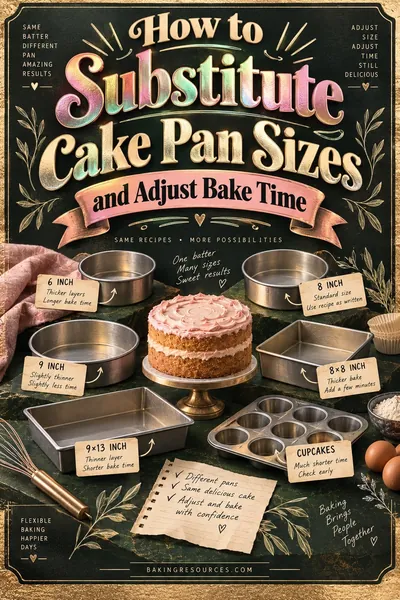
Round Cake Pan Sizes and Dimensions

A standard round 9 inch cake pan measures 9 inches across the inside of the top rim and 2 inches deep. It holds about 8 cups of water level to the rim, which means 5 to 6 cups of batter in real use, since you fill a cake pan two thirds full and no more. That's a two-layer cake for 12 to 16 people.
The four sizes worth owning are 6, 8, 9, and 10 inches, all 2 inches deep. Swapping between them isn't about the diameter. It's about the surface area, and the numbers are not what your eye tells you.
Working out a swap right now? Our free cake pan converter does the area math and the batter volume for any two pans.
Updated September 2026
Round cake pan sizes: the full chart
Every volume below is level-to-the-rim capacity, the number you get by filling the pan with water. The batter column is two thirds of that, which is the number you should actually be doing math with.
| Pan size | Metric | Depth | Surface area | Volume to rim | Batter it takes | Servings (2 layers) |
|---|---|---|---|---|---|---|
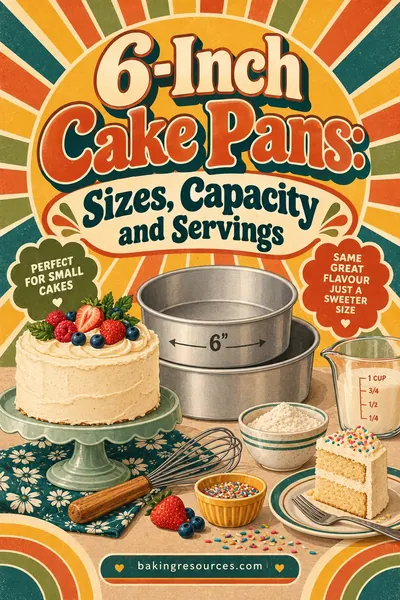
| 6 inch | 15 cm | 2 in | 28.3 sq in | 4 cups | 2 1/2 to 3 cups | 6 to 8 |
| 7 inch | 18 cm | 2 in | 38.5 sq in | 5 1/2 cups | 3 1/2 cups | 8 to 10 |
| 8 inch | 20 cm | 2 in | 50.3 sq in | 6 cups | 4 cups | 8 to 12 |
| 9 inch | 23 cm | 2 in | 63.6 sq in | 8 cups | 5 to 6 cups | 12 to 16 |
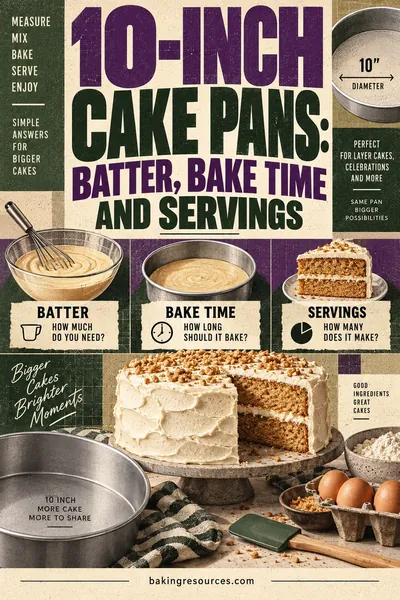
| 10 inch | 25 cm | 2 in | 78.5 sq in | 11 cups | 7 cups | 16 to 20 |
| 12 inch | 30 cm | 2 in | 113.1 sq in | 15 cups | 10 cups | 25 to 30 |
| 14 inch | 35 cm | 2 in | 153.9 sq in | 21 cups | 14 cups | 35 to 40 |
Deep pans, the 3-inch ones sold for tall layer cakes and cheesecakes:
| Pan size | Depth | Volume to rim | Batter it takes | Notes |
|---|---|---|---|---|
| 6 inch | 3 in | 6 cups | 4 cups | Tall single layer, or split into two |
| 8 inch | 3 in | 10 cups | 6 1/2 cups | Cheesecake standard |
| 9 inch | 3 in | 12 cups | 8 cups | Replaces two 2-inch 9s in one bake |
| 10 inch | 3 in | 15 cups | 10 cups | Springforms often run shallower, near 12 cups |
Two honest caveats on these figures.
Pan brands vary by up to a cup at the same nominal size, because of how much the sides slope. If a swap is going to be tight, fill your own pan with water from a measuring cup and write the number on a piece of tape underneath it. Thirty seconds, and you never have to guess again.
Servings depend entirely on how you slice. The numbers above assume a normal dessert slice. Wedding-style slicing gets roughly twice as many out of the same cake.
How to measure a cake pan properly
Cake pans are named by their inside top diameter, not the outside. Measuring across the outer rim adds a quarter inch or more and will send you to the wrong row of the chart.
Lay a ruler flat across the top of the empty pan and read the distance between the inside edges. Then stand the ruler inside the pan against the wall and read the inside depth from the base to the rim. That's your two numbers.
The depth catches people out more than the diameter. "Round cake pan" almost always means 2 inches deep, but plenty of thrift-store and hand-me-down pans are 1 1/2 inches. An 8-inch pan at 1 1/2 inches deep holds about 4 1/2 cups, not 6. A quarter less than the chart says, and enough to put batter on your oven floor.
Surface area is the number that matters
Going from a 9-inch to an 8-inch pan sounds like a small step. One inch. It isn't.
Area is π times the radius squared, so a one-inch change in diameter changes the area by a lot more than 1/9th. Here's every common round pan measured against a 9-inch:
| Pan | Surface area | Compared to a 9-inch | Batter depth vs a 9-inch |
|---|---|---|---|
| 6 inch | 28.3 sq in | 44% | 2.25x deeper |
| 7 inch | 38.5 sq in | 61% | 1.65x deeper |
| 8 inch | 50.3 sq in | 79% | 1.26x deeper |
| 9 inch | 63.6 sq in | 100% | Baseline |
| 10 inch | 78.5 sq in | 123% | 0.81x, shallower |
| 12 inch | 113.1 sq in | 178% | 0.56x, much shallower |
Read the last column as "what happens if you pour the same batter in." Move a 9-inch recipe into an 8-inch pan without changing anything and your batter sits 26% deeper. That's why the edges overbake while the center is still raw, and it's the single most common pan-swap failure.
Move it up to a 10-inch and the batter is a fifth shallower, so it bakes faster and comes out flatter and drier if you don't pull it early.
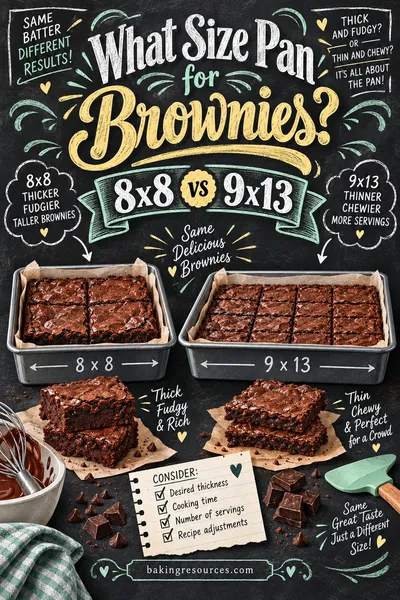
Two 9-inch rounds give you 127 square inches of pan. A 9x13 gives you 117. That's why two 9-inch layers are the standard stand-in for a sheet cake, and our 9x13 pan substitute guide has the rest of those swaps.
Round to square and round to rectangle
A square pan holds more than a round pan of the same nominal size, because the corners are free real estate. The rule of thumb bakers use: a round pan swaps with a square pan one inch smaller.
| Round pan | Nearest square or rectangle | Area match |
|---|---|---|
| 8 inch round (50.3) | 7 inch square (49) | Within 3% |
| 9 inch round (63.6) | 8 inch square (64) | Within 1% |
| 10 inch round (78.5) | 9 inch square (81) | Within 4% |
| 12 inch round (113.1) | 10 inch square (100) | 12% off, run it deeper |
| Two 9 inch rounds (127.2) | One 9x13 (117) | 9% off, run it deeper |
| Two 8 inch rounds (100.5) | One 9x13 (117) | 14% short, batter runs thin |
The 9-inch round and the 8-inch square are within one percent of each other. Those two swap straight across with no change to time or temperature at all. It's the single most useful pan fact in this article.
How full should a round cake pan be?
Two thirds full, measured by depth. In a 2-inch pan, that's batter sitting about 1 1/3 inches deep, which leaves two thirds of an inch of clear wall above it.
| Fill level | What happens |
|---|---|
| Half full | Bakes fast and flat. Fine for thin layers you plan to stack |
| Two thirds | The target. Full dome, no spill, even bake |
| Three quarters | Works for low-rise batters like cheesecake and pound cake |
| To the rim | Overflow, sunken middle, and a burnt smell |
Batters with a lot of chemical leavening. Most butter cakes and anything from a box. Need the full third of headroom. Cheesecake, flourless chocolate cake, and dense pound cake barely rise, so 3/4 full is safe there.
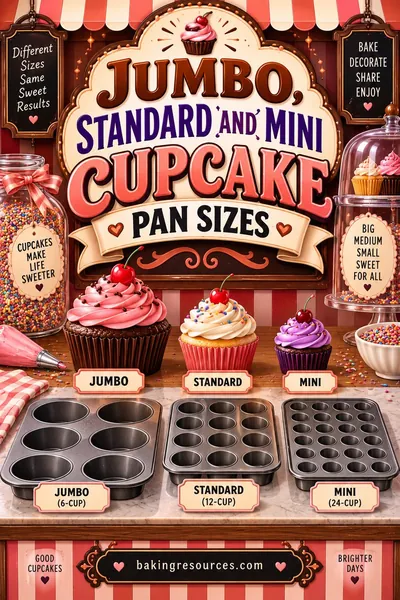
If you have extra batter after filling to two thirds, bake it as cupcakes rather than crowding the pan. A standard cupcake well takes about 1/3 cup, so a leftover cup of batter is 3 cupcakes, and they'll be done in 18 to 22 minutes.
Bake time by batter depth, not by pan size
Depth drives bake time. Diameter barely matters once the depth is set, because heat travels in from the sides and up from the base at the same rate whatever the width.
| Batter depth | Typical bake at 350°F | Adjustment |
|---|---|---|
| Under 3/4 inch | 15 to 22 min | Thin layers. Check early, they go from done to dry fast |
| 3/4 to 1 1/4 inch | 22 to 32 min | The comfortable range for most layer cakes |
| 1 1/4 to 1 3/4 inch | 32 to 45 min | Standard 2-inch pan filled properly |
| Over 1 3/4 inch | 45 to 70 min | Drop to 325°F and consider a bake-even strip |
Anything sitting deeper than about 2 inches wants a lower oven. At 350°F the outside of a deep cake sets and browns long before the middle is warm, and you get a domed, cracked top over a raw core. Dropping to 325°F and adding 15 minutes fixes it.
Doneness beats arithmetic every time. A butter cake is done at 205 to 210°F in the center, and that number holds no matter which pan you used. A toothpick with a few moist crumbs says the same thing less precisely.
Pan material changes the numbers too
Light aluminum is the baseline everything on this page assumes. It conducts fast and reflects, so you get pale, even sides and a flat top.
Dark or nonstick metal absorbs heat and browns much harder. Drop the oven 25°F and start checking 5 minutes early. This is the usual reason a cake that worked at a friend's house burns at yours.
Glass is uncommon in round cake pans but shows up as a pie plate pressed into service. Glass heats slowly and holds heat, so drop 25°F and add 5 to 10 minutes.
Silicone insulates instead of conducting. Expect 10 to 15 minutes longer, weak browning on the sides, and a floppy pan that needs a sheet pan underneath it for transport.
Springform pans leak. A thin cake batter will find the seam, so line the base with parchment and wrap the outside in foil if the batter is loose or you're using a water bath. Most 9-inch springforms are 2 1/2 to 3 inches deep, so check yours before trusting the 3-inch row above.
Straight-sided vs sloped is the quiet one. Professional-style pans have vertical walls; supermarket pans slope outward, so a "9-inch" sloped pan is 9 inches at the top and closer to 8 1/2 at the base. That costs you about 5 to 8 percent of the volume and gives you a slanted cake edge that's harder to stack neatly.
Worked example 1: a two-layer 9-inch recipe in 8-inch pans
What you have: a recipe written for two 9-inch rounds, and two 8-inch rounds in the cupboard.
Step 1. How much batter is there? Two 9-inch pans filled to two thirds is 5.3 cups each, so about 10.6 cups total.
Step 2. What will the 8-inch pans take? Working capacity is 4 cups each, or 8 cups total. You're 2.6 cups over.
Step 3. What happens if you ignore that? Split 10.6 cups between two 8-inch pans and each gets 5.3 cups. One cup is 14.4 cubic inches, so that's 76.5 cubic inches sitting on 50.3 square inches of pan. 1.52 inches deep. The two-thirds line in a 2-inch pan is 1.33 inches. You're over it, and that batter is going onto the oven floor.
Step 4. The fix. Put 4 cups in each 8-inch pan and bake the remaining 2.6 cups as cupcakes. At 1/3 cup per well that's 8 cupcakes, done in about 20 minutes while the layers are still going.
Step 5. The timing. Both pans are filled to the same fraction, so the batter depth is nearly identical to the original and the bake time barely moves. Check 2 to 3 minutes early and pull at 205°F.
What you end up with: an 8-inch two-layer cake that's slightly taller and a touch smaller across than the recipe intended, serving 8 to 12 instead of 12 to 16, plus 8 cupcakes for the freezer.
Worked example 2: scaling a 9-inch recipe down to 6-inch pans
Six-inch pans are having a moment, and the math to get there is simple once you use area instead of diameter.
The ratio. A 6-inch pan is 28.3 square inches against a 9-inch pan's 63.6. That's 0.44, so multiply every ingredient by 0.45 to make two 6-inch layers from a two-9-inch recipe.
Real numbers. Say the recipe calls for 250 g flour, 200 g sugar, 3 large eggs, and 170 g butter.
- Flour: 250 x 0.45 = 113 g
- Sugar: 200 x 0.45 = 90 g
- Butter: 170 x 0.45 = 77 g
- Eggs: 3 large eggs weigh about 150 g shelled. 150 x 0.45 = 68 g of beaten egg, which is about one and a third eggs
That egg line is why scaling by weight beats scaling by count. Crack all three eggs into a bowl, beat them, and weigh out 68 g. Guessing at "one and a bit eggs" is how a cake ends up either rubbery or crumbly. Our guide to scaling a recipe covers the rest of the awkward ingredients, including leavening and salt.
The other option: don't scale at all. That same 10.6 cups of batter divides into four 6-inch layers at 2.65 cups each, which is exactly the two-thirds fill for a 6-inch pan. A two-layer 9-inch recipe makes a four-layer 6-inch cake with no math whatsoever. Bake in two batches if you only own two pans, and keep the second batch of batter at room temperature, not in the fridge.
Bake time: 6-inch layers at the same fill depth run within a couple of minutes of 9-inch layers. Same temperature, check at the recipe time.
Frosting and lining, sized by pan
Buttercream for a filled and frosted layer cake, using a normal crumb coat plus a final coat:
| Cake | Frosting needed |
|---|---|
| Two 6-inch layers | 2 to 2 1/2 cups |
| Two 8-inch layers | 3 to 4 cups |
| Two 9-inch layers | 4 to 5 cups |
| Three 8-inch layers | 4 1/2 to 5 1/2 cups |
| Two 10-inch layers | 6 to 7 cups |
Add a cup if you're piping borders or a shell edge. Our buttercream guide has the batch sizes.
For a fondant finish instead, fondant quantities by pan size covers the rolled sheet each of these cakes needs.
For parchment, cut a circle to the exact inside diameter and, if you want clean vertical sides, a collar strip as long as the circumference. Circumference is π times the diameter:
- 6-inch pan: 18.8-inch strip
- 8-inch pan: 25.1-inch strip
- 9-inch pan: 28.3-inch strip
- 10-inch pan: 31.4-inch strip
Round up an inch for the overlap. How to line a cake pan walks through the folding trick that gets you a perfect circle without tracing.
Frequently asked questions
What are the dimensions of a round 9 inch cake pan?
Nine inches across the inside of the top rim and 2 inches deep, giving 63.6 square inches of surface area. It holds 8 cups of water to the rim and takes 5 to 6 cups of batter at the correct two-thirds fill. Deep versions run 3 inches and hold about 12 cups.
Can I use an 8 inch pan instead of a 9 inch?
Yes, but not with the same amount of batter. An 8-inch pan has 21% less surface area, so the same batter sits 26% deeper and the edges will overbake before the middle sets. Hold back about a fifth of the batter, bake it as cupcakes, and drop the oven 25°F if the cake is deep.
How much batter goes in a 9 inch round pan?
Five to six cups, which fills a 2-inch pan two thirds of the way up. Cheesecake and pound cake can go to three quarters full since they barely rise. Anything with a lot of baking powder needs the full third of headroom.
What size cake pan feeds 20 people?
Two 10-inch rounds, or three 8-inch rounds, both land in the 16 to 20 range with generous slices. A single 12-inch round gets you 25 to 30 at dessert-slice size. Sheet cakes go further per pan if you're not stacking layers.
Is a 9 inch round the same as an 8 inch square?
For batter purposes, yes. A 9-inch round is 63.6 square inches and an 8-inch square is 64, so they're within one percent. Swap them straight across with no change to temperature or time.
How do I convert a two-layer recipe to one deep pan?
Two 9-inch layers hold about 10.6 cups of batter, which fits a 9x3-inch pan filled two thirds full. Drop the oven to 325°F and add 20 to 30 minutes, because the batter is now sitting more than twice as deep. Check for 205°F in the center rather than trusting a time.
Why does my cake dome in the middle?
The edges set before the center does, so the center keeps rising with nowhere to go. Deep batter, a hot oven, and dark pans all make it worse. Dropping 25°F, using a damp bake-even strip around the pan, or spreading the batter slightly higher at the edges all help.
Do I need to change the temperature for a different pan size?
Only when the batter depth changes. Same depth means same temperature and roughly the same time. Deeper than about 1 3/4 inches, drop to 325°F and add time; shallower than 3/4 inch, keep 350°F and start checking 8 minutes early.
What's the most useful round pan size to own?
Two 8-inch and two 9-inch, all 2 inches deep, in light aluminum. That covers nearly every layer cake recipe written in the US, and the 9-inch doubles as a stand-in for an 8-inch square. Add a 6-inch pair if you make small cakes often, and a springform for cheesecake.
Related guides: 9x13 pan substitute | How to scale a recipe | How to line a cake pan | How to cool a cake | Cake pan converter