Loaf Pan Sizes: What Standard, Large and Bread Tins Hold

There are two standard loaf pan sizes in an American kitchen. The 8.5 x 4.5 x 2.5 inch pan holds about 6 cups to the rim and takes 4 cups of batter. The 9 x 5 x 2.75 inch pan holds about 8 cups and takes 5 1/3 cups of batter. That 2 cup gap is a third more room, which is exactly why a recipe written for one overflows or comes out flat in the other.
Everything else on the shelf is a variation on those two: 1 lb and 2 lb bread tins, long 12 inch pans, square-sided Pullman pans with lids, and the shallow bar pans sold as "loaf" pans that are really something else. The chart below gives dimensions, capacity, dough weight and bake time for all of them.
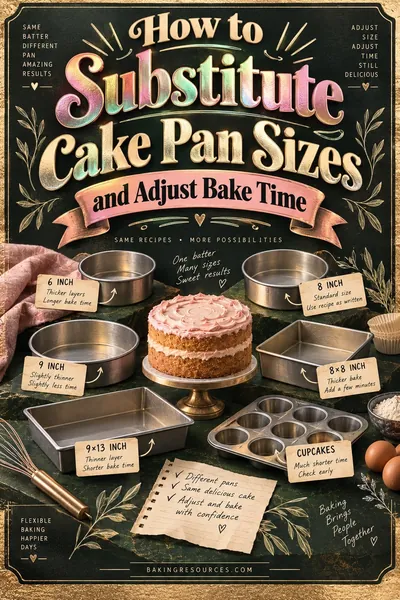
Swapping between two pans you own? Our free cake pan converter works out the volume difference and tells you how much batter to move.
Updated September 2026
Loaf pan sizes chart: dimensions, capacity and bake time
Measure across the inside of the top rim, not the outside of the pan. The outside number printed on the box is usually a quarter to half an inch bigger, and it is the reason so many people think they own a 9x5 when they own an 8.5 x 4.5.
| Pan (inside rim) | Metric | Volume to rim | Batter at 2/3 fill | Yeast dough weight | Quick bread at 350°F |
|---|---|---|---|---|---|
| 7.5 x 3.5 x 2.25 in | 19 x 9 x 6 cm | 4 cups | 2 2/3 cups | 400 to 480 g | 40 to 50 min |
| 8 x 4 x 2.5 in | 20 x 10 x 6 cm | 5 1/2 cups | 3 2/3 cups | 550 to 650 g | 45 to 55 min |
| 8.5 x 4.5 x 2.5 in | 21.5 x 11.5 x 6.5 cm | 6 cups | 4 cups | 660 to 780 g | 45 to 55 min |
| 9 x 5 x 2.75 in | 23 x 13 x 7 cm | 8 cups | 5 1/3 cups | 880 to 1,040 g | 55 to 70 min |
| 9 x 5 x 3 in | 23 x 13 x 7.5 cm | 9 cups | 6 cups | 990 to 1,170 g | 60 to 75 min |
| 10 x 5 x 3 in | 25 x 13 x 7.5 cm | 10 cups | 6 2/3 cups | 1,100 to 1,300 g | 65 to 80 min |
| 12 x 4 x 4 in | 30 x 10 x 10 cm | 13 cups | 8 2/3 cups | 1,200 to 1,400 g | Not typical |
| Pullman, 9 x 4 x 4 in | 23 x 10 x 10 cm | 10 cups | Lidded, see below | 900 to 1,000 g | Not typical |
| Pullman, 13 x 4 x 4 in | 33 x 10 x 10 cm | 14 1/2 cups | Lidded, see below | 1,300 to 1,450 g | Not typical |
Two honest caveats.
First, sloped sides eat capacity. A pan sold as 9x5 with straight walls really does hold 8 to 8 1/2 cups. The same nominal pan with a strong flare measures 9 across the top and 8 across the base, and holds closer to 7. If your loaves keep rising differently from the recipe photo, the slope is a likely culprit.
Second, the dough weight column is a guide, not a law. It works out to roughly 110 to 130 g of dough per cup of pan capacity for an open-top yeast loaf. Lean, wet doughs sit at the low end because they spring hard in the oven. Enriched doughs with butter, egg and milk sit at the high end because fat weighs down the rise.
Standard loaf pan size: 8.5 x 4.5 or 9 x 5?
Both get called standard, and that ambiguity causes more failed loaves than any other pan question.
The 8.5 x 4.5 is the better default for yeast bread. A sandwich loaf built on 500 g of flour makes roughly 830 g of dough, which fills this pan to a proper domed shape with tall, straight slices. In a 9x5, the same dough spreads out and bakes into a wide, squat loaf that makes short sandwich slices.
The 9x5 is the better default for quick breads and batters. Banana bread, pumpkin bread and zucchini bread recipes almost all come from the era when 9x5 was the common pan, and their batter volume is written for 8 cups of room. Put that batter in an 8.5 x 4.5 and you are 2 cups over.
Here is the practical difference at the fill line:
| Situation | 8.5 x 4.5 pan | 9 x 5 pan |
|---|---|---|
| Capacity to rim | 6 cups | 8 cups |
| Safe batter fill | 4 cups | 5 1/3 cups |
| A 4 1/2 cup quick bread batter | 75% full, will dome high and may spill | 56% full, safe and a little low |
| 830 g sandwich dough | Fills well, tall dome | Fills wide, short dome |
| Bake time at 350°F | 45 to 55 min | 55 to 70 min |
If you own one pan and want it to do both jobs, buy the 8.5 x 4.5 and bake the spare cup of quick bread batter as two or three muffins alongside. That is a far better outcome than a loaf that sinks in the middle because it climbed past the rim before the crumb set.
Bread tin dimensions: 1 lb, 2 lb and metric sizes
Outside the US, loaf pans are sold by the weight of the finished loaf rather than by inches. The names are approximate, and the sizes drift by brand more than American pans do.
| Tin name | Typical inside size | Metric | Capacity | US pan it matches |
|---|---|---|---|---|
| 1 lb tin | 6 x 3.5 x 3 in | 15 x 9 x 7.5 cm | 3 1/2 to 4 cups | Small loaf, 7.5 x 3.5 |
| 1.5 lb tin | 7.5 x 4 x 3 in | 19 x 10 x 7.5 cm | 5 cups | Between the two standards |
| 2 lb tin | 8.5 x 4.5 x 3 in | 21.5 x 11.5 x 7.5 cm | 7 to 7 1/2 cups | Close to a 9x5 |
| 3 lb tin | 10.5 x 5 x 3.5 in | 27 x 13 x 9 cm | 11 cups | Long 10 x 5 |
The number on the tin refers to the baked loaf, not the dough. A 2 lb tin takes a recipe built on about 500 g of flour, which is the same flour weight most American sandwich loaf recipes use. So a 2 lb tin and an 8.5 x 4.5 pan are close cousins, even though the tin is usually half an inch deeper.
Metric tins also tend to be taller and narrower than US pans at the same volume. Taller means the crust sets while the center is still climbing, so you get a more dramatic split up the top ridge. That is a feature, not a fault.
Pullman pans and why square sides change everything
A Pullman pan, sometimes labeled pain de mie, is a straight-sided box with a sliding lid. The two common sizes are 9 x 4 x 4 and 13 x 4 x 4 inches.
With the lid on, the loaf cannot dome. It fills the box and comes out as a square-cornered brick, which slices into perfectly uniform sandwich squares with almost no waste. That uniformity is the whole point.
Dough weight matters more here than in any other pan, because there is nowhere for a mistake to go.
- Too little dough and you get a short loaf with a dense, tight crumb and a gap under the lid.
- Too much dough and it pushes against the lid, forces itself out of the seams, and comes out with a compressed, gummy band near the top.
Aim for 90 to 100 g of dough per cup of pan capacity, which is slightly less than an open pan needs because there is no dome to fill. For the 13 x 4 x 4 that is 1,300 to 1,450 g. For the 9 x 4 x 4 it is 900 to 1,000 g.
The method matters as much as the weight. Shape the dough, drop it in, and let it proof until the crown reaches about 80% of the pan height, roughly an inch below the rails. Then slide the lid on and bake. If you cap it at 100%, the oven spring has nowhere to go.
Bake lidded loaves at 350 to 375°F and pull the lid off for the last 10 minutes if you want a little color on the top. Done is 190 to 200°F in the center for a soft enriched loaf. Our guide on how to tell when bread is done covers the internal temperatures for every style.
Worked example: a 9x5 quick bread recipe in an 8.5 x 4.5 pan
The situation. You have a banana bread recipe written for a 9x5 pan and only an 8.5 x 4.5 in the cupboard. This is the single most common loaf pan problem, and it is very fixable.
Step 1. Find the real gap. The 9x5 holds 8 cups, the 8.5 x 4.5 holds 6 cups. That is 6 divided by 8, or 0.75. Your pan has 25% less room.
Step 2. Measure what you actually have. Scrape the mixed batter into a large liquid measuring cup. Say you get 4 1/2 cups, which is typical for a two-banana loaf built on 2 cups of flour (250 g at the standard 125 g per cup).
Step 3. Compare to the fill line. The 8.5 x 4.5 pan's two-thirds line is 4 cups. You have 4 1/2. You are half a cup over, which is about 12% and enough to cause a spill.
Step 4. Move the extra. Put 4 cups in the loaf pan and the remaining 1/2 cup into two standard muffin wells at 1/4 cup each. Bake the muffins on the same rack and pull them at 18 to 22 minutes.
Step 5. Adjust the bake. Depth in the smaller pan is about the same, but the pan is shorter and heat reaches the center sooner. Keep 350°F and start checking at 45 minutes instead of the 60 the recipe says. Pull at 200 to 205°F in the center.
The alternative: scale the recipe to 75% instead. Two cups of flour becomes 1 1/2 cups (188 g), and every other ingredient drops by the same quarter. Our guide to scaling a recipe covers the ingredients that refuse to scale in a straight line, eggs above all.
Worked example: dough weight for a 13 x 4 x 4 Pullman
The situation. You want to know how big a batch to mix for a full lidded Pullman loaf.
Step 1. Pan volume. 13 x 4 x 4 = 208 cubic inches. One cup is 14.44 cubic inches, so that is 14.4 cups.
Step 2. Dough weight. At 95 g per cup, 14.4 cups needs about 1,370 g of dough.
Step 3. Back-calculate the flour. A basic sandwich dough runs about 165% of the flour weight once you add water, salt, a little sugar and fat. So 1,370 divided by 1.65 is 830 g of flour, call it 830 to 850 g. At 125 g per cup that is roughly 6 2/3 cups, though weighing flour is far more accurate than scooping it.
Step 4. Sanity check against the proof. Shaped and dropped in, 1,370 g of dough sits about 1 1/2 inches deep in a 4 inch pan. It needs to roughly double to reach the 80% mark before the lid goes on, which takes 45 to 75 minutes at a warm room temperature.
Step 5. Bake. 350°F, lid on, 35 to 45 minutes, until the center reads 190 to 200°F. Turn it out immediately or steam will soften the crust flat.
Material changes the numbers again
Two pans of identical size bake differently depending on what they are made of. This is not a small effect.
| Material | Adjustment | What you get |
|---|---|---|
| Light aluminum or aluminized steel | None, the baseline | Even, pale sides and a tender crust |
| Dark nonstick metal | Drop 25°F | Fast, dark browning on the sides |
| Glass | Drop 25°F, add 5 to 10 min | Slow to heat, holds heat hard, pale top |
| Ceramic and stoneware | Drop 25°F, add 5 to 10 min | Gentle even heat, very slow to cool |
| Silicone | Add 5 to 10 min, set on a sheet pan | Insulates rather than conducts, pale sides |
| Paper bake-in | Add 5 to 10 min | No release problem, pale sides, good for gifting |
Glass deserves a note of its own, because loaf pans in glass are so common. Glass takes longer to come up to temperature, then radiates heat steadily long after you take it out. That means the loaf keeps cooking in the pan on the counter. Turn glass-baked loaves out after five minutes, not fifteen.
Dark metal is the opposite problem. A narrow pan has a lot of wall for very little floor, so the sides brown well before the center sets. Dropping the oven 25°F and adding a few minutes evens it out.
Depth is the spec nobody reads
Two loaf pans can share a footprint and bake nothing alike if one is 2 inches deep and the other is 3.
Bake time follows batter depth, not pan length. Batter sitting 2 inches deep takes roughly twice as long to cook through as batter at 1 1/4 inches, whatever the pan around it looks like.
| Batter depth | Time at 350°F |
|---|---|
| 1 in | 20 to 26 min |
| 1 1/4 to 1 1/2 in | 28 to 35 min |
| 1 3/4 in | 38 to 48 min |
| 2 in | 50 to 65 min |
| 2 1/2 in and up | 65 to 85 min, drop to 325°F |
This is why "loaf pans" sold at 8 x 4 x 2 inches behave like bar pans. Fill one to two thirds and the batter sits barely 1 1/3 inches deep, so it bakes in half the time a 9x5 needs and comes out with a much higher crust-to-crumb ratio. Great for a dense fruit loaf, wrong for a sandwich bread.
If you are working the other direction and want smaller portions, our guide to mini loaf pan sizes has the yields and times for the 5.75 x 3 pan and the linked trays.
Substituting a loaf pan for something else entirely
Sometimes the loaf pan is what you have, and the recipe wants something else.
| Recipe calls for | Loaf pan equivalent | Notes |
|---|---|---|
| One 8 inch round, 2 in deep | One 8.5 x 4.5 loaf | Both hold about 6 cups. Add 10 to 15 min |
| One 9 inch round, 2 in deep | One 9x5 loaf | Both hold about 8 cups. Add 15 min |
| One 8x8 square | One 9x5 loaf | Both hold about 8 cups. Add 15 to 20 min |
| One 9x13 sheet | Two 9x5 loaves | The sheet holds 14 to 16 cups |
| One 12-cup bundt | One 9x5 plus 4 muffins | The bundt holds 12 cups usable |
| 12 standard muffins | One 8.5 x 4.5 loaf | Muffins take 4 cups total. Add 25 to 30 min |
The muffin row is worth memorizing. A dozen muffins and one 8.5 x 4.5 loaf hold the same batter, since a muffin well takes 1/3 cup. The loaf just needs about half an hour longer because the batter is three times deeper.
For the full area math on round and rectangular swaps, our guide on how to substitute cake pan sizes has the scaling matrix, and uncommon baking pan sizes covers the odd rectangles like 8x12 and 7x11.
Lining, release and storage
Loaf pans stick along the long walls more than any other pan, because that is where the sugars in the batter pool and caramelize.
A parchment sling solves it in ten seconds. Cut a strip as wide as the pan floor and long enough to hang over both short ends by an inch. For a 9x5, that is a strip 5 inches wide by about 14 inches long. Grease the pan, lay the sling in, grease the top of the sling. You lift the loaf out by the handles with nothing left behind. Our guide to lining a cake pan has the folding method if you want full coverage on all four sides.
Grease and flour still works for lean yeast doughs, which stick far less than sugary batters. Use cocoa powder instead of flour for anything chocolate so you do not get a white dusting on the crust.
Cool for the right length of time. Five to ten minutes in the pan for quick breads, then out onto a rack. Yeast loaves come out immediately. Leave either one in the pan too long and steam condenses against the metal, leaving a damp gray band around the bottom crust. Our guide on storing baked goods has the wrapping comparison once the loaf is fully cool.
Frequently asked questions
What is the standard loaf pan size?
Two sizes both get called standard: 8.5 x 4.5 x 2.5 inches, which holds 6 cups, and 9 x 5 x 2.75 inches, which holds 8 cups. Yeast bread recipes usually assume the smaller one, and quick bread recipes usually assume the larger. Measure inside the rim, since the box lists outside dimensions.
How many cups does a 9x5 loaf pan hold?
About 8 cups of water to the rim, and you should only fill it with 5 1/3 cups of batter so there is room to rise. Straight-sided pans hit the full 8 to 8 1/2 cups, while heavily sloped ones hold closer to 7. Do the water test once and write the number on the pan with masking tape.
Can I use a 9x5 pan instead of an 8.5 x 4.5?
Yes, with one adjustment. The 9x5 has 33% more floor area, so the batter sits shallower and bakes faster. Start checking 10 to 15 minutes early. The loaf will be wider and shorter, which matters for sandwich slices and not at all for banana bread.
How much dough goes in a loaf pan?
Roughly 110 to 130 g of dough per cup of pan capacity for an open-top loaf, so 660 to 780 g for an 8.5 x 4.5 and 880 to 1,040 g for a 9x5. A lidded Pullman takes slightly less per cup, 90 to 100 g, because the loaf cannot dome above the rim.
What size is a 2 lb loaf tin in inches?
About 8.5 x 4.5 x 3 inches, or 21.5 x 11.5 x 7.5 cm, holding roughly 7 to 7 1/2 cups. The 2 lb refers to the finished loaf weight, not the dough. It takes a recipe built on about 500 g of flour, so it is close to an American 8.5 x 4.5 pan but usually half an inch deeper.
Why did my loaf overflow the pan?
You filled past about three quarters. Batter needs a third of the pan empty to climb into, and a loaf pan is narrow enough that the climb happens fast. Measure your batter in a liquid cup, compare it to two thirds of your pan's capacity, and bake the excess as muffins rather than gambling.
Do I need to change the temperature for a glass loaf pan?
Yes. Drop the oven 25°F and expect to add 5 to 10 minutes. Glass heats slowly then holds that heat, so the sides can overbake while the center lags. Turn the loaf out of a glass pan after five minutes, since the pan keeps cooking it on the counter.
What is a Pullman pan used for?
Square-cornered sandwich loaves. The sliding lid stops the dough from doming, so every slice is the same size with no rounded top to trim off. It is also used lidless for a normal-looking loaf with unusually straight sides. The two common sizes are 9 x 4 x 4 and 13 x 4 x 4 inches.
Related guides: Mini loaf pan sizes | How to substitute cake pan sizes | How to tell when bread is done | Types of bread | Cake pan converter