Why Is My Bread Gummy Inside?

You cut it too soon. That's the answer for most gummy loaves, and it has nothing to do with the recipe. Bread is still finishing as it cools: the starch that gelatinized in the oven has to set into a firm gel, and until it does, the knife smears it instead of slicing it.
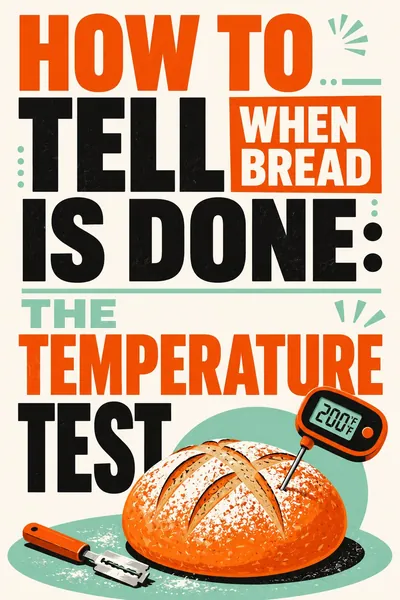
Why is my bread gummy even when the crust is dark and the loaf sounds hollow? Because color and sound are not doneness tests. A lean loaf needs an internal temperature of 200 to 210°F, and then a full two hours of cooling before the crumb structure is finished.
If you sliced at 30 minutes, the loaf was never gummy. It was unfinished, and you interrupted it.
Get the bake itself right first: our free baking time calculator adjusts times when you change loaf size, pan or temperature, so you stop working from a number written for someone else's oven.
Updated September 2026
Why is my bread gummy? The 6 causes, ranked
| # | Cause | How common | The tell |
|---|---|---|---|
| 1 | Sliced before it cooled | Very common | Gummy right at the knife, fine an hour later |
| 2 | Underbaked | Very common | Pale, soft crust, damp all the way through |
| 3 | Steam trapped after baking | Common | Wet band at the bottom, damp crust |
| 4 | Too much water for the flour used | Common | Wet and sticky everywhere, big open holes |
| 5 | Under-fermented dough | Occasional | Tight gluey layer near the base, small crumb |
| 6 | High-enzyme flour (rye, sprouted grain) | Occasional | Sticky even after a long cool, dark crumb |
Work down that list in order. The first three are process problems you can fix on the next loaf without touching the recipe.
Cause 1: you cut it while it was still warm
This is the one nobody wants to hear, so here's the mechanism, because knowing why makes the waiting easier.
During the bake, water and heat break open the starch granules in the flour and they swell into a soft gel. That's gelatinization, and it's what turns dough into crumb. But the gel is soft while it's hot. As the loaf cools, the starch molecules re-associate into an ordered structure and the gel firms up. That process is called retrogradation, and it is not finished when the loaf leaves the oven.
Cut a loaf at 150°F and the crumb has no structural integrity yet. The knife compresses it, the soft starch smears, and you get that dense, gluey, slightly translucent surface people describe as gummy. The bread was fine. The timing wasn't.
How long to wait:
| Loaf | Minimum cool | Ideal |
|---|---|---|
| Dinner rolls, small buns | 15 min | 30 min |
| 1 lb sandwich loaf | 1 hour | 90 min |
| 1.5 to 2 lb hearth loaf | 90 min | 2 hours |
| Large sourdough boule | 2 hours | 4 hours |
| Rye or 100% whole grain | 4 hours | Overnight |
| Gluten free loaf | 3 hours | Fully cold |
The real rule is temperature, not time. Slice when the middle of the loaf is at or below about 95°F, which is barely warm to the back of your hand. Put your probe thermometer back in if you're not sure.
Cool on a wire rack, never on a solid surface or in the pan. Air has to reach the bottom.
Cause 2: the loaf was underbaked
The second big cause, and the one people usually check first. Crust color is a terrible doneness signal, because sugar and dairy brown long before the middle is baked.
Take the internal temperature. It's the only test that answers the question directly.
| Bread type | Done at |
|---|---|
| Lean hearth loaf, baguette, ciabatta | 205 to 210°F |
| Sourdough boule | 205 to 210°F |
| Sandwich or pan loaf | 195 to 205°F |
| Enriched: brioche, challah, babka | 190 to 200°F |
| Dinner rolls, soft buns | 190 to 195°F |
| Quick breads, banana bread | 200 to 210°F |
Push the probe through the side or the bottom into the geometric middle of the loaf, not through the top, where you'll hit the closed crust and read low. Our full guide on how to tell when bread is done ranks every doneness test honestly, including which ones are close to useless.
Three things that cause a loaf to come out under temperature:
- The oven ran cool. Hang a standalone thermometer inside and check. A 25 to 50°F drift is common and it's usually the loaf's whole problem.
- A dark crust arrived early and you panicked. If the crust is done before the middle is, tent the loaf with foil and keep baking. Color is not doneness.
- The loaf was bigger than the recipe assumed. A 900 g loaf takes meaningfully longer than a 700 g one at the same temperature. Bake time follows mass, not the number on the recipe.
Cause 3: steam got trapped after the bake
A loaf that hits 208°F and comes out perfectly can still turn gummy in the next hour if the steam has nowhere to go.
Bread loses a real amount of water during cooling. That water leaves as vapor through the crust. Block the escape and it condenses, runs back into the crumb, and gives you a damp band, usually at the bottom where gravity takes it.
The three ways people trap steam:
- Cooling in the pan. The metal sides and base hold the moisture against the loaf. Turn a pan loaf out within 5 minutes of leaving the oven.
- Cooling on a plate or board. Same problem, smaller. A wire rack is not optional.
- Bagging it warm. This is the worst one. A loaf sealed in plastic at 100°F sweats, the crust goes soft and leathery, and the crumb picks up the water. Wait until it is genuinely cold, which for a big loaf is longer than you think.
That last one also ruins a good crust, which is a separate annoyance. Our guide on how to store baked goods covers what to wrap in what, and how long each kind of bread actually keeps.
Cause 4: too much water for the flour you used
Hydration is the weight of water as a percentage of the weight of flour. A dough at 65 percent has 650 g of water per 1,000 g of flour. That's a standard sandwich loaf. Ciabatta runs 80 percent and above.
Higher hydration doughs are wonderful and they are also much less forgiving. They need a longer bake to drive off the extra water, and a much longer cool. Pull a 78 percent hydration loaf at 200°F and slice it at an hour and it will be gummy every single time.
The catch is that most home bakers don't know their real hydration, because they measured flour by volume. Here's what that does.
Worked example: how 64 percent hydration becomes 74 percent
A recipe calls for 4 cups bread flour and 1 1/2 cups water.
The author scoops the cup into the flour bag, so their 4 cups weigh 4 × 147 g = 588 g. Water at 236 g per cup gives 1.5 × 236 = 354 g.
Their hydration: 354 divided by 588 = 60 percent. A firm, easy sandwich dough.
You spoon the flour in gently and level it, so your 4 cups weigh 4 × 127 g = 508 g. Same water: 354 g.
Your hydration: 354 divided by 508 = 70 percent.
Ten percentage points is not a rounding error. It's the difference between a sandwich dough and a rustic dough. Yours is slacker, spreads more, bakes wetter, needs 5 to 10 minutes longer in the oven and twice the cooling time, and nothing in the recipe warned you.
The fix is weight. Weigh flour and water and the number becomes yours to control rather than something you inherit. Run any cup-based recipe through our grams to cups converter once and write the grams in the margin. Baker's percentage explains how to read and adjust hydration properly, and how to measure flour covers the scooping problem in detail.
One more note on flour choice. Bread flour absorbs about 5 to 8 percent more water than all-purpose, so swapping all-purpose into a bread flour recipe raises the effective hydration and can hand you a gummy crumb from a recipe that used to work. Bread flour vs all-purpose has the substitution math.
Cause 5: the dough was under-fermented
An under-proofed loaf gives a very specific gummy: a tight, gluey layer near the bottom, with a dense small-holed crumb above it and often a sharp break in the crust where it burst.
The mechanism is oven spring gone wrong. A dough that hasn't fermented enough still has a lot of expansion left in it. That expansion happens fast in the oven, the loaf pushes up, and the lower part of the crumb gets compressed by everything above it before the structure sets. Compressed, moist crumb reads as gummy.
Over-fermentation gives a different failure. The gluten has broken down, the loaf collapses instead of springing, and you get a flat, dense, damp crumb throughout rather than a band.
The poke test tells you which side you're on. Flour a finger, press half an inch into the shaped dough, and watch:
- Springs straight back: under-proofed, give it more time.
- Springs back slowly and leaves a slight dent: ready.
- Dent stays put and the dough sighs: over-proofed.
Why is my bread dense works through fermentation and gluten development in depth, and why didn't my bread rise covers the yeast side if the dough barely moved at all.
Cause 6: high-enzyme flour, which is a real and underrated cause
This is the one that catches people who did everything else right.
Flour contains amylase, an enzyme that breaks starch down into sugars. A little is good, because it feeds the yeast and helps the crust color. Too much is a problem, because amylase keeps working during the early part of the bake, breaking down the very starch that's supposed to be setting into your crumb. The result is a sticky, gummy loaf that never firms up no matter how long you cool it.
Where high amylase comes from:
- Rye flour is naturally high in it, which is why traditional rye breads are soured. Acid slows amylase down. An unsoured 100 percent rye loaf is famously gummy, and that's the flour talking, not the baker.
- Sprouted grain flours have high enzyme activity by definition, since sprouting is exactly the process that switches those enzymes on.
- Wheat that sprouted in the field before harvest carries the same problem. Millers screen for it with a standard test called the falling number, and flour that fails goes to blending rather than to bread.
What to do about it:
- For rye, use a sourdough starter or add acidity. Keep rye under about 30 percent of the total flour if you're not souring.
- Bake high-rye loaves to the top of the temperature range, 205 to 210°F.
- Cool them far longer than wheat bread. Traditional rye is often left a full day before slicing, and that is not superstition.
- For sprouted flours, blend rather than going all in, and expect a moister crumb as normal rather than a fault.
Types of flour covers protein and behavior for every flour on the shelf, including the ones that never make a dry crumb.
Diagnostic table: where the gumminess sits tells you the cause
| Where it is | What it looks like | Most likely cause |
|---|---|---|
| At the knife, only when warm | Smeared, dense, translucent | Sliced too soon |
| Everywhere, whole loaf | Damp, soft, doughy center | Underbaked |
| A band along the bottom | Wet, compact, distinct edge | Steam trapped, or cooled in the pan |
| A band above the bottom crust | Gluey, tight, small holes | Under-fermented |
| Everywhere, with big holes | Wet, sticky, tunnels | Hydration too high for the bake time |
| Around fruit, cheese or vegetables | Wet halo around the inclusion | Wet add-ins, drain or reduce them |
| Sticky even fully cold, dark crumb | Slack, tacky, almost paste-like | High enzyme flour, needs acid |
| Only after wrapping | Fine at first, gummy by morning | Bagged before it was cold |
Worked example: a 900 g sourdough boule, cooled properly
This is what the cooling curve actually looks like on a large loaf, measured in the middle of the crumb.
| Time out of the oven | Center temperature | What is happening | Slice? |
|---|---|---|---|
| 0:00 | 208°F | Starch gel soft, steam saturated | No |
| 0:30 | 150°F | Crust crackling, steam escaping fast | No |
| 1:00 | 118°F | Retrogradation well underway | No |
| 1:30 | 99°F | Crumb firming, still warm to the hand | Barely |
| 2:00 | 86°F | Structure set, crumb slices clean | Yes |
| 4:00 | Room temp | Fully set, best texture and flavor | Yes |
The loaf at 1:00 is not underbaked. It hit 208°F and it is completely cooked. Slice it there and you'll swear it's gummy, because the gel has not finished setting and the knife destroys what structure exists.
Two hours is the honest minimum on a loaf this size, and four is better. If you want warm bread, cut a slice from the cold loaf and toast it. That gives you warmth without wrecking the crumb.
Can you rebake gummy bread?
Sometimes, and it's worth trying before you write the loaf off.
If the loaf is genuinely underbaked and you catch it within about an hour:
- Put the whole uncut loaf back in a 350°F oven.
- Give it 10 to 20 minutes, depending on size.
- Tent it with foil if the crust is already dark.
- Check the internal temperature. You want 205 to 210°F for a lean loaf.
- Cool it fully this time. All of it.
If you already cut it, rebaking works less well because the cut face dries out before the middle catches up. Lay the halves cut side up and accept a drier loaf.
If the loaf is cold and set, rebaking will not undo gumminess. Once starch has retrograded around excess moisture, reheating just softens it temporarily. Slice it thin and toast it instead. Toasting drives off free moisture and the gummy texture largely disappears.
Quick breads and gluten free loaves
Both fail in their own way and neither is really a yeast problem.
Quick breads go gummy from two causes: overmixing, which develops gluten that traps moisture in a tight rubbery crumb, and too much wet produce. Grated zucchini, mashed banana and pumpkin all carry a lot of water. Squeeze grated vegetables in a towel first, and mix quick bread batter only until the dry streaks disappear. Test at the middle with a skewer and look for 200 to 210°F.
Gluten free bread relies on starch and gums instead of gluten, so it holds far more water and sets far more slowly. Bake it to 205 to 210°F, which is higher than most gluten free recipes suggest, and cool it completely before cutting. Slicing a gluten free loaf warm produces the worst gumminess of any bread. The gluten free baking substitutions guide covers blend behavior in more detail.
Frequently asked questions
How long should bread cool before slicing?
Until the middle is at or below about 95°F, which is barely warm. For a 1 lb sandwich loaf that's around an hour, for a large sourdough boule it's 2 to 4 hours, and for rye or 100 percent whole grain it's better to wait overnight. Cool on a wire rack so air reaches the bottom.
Is gummy bread underbaked or undercooked?
Not always. The most common cause is slicing before the crumb has set, which happens even on a perfectly baked loaf. Check the internal temperature before blaming the bake: 200 to 210°F for a lean loaf, 190 to 200°F for enriched. If it hit those numbers, the problem was cooling, not baking.
Why is my bread gummy at the bottom only?
That band comes from steam that couldn't escape, or from an under-fermented dough compressed by oven spring. Turn pan loaves out within five minutes and cool on a wire rack. If the crumb above the band is also tight and small-holed, the dough needed a longer proof.
Can I put gummy bread back in the oven?
Yes, if it's genuinely underbaked and still whole and warm. Return it to a 350°F oven for 10 to 20 minutes, tenting with foil if the crust is dark, and check for 205 to 210°F internal. A loaf that's already cold and set won't improve, and one you've already cut will just dry out at the cut face.
Why is my rye bread always gummy?
Rye flour is high in amylase, an enzyme that breaks starch down during the bake, so an unsoured rye loaf struggles to set a firm crumb. Use a sourdough starter or another source of acidity, keep rye under about 30 percent of total flour if you're not souring, bake to 210°F, and leave the loaf a full day before cutting.
Does high hydration dough always come out gummy?
No, but it needs a longer bake and a much longer cool. The extra water has to leave the loaf, and that happens partly in the oven and partly during cooling. Bake to the top of the temperature range and double your usual cooling time before you slice.
Why did my bread machine loaf come out gummy inside?
Bread machines run a fixed program regardless of your flour, so a dough that's wetter than the machine expects gets the same bake as a firm one. Weigh your flour and water, and if the loaf is still damp, let it finish in a 350°F oven for 10 to 15 minutes. Turn it out of the pan immediately either way, because a machine pan traps steam like nothing else.
Is gummy bread safe to eat?
Yes, as long as the loaf reached a proper internal temperature. Gumminess is a texture problem caused by unset starch or trapped moisture, not a food safety one. A genuinely raw center in the middle of a loaf is a different matter, so if the middle is still wet dough rather than dense crumb, rebake it.
Related guides: How to tell when bread is done | Why is my bread dense | Baker's percentage | Baking time calculator | Grams to cups converter