How Long Sourdough Takes to Rise

How long sourdough takes to rise depends almost entirely on temperature: 4 to 5 hours of bulk fermentation at 78°F with 20 percent ripe starter, or 8 to 12 hours at 63°F for the same dough. After shaping, add 45 minutes to 2 hours at room temperature, or 8 to 16 hours in the refrigerator.
Sourdough has three separate rises, not one, and mixing them up is why so many timings on the internet disagree. Your starter rises, your dough bulk ferments, and your shaped loaf proofs. The chart below covers all three.
Updated September 2026
Want to hedge a slow sourdough with a pinch of commercial yeast, or convert the recipe to yeast for a same-day loaf? Our free yeast converter matches the yeast amount to the rise length you actually have time for.
The three rises, and how long each one takes
| Stage | What is happening | Typical time | Done when |
|---|---|---|---|
| Starter ripening | The starter builds population after a feed | 4 to 8 hours at 75 to 78°F on a 1:1:1 feed | Domed, at peak, smells sharp and yeasty |
| Bulk fermentation | The whole dough ferments and builds strength | 4 to 5 hours at 78°F | Risen 50 to 75 percent, jiggly, domed |
| Final proof | The shaped loaf relaxes and rises again | 45 min to 2 hrs at room temp, or 8 to 16 hrs at 39°F | Poke springs back slowly, leaves a dent |
Add those up and a full sourdough day runs 8 to 12 hours of active fermentation from feeding the starter to the loaf going in the oven, or 5 to 6 hours plus an overnight in the refrigerator if you split it across two days.
That is the honest headline number, and it is why sourdough is a weekend habit for most people rather than a weeknight one.
How long sourdough takes to rise at each temperature
Temperature is the single biggest lever you have. Everything below assumes 20 percent ripe starter by flour weight, a standard 70 to 75 percent hydration dough, and bulk fermentation to a 50 to 75 percent rise.
| Dough temperature | Bulk fermentation time | Notes |
|---|---|---|
| 62 to 64°F | 8 to 12 hours | Cool kitchen or a winter counter. Very forgiving window |
| 66 to 68°F | 7 to 9 hours | Sour, complex flavor. Easy to time overnight |
| 70 to 72°F | 5 1/2 to 7 hours | Typical American kitchen. The most common real-world case |
| 74 to 76°F | 4 1/2 to 6 hours | Sweet spot for flavor and schedule |
| 78 to 80°F | 4 to 5 hours | The temperature most published recipes assume |
| 82 to 84°F | 3 to 4 hours | Fast. The window between ready and overproofed narrows |
| 86°F and up | 2 1/2 to 3 hours | Watch it constantly. Acid builds faster than gas |
| 38 to 40°F | Effectively stalled | Fridge temperature. Used for proofing, not for bulk |
As a rough working rule, every 15°F warmer roughly halves the time, and every 15°F cooler roughly doubles it. That single sentence lets you convert any recipe's timings to your own kitchen.
Two practical notes on that chart.
Dough temperature is not room temperature. Dough made with cold tap water in a 72°F kitchen can sit at 66°F for the first hour, which adds a full hour to the bulk. Take the dough's temperature with an instant read thermometer after mixing, and adjust your water temperature next time to hit your target.
Second, the rows toward the bottom are less forgiving. A cool dough gives you an hour of leeway either side. An 86°F dough gives you fifteen minutes, and the acid builds faster than the gas does, so you end up with a sour, slack dough that never got much lift.
How much starter you use changes everything
The second lever is the percentage of ripe starter, calculated against the flour weight in the dough. Everything below assumes a 78°F dough.
| Ripe starter | Bulk time at 78°F | Flavor | Best for |
|---|---|---|---|
| 5 percent | 8 to 10 hours | Most sour, most complex | Overnight bulk in a cool kitchen |
| 10 percent | 6 to 7 hours | Noticeably tangy | A full day at home |
| 20 percent | 4 to 5 hours | Balanced. The default | Most published recipes |
| 30 percent | 3 to 4 hours | Mild, bready | Getting a loaf done in an afternoon |
| 40 percent | 2 1/2 to 3 hours | Least sour | Rushing, and it shows |
More starter is faster and less sour. Less starter is slower and more sour. That relationship surprises people who assume that a longer rise always means more tang, but the tang comes from the acid bacteria, and they need hours to work regardless of how many yeast cells you started with.
This is the same trade-off you make with commercial yeast, just at a different scale. Our pizza dough rise time guide runs the identical math with instant yeast, where 1 percent gives you a couple of hours and 0.08 percent gives you three days.
Do not trust the clock. Read the dough
Every time in this article is a starting estimate. The actual finish line is a set of physical signs, and once you learn them you stop needing the chart.
Bulk fermentation is done when the dough has risen 50 to 75 percent. Not doubled. Doubling was the old advice and it puts most home bakers into overproofed territory, because a dough at 100 percent has already spent most of its strength.
Here is how to measure that reliably:
- Use a straight-sided container. A bowl that flares out makes a 50 percent rise look like 20 percent.
- Mark the starting level with a rubber band or a strip of tape the moment bulk begins.
- Or use an aliquot jar. Pinch off about 2 tablespoons of dough right after mixing, press it into a small straight-sided jar, mark the level, and keep it beside the main dough. It rises at the same rate and it is far easier to read.
Three other signs back up the measurement:
- The jiggle. Nudge the container. Ready dough moves as one wobbling mass, like a set custard.
- The dome. The surface goes from flat to gently domed, with a few bubbles visible at the edges of the container.
- The feel. The dough is airy and light rather than dense, and it pulls away from the sides in one piece rather than sticking in shreds.
If your dough is not moving at all, the problem is usually starter strength or temperature rather than time, and why your dough is not rising works through the causes in order.
The final proof: room temperature or refrigerator
After you shape the loaf, it rises again. You have two routes and they are not equivalent.
| Route | Time | Temperature | What you get |
|---|---|---|---|
| Room temperature proof | 45 min to 2 hrs | 75 to 78°F | Bake the same day. Softer crust. Harder to score |
| Cold retard | 8 to 16 hrs | 38 to 40°F | Deeper flavor, blistered crust, easy scoring, bake when you like |
| Long cold retard | 16 to 24 hrs | 38 to 40°F | Very tangy. Slight risk of overproofing at the top end |
The cold retard is the reason so many home loaves look bakery-quality. Cold dough is firm, so it holds its shape when you turn it out and it takes a razor cleanly, which is most of what scoring bread is about. It also lets you bake at 7 a.m. without having been awake at 3.
The poke test decides it. Flour a finger and press about half an inch into the side of the loaf. If the dent springs back immediately, it needs more time. If it springs back slowly and leaves a shallow dent, bake it now. If it does not spring back at all, it is overproofed, so bake it immediately and accept a flatter loaf.
Bake straight from the refrigerator. There is no need to bring a cold loaf up to room temperature, and doing so costs you the firmness that made the retard worth it.
Worked example: a full sourdough timeline
Here is a 1,000 g dough in baker's percentages, with real clock times attached. Baker's percentages are all measured against flour weight, and our baker's percentage guide explains the system if it is new to you.
- Bread flour: 500 g (100 percent)
- Water: 350 g (70 percent)
- Ripe 100 percent hydration starter: 100 g (20 percent)
- Salt: 10 g (2 percent)
Counting the flour and water inside the starter, that is 550 g of total flour and 400 g of total water, so the true hydration is about 73 percent.
| Time | What happens | Why |
|---|---|---|
| 8:00 a.m. Friday | Feed the starter 1:1:1 | Peaks in 4 to 8 hours at 75 to 78°F |
| 1:00 p.m. | Mix flour and water only, rest 45 min | The autolyse hydrates the flour before salt goes in |
| 1:45 p.m. | Add ripe starter and salt, mix to 78°F dough | Take the dough temperature here, not the room's |
| 2:00 p.m. | Bulk fermentation starts. Mark the container | The clock that matters begins now |
| 2:30, 3:00, 3:30, 4:00 p.m. | Four sets of stretch and folds, 30 min apart | Builds strength without kneading |
| 6:30 p.m. | Bulk ends at 4 1/2 hours, dough up about 60 percent | Within the 4 to 5 hour window for 78°F |
| 6:35 p.m. | Preshape, bench rest 20 minutes | Lets the gluten relax before final shaping |
| 7:00 p.m. | Shape, into a floured banneton, cover | Final proof begins |
| 7:15 p.m. | Into the refrigerator at 39°F | Cold retard, 12 hours |
| 7:15 a.m. Saturday | Bake straight from the fridge | Firm, cold dough scores cleanly |
| 8:00 a.m. | Loaf reads 205 to 210°F in the center | The doneness number for any lean bread |
Total elapsed time from feeding the starter to a cooled loaf: about 26 hours, of which maybe 40 minutes is actual hands-on work. That is the real shape of sourdough. It is patient, not laborious.
Wait at least two hours before cutting into it, and preferably four. Slicing a hot sourdough gives you a gummy crumb every time, which is one of several causes covered in why bread turns out gummy.
Sourdough against commercial yeast, hour for hour
If you have swapped a yeast recipe for sourdough and the timings feel wrong, this is why. Sourdough carries far fewer yeast cells per gram of dough, and a slice of the fermentation goes into acid rather than gas.
| Method | Leavener amount for 500 g flour | Bulk time at room temperature |
|---|---|---|
| Instant yeast, standard | About 3.5 g | 2 to 3 hours |
| Instant yeast, slow | About 1.75 g | 4 to 6 hours |
| Instant yeast, overnight cold | About 0.8 g | 12 to 24 hours in the fridge |
| Ripe sourdough starter, 20 percent | 100 g | 4 to 5 hours at 78°F |
So a 20 percent sourdough build runs on roughly the same clock as a slow yeasted dough, and about twice as long as a standard yeasted one. Substituting a starter into a yeast recipe means multiplying every rise time by about two, not following the original timings and hoping. Our guide to converting a yeast recipe to sourdough handles the flour and water the starter brings with it as well as the timing.
Troubleshooting a rise that is off
| What you see | Likely cause | What to change |
|---|---|---|
| Almost no rise after 6 hours | Starter was not at peak when you used it | Use starter that has doubled and domed, before it collapses |
| Dough rose fast then went slack | Dough too warm, over 84°F | Cooler water, or move it off the warm counter |
| Bulk took 10 hours in a warm kitchen | Weak or young starter | Feed it twice a day for a week before baking |
| Loaf spread flat on the peel | Overproofed in the final rise | Shorten the proof, or shape more tightly |
| Dense, tight crumb | Underproofed bulk | Go to 50 to 75 percent rise, not by the clock |
| Very sour, poor oven spring | Long ferment at low temperature | Use more starter and a shorter, warmer bulk |
| Big holes near the crust, dense base | Under-bulked but over-proofed after shaping | Move time from the final proof back into bulk |
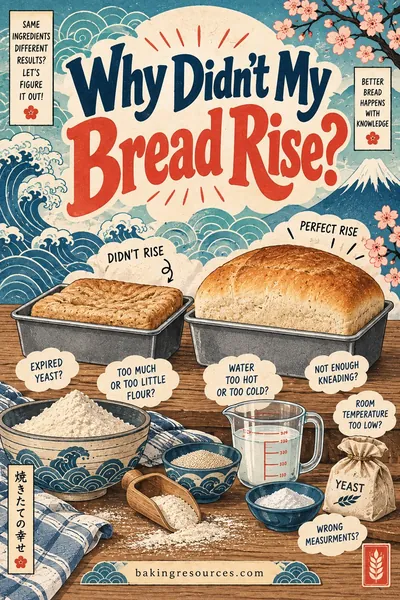
If the loaf simply never lifted, why bread does not rise covers the failures that are not about timing at all.
Frequently asked questions
How long should sourdough bulk ferment?
At 78°F with 20 percent ripe starter, 4 to 5 hours. At a more typical 70°F kitchen, expect 5 1/2 to 7 hours for the same dough. Time is only an estimate, though. Stop when the dough has risen 50 to 75 percent in a straight-sided container and jiggles as one mass.
Can sourdough rise for too long?
Yes. An overproofed dough has used up its sugars and its gluten has been broken down by acid, so it spreads flat on the peel and bakes dense with a pale crust. The poke test is your warning: if a dent does not spring back at all, bake immediately and treat the result as flatbread practice.
How long can sourdough stay in the fridge before baking?
8 to 16 hours is the reliable window at 38 to 40°F, and many bakers stretch it to 24. Past a day, the yeast keeps working slowly even in the cold and the loaf starts drifting into overproofed. Keep it covered so the surface does not dry into a skin.
Why is my sourdough taking so long to rise?
The three usual causes, in order of likelihood: the starter was not at its peak when you used it, the dough is colder than you think, or the starter is young and underfed. Take the dough's temperature rather than the room's, and feed the starter twice a day for several days before an important bake.
Does sourdough need a second rise?
Yes. Bulk fermentation ferments the dough, and the final proof after shaping lets the tightened gluten relax and fill with gas again. Skipping it gives you a tight, dense loaf that tears at the score line. The final proof is short compared with bulk: 45 minutes to 2 hours warm, or 8 to 16 hours cold.
What temperature is best for rising sourdough?
76 to 78°F is the sweet spot, because it gives good yeast activity without letting the acid bacteria run ahead of the gas. Cooler is slower and more sour but very forgiving. Above 84°F the useful window narrows to minutes, and you tend to get sourness without much lift.
How do I speed up sourdough without ruining it?
Two safe levers. Raise the starter to 30 percent of the flour weight, which cuts bulk to 3 to 4 hours at 78°F. Or raise the dough temperature to 80°F with warmer mixing water. Do both and you are looking at under 3 hours, with less flavor and a much tighter margin for error.