Why Is My Dough Not Rising?

Dough that sits flat is almost always one of three things: the yeast is dead, the kitchen is too cold, or the liquid was hot enough to kill the yeast on contact. Check them in that order and you will find the cause within about 15 minutes, usually less.
The good news is that a dough which has not risen yet is far easier to save than a loaf already in the oven. Most flat doughs can be rescued with a fresh yeast slurry and another hour.
Before you add more yeast, check the dose you actually used against what the recipe wanted: our free yeast converter handles active dry, instant and fresh in teaspoons, packets and grams.
Updated September 2026
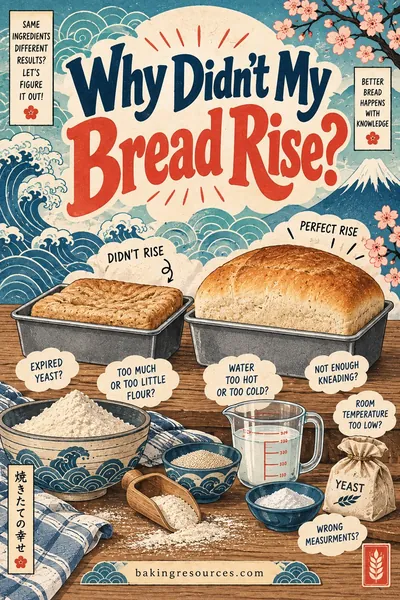
Why is my dough not rising? Run this triage first
Do not throw the dough out and do not add anything yet. Answer these four questions in order, and the answer is almost always in the first two.
| Ask this | If yes | What it means | Where to go |
|---|---|---|---|
| 1. Was the liquid hotter than warm bathwater? | Hot tap water often runs 120 to 140°F | The yeast died on contact. Nothing will happen no matter how long you wait | Cause 1 |
| 2. Is the room under about 68°F? | Winter kitchens sit at 62 to 66°F all day | The dough is not dead, it is slow. It may need three times the stated time | Cause 2 |
| 3. Has the yeast been open more than 6 months, or is it past its date? | Very likely dead or weak | Proof a teaspoon separately to confirm | Cause 3 |
| 4. Did yeast and salt sit dry against each other before the water went in? | Salt draws water out of yeast cells | Partial kill. The rise will be weak rather than absent | Cause 4 |
The single fastest test: stir 1 teaspoon of your yeast and 1/2 teaspoon of sugar into 1/4 cup of water at 110 to 115°F. Wait 10 minutes. A thick, domed, foamy head means the yeast is alive and your problem is temperature or time. A few sad bubbles or nothing at all means the yeast is the problem, and it is fixable. How to proof yeast walks through what a healthy proof looks like at 5 and 10 minutes.
Cause 1: your liquid was too hot
This is the most common way home bakers kill a batch, and it is invisible. The dough looks completely normal going into the bowl.
The temperatures that matter:
| Water temperature | What happens to the yeast |
|---|---|
| 60 to 80°F | Alive, slow, perfectly usable |
| 100 to 110°F | Active and comfortable, safe for any yeast |
| 110 to 115°F | The proofing sweet spot, fastest visible foam with no damage |
| 120°F | Damage starts here |
| 130°F and up | Reliably dead |
Hot water straight from a tap frequently runs 120 to 140°F, which sits squarely in the kill zone. The whole problem is that 115°F and 130°F feel almost identical on your fingers. Both read as "warm".
How to hit it without a thermometer: run the water on the inside of your wrist. The proofing window feels barely warm, roughly like a baby's bath. If it feels pleasantly hot, it is already too hot.
Can you save it? Yes, and the fix is easy. Let the dough cool to room temperature, then work in a fresh yeast slurry (see the rescue section below). Nothing about the flour, salt or sugar was harmed.
Cause 2: your kitchen is colder than the recipe assumed
Every rise time printed in every recipe was measured in someone else's kitchen. Most of them assume around 75°F. A 65°F winter kitchen can easily double or triple that time.
Yeast activity roughly halves for every 15 to 17°F drop in dough temperature. That is not a small effect once you scale it out.
| Dough temperature | Rough bulk fermentation time | Notes |
|---|---|---|
| 60°F | 4 to 5 hours | Very slow, but flavor is excellent |
| 68°F | 2.5 to 3 hours | A normal cool kitchen |
| 75°F | 1.5 to 2 hours | What most recipes assume |
| 80°F | 1 to 1.5 hours | Fast, slightly less flavor development |
| 85°F and up | Under 1 hour | Risky, easy to overshoot, yeasty flavor |
| 38°F (fridge) | 8 to 24 hours | The overnight cold retard |
Your dough is probably fine. It is doing exactly what it should, just on its own schedule. Judge by volume and feel, never by the clock: the dough should roughly double, feel airy and jiggly when you tip the bowl, and hold a dent when you poke it gently.
Five ways to warm a dough safely
- The oven light trick. Put the covered bowl in a turned-off oven with only the interior light on. Most ovens settle around 75 to 85°F this way. Check it with a thermometer once so you know your own oven.
- The hot water bath. Set a mug of boiling water on the oven floor or in a closed microwave with the dough. Refresh it after an hour.
- On top of the fridge. The warmest surface in a lot of kitchens, usually 5 to 8°F above room temperature.
- A heating pad on low with a folded towel between it and the bowl.
- Warmer mixing water. The best fix, because it works from the start rather than trying to catch up later. See the dough temperature math below.
What not to do: never set a dough on a radiator, in a sunny window in summer, or in an oven you preheated "just for a second". Anything above about 100°F on the surface of the dough starts killing the outer layer while the center stays cold.
Cause 3: your yeast was already dead
Yeast dies quietly. It does not smell wrong, change color or clump. A dead packet looks exactly like a live one.
What kills it in storage:
- Age. Unopened, active dry yeast keeps about two years to the printed date. Once the jar or packet is open, it lasts 4 to 6 months in the fridge and up to a year in the freezer.
- Air and warmth together. An opened jar in a cabinet above the stove is the worst case. Open yeast belongs in an airtight container in the freezer.
- Moisture. A wet spoon in the jar starts a slow decline you will never see coming.
Test before you commit 500 g of flour. Ten minutes and a quarter cup of water is cheap insurance. Modern active dry yeast does not need to be dissolved before use, so treat proofing as a freshness check rather than a required step.
Or the dose was simply too small
Not every underperforming dough has bad yeast. Sometimes there just was not enough of it, and this happens most often when someone swaps one type for another.
Instant yeast is more concentrated than active dry. The working figure is that instant needs about 25 percent less, or going the other way, active dry is instant multiplied by 1.33. If you swapped instant for active dry one for one, you used 25 percent less yeast than the recipe wanted and the rise runs slow.
The reference numbers:
- 1 US packet = 2 1/4 teaspoons = 7 g of either active dry or instant
- About 3.1 g per teaspoon for both dry types
- Fresh yeast is about 3 times the weight of instant, so a 7 g packet is replaced by roughly 15 to 19 g of fresh
- One packet suits about 500 g of flour for a same-day loaf
Active dry vs instant yeast has the full comparison, and the yeast converter does the arithmetic in both directions.
The old 1:2:3 bakery rule (instant, active dry, fresh) overdoses the active dry. Modern active dry is dried far better than the product that rule was written for. Use 1.33, not 2.
Cause 4: salt hit the yeast directly
Salt draws water out of yeast cells through the bowl wall of the cell itself. In a mixed dough, spread through the water, that is a mild braking effect and is exactly what you want. Piled dry, straight onto yeast granules, it does real damage.
The habit that fixes it: add flour to the bowl, then put salt on one side and yeast on the other, and let the water go in before you stir. Ten seconds of care, permanently solved.
Too much salt, even mixed properly, slows everything down
Salt at the normal level of 1.8 to 2.2 percent of the flour weight slows fermentation slightly and that is by design. It keeps the rise controlled and the flavor good.
Push past about 2.5 percent and the brake gets heavy. Bread that tastes noticeably salty is also bread that took twice as long to rise.
The measuring trap here is real. Salt is sold in very different crystal sizes:
| 1 teaspoon of | Weighs about |
|---|---|
| Fine table salt | 6 g |
| Morton kosher salt | 4.8 g |
| Diamond Crystal kosher salt | 2.8 g |
Swapping table salt into a recipe written for Diamond Crystal more than doubles the salt. If your dough rises slowly and tastes sharp, this is worth checking. Kosher salt vs table salt has the full conversion, and bakers percentage explains why salt is always expressed against flour weight.
Cause 5: too much sugar or fat for the yeast to work through
A little sugar feeds yeast. A lot of sugar fights it.
Above roughly 10 percent sugar by flour weight, sugar starts pulling water away from the yeast cells the same way salt does. Sweet doughs (cinnamon rolls, brioche, panettone, Hawaiian rolls) are genuinely slower risers, and that is normal, not a fault.
What to expect from an enriched dough:
- Bulk fermentation takes 1.5 to 2 times as long as a lean dough at the same temperature
- More yeast is normal. Sweet dough recipes often call for double the yeast of a lean loaf
- Osmotolerant yeast (sold as "gold" instant yeast) is formulated for exactly this and is worth buying if you make sweet dough often
Fat does something different but ends with the same slow rise. Butter, oil and eggs coat the flour and physically slow both gluten development and gas movement. A brioche at 50 percent butter is meant to take all day.
The mistake to avoid: looking at a slow enriched dough, deciding the yeast is dead, and adding more. You end up with a boozy, over-yeasted flavor. Give it time first.
Cause 6: the dough is too stiff, or the flour is wrong
Yeast needs free water to move through. A dough with too much flour has less of it, so gas production and gas movement both slow down.
A cup of all-purpose flour weighs 125 g spooned and leveled, and about 145 g if you scoop the cup straight into the bag. That 20 g gap per cup compounds fast.
Worked example: what 60 extra grams does
A recipe calls for 3 cups of flour and 1 cup of water.
- Intended: 3 × 125 = 375 g flour, with 236 g water = 62.9 percent hydration. A soft, smooth dough.
- Scooped: 3 × 145 = 435 g flour, same 236 g water = 54.3 percent hydration. Stiff, bagel territory.
You did not make a slightly drier loaf. You made a different dough, and it will rise noticeably slower because the yeast has less free water to work in. How to measure flour covers all three methods with numbers, and the grams to cups converter removes the guesswork entirely.
Flour type matters too. Whole wheat and rye absorb far more water than white flour, so a straight substitution gives you a stiff dough as well as a heavier one. Add roughly 10 percent more water when converting a white loaf to whole wheat. Types of flour has the absorption and protein figures.
Cause 7: you are judging the rise wrong
Sometimes the dough rose fine and the bowl lied to you.
A wide bowl hides a rise. The same volume of dough that looks obviously doubled in a straight sided container looks barely changed in a wide mixing bowl, because the increase spreads sideways instead of up.
Better ways to judge:
- Use a straight sided container and mark the starting level with a rubber band or a strip of tape. Now doubling is a visual fact, not a judgment call.
- The poke test for the final proof. Flour a fingertip, press half an inch into the side of the dough, and watch. Springs back fast and vanishes: not ready. Springs back slowly and leaves a shallow dent: bake it now. Stays exactly where you pressed: over-proofed.
- Feel the weight. Fermented dough feels airy and light for its size, and jiggles when you shake the container.
If your loaf came out heavy despite a rise that looked normal, the problem may be later in the process, and why is my bread dense works through what happens between the last proof and the cooling rack.
How to rescue a dough that has not risen
You do not have to throw it away. Here is the order to work through.
Step 1: give it more time, in a warmer spot
If the yeast tested alive, this alone fixes most cases. Move the covered bowl somewhere 75 to 80°F and check every 30 minutes. Cold dough can take three hours to do what a warm one does in one.
Step 2: add a fresh yeast slurry
If the yeast tested dead, mix a new batch of yeast into a small amount of warm liquid and knead it in.
- Proof 2 1/4 teaspoons (7 g) of fresh yeast in 1/4 cup of water at 110 to 115°F with 1/2 teaspoon of sugar. Wait until it foams, about 10 minutes.
- Add 1 to 2 tablespoons of flour to the slurry to make a soft paste, which is easier to distribute.
- Flatten the dough, spread the slurry over it, fold it in, then knead 5 to 8 minutes until it is fully mixed with no wet streaks.
- Rest and rise as normal. Expect a fairly quick rise, since the flour has been hydrating this whole time.
The loaf will not be perfect but it will be real bread. How to knead dough covers the technique if the dough has gone sticky.
Step 3: repurpose it
If the dough is hours old and refuses to move, flat dough still makes flatbread, crackers, pizza base or breadsticks. Roll it thin, dock it with a fork, brush with oil and salt, and bake hot at 450°F. Nobody will know it was supposed to be a loaf.
Get the dough temperature right from the start
Professional bakers do not warm dough after the fact, they set the temperature at mixing by adjusting the water. The target, called desired dough temperature, is usually 75 to 78°F for a straight lean dough.
The formula: water temperature = (target × 3) minus (flour temperature + room temperature + friction factor).
The friction factor is the heat your mixing adds: use about 5°F for hand kneading and 15 to 20°F for a stand mixer.
Worked example: winter kitchen, hand kneading
- Target dough temperature: 78°F, so 78 × 3 = 234
- Flour temperature: 66°F (it has been sitting in a cold pantry)
- Room temperature: 65°F
- Friction factor: 5°F for hand kneading
- Total to subtract: 66 + 65 + 5 = 136
- Water temperature needed: 234 minus 136 = 98°F
That is noticeably warmer than the "warm water" most people use, and it is why the same recipe behaves so differently in January and July. In an 80°F August kitchen the same math gives you 234 minus (78 + 80 + 5) = 71°F, which is cool tap water.
One measurement, taken at the start, removes most rise-time surprises for good.
Frequently asked questions
How long should I wait before deciding my dough is dead?
Give it two hours at room temperature before you conclude anything, and three if the kitchen is under 68°F. Look for any change at all: a slightly domed surface, a few bubbles at the edge, a softer feel. Some movement means it is alive and slow. Absolutely no change after two warm hours means the yeast is gone.
Can I add more yeast to dough that did not rise?
Yes, and it usually works. Proof 7 g of fresh yeast in 1/4 cup of water at 110 to 115°F with a pinch of sugar, stir in a tablespoon of flour to make a paste, then knead it thoroughly into the flattened dough. Give it a full rise afterward. The texture will be slightly less open than a first-try loaf, but it bakes into good bread.
Why is my dough rising in the fridge but not on the counter?
That combination usually means the counter dough was warm enough to over-proof and collapse while you were not watching, so it looks flat rather than risen. Cold dough ferments slowly and steadily, which is more forgiving. Mark the starting level on a straight sided container so you can see whether it rose and fell rather than never rising.
Does old flour stop dough from rising?
Rarely. Flour does not feed yeast any less as it ages, though whole grain flours go rancid within a few months at room temperature and affect flavor. If your dough will not rise, check the yeast, the water temperature and the room temperature first. Flour is almost never the cause.
Can I let dough rise overnight in the fridge?
Yes, and it usually improves the flavor. A cold retard at around 38°F takes 8 to 24 hours instead of 1 to 2 at room temperature, and the slower fermentation develops more complex flavor. Cut the yeast to roughly a third of the recipe amount for a long cold rise, or the dough will over-proof before morning.
Why does my sweet dough take so long to rise?
Sugar above about 10 percent of the flour weight pulls water away from the yeast, and fat coats the flour and slows gas movement. Enriched doughs simply run 1.5 to 2 times slower than lean ones at the same temperature. Use osmotolerant instant yeast (sold as gold) if you bake sweet dough often, and plan for the longer timeline rather than adding more yeast.
Is it possible for dough to rise too much?
Yes, and over-proofed dough looks like a rise problem in the finished loaf. The gluten stretches past what it can hold, the structure gives way, and you get a squat, spread out loaf with a pale flat top. Use the poke test: if the dent you press into the dough stays exactly where you put it, get it in the oven immediately.
Do I need to preheat the oven differently if the rise was slow?
No, but preheat it properly either way. Give the oven 30 to 45 minutes rather than trusting the beep, since the walls and rack are still cold when the thermostat says ready, and home ovens routinely run 25 to 50°F off their dial. Our oven temperature converter handles Fahrenheit, Celsius and gas mark conversions.
Related guides: How to proof yeast | Active dry vs instant yeast | Why is my bread dense | How to knead dough | Yeast converter