How Long Should Pizza Dough Rise?

At room temperature, 1 1/2 to 2 hours of bulk rise plus 1 to 2 hours in balls is enough, using about 1% instant yeast by flour weight. In the refrigerator, 24 to 72 hours with a tenth of that yeast gives you a far better crust for the same effort.
So the real answer to how long should pizza dough rise is that you choose the time first, then set the yeast to match it. A two-hour dough and a two-day dough both finish fully risen. Only one of them tastes like a pizzeria.
Working out the yeast for your schedule? Our free yeast converter handles instant, active dry, rapid rise and fresh in both directions.
Updated September 2026
Pizza dough rise time by method
Every row here reaches the same volume. What changes is the flavor, the crust color and how easy the dough is to stretch.
| Plan | Instant yeast (% of flour) | Bulk rise | Ball proof | Total | Crust you get |
|---|---|---|---|---|---|
| Emergency, 1 hr | 2% | 20 min | 30 to 40 min | About 1 hr | Bready, pale, tastes of yeast |
| Same day, quick | 1% | 1 1/2 to 2 hrs | 1 to 2 hrs | 3 to 4 hrs | Fine, plain, perfectly usable |
| Same day, slow | 0.3 to 0.5% | 3 to 4 hrs | 2 hrs | 5 to 6 hrs | Noticeably better, easier to stretch |
| Overnight cold | 0.2 to 0.25% | 1 hr room, then fridge | 12 to 18 hrs cold | 18 to 24 hrs | Good color, real flavor |
| Two day cold | 0.1 to 0.15% | 1 hr room, then fridge | 36 to 48 hrs cold | 48 hrs | Excellent, blistered, complex |
| Three day cold | 0.05 to 0.1% | 1 hr room, then fridge | 60 to 72 hrs cold | 72 hrs | The best you will make at home |
| Neapolitan, room temp | 0.1 to 0.2% | 2 hrs at 64 to 68°F | 6 to 8 hrs at 64 to 68°F | 8 to 10 hrs | Soft, puffy rim, classic |
Multiply the instant yeast figures by 1.25 if you are using active dry. Rapid rise and bread machine yeast swap one for one with instant.
Look at the top and bottom rows together. The 72 hour dough uses about one twentieth of the yeast the one-hour dough needs, and it is unambiguously the better pizza. The yeast was never the limiting factor. Time was.
How long should pizza dough rise at room temperature?
For a standard 1% instant yeast dough in a 72 to 75°F kitchen, plan on 1 1/2 to 2 hours of bulk rise, then divide into balls and give them 1 to 2 more hours before you stretch.
The bulk rise is where fermentation does most of its work. The ball proof is mostly about relaxation: the gluten you tightened while shaping needs time to let go, or the dough snaps back every time you push it out.
Two things quietly change those numbers.
Kitchen temperature. Fermentation roughly doubles in speed for every 17°F you go up, and halves for every 17°F you go down. That single rule explains why the same dough behaves differently in January and July.
| Kitchen temperature | Multiply the rise time by |
|---|---|
| 60°F | 2.0 |
| 65°F | 1.6 |
| 70°F | 1.2 |
| 75°F (the baseline) | 1.0 |
| 80°F | 0.8 |
| 85°F | 0.6 |
| 90°F | 0.4, and watch it constantly |
A two-hour bulk rise at 75°F becomes about 3 1/4 hours at 65°F, and roughly 1 1/4 hours at 85°F.
Dough temperature after mixing. Measure it with an instant-read thermometer right after the dough comes together. Target 75 to 78°F. A stand mixer adds several degrees of friction heat, and warm tap water adds more. If your dough comes out at 82°F, everything on the chart above runs about 25% fast.
Cold ferment pizza dough: the schedule that changes everything
Putting shaped dough balls in a 38 to 40°F refrigerator slows the yeast to a crawl. The flour enzymes keep working at full speed.
That gap is the whole trick. Enzymes break starch into simple sugars and protein into amino acids. Those sugars feed browning in the oven, and those amino acids feed flavor. Give a dough two days on a cold shelf and you get depth you cannot buy with more yeast.
The other benefit is handling. Cold dough is firmer, less sticky and far easier to stretch without tearing. If your dough usually fights you, a night in the fridge fixes it more reliably than any technique change. Our guide on why dough is too sticky covers the hydration side of the same problem.
A practical cold schedule:
- Mix, then rest the dough 20 to 30 minutes covered.
- Knead or fold, then bulk rise 1 hour at room temperature. This wakes the yeast before the cold shuts it down.
- Divide, ball tightly, and put each ball in its own sealed container with room to expand by half.
- Refrigerate 24 to 72 hours.
- Take the balls out 1 1/2 to 2 hours before you bake, and leave them sealed on the counter.
That last step matters more than people expect. A cold ball tears when you stretch it and it never puffs properly in the oven. A 250 g ball needs about 90 minutes to come up to room temperature, and closer to 2 hours in a cold kitchen.
Past 72 hours, most home doughs start losing gluten strength. The dough goes slack, tears easily, and the rim stops holding air. Three days is the practical ceiling unless you are working at very low hydration.
How to tell when pizza dough is actually ready
Clocks are a starting estimate. The dough itself is the real instrument.
| Stage | Ready looks like | Not ready | Gone too far |
|---|---|---|---|
| Bulk rise | Increased by 50 to 75%, domed, a few bubbles at the edge | Barely moved, dense and tight | Doubled and starting to flatten, big surface blisters |
| Ball proof | Puffy, relaxed, spreads slightly, springs back slowly | Tight, holds a tall dome, snaps back fast | Flat, spreading wide, sticky and fragile |
| Poke test | Dent fills back partway over a few seconds | Springs back immediately | Dent stays put, dough sighs |
| Stretching | Opens smoothly, holds shape | Snaps back, needs 20 more minutes | Tears at the center, no strength |
The poke test is the one to learn. Flour a fingertip, press half an inch into the dough, and pull out. A slow, partial spring back means ready. Fast and complete means give it more time. No spring back at all means you are past the peak.
Pizza dough does not need to double. This is where bread advice misleads people. A pizza dough at 50 to 75% expansion has plenty of gas and still has the gluten strength to hold a rim. A fully doubled bulk often means you are already on the way down.
Worked example: a same-day 5 hour plan
The situation. You want pizza tonight, you are starting at 2 pm, and dinner is at 7. You have 1,000 g of flour and instant yeast.
Step 1. Set the yeast to the time. Five hours puts you in the slow same-day row, so use 0.4% instant yeast. That is 1,000 x 0.004 = 4 g, which is about 1 1/4 teaspoons at 3.1 g per teaspoon.
Step 2. Note the dough temperature. Mix and check: say it reads 76°F. That is right on the baseline, so no adjustment.
Step 3. Bulk rise. 2 pm to 5:30 pm, covered, on the counter. You are looking for a 60 to 70% increase, not a double.
Step 4. Divide and ball. At 5:30 pm, divide into balls. For 12 inch pizzas, use 250 g per ball, which gives you four balls from a 1,650 g dough at 65% hydration. Ball them tightly, seam side down, spaced apart in a covered tray.
Step 5. Ball proof. 5:30 pm to 7 pm, 90 minutes. The balls should be puffy and spread slightly at the base.
Step 6. Check before you commit. At 6:45, poke one. Slow partial spring back means go. Fast spring back means give it 20 minutes and eat at 7:20.
The math check: 4 g of yeast across 1,000 g of flour over 5 1/2 hours produces the same volume as 10 g over 2 hours. You spent an extra three hours of waiting and gained real flavor and much easier stretching.
Worked example: a 48 hour cold ferment timeline
The situation. Pizza on Saturday at 7 pm. You are mixing Thursday evening.
| When | What happens | Detail |
|---|---|---|
| Thu 6:30 pm | Mix | 1,000 g flour, 1 g instant yeast (0.1%), weigh it on a scale that reads to 0.1 g |
| Thu 6:50 pm | Rest | 20 min covered, no kneading yet |
| Thu 7:10 pm | Knead or fold | 5 min, then check dough temp, aim 75 to 78°F |
| Thu 7:15 pm | Bulk rise | 1 hour at room temperature |
| Thu 8:15 pm | Divide and ball | Four 250 g balls, or five at 200 g for 10 inch pizzas |
| Thu 8:30 pm | Refrigerate | Sealed containers, 38 to 40°F |
| Sat 5:00 pm | Out of the fridge | Still sealed, on the counter |
| Sat 6:45 pm | Poke test | Should be relaxed, puffy, slow spring back |
| Sat 7:00 pm | Stretch and bake | Oven already at full heat for 45 minutes |
Why 1 g and not 2. At 0.1%, the balls will grow by roughly half over 44 hours of cold. At 0.2% they will fill the containers by Friday afternoon and be flat by Saturday. When you are cold fermenting, err low. You can always give the dough an extra hour on the counter at the end. You cannot un-overproof it.
Weighing 1 g of yeast needs a scale that reads to 0.1 g. A teaspoon measure cannot do it, and eyeballing a fifth of a teaspoon is the single most common reason a long cold ferment overproofs.
Dough ball weight and pizza size
Rise time interacts with ball size, because a bigger ball ferments slightly warmer in the middle and holds its heat longer coming out of the fridge.
| Pizza diameter | Ball weight | Thickness factor | Fridge to room temp |
|---|---|---|---|
| 8 in personal | 120 to 140 g | 0.075 to 0.085 | 45 to 60 min |
| 10 in | 180 to 200 g | 0.075 to 0.085 | 60 to 75 min |
| 12 in | 240 to 260 g | 0.075 to 0.085 | 75 to 90 min |
| 14 in | 320 to 350 g | 0.075 to 0.085 | 90 to 110 min |
| 16 in | 420 to 450 g | 0.075 to 0.085 | 2 hrs |
| 12 in pan or Sicilian | 300 to 340 g | 0.10 to 0.12 | 90 min |
Thickness factor is dough weight in ounces divided by pizza area in square inches. A 12 inch pizza covers 113 square inches, so a 250 g ball (8.8 oz) works out to 0.078. That is the New York style standard, and it is a useful number to carry between recipes of different sizes. Our guide to baker's percentage shows how to convert a whole recipe into ratios so scaling stays honest.
Overproofed pizza dough, and how to rescue it
Overproofed dough is flat, sticky, smells strongly of alcohol, and tears the moment you stretch it. The gluten has been degraded by enzymes and acid, and the gas structure has collapsed.
The rescue that usually works:
- Turn the ball out and press it flat to knock out the gas.
- Fold it in thirds like a letter, then in thirds the other way.
- Reball it tightly, seam side down.
- Rest 45 to 60 minutes at room temperature.
You are rebuilding gluten structure by hand and giving the remaining live yeast a fresh start on the sugars left in the dough. The result is not as good as a correctly timed dough, but it is a pizza rather than a puddle.
If it fails the fold test, meaning the dough tears rather than stretches when you fold it, it is past saving as pizza. Roll it thin, dock it with a fork, and bake it as flatbread.
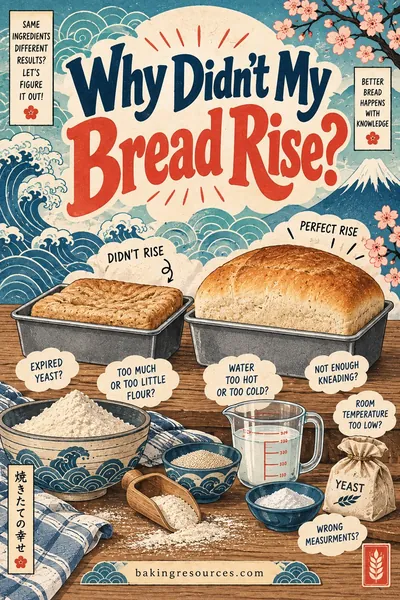
Preventing it is easier than fixing it. Cut the yeast, not the time. Underproofed dough just needs another 30 minutes on the counter, and it is a much smaller problem. Our guide on why dough is not rising runs through the opposite failure in order of likelihood.
Flour and hydration change the clock too
Protein content. Bread flour at 12 to 14% protein holds gas longer and tolerates a 72 hour ferment. All-purpose at 10 to 11.7% goes slack sooner, so cap it at about 48 hours. Our comparison of bread flour vs all-purpose covers what the protein difference actually does to the dough.
Hydration. A 70% hydration dough ferments faster than a 60% one at the same yeast and temperature, because the yeast and enzymes both need water to work. Wetter dough is also slacker at the end, so it hits the overproofed point sooner.
Salt. Standard pizza dough runs 2 to 3% salt by flour weight. Salt slows fermentation and tightens gluten, and both are useful. Cut the salt and the dough races and tears. Push past 3% and the rise drags noticeably.
Sugar and oil. New York style doughs often carry 1 to 2% sugar and 1 to 3% oil. Small amounts of sugar speed things slightly and help the crust brown. Oil softens the crumb and slows gas escape a little.
Once the dough is right, the oven is the other half. Our guide to pizza oven temperature has the target numbers for home ovens, stones and steels.
Frequently asked questions
How long should pizza dough rise before you use it?
Two to four hours total at room temperature with about 1% instant yeast, split into a 1 1/2 to 2 hour bulk rise and a 1 to 2 hour ball proof. If you have longer, a 24 to 48 hour cold ferment with a quarter of that yeast gives a better crust with less active work.
Can pizza dough rise too long?
Yes. Past its peak the gluten breaks down, the dough goes flat and sticky, and it tears when you stretch it. At room temperature that happens in about 4 to 6 hours with a standard yeast dose. In the refrigerator it takes 3 days or more. Cutting the yeast is the fix, not shortening the schedule.
Does pizza dough need a second rise?
The ball proof is technically a second rise, and skipping it makes stretching much harder. Balling tightens the gluten, and it needs 1 to 2 hours at room temperature to relax. Cold dough needs 1 1/2 to 2 hours on the counter to do the same job.
How long can pizza dough sit out after being refrigerated?
Two to three hours is comfortable for a 250 g ball. Past four hours at a warm room temperature it starts overproofing, especially in summer. Take the balls out 90 minutes before you plan to stretch, and leave them sealed so the surface does not dry into a skin.
Should pizza dough double in size?
No, and this is where bread advice misleads people. A 50 to 75% increase in the bulk rise leaves enough gluten strength to hold a puffy rim. A fully doubled bulk usually means the dough is already on its way down, which shows up as a flat crust with no oven spring.
How much yeast for a 24 hour pizza dough?
About 0.2 to 0.25% instant yeast by flour weight, so 1 to 1.25 g for 500 g of flour, which is roughly a quarter teaspoon. Use 1.25 times that if you are working with active dry. Weigh it on a scale that reads to 0.1 g rather than trying to eyeball a fraction of a spoon.
Can I freeze pizza dough instead of letting it rise longer?
Yes. Freeze the balls after the bulk rise, wrapped tightly, and use them within three months. Thaw overnight in the refrigerator, then bring to room temperature for 2 hours. Freezing kills some of the yeast, so a frozen ball rises a little slower and benefits from an extra 30 minutes on the counter.
Why does my pizza dough shrink back when I stretch it?
It has not relaxed enough. The gluten is still tight from balling, and it needs another 20 to 40 minutes at room temperature. Cold dough does this too, so check that the balls actually reached room temperature and not just the surface. Never fight it with a rolling pin, since that knocks out the gas you spent hours building.
Related guides: Active dry vs instant yeast | Why is my dough not rising | Pizza oven temperature | How to knead dough | Yeast converter tool