Why Is My Banana Bread Dense?

Dense banana bread comes down to three things far more often than anything else: too much flour, an overmixed batter, or too much banana for the amount of flour. Rule those out in that order and you'll find your answer on the first or second loaf.
Two more show up regularly: leavening that has gone flat, and a loaf pulled from the oven before the middle finished setting. Quick breads are done at 200 to 205°F in the center, and almost everyone underbakes them.
Weigh the flour before you change anything else. Our free grams to cups converter turns any cup measurement into grams, which is the single fastest fix on this page.
Updated September 2026
Why is my banana bread dense? Start with the crumb
Slice the loaf and look at the cut face before you touch the method. The crumb tells you which cause you're dealing with, and the five patterns below look very different from each other.
| What the slice looks like | Most likely cause | The fix |
|---|---|---|
| Tight, dry, close crumb with a normal domed top | Too much flour | Weigh at 125 g per cup instead of scooping |
| Wet, gummy stripe along the bottom and a fine crumb above it | Too much banana, or underbaked | Cut banana to 60 to 90 percent of the flour weight. Bake to 200 to 205°F |
| Long vertical tunnels and a tough, rubbery chew | Overmixed after the flour went in | Stir until the last dry streak vanishes, then stop |
| Barely rose, flat top, heavy all through | Dead baking soda, or no acid to react with it | Test the soda in vinegar. Check for buttermilk, yogurt or brown sugar in the mix |
| Sunken middle with cooked, dry edges | Pulled too early, or the pan was overfilled | Fill to two thirds and check the center temperature |
Each of those gets a full section below. Jump to the row that matches your loaf.
Cause 1: too much flour, and the measuring cup problem
This is first because it's the most common and because the error is bigger than people expect.
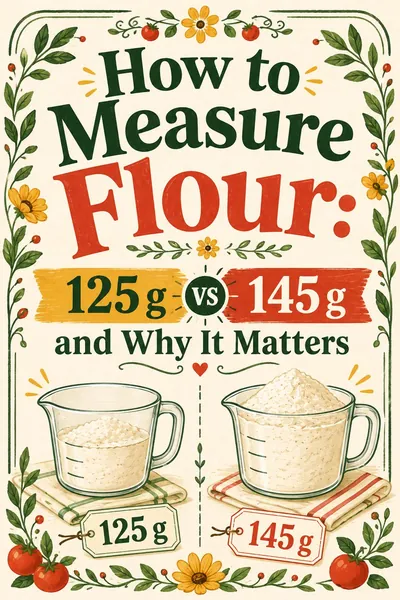
A cup of all-purpose flour weighs 125 g if you spoon it into the cup and level it. Dip the cup into the bag and it comes out around 145 g. That's a 20 g swing from nothing but how you filled it, and it happens every single cup.
Banana bread usually calls for 2 cups of flour. So:
- Spoon and level: 2 x 125 = 250 g
- Scoop and sweep: 2 x 145 = 290 g
- You added 40 g of extra flour, or 16 percent more structure than the recipe intended
Now look at what that does to the balance of the loaf. Say the mix has 240 g of mashed banana, which is 1 cup.
- As written: 240 g banana against 250 g flour = 96 percent banana to flour
- What you made: 240 g banana against 290 g flour = 83 percent
That 13 point drop is the difference between a moist, tender loaf and a dry, tight one. The extra flour soaks up moisture that was supposed to stay free in the crumb, and it brings extra gluten with it.
The fix is a scale, and nothing else comes close. If you don't have one, spoon the flour in and level with the back of a knife. Never dip the cup, never tap it on the counter, and never shake it flat. How to measure flour walks through all three methods with the gram weights for each.
One quiet version of this same mistake: flour measured after sifting versus before. "1 cup sifted flour" means sift first, and that cup lands around 115 g. "1 cup flour, sifted" means measure first, then sift, which is 125 g. The word order changes the loaf.
Cause 2: overmixing, the quick bread trap
Banana bread is a quick bread, and quick breads are mixed by a rule that feels wrong the first time you follow it: stop while the batter still looks slightly lumpy.
Flour plus liquid plus stirring equals gluten. In yeast bread that's the whole point. In a quick bread it's the enemy, because gluten strands make a chewy, tight, rubbery crumb instead of a soft crumbly one.
What overmixing looks like in the finished loaf
- Tunnels. Long vertical holes running up through the slice, like someone pushed a straw through it. Gas got trapped in a stretchy gluten network and pushed straight up instead of spreading out.
- A tall, peaked, cracked dome. A gentle crack down the middle is normal for a loaf pan. A steep pointed ridge means the batter was too elastic.
- A chewy, bready bite rather than a tender one that breaks apart on the fork.
- A darker, denser band near the base where the structure collapsed under its own weight.
The stop signal
Mix the wet ingredients thoroughly. Whisk the dry ingredients together separately. Then combine them with a spatula, not a mixer, and stop the moment the last dry streak of flour disappears. That is usually 10 to 15 folds, and the batter should still look a bit rough and lumpy.
Those lumps are hydrated flour, not raw pockets. They smooth out in the oven. A perfectly smooth banana bread batter has almost always been mixed too far.
Our guide to what overmixing does to batter has the stop signals for every mixing method, and the same principle explains why muffins turn out dry, since muffins use the identical method.
A stand mixer is the usual culprit. It's fine for creaming butter and sugar, which is a different job covered in how to cream butter and sugar. Once the flour goes in, switch to a spatula by hand. Fifteen seconds on low in a stand mixer will do more work than a minute of gentle folding.
Cause 3: too much banana for the flour
This one surprises people, because more banana sounds like a good idea. Bananas are roughly three quarters water by weight, so every extra one you add is mostly liquid going into a batter whose flour content hasn't changed.
Past a point, the loaf can't set. You get a wet, heavy, pudding-like band through the middle that reads as dense even though the bread rose fine.
The ratio that actually predicts texture
Compare the weight of mashed banana to the weight of flour:
| Banana as a share of flour weight | What you get |
|---|---|
| 40 to 55% | Light and cakey, mild banana taste, dries out fast |
| 60 to 90% | The sweet spot. Moist, tender, clearly banana, holds its shape |
| 95 to 115% | Very moist, denser crumb, a slightly damp center |
| Over 120% | Wet, gummy, and often sunken. It will not set properly |
Weights worth memorizing: 1 cup of mashed banana is about 240 g, and one medium peeled banana mashes down to roughly 115 to 120 g, or half a cup. So "3 medium bananas" is anywhere from 300 g to 400 g depending on what the store was selling that week.
That range is the real problem. A recipe written for 3 small bananas and made with 3 large ones can land 100 g of extra liquid in the bowl, which is nearly half a cup.
The fix: weigh the mashed banana, don't count fruit. If you're over, either hold some back or add flour to match. To add flour, multiply the excess banana by about 0.4. So 80 g of extra banana wants roughly 32 g of extra flour.
Overripe versus underripe changes the number too
As a banana ripens, its starch converts to sugar and its flesh loses firmness and free water shifts around. A blackened banana mashes into a thin, syrupy puree. A yellow one with green tips mashes into a stiff, starchy paste with lumps in it.
Underripe bananas cause density in two ways. They contribute less sweetness, so the loaf tastes flat, and they leave firm chunks in the batter that never fully break down. Those chunks turn into wet spots in the slice.
If your bananas aren't ready, don't roast them and don't rush it. A roasted banana loses water in the oven and then adds concentrated sugar to the batter, which changes both the moisture and the browning. Wait for skins that are more black than yellow.
Cause 4: your leavening was doing nothing
Banana bread is nearly always leavened with baking soda, and baking soda only works if there's an acid in the batter for it to react with.
Bananas are mildly acidic, and most recipes add more acid on purpose through buttermilk, yogurt, sour cream or brown sugar. Remove that acid in a substitution and the soda has nothing to do.
The two things that go wrong
The soda is old. Baking soda doesn't expire in a dramatic way, it just gets weaker as it picks up moisture and stray acids from the air. Test it: drop 1/4 teaspoon into 2 teaspoons of white vinegar. It should erupt instantly and violently. A lazy fizz means replace it.
The dose is wrong. The working ceiling is about 1/4 teaspoon of baking soda per cup of flour. Level teaspoons, not heaped ones. Baking soda weighs roughly 4.6 g per teaspoon, and baking powder about 4 g per teaspoon, so a heaped spoon can easily be half again as much as you meant.
Too little soda gives you a short, heavy loaf. Too much gives you a loaf that rises fast, runs out of gas, and collapses into a dense center, plus a soapy metallic aftertaste. Both read as "dense" from the outside.
Our baking soda vs baking powder guide explains why the two aren't interchangeable, and how long baking powder lasts has the storage and testing details for both.
A note on substitutions. Swapping regular milk for buttermilk removes acid. So does swapping all brown sugar for white. If you make either swap, the soda loses part of its partner, and the loaf comes out heavier. Our baking substitutions guide lists which swaps carry acid and which don't.
Cause 5: you pulled it too early
An underbaked banana bread feels exactly like a dense one. The center is heavy and damp, the slice smears on the knife, and the whole loaf sits low.
Loaf pans are the hardest shape to bake through. They're deep and narrow, so the top surface browns and looks finished long before heat reaches the middle.
Bake to a temperature, not a clock
| Bake | Done at (center) |
|---|---|
| Banana bread and other quick breads | 200 to 205°F |
| Muffins | 200 to 205°F |
| Butter cake | 205 to 210°F |
| Lean yeast bread | 200 to 210°F |
An instant-read thermometer pushed into the center of the loaf settles it in three seconds. The toothpick test works too, but it lies more often here than anywhere else, because a pick can pass straight through a wet stripe and come out clean from the drier crumb above it. Test in two or three spots if you're going by pick.
If the top is browning before the center sets, tent it loosely with foil at about the 35 minute mark and keep going. Do not lower the oven and hope. A tented loaf can take another 15 to 20 minutes and comes out fine.
Then let it cool
Banana bread keeps cooking after it leaves the oven, and the starches finish setting as the temperature falls. Cut it hot and you compress a still-soft crumb into a gummy slice from a loaf that was actually fine.
Ten minutes in the pan, then out onto a rack for at least an hour. Our guide to cooling a cake covers the same physics and the timing for every shape.
Cause 6: the pan is the wrong size
Batter depth controls bake time more than anything else, and loaf pans vary more than people realize.
| Pan | Volume to rim | Batter at 2/3 fill | Typical bake at 350°F |
|---|---|---|---|
| 8.5 x 4.5 x 2.5 in | 6 cups | 4 cups | 55 to 65 min |
| 9 x 5 x 2.5 in | 8 cups | 5 1/3 cups | 50 to 60 min |
| 8 x 4 in (1 lb tin) | 4 cups | 2 2/3 cups | 45 to 55 min |
| 3 mini loaves, 5.75 x 3 in | 2 cups each | 1 1/3 cups each | 25 to 35 min |
The 8.5 x 4.5 and the 9 x 5 are both sold as "standard," and they are not the same pan. The smaller one holds a quarter less. Pour a 9 x 5 batch into an 8.5 x 4.5 and you get a deeper loaf with a tall cracked dome, a longer bake, and a much higher chance of a raw middle.
Full dimensions for every size are in our loaf pan size chart, and the area math for swapping any two pans is in how to substitute cake pan sizes.
Material matters too. Dark nonstick metal absorbs heat and sets the crust early, so drop the oven 25°F and check 5 minutes sooner. Glass heats slowly then holds that heat, so drop 25°F and add 5 to 10 minutes. Light aluminum is the baseline every number here assumes.
A worked example: fixing a loaf that came out heavy
What happened. A 2 cup flour recipe, 3 large bananas, mixed in a stand mixer until smooth, baked 55 minutes in a dark 8.5 x 4.5 pan. The result is short, wet in the middle, chewy at the edges.
Step 1. Weigh what you actually used. Three large bananas mashed came to 390 g. The scooped flour came to 290 g. That is a banana-to-flour ratio of 390 ÷ 290 = 134 percent, which is far past the 120 percent limit where a loaf stops setting.
Step 2. Correct the flour first. Spoon and level 2 cups properly and you get 250 g. That's the intended number.
Step 3. Correct the banana. At 250 g of flour, the top of the good range is 90 percent, which is 250 x 0.9 = 225 g of mashed banana. Round to 240 g, one full cup, and you're at 96 percent. That's still moist and still very much a banana loaf.
Step 4. Or keep all the banana and add flour to match. If you refuse to waste 150 g of banana, multiply the excess by 0.4: 390 - 240 = 150 g excess, and 150 x 0.4 = 60 g of extra flour. New flour total: 310 g. Bump the soda by about 1/8 teaspoon to keep the ratio near 1/4 teaspoon per cup.
Step 5. Fix the method. Wet in one bowl, dry in another, spatula only, stop at the last dry streak. Roughly 12 folds.
Step 6. Fix the bake. The dark pan means 325°F, not 350°F. Foil tent at 35 minutes. Pull at 202°F in the center, which will land somewhere around 65 to 75 minutes with the extra banana in there.
What changed. Two of the six causes were stacked on top of each other, which is normal. A dense loaf is usually not one mistake.
Can you save a dense loaf that's already baked?
Not as a loaf, but it doesn't have to be a loss.
- Slice it thin and toast it. A tight crumb toasts beautifully and thin slices hide density well.
- Cube it for a bread pudding base or French toast. Dense bread absorbs custard without falling apart, which is the one job where an airy loaf is worse.
- Dry the slices low and blitz them into crumbs for streusel toppings and coatings.
- Put it back in the oven if the middle is genuinely raw and the loaf came out less than 20 minutes ago. Return it to a 325°F oven, tented, for 10 to 15 minutes. Once it has cooled fully, this no longer works. It just dries the outside.
Storage matters for the next loaf too. Banana bread holds moisture well but goes sticky-topped if you wrap it warm. Cool it completely, then wrap. Our guide to storing baked goods covers the timing for each type.
Frequently asked questions
Why is my banana bread dense in the middle but fine at the edges?
That's an underbaked center, not a batter problem, especially if the edges taste dry. Loaf pans concentrate the slowest heat in a narrow column down the middle. Bake to 200 to 205°F in the center rather than to a time, and tent the top with foil once it hits the color you want so you can keep baking without burning it.
Can too many bananas make banana bread dense?
Yes, and it's one of the most common causes. Banana is about three quarters water, so extra fruit is mostly extra liquid. Keep the mashed banana between 60 and 90 percent of the flour weight. One cup of mashed banana is about 240 g, and one medium banana is roughly 115 to 120 g mashed.
Should banana bread batter be lumpy?
It should. Lumps in a quick bread batter are hydrated flour, and they smooth out in the oven. A glossy, perfectly smooth batter means the gluten has been worked, which gives you tunnels and a chewy crumb. Stop folding the moment the last dry streak disappears, usually around 10 to 15 strokes.
Does old baking soda make banana bread dense?
It can, and it's the cheapest cause to rule out. Drop 1/4 teaspoon of soda into 2 teaspoons of white vinegar. A violent instant fizz means it's fine. Anything less means replace it. Also check that the recipe still has an acid in it, since soda needs one to work, and swapping buttermilk for plain milk removes it.
Why did my banana bread sink in the middle?
Usually too much leavening, too much banana, or the oven door opened before the structure set. Stay near 1/4 teaspoon of baking soda per cup of flour, keep the banana under 120 percent of the flour weight, and leave the door shut for the first 40 minutes. Our guide to why cakes sink covers the same failure in detail.
Is dense banana bread undercooked or overmixed?
The crumb tells you. Undercooked gives you a wet, smeary band low in the slice while the top half looks normal. Overmixed gives you long vertical tunnels and a chewy, rubbery bite all the way through. A thermometer reading under 195°F in the center points at the first one.
How full should I fill a banana bread pan?
Two thirds, and no more. A 9 x 5 pan holds 8 cups to the rim, so 5 1/3 cups of batter is the target. Overfilling gives you a mushroomed top, a raw middle, and batter down the side of the oven. Bake any excess as muffins for 20 to 25 minutes.
Does using butter instead of oil make banana bread denser?
Slightly, and it's a texture trade rather than a mistake. Oil is 100 percent fat and stays liquid at room temperature, so an oil loaf tastes moister and softer on day two. Butter is about 80 percent fat and 16 percent water, so a butter loaf is a touch firmer with better taste. If you swap, use 80 g of oil for every 100 g of butter and add 16 g of liquid back.
Related guides: How to measure flour | What overmixing does | Loaf pan sizes | Baking soda vs baking powder | Why is my bread dense | Grams to cups converter