How to Substitute Cake Pan Sizes and Adjust Bake Time

Here is how to substitute cake pan sizes and adjust bake time in two moves. First, divide the new pan's floor area by the old pan's floor area, and multiply every ingredient by that number. Second, work out the new batter depth, because depth sets the time: add 10 to 15 minutes and drop the oven 25°F for every extra half inch of depth, or cut 8 to 12 minutes for every half inch shallower.
Volume tells you whether the batter fits. Area tells you how much to make. Depth tells you how long to bake it. Those are three different numbers and mixing them up is the reason pan swaps go wrong.
Updated September 2026
Skip the arithmetic. Put your original pan and your new pan into our free cake pan converter and it returns the scaling factor and the bake time adjustment in one step.
How to substitute cake pan sizes and adjust bake time, step by step
Five steps, in order. Do them in this order and the answer comes out right every time.
Step 1. Find both pan areas. For a round pan, area equals 3.1416 times the radius squared. A 9-inch round has a 4.5-inch radius, so 3.1416 x 4.5 x 4.5 = 63.6 square inches. For a rectangle, multiply length by width. Skip the math and use the chart in the next section.
Step 2. Divide new by old. That is your scaling factor. Going from a 9-inch round to a 9x13, the factor is 117 divided by 63.6, which is 1.84.
Step 3. Multiply the ingredients. Every ingredient by weight, times the factor. Weight makes this painless, since 375 g of flour times 1.84 is 690 g and there are no fractions to fight. Round the factor to something friendly first, like 1.75 or 2, then adjust.
Step 4. Check the fit. Multiply the new pan's total capacity by 0.67. If your scaled batter volume is under that number you are fine. If it is over, either scale down or bake the extra separately.
Step 5. Set the time from depth. Depth in inches equals cups of batter times 14.4, divided by pan area in square inches. Compare the new depth to the old depth and apply the time rule. Then ignore the clock and test for doneness anyway.
Step 3 is where you might want the recipe scaler, which handles the ingredient multiplication once you know the factor.
The pan area and capacity chart
Every number here is measured across the inside top of the pan. Volumes are level to the rim, and the working capacity column is the two-thirds figure you should actually plan against.
| Pan | Area (sq in) | Volume to rim (cups) | Working capacity (cups) |
|---|---|---|---|
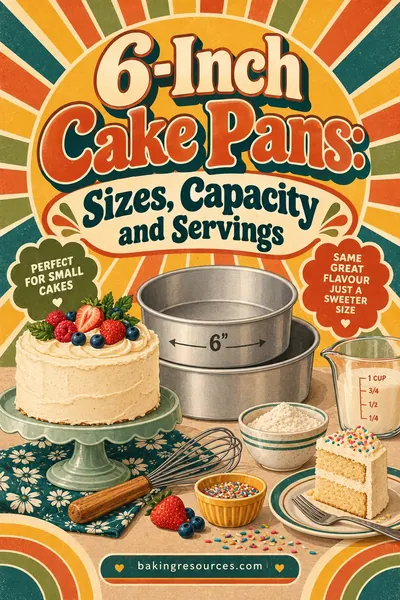
| 6-inch round, 2 in deep | 28.3 | 4 | 2.7 |
| 7-inch round, 2 in deep | 38.5 | 5.5 | 3.7 |
| 8-inch round, 2 in deep | 50.3 | 6 | 4 |
| 9-inch round, 2 in deep | 63.6 | 8 | 5.3 |
| 9-inch round, 3 in deep | 63.6 | 12 | 8 |
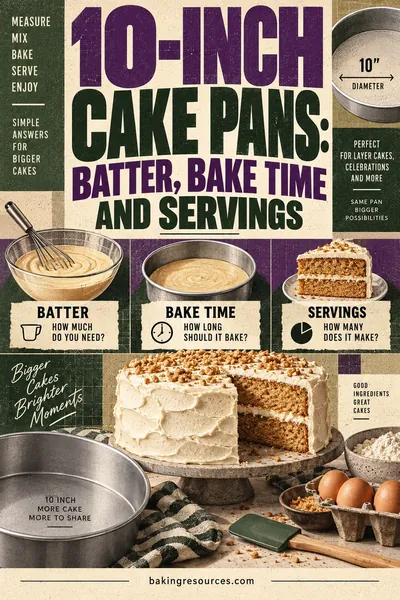
| 10-inch round, 2 in deep | 78.5 | 10 to 11 | 7 |
| 12-inch round, 2 in deep | 113 | 15 | 10 |
| 8x8 square, 2 in deep | 64 | 8 | 5.3 |
| 9x9 square, 2 in deep | 81 | 10 | 6.7 |
| 7x11, 2 in deep | 77 | 10 | 6.7 |
| 8x12, 2 in deep | 96 | 12 | 8 |
| 9x13, 2 in deep | 117 | 14.5 | 9.7 |
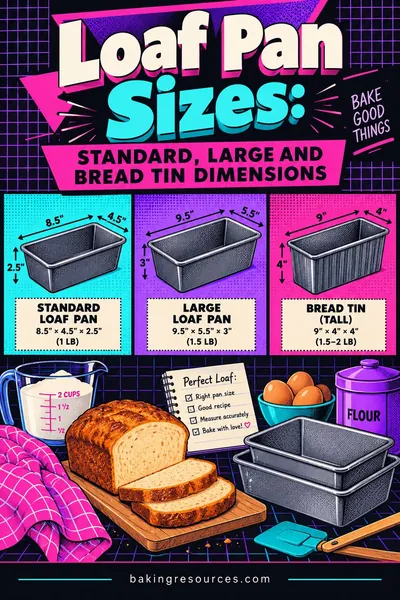
| 8x4 loaf, 2.5 in deep | 32 | 6 | 4 |
| 9x5 loaf, 3 in deep | 45 | 8 | 5.3 |
| 10-inch tube or Bundt | 78.5 gross | 12 | 8 |
| 10x15 jelly roll, 1 in deep | 150 | 10 | 6.7 |
| 13x18 half sheet, 1 in deep | 234 | 12 | 8 |
| 12-well muffin pan | 1/2 cup per well | 6 | 4 |
Two rows deserve a note. A Bundt pan's gross area overstates it, because the center tube takes floor space away, so treat the capacity column as the real number there. And a jelly roll pan has enormous area but shallow sides, so it holds less than a 9x13 despite being bigger across.
Our round cake pan sizes guide breaks the circular family down further, including servings per size.
The scaling factor matrix
This is the lookup version of step 2. Find your original pan on the left, your new pan across the top, and multiply your recipe by the number where they meet.
| From (down) / To (across) | 8-in round | 9-in round | 8x8 | 9x9 | 9x13 | 9x5 loaf |
|---|---|---|---|---|---|---|
| 8-inch round | 1.00 | 1.26 | 1.27 | 1.61 | 2.33 | 0.89 |
| 9-inch round | 0.79 | 1.00 | 1.01 | 1.27 | 1.84 | 0.71 |
| 8x8 square | 0.79 | 0.99 | 1.00 | 1.27 | 1.83 | 0.70 |
| 9x9 square | 0.62 | 0.79 | 0.79 | 1.00 | 1.44 | 0.56 |
| 9x13 pan | 0.43 | 0.54 | 0.55 | 0.69 | 1.00 | 0.38 |
| Two 8-inch rounds | 0.50 | 0.63 | 0.64 | 0.81 | 1.16 | 0.45 |
| Two 9-inch rounds | 0.40 | 0.50 | 0.50 | 0.64 | 0.92 | 0.35 |
Three things fall out of that table immediately.
An 8-inch round and an 8x8 square are effectively the same pan, 50.3 against 64 square inches. The factor of 1.27 means a square holds about a quarter more, which is why square pans of the "same" size always look bigger.
A 9-inch round is almost exactly the same as an 8x8 square, factor 1.01. Straight swap, no math, no time change.
Two 9-inch rounds are about 8 percent bigger than a 9x13. That is close enough to call them interchangeable, and it is the reason that swap appears on every chart. Our 9x13 pan substitutes page has the full set of swaps for that pan specifically.
Why depth, not size, decides the bake time
A cake bakes from the outside in. Heat crosses the pan wall and the pan floor by conduction, and reaches the top by hot air and radiation. The center is the last part to arrive at setting temperature.
Double the depth and the center is twice as far from every heat source, but the outside is still cooking the whole time. That gap is what produces a dark, dry edge around a wet middle.
The formula for depth is short:
Depth in inches = (cups of batter x 14.4) / pan area in square inches
The 14.4 is the number of cubic inches in one US cup. Run your original recipe through it, run the new pan through it, and compare.
| Depth change vs original | Time change | Temperature change |
|---|---|---|
| 1 inch shallower | 16 to 24 min less | None, or up 25°F |
| 1/2 inch shallower | 8 to 12 min less | None |
| Within 1/4 inch | None | None |
| 1/2 inch deeper | 10 to 15 min more | Down 25°F |
| 1 inch deeper | 20 to 30 min more | Down 25°F |
| 1 1/2 inches deeper | 35 to 45 min more | Down 50°F, and tent with foil |
The temperature column is the half people skip. Adding time alone to a deeper pan just gives the edges longer to overbake. Dropping the oven slows the outside enough for the heat to reach the middle before the edge dries out. That trade, longer at lower heat, is the entire technique.
The reverse works too. A thin sheet of batter can go 25°F hotter for a shorter bake and come out with a better crumb, because the middle sets almost as fast as the edges do.
Our baking time calculator runs this depth math directly, and the oven temperature converter handles the Fahrenheit, Celsius and gas mark side.
Worked example 1: an 8-inch round recipe scaled up to a 9x13
The original. A single-layer butter cake for one 8-inch round: 1 1/2 cups (188 g) all-purpose flour, 1 cup (200 g) sugar, 1 stick (113 g) butter, 2 large eggs, 1/2 cup (120 g) milk, 1 1/2 tsp (6 g) baking powder. Bakes at 350°F for 30 to 35 minutes. Batter volume about 3 cups.
Step 1, areas. 8-inch round is 50.3 sq in. 9x13 is 117 sq in.
Step 2, factor. 117 divided by 50.3 = 2.33. Round it down to 2.25, which is a friendlier number and leaves a little headroom.
Step 3, scale.
| Ingredient | Original | x 2.25 | What to actually use |
|---|---|---|---|
| Flour | 188 g | 423 g | 423 g, or 3 1/3 cups at 125 g per cup |
| Sugar | 200 g | 450 g | 450 g |
| Butter | 113 g | 254 g | 254 g, or 2 sticks plus 2 tbsp |
| Eggs | 2 large (100 g) | 225 g | 4 eggs plus 1 yolk, or weigh to 225 g |
| Milk | 120 g | 270 g | 270 g |
| Baking powder | 6 g | 13.5 g | 13.5 g, about 3 1/3 tsp |
Eggs are the awkward one, and weighing solves it. One large egg out of the shell is about 50 g, a yolk is about 18 g and a white about 32 g, so 225 g is four whole eggs plus one yolk. If you would rather not split an egg, use four and add 25 g of milk.
Step 4, check the fit. 3 cups of batter times 2.25 is 6.75 cups. The 9x13 has a working capacity of 9.7 cups. Comfortable.
Step 5, set the time. Original depth: 3 x 14.4 divided by 50.3 = 0.86 inches. New depth: 6.75 x 14.4 divided by 117 = 0.83 inches. That is 0.03 inches shallower, which is nothing.
Result: same oven at 350°F, same 30 to 35 minutes, maybe checking a minute or two early. Confirm at 200 to 205°F internal.
That is the ideal case. The pans had the same proportions, so the depth stayed put and nothing about the bake changed. Most swaps between shallow rectangular and round pans behave this way.
Worked example 2: two 8-inch layers into one 9x5 loaf pan
This one is deliberately awkward, because it shows what happens when the shape changes and not just the size.
The original. A two-layer recipe filling two 8-inch rounds with about 2.75 cups of batter each, 5.5 cups total, baked at 350°F for 28 to 32 minutes.
Step 1, areas. Two 8-inch rounds are 100.6 sq in combined. One 9x5 loaf pan is 45 sq in.
Step 2, factor. 45 divided by 100.6 = 0.45. So you would scale the recipe to 45 percent of itself, which gives 2.5 cups of batter.
Or keep the recipe whole and check the fit. The 9x5 loaf holds 8 cups to the rim, so the working ceiling is 5.3 cups. Your 5.5 cups is just over it. Bake 5 cups in the loaf pan and put the last half cup into two muffin wells.
Step 3, the depth. Original depth in one 8-inch round: 2.75 x 14.4 divided by 50.3 = 0.79 inches. New depth in the loaf pan: 5 x 14.4 divided by 45 = 1.60 inches.
Step 4, the difference. 1.60 minus 0.79 is 0.81 inches deeper. That is a little over 1 1/2 half-inch steps.
Step 5, apply the rule. Roughly 16 to 24 minutes more, and drop the oven 25°F. So 325°F for 48 to 58 minutes instead of 350°F for 28 to 32.
Step 6, protect the top. At that depth the surface browns long before the middle sets, so tent loosely with foil at about the 35 minute mark. Test at 200 to 205°F internal, and expect the loaf to crack down the middle, which is normal for a deep narrow pan and not a fault.
The muffins bake at the original 350°F for 18 to 22 minutes, since their depth matches the original layers much more closely than the loaf does.
Compare the two examples and the lesson is clear. Example 1 moved the batter sideways and nothing changed. Example 2 stacked the same batter into a third of the footprint and the whole bake had to be rebuilt.
What does not scale linearly
Multiplying every line by the same number works for most ingredients and fails for a handful.
Eggs. They come in fixed units. Weigh them, or round to whole eggs and correct the difference with liquid.
Chemical leaveners. Baking powder at 4 g per teaspoon and baking soda at about 5 g per teaspoon scale fine as long as the batter depth stays similar. If the new pan makes the batter noticeably deeper, trim the leavening by 10 to 20 percent, because a deep batter takes longer to set and an over-leavened deep cake rises fast, then falls. That collapse pattern is one of the causes covered in why a cake sinks.
Salt and strong flavorings. Vanilla, almond extract, spices and salt scale at roughly 75 to 80 percent of the factor when you go above 2x. Doubling a recipe rarely needs double the almond extract.
Yeast. Scales sub-linearly in both directions and depends on the proof time you want. Our yeast converter handles that separately.
Pan prep. Grease and flour scales with the pan's surface area including the sides, not with the batter volume.
Cooling time. A deeper cake holds heat far longer. Give a loaf-shaped bake 15 minutes in the pan and at least an hour on a rack, which our guide to cooling a cake covers in detail.
For the ingredient side of scaling in general, including halving awkward fractions, our full guide on how to scale a recipe goes deeper than this page does.
Pan material shifts the numbers again
| Material | Effect | Adjustment |
|---|---|---|
| Light aluminum | Baseline, most recipes assume it | None |
| Dark or nonstick metal | Absorbs heat, browns hard | Drop 25°F, check 8 to 10 min early |
| Glass or ceramic | Slow to heat, then holds heat | Drop 25°F, pull slightly early |
| Stoneware | Very slow and steady | Drop 25°F, add 5 to 10 min |
| Disposable foil | Thin, uneven, flexes | Set on a preheated sheet pan |
| Insulated or air-core | Slows bottom browning | Add 5 min, expect pale bottoms |
Material and depth stack. A deep batter in a dark pan needs the 25°F drop for depth and another for the pan, which is a 50°F reduction and a much longer bake. That is a real situation, not a hypothetical, and it is how people end up with a cake that reads done on the outside at 40 minutes and is still batter at the center.
Doneness beats every calculation on this page
Every number here is a starting point, because ovens run off their dials, batters differ and altitude changes everything.
Test three ways. A toothpick in the center should come out clean or with a few dry crumbs for cake and quick bread. An instant-read thermometer should show 200 to 205°F in the center of a butter cake, quick bread or muffin. And the surface should spring back with no dent when you press it lightly.
Two extra signals: the cake pulls slightly away from the pan sides when it is done, and the smell shifts from raw batter to cake a few minutes before it finishes. That smell change is your cue to start testing.
Frequently asked questions
How do I know what size pan to use instead?
Compare floor areas, not diameters. Divide the new pan's area by the old pan's area, and if the answer lands between 0.9 and 1.1 the pans are interchangeable with no changes at all. Outside that range, multiply your ingredients by the factor and recheck the batter depth before setting a time.
Do I really need to change the temperature, or just the time?
Change the temperature whenever the batter depth changes by half an inch or more. A deeper batter at the original temperature means the edges spend all the extra minutes overbaking while the center catches up, so you get a dry rim and a wet middle. Down 25°F for deeper, and you can go up 25°F for a much shallower bake.
What is the scaling factor from an 8x8 to a 9x13?
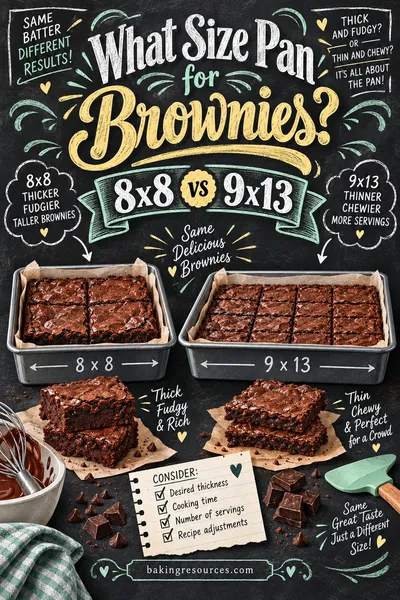
1.83, since a 9x13 has 117 square inches of floor against the 8x8's 64. In practice most people round to 1.75 or simply double the recipe and accept a slightly deeper cake, which needs about 5 extra minutes. Our brownie pan size guide works through that exact pair in more detail.
Can I bake a two-layer recipe in one deep pan?
Yes, if the pan holds it and you accept a much longer bake. Two 9-inch layers hold about 5.5 cups combined, which fits a 9x3 round with its 8-cup ceiling. The batter goes from roughly 0.6 inches deep per layer to about 1.25 inches in one pan, so add 20 to 30 minutes, drop to 325°F, and tent the top when it colors.
How full should a cake pan be?
Two thirds of its total volume, never more. Batter can gain 40 percent in height before the structure sets, so anything past two thirds either spills over the rim or sets on the outside while the raw middle is still climbing. Multiply the pan's cup capacity by 0.67 and bake the extra as cupcakes.
Does the same math work for square and rectangular pans?
Yes, and it is easier, since area is just length times width. The one caveat is corners. Square and rectangular pans deliver more heat into the corner pieces than a round pan does to any part of its edge, so corners bake faster and set firmer. That is a texture difference, not a timing one.
How does changing the pan affect servings?
More than people expect, because the slices change shape as well as count. A 9x13 typically gives 15 to 24 pieces, two stacked 9-inch layers give 12 to 16 taller slices from the same batter, and a loaf gives 10 to 12 slices. Our cake servings calculator sizes the pan to a headcount instead of the other way around.
Why did my cake overflow after I switched pans?
You went past the two-thirds line. It is the single most common pan swap failure, and it happens because capacity to the rim looks generous on a chart while real batter needs room to climb. Run the 0.67 multiplication before you pour, and set the pan on a rimmed sheet pan so any spill lands somewhere you can wash.
Where to go next
Pan swaps, ingredient scaling and bake time are one problem in three parts.
Run the pan pair through the cake pan converter for the factor and the time change together. Use the recipe scaler for the ingredient math once you have the factor. Then set the clock with the baking time calculator and confirm with a thermometer, because the last word on doneness always belongs to the cake.