Square Cake Pan Sizes and Dimensions

Square cake pan sizes and dimensions are easier to work with than round ones, because the floor area is just one side times the other. An 8x8 pan gives you 64 square inches and holds about 8 cups of water to the rim, which is 5 to 5 1/2 cups of batter in real use. A 9x9 is 81 square inches, 10 cups to the rim, and 6 1/2 to 7 cups of batter.
That one-inch difference in the name is a 27 percent difference in capacity. It's the single most expensive misread in home baking, because the pans sit side by side in the cupboard and look almost identical.
Swapping between two pans right now? Our free cake pan converter does the area math and tells you how much batter each one takes.
Updated September 2026
Square cake pan sizes and dimensions: the full chart
Every volume below is level-to-the-rim capacity, which is the number you get by filling the empty pan with water from a measuring cup. The batter column is two thirds of that, because two thirds full is the ceiling for a cake with any leavening in it.
| Pan size | Metric | Depth | Floor area | Volume to rim | Batter it takes | Party servings | Wedding servings |
|---|---|---|---|---|---|---|---|
| 6 x 6 | 15 x 15 cm | 2 in | 36 sq in | 4 1/2 cups | 3 cups | 7 | 18 |
| 7 x 7 | 18 x 18 cm | 2 in | 49 sq in | 6 cups | 4 cups | 10 | 24 |
| 8 x 8 | 20 x 20 cm | 2 in | 64 sq in | 8 cups | 5 to 5 1/2 cups | 12 to 13 | 32 |
| 9 x 9 | 23 x 23 cm | 2 in | 81 sq in | 10 cups | 6 1/2 to 7 cups | 16 | 40 |
| 10 x 10 | 25 x 25 cm | 2 in | 100 sq in | 12 cups | 8 cups | 20 | 50 |
| 12 x 12 | 30 x 30 cm | 2 in | 144 sq in | 18 cups | 12 cups | 28 | 72 |
| 14 x 14 | 35 x 35 cm | 2 in | 196 sq in | 24 cups | 16 cups | 39 | 98 |
| 16 x 16 | 40 x 40 cm | 2 in | 256 sq in | 32 cups | 21 cups | 51 | 128 |
Serving counts assume a finished cake about 4 inches tall, so two 2-inch layers with filling between them. Cut a single layer instead and the party number roughly halves. The wedding column is the catering standard of a 1 by 2 inch piece, which is why it looks so much higher. Both numbers are honest answers to different questions, and our cake serving calculator draws the cutting grid for either one.
Then there are the deep square pans, sold for tall layer cakes and for people who hate splitting batter across two pans:
| Pan size | Depth | Volume to rim | Batter it takes | What it's really for |
|---|---|---|---|---|
| 8 x 8 | 3 in | 12 cups | 8 cups | One tall layer you split in two after cooling |
| 9 x 9 | 3 in | 15 cups | 10 cups | Replaces two shallow 9x9s in a single bake |
| 10 x 10 | 3 in | 18 cups | 12 cups | Base tier for a square tiered cake |
| 12 x 12 | 3 in | 27 cups | 18 cups | Big-batch sheet cake territory |
Two honest caveats before you trust any chart, including this one.
Brands vary. Supermarket pans slope outward, so a pan that measures 8 inches across the top can be 7 1/2 inches across the base. That costs you 6 to 8 percent of the floor area and makes the corners run ahead of the middle. Straight-sided professional pans hold noticeably more than their sloped equivalents at the same nominal size.
And the depth on your pan may not be what you assume. "Square cake pan" almost always means 2 inches deep, but plenty of older and cheaper pans are 1 1/2 inches. An 8x8 at 1 1/2 inches deep holds about 6 cups, not 8. That's a quarter less capacity, and enough to send batter onto your oven floor.
How to measure a square cake pan the right way
Square pans are named by their inside top measurement, not the outside. Measuring across the outer rim adds a quarter inch or more, which is exactly enough to put you on the wrong row.
Lay a ruler flat across the top of the empty pan and read from inside edge to inside edge. Then stand the ruler inside against a wall and read the depth from the base up to the rim. Two numbers, thirty seconds.
Better still, do the water test once and never think about it again. Fill the pan from a 1-cup measure, counting as you go, until the water reaches the rim. Write the number on a strip of masking tape and stick it underneath the pan. That figure beats every published chart, because it's your actual pan with its actual slope.
If your pan turns out to be an odd size, our guide to uncommon baking pan sizes works through the in-between rectangles like 7x11 and 8x12 that keep showing up in older recipes.
Why floor area decides everything, not the side length
Here's the trap. Going from an 8x8 to a 9x9 sounds like a 12 percent change, because 9 is 12 percent more than 8. It isn't. Area grows with both sides at once, so 64 becomes 81, and that's 27 percent more floor.
Every swap you'll ever make between square pans comes down to one number: the ratio of the two floor areas. Multiply the whole recipe by that ratio and the batter lands at the same depth in the new pan, which means the same oven temperature and almost the same time.
| From this pan | To 6x6 | To 8x8 | To 9x9 | To 10x10 | To 12x12 |
|---|---|---|---|---|---|
| 6 x 6 (36 sq in) | 1.00 | 1.78 | 2.25 | 2.78 | 4.00 |
| 8 x 8 (64 sq in) | 0.56 | 1.00 | 1.27 | 1.56 | 2.25 |
| 9 x 9 (81 sq in) | 0.44 | 0.79 | 1.00 | 1.23 | 1.78 |
| 10 x 10 (100 sq in) | 0.36 | 0.64 | 0.81 | 1.00 | 1.44 |
| 12 x 12 (144 sq in) | 0.25 | 0.44 | 0.56 | 0.69 | 1.00 |
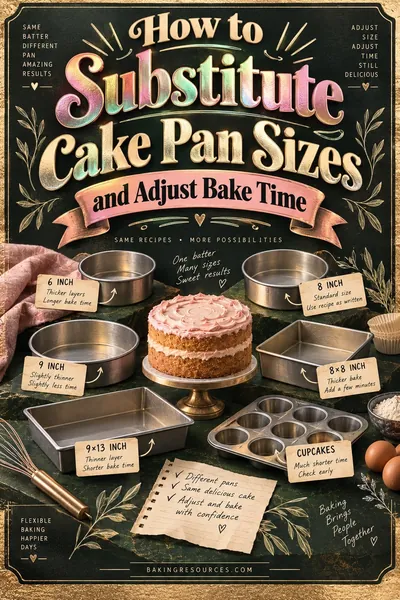
Read it as: find your original pan on the left, find the pan you own along the top, and multiply every ingredient by the number where they meet. The full method, including what to do about eggs that don't divide neatly, lives in our guide to substituting cake pan sizes.
Square vs round: the free swaps worth memorizing
A square pan always holds more than the round pan with the same number on it, because a circle loses the corners. The factor is pi over 4, or about 0.785, every single time.
| Square pan | Round pan of the same name | Difference | Verdict |
|---|---|---|---|
| 8 x 8 (64 sq in) | 8 inch round (50.3 sq in) | Square holds 27% more | Not a swap. Scale or you'll overflow |
| 8 x 8 (64 sq in) | 9 inch round (63.6 sq in) | Within 1% | Free swap. Change nothing |
| 9 x 9 (81 sq in) | 9 inch round (63.6 sq in) | Square holds 27% more | Not a swap |
| 9 x 9 (81 sq in) | 10 inch round (78.5 sq in) | Within 4% | Free swap. Change nothing |
| 10 x 10 (100 sq in) | 12 inch round (113 sq in) | Round holds 13% more | Close, batter runs shallow |
| 6 x 6 (36 sq in) | 7 inch round (38.5 sq in) | Within 7% | Near enough to swap |
The line to keep in your head is short: an 8-inch square equals a 9-inch round, and a 9-inch square equals a 10-inch round. Those two pairs cover most of what a home baker ever needs. Our round cake pan sizes chart has the same treatment from the circular side.
The one thing that doesn't carry across is the edges. A square pan delivers heat into each corner from two directions at once, so corner pieces set firmer and brown harder than anything a round pan produces. That's a texture difference, not a timing one, and for brownies it's the whole point.
Worked example: taking a 9x9 recipe into an 8x8
This is the swap people actually need, because 9x9 recipes are everywhere and 8x8 is the pan most kitchens own.
The recipe, written for a 9x9 snack cake: 250 g all-purpose flour, 200 g granulated sugar, 113 g butter, 2 large eggs, 180 ml milk, 2 teaspoons baking powder, 1/2 teaspoon salt. That comes out to roughly 6.6 cups of batter.
Step 1. Find the factor. 64 square inches divided by 81 is 0.79.
Step 2. Scale everything.
| Ingredient | 9x9 original | x 0.79 | What to actually use |
|---|---|---|---|
| All-purpose flour | 250 g | 197.5 g | 198 g |
| Granulated sugar | 200 g | 158 g | 158 g |
| Butter | 113 g | 89 g | 89 g |
| Large eggs | 2 | 1.58 | 1 whole egg plus 1 yolk, or beat 2 and weigh out 79 g |
| Milk | 180 ml | 142 ml | 142 ml |
| Baking powder | 2 tsp | 1.58 tsp | 1 1/2 tsp |
| Salt | 1/2 tsp | 0.4 tsp | 1/2 tsp, salt doesn't need scaling |
Step 3. Check the depth. The original was 6.6 cups over 81 square inches. Depth in inches equals cups times 14.4 divided by area, so 6.6 x 14.4 / 81 = 1.17 inches. The new batch is 5.2 cups over 64 square inches: 5.2 x 14.4 / 64 = 1.17 inches. Identical.
Step 4. Bake it the same. Same depth means same temperature and same time. Start checking two minutes early anyway, because an 8x8 has slightly more edge per square inch than a 9x9 and the outside sets a touch sooner.
The lazy version. If you can't face the arithmetic, multiply by 0.8 instead of 0.79. The difference is under a gram on every line in this recipe. Where the lazy version breaks down is a big jump, like a 12x12 down to an 8x8, because a 5 percent error on a large batch is a real amount of batter.
Batter depth, bake time, and the number that connects them
Depth is the only thing that changes bake time. Not the pan's name, not its shape, not its metal.
Depth in inches = (cups of batter x 14.4) / floor area in square inches
Once you have both depths, the adjustment is simple:
- Within 15 percent of the original depth: change nothing, check five minutes early.
- Up to 30 percent deeper: drop the oven 25°F and add 10 to 15 minutes.
- More than 30 percent deeper: drop 25°F, add 15 to 25 minutes, and tent the top with foil once it's browned.
- Up to 30 percent shallower: keep the temperature and start testing 8 to 10 minutes early.
- More than 30 percent shallower: raise the oven 25°F so the edges set before the middle dries out, and check very early.
Say you pour a full 9x9 batch into an 8x8 without scaling. 6.6 cups over 64 square inches is 1.48 inches, which is 27 percent deeper than the original 1.17. That's a 25°F drop and about 12 extra minutes, and it's cutting the two-thirds rule very close in a 2-inch pan. Scaling is the better answer.
Our oven temperature converter handles the Fahrenheit, Celsius and gas mark side if your recipe came from somewhere else.
Metric square pans: 20 cm, 23 cm, and the ones that aren't quite right
European and Australian recipes call for square pans in centimeters, and the conversions are close but not exact.
| Metric pan | True inches | Nearest US pan | Area gap | Do you need to adjust? |
|---|---|---|---|---|
| 15 x 15 cm | 5.9 in | 6 x 6 | 2% smaller | No |
| 18 x 18 cm | 7.1 in | 7 x 7 | 3% larger | No |
| 20 x 20 cm | 7.9 in | 8 x 8 | 3% smaller | No |
| 23 x 23 cm | 9.1 in | 9 x 9 | 3% larger | No |
| 25 x 25 cm | 9.8 in | 10 x 10 | 3% smaller | No |
| 22 x 22 cm | 8.7 in | 9 x 9 | 6% smaller | Not really, batter sits slightly deeper |
| 28 x 18 cm | 11 x 7 in | 11 x 7 rectangle | Exact | It's a rectangle, use the rectangle math |
Every gap in that table is under 6 percent, which is inside the variation between two brands of the same nominal pan. So if a British or Australian recipe asks for a 20 cm square, your 8x8 is the pan. Bake it as written.
The genuine difference with those recipes isn't the pan, it's the cup. A metric cup is 250 mL against the American 236.588 mL, so any recipe that measures by cups is about 6 percent off before you start. Weigh instead, and use our grams to cups converter if the recipe gives you one and you want the other.
Which square pans are actually worth owning
If you're buying, buy in this order.
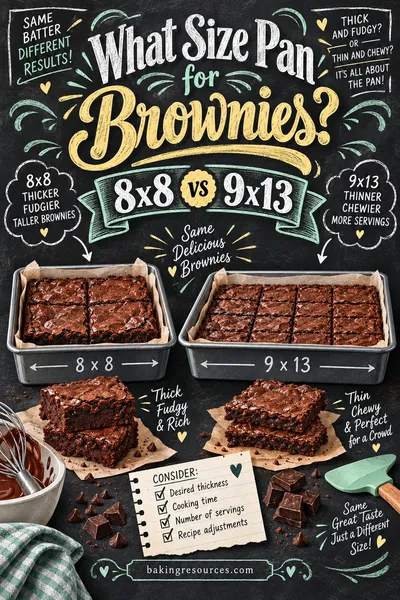
1. An 8x8, light aluminum, straight sided, 2 inches deep. It's the default pan for brownies, bar cookies, snack cakes and small casseroles. Light metal browns gently, so the edges set instead of scorching. Our brownie pan size guide explains why this pan is the baseline for nearly every brownie formula printed.
2. A 9x9. It covers the recipes written for it and doubles as a stand-in for a 10-inch round. If you'd rather own one square pan than two, own the 8x8, because scaling up is easier than scaling down when eggs are involved.
3. A 9x13. Not square, but it's the pan that finishes the set. An 8x8 recipe times 1.83 fills it exactly, and our 9x13 pan substitutes guide covers the swaps in both directions.
Skip dark nonstick for cakes. Dark metal absorbs more radiant heat and browns the crust before the center is done, which is why so many nonstick brownies come out with hard corners and a raw middle. If dark nonstick is what you have, drop the oven 25°F and expect the corners to run ahead.
Glass runs the other way. It heats slowly and holds heat, so the cake keeps cooking after it leaves the oven. Drop 25°F for glass too, and pull it a few minutes early.
Whatever metal you use, line the base with parchment. A square pan has four corners for a cake to grab onto, and our guides to lining a cake pan and cakes stuck to the pan cover the sling method that gets bars out in one piece.
Frequently asked questions
Is a 9x9 pan much bigger than an 8x8?
Yes, much bigger than it looks. A 9x9 has 81 square inches of floor against the 8x8's 64, so it's 27 percent larger. An 8x8 recipe poured into a 9x9 comes out about a quarter thinner, bakes faster, and loses its fudgy middle. Multiply the recipe by 1.27 to keep the depth the same.
How many cups does an 8x8 pan hold?
About 8 cups filled level to the rim, and 5 to 5 1/2 cups of batter in practice, since you never fill a cake pan past two thirds. A 3-inch deep 8x8 holds around 12 cups to the rim and takes 8 cups of batter. Fill your own pan with water from a measuring cup to get the exact figure, because sloped supermarket pans hold less than straight-sided ones.
What is a 20 cm square tin in inches?
A 20 x 20 cm pan is 7.9 inches square, which is an 8x8 for every practical purpose. The area gap is about 3 percent, smaller than the difference between two brands of American 8x8. Use your 8x8 with no changes to quantity, temperature or time.
Can I use a 9-inch round instead of an 8-inch square?
Yes, and it's the cleanest swap in baking. A 9-inch round is 63.6 square inches against the 8x8's 64, a gap of well under 1 percent. Same batter, same depth, same temperature, same time. The only difference is that you lose the crisp corner pieces.
How many people does a 9x9 square cake serve?
About 16 party servings from a two-layer cake roughly 4 inches tall, cut into pieces a bit over 2 inches square. Cut as a single 2-inch layer it's closer to 8. Cut the catering way, into 1 by 2 inch pieces, the same pan gives 40 wedding servings, which is why professional charts look so generous.
Do glass and metal square pans bake the same?
No. Glass heats slowly, then holds that heat and keeps cooking after you pull it out, so the edges over-bake while you wait for the center. Drop the oven 25°F for glass and check 5 minutes early. Light aluminum is the reference for almost every published bake time, and dark nonstick needs the same 25°F drop as glass for a different reason: it browns too fast.
What can I use if I don't have a square cake pan?
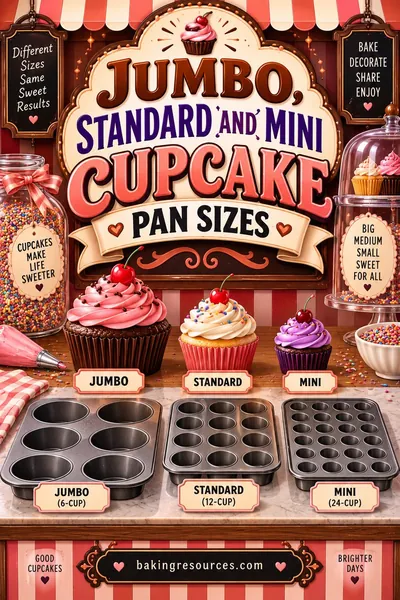
A 9-inch round covers an 8x8 exactly, and a 10-inch round covers a 9x9 within 4 percent. Failing that, a 9x13 takes an 8x8 recipe multiplied by 1.83, or you can build a foil dam across the 13-inch side to shrink the pan down. Cupcakes are the other escape hatch: an 8x8 batch fills about 12 standard wells, and our cake mix to pan size guide has the yields.
Why do the corners of my square cake bake faster than the middle?
Because a corner takes heat from two walls plus the base while the middle takes it from the base alone. It's built into the shape and you can't remove it, but you can soften it. Use light-colored aluminum instead of dark metal, line the pan with a parchment sling that overhangs the sides, and drop the oven 25°F while adding a few minutes. Insulated bake strips wrapped around the outside work too, and they're the reason bakery square cakes come out flat on top.