Baking Pan 8 x 12: Sizes, Capacity and Substitutes

A baking pan 8 x 12 inches and 2 inches deep gives you 96 square inches of floor and holds about 12 cups to the rim, which is 3 quarts. That is 82 percent of a 9x13, so a 9x13 recipe poured into one sits about 22 percent deeper and needs a cooler oven and more time.
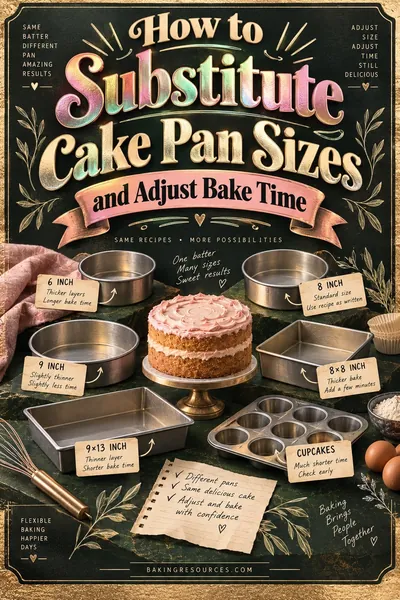
The closest straight swap is two 8-inch round pans, which come to 100.5 square inches. That is within 5 percent, so you can move a recipe between them with no changes at all.
Need the numbers for a pan that is not on this page? Our free cake pan converter does the area and depth math for any two pans.
Updated September 2026
What a baking pan 8 x 12 actually holds
Pans are named by their inside top measurements, not the outside. Measuring across the outer rim adds a quarter inch on each side, which is enough to put you in the wrong row.
| Pan | Metric | Floor area | Volume to rim | Batter at 2/3 fill | Quart equivalent |
|---|---|---|---|---|---|
| 7x11, 2 in deep | 18 x 28 cm | 77 sq in | 10 cups | 6 2/3 cups | 2.5 qt |
| 8x12, 2 in deep | 20 x 30 cm | 96 sq in | 12 cups | 8 cups | 3 qt |
| 8x8, 2 in deep | 20 x 20 cm | 64 sq in | 8 cups | 5 1/3 cups | 2 qt |
| 9x9, 2 in deep | 23 x 23 cm | 81 sq in | 10 cups | 6 2/3 cups | 2.5 qt |
| 9x13, 2 in deep | 23 x 33 cm | 117 sq in | 14.5 cups | 9 2/3 cups | 3.5 qt |
| 10x15 jelly roll, 1 in | 25 x 38 cm | 150 sq in | 10 cups | 7 cups | 2.5 qt |
| Quarter sheet 9x13, 1 in | 23 x 33 cm | 117 sq in | 8 cups | 5 1/3 cups | 2 qt |
One thing that confuses people: a glass dish sold as "3 quart" usually holds more than 12 cups to the actual rim. Dish makers print the safe fill line, not the brim, because you are meant to be able to carry a casserole without wearing it. Fill your own dish with water from a measuring cup once and write the real number on tape underneath it.
Why 8x12 and 7x11 exist at all
Neither is a standard American cake pan size, which is why recipes almost never call for them.
8x12 shows up in two places. It is the metric 20 by 30 cm pan, which is the standard traybake size across Europe and much of Asia, so it appears constantly in imported recipes. And a few US brands sell an 8x12 as a small sheet pan or a brownie pan.
A baking pan 7 x 11 is the classic American glass oblong, sold as a 2-quart or 2.5-quart dish and stocked in almost every supermarket. It is the size most people already own without ever having seen a recipe written for it.
So the practical question is not "what do I bake in these" but "what do I do with the 9x13 or 8x8 recipe in front of me". That is the rest of this page.
The area chart that settles every swap
Batter depth is what governs bake time, and depth is volume divided by floor area. So the only number you need is how the two floors compare.
| Pan | Floor area | vs 8x12 | vs 7x11 | vs 9x13 |
|---|---|---|---|---|
| 8x8 square | 64 sq in | 67% | 83% | 55% |
| 9x9 square | 81 sq in | 84% | 105% | 69% |
| 7x11 rectangle | 77 sq in | 80% | 100% | 66% |
| 8x12 rectangle | 96 sq in | 100% | 125% | 82% |
| 9x13 rectangle | 117 sq in | 122% | 152% | 100% |
| 9 inch round | 63.6 sq in | 66% | 83% | 54% |
| Two 8 inch rounds | 100.5 sq in | 105% | 131% | 86% |
| Two 9 inch rounds | 127.2 sq in | 133% | 165% | 109% |
| 10x15 jelly roll | 150 sq in | 156% | 195% | 128% |
Three matches jump out of that table, and they are the useful ones to memorize.
7x11 and 9x9 are within 5 percent. Swap them straight across with no change to temperature or time. If a recipe calls for a 9-inch square and you own the glass oblong, you are done thinking.
8x12 and two 8-inch rounds are within 5 percent. A traybake written for a 20 by 30 cm pan becomes a two-layer 8-inch cake with no math at all, and the reverse works too.
8x12 is exactly 1.5 times an 8x8. Sixty-four times 1.5 is 96, precisely. Multiply an 8-inch square recipe by 1.5 and it fits an 8x12 at the same depth, which means the same temperature and nearly the same time.
Anything more than about 10 percent off in either direction needs a real adjustment, and our 9x13 pan substitute guide has the wider set of those swaps.
Bake time follows depth, not pan size
Once the batter depth is set, the width barely matters. Heat travels in from the sides and up from the base at the same rate whatever the shape.
| Batter depth | At 350°F | What to do |
|---|---|---|
| Under 3/4 in | 15 to 22 min | Thin layers and bars. Check early, they dry fast |
| 3/4 to 1 1/4 in | 22 to 35 min | The comfortable range for most traybakes |
| 1 1/4 to 1 3/4 in | 35 to 48 min | A properly filled 2-inch pan |
| Over 1 3/4 in | 48 to 70 min | Drop to 325°F and add time |
To turn cups into depth: one cup is 14.4375 cubic inches. Multiply your cups of batter by 14.44, divide by the pan's floor area, and you have the depth in inches.
For an 8x12 that shortcut becomes cups x 0.15 = inches deep. Eight cups of batter sits 1.2 inches deep. For a 7x11 it is cups x 0.19, so eight cups sits 1.5 inches deep in the smaller pan. Our baking time calculator does the same arithmetic and adds the temperature adjustment.
Doneness beats any clock. A butter cake is done at 205 to 210°F in the center. Brownies come out at 200 to 205°F for fudgy and a little higher for cakey, which is covered in our guide to cakey brownies.
Worked example: a 9x13 recipe in an 8x12 pan
What you have: a brownie recipe written for a 9x13, and an 8x12 pan.
Step 1. The ratio. 96 divided by 117 is 0.82. The 8x12 has 18 percent less floor.
Step 2. Option A, scale the recipe down. Multiply everything by 0.82. If the recipe calls for 227 g butter, 400 g sugar, 4 large eggs, 125 g flour and 85 g cocoa:
- Butter: 227 x 0.82 = 186 g
- Sugar: 400 x 0.82 = 328 g
- Flour: 125 x 0.82 = 103 g
- Cocoa: 85 x 0.82 = 70 g
- Eggs: 4 large eggs are about 200 g shelled, so 200 x 0.82 = 164 g of beaten egg, which is a bit over three eggs
Beat all four eggs together, weigh out 164 g, and use the rest for something else. Guessing at "three and a bit eggs" is how a brownie ends up either rubbery or greasy. Our guide to scaling a recipe has the rules for leavening and salt, which do not scale in a straight line.
Step 3. Option B, bake the whole thing and adjust. Say the full recipe makes 6 cups of batter. In a 9x13 that sits 6 x 14.44 / 117 = 0.74 inches deep. In the 8x12 it becomes 6 x 14.44 / 96 = 0.90 inches deep, or 22 percent deeper.
Step 4. The adjustment for option B. Drop the oven 25°F and add 8 to 12 minutes. The lower temperature stops the edges setting before the middle has caught up, which is the classic failure when you move a recipe into a smaller pan.
Which one to pick. Scale it down if you care about the texture matching the original, which matters for brownies and bar cookies. Bake it all if you would rather have more of it, which is nearly always the honest answer.
Worked example: an 8x8 recipe up to an 8x12
This is the clean one, because the ratio is exactly 1.5.
The recipe: an 8-inch square blondie with 113 g butter, 200 g light brown sugar, 2 large eggs, 125 g all-purpose flour and 1/2 teaspoon salt.
Multiply by 1.5:
- Butter: 170 g, which is 12 tablespoons
- Brown sugar: 300 g packed
- Eggs: 2 large eggs are 100 g shelled, so 150 g, which is exactly 3 large eggs
- Flour: 188 g, or 1 1/2 cups at 125 g per cup
- Salt: 3/4 teaspoon
The egg line landing on a whole number is not luck, it is what happens whenever the scale factor is a simple fraction. Look for those before you reach for a calculator.
Bake time: the depth is unchanged, so keep the temperature and check two minutes early. An 8x12 has slightly less edge per square inch than an 8x8, so if anything the corners brown a touch less.
Yield: the 8x8 cut into 16 pieces becomes 24 pieces of the same size in the 8x12, cut 4 by 6.
Servings and cutting patterns
| Pan | Cut pattern | Pieces | Piece size |
|---|---|---|---|
| 7x11 | 4 x 5 | 20 | 1.75 x 2.2 in |
| 7x11 | 3 x 4 | 12 | 2.3 x 2.75 in |
| 8x12 | 4 x 6 | 24 | 2 x 2 in |
| 8x12 | 3 x 4 | 12 | 2.7 x 3 in |
| 9x13 | 4 x 6 | 24 | 2.25 x 2.2 in |
| 8x8 | 4 x 4 | 16 | 2 x 2 in |
Bakery brownies are usually cut 2 by 2 inches. Party squares run smaller, closer to 1.5 inches. An 8x12 cut into 24 gives you exactly the standard 2-inch square, which is a nice quiet argument for owning one.
Material and shape adjustments
Light aluminum is the baseline every number on this page assumes. It conducts fast and reflects, so the edges stay pale and even.
Glass, which is what most 7x11 dishes are, heats slowly and then holds that heat. Drop the oven 25°F and add 5 to 10 minutes. Glass also keeps cooking after it leaves the oven, so pull bars a couple of minutes earlier than you would from metal.
Dark or nonstick metal absorbs heat and browns hard. Drop 25°F and start checking 5 minutes early.
Ceramic behaves like glass but is usually thicker, so add another 5 minutes on top.
Sloped sides. Supermarket pans slope outward, so an "8x12" measured at the top can be 7.5 by 11.5 at the base. That costs 5 to 8 percent of the floor area and makes the corners bake faster than the middle. Straight-sided pans are worth buying if you cut bars into neat squares.
Depth. Almost everything on this page assumes 2 inches. Plenty of glass oblongs are only 1.75 inches, and some are 2.5. A half inch of difference on a 7x11 is 2 1/2 cups of capacity, which is a lot to be wrong about.
Choosing between them if you are buying one
If you own a 9x13 and want a second rectangular pan, buy the 7x11, because it doubles as your 9-inch square and it is the size most casserole recipes assume.
If you cook from metric or European recipes, buy the 8x12 (20 by 30 cm), because it is the traybake standard and because the 1.5 relationship with an 8x8 makes scaling painless.
If you bake layer cakes more than bars, skip both and buy two 8-inch rounds, which cover 8x12 territory anyway. The full set of round sizes is in our round cake pan chart, and the small end of that range is covered in the 6 inch cake pan guide.
Frequently asked questions
What size is an 8 x 12 baking pan in cm?
Twenty by thirty centimeters, at the standard 2-inch (5 cm) depth. That is the default traybake size in European and Australian recipes, so any recipe listing a 20 x 30 cm tin is written for exactly this pan.
Can I use a 9x13 pan instead of an 8x12?
Yes, and it is the easier direction. The 9x13 has 22 percent more floor, so the same batter sits shallower and bakes faster. Keep the temperature the same and start checking 5 to 8 minutes early. Going the other way, from 9x13 down to 8x12, is the one that needs a cooler oven.
What can I substitute for a baking pan 7 x 11?
A 9-inch square pan, which is 81 square inches against 77 and close enough to swap with no changes at all. Two 8-inch rounds work too, though they hold about 30 percent more, so the batter will run shallow. An 8x8 is 17 percent smaller, so hold back a cup of batter and bake the rest as cupcakes.
How many cups does an 8x12 pan hold?
About 12 cups filled to the rim, and 8 cups at the correct two-thirds fill for a cake batter. Bar batters and brownies can go higher, closer to three quarters full, because they barely rise. A 7x11 holds 10 cups to the rim and 6 2/3 cups of cake batter.
Is an 8x12 pan the same as a quarter sheet?
No. A true quarter sheet is 9x13 and only 1 inch deep, so it holds about 8 cups despite having more floor area. Some brands market an 8x12 as a small sheet pan, which is a naming choice rather than a standard. The real quarter, half and full sheet dimensions are laid out in our guide to sheet cake pan sizes. Check the depth before you trust either label.
Do I need to change the oven temperature for an odd pan size?
Only if the batter depth changes. Same depth means same temperature and roughly the same time. Once the batter is more than about 20 percent deeper than the original, drop 25°F and add time so the center sets before the outside overbakes.
How do I convert a metric traybake recipe to US pans?
A 20 x 30 cm tin is an 8x12, and two 8-inch rounds are the closest common substitute at 105 percent of the floor. An 18 x 28 cm tin is a 7x11, which swaps straight with a 9-inch square. For the ingredient side of the conversion, weigh everything rather than trusting cup equivalents, since a metric recipe was written by weight in the first place.
Why do my bars overbake at the edges in a rectangular pan?
Rectangles have more perimeter per square inch than squares do, so the corners get heat from two sides while the middle gets it from below. Dropping the oven 25°F and adding time helps, and so does an aluminum pan instead of a dark one. Lining the pan with a parchment sling also insulates the edges slightly.
Related guides: 9x13 pan substitutes | Round cake pan sizes | 6 inch cake pan guide | How to scale a recipe | Cake pan converter