Why Are My Brownies Cakey?

Cakey versus fudgy is a ratio question, not a technique question. More flour and more egg relative to the fat and sugar gives you cake. More fat and sugar relative to flour gives you fudge.
Leavening and beating decide the rest. Any baking powder or baking soda in a brownie recipe pushes it toward cake, and so does every extra minute you spend whipping air into the eggs. A brownie is a cake batter that has been deliberately starved of structure, so anything that adds structure or air moves it back toward cake.
The fix is arithmetic. Cut the flour by about a third, add fat, drop one whole egg for a yolk, and delete the leavening. Numbers for all of that are below.
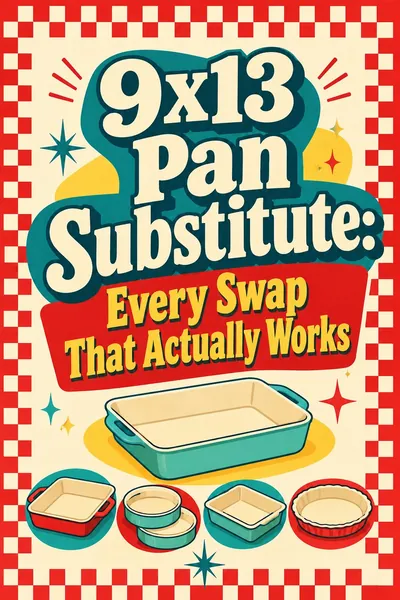
Baking in a different pan than the recipe called for is the other common cause, and it is the sneakiest one. Our free pan size converter tells you how much to scale a batter so it bakes to the same depth in the pan you actually own.
Updated August 2026
Why are my brownies cakey instead of fudgy?
Six things make a brownie cakey. Usually two or three are happening at once.
- Too much flour. Scoop-and-sweep measuring puts 145 g in a cup instead of the 125 g a recipe assumes, so "1 cup" can be 16% more flour than intended.
- Too many eggs, or too much egg white. Egg white is water plus structural protein. It sets into a spongy network, which is exactly what cake is.
- Leavening. Even 1/2 teaspoon of baking powder creates gas bubbles that lift the crumb into a fine, open cake texture.
- Not enough fat. Fat coats flour proteins and stops gluten from forming. Less fat means more gluten, more chew, more cake.
- Too much beating. Air whipped into eggs and sugar acts as leavening even without baking powder.
- Overbaking. Five extra minutes turns a fudgy center firm and dry, and dry reads as cakey even when the recipe was right.
The brownie lever table
Every lever pulls in both directions. Read the row, decide which side you want, and change one thing at a time so you know what worked.
| Lever | Pushes cakey | Pushes fudgy | Why it works this way |
|---|---|---|---|
| Fat to flour ratio | Below about 1:1 by weight | Above about 1.5:1 by weight | Fat coats flour particles and blocks gluten. High fat gives a dense, close crumb that stays soft when cool. |
| Flour amount | More flour | Less flour, down to about 70% of the original | Flour is the only structure builder in the batter. Cut it and the crumb has nothing to hold an open network. |
| Eggs | More whole eggs, extra whites | Fewer eggs, swap a whole egg for a yolk | Whites are water and protein that set spongy. Yolks are fat and emulsifier that set rich and dense. |
| Leavening | Any baking powder or soda | None at all | Gas bubbles inflate the crumb. Fudgy brownies use zero chemical leavening. |
| Sugar | Less sugar | More sugar, to a point | Sugar holds water, keeps the center soft, and delays starch from firming up. It also builds the shiny top. |
| Beating time after eggs go in | Long, until pale and thick | 30 to 60 seconds, just combined | Whipped eggs trap air, and trapped air is leavening you did not intend to add. |
| Bake time | Longer, until a clean toothpick | Shorter, until moist crumbs cling | Every extra minute drives off water and firms the starch. |
| Pan depth | Thin batter in a big pan | Thicker batter in the pan the recipe named | A thinner layer loses more water per unit of volume and bakes through faster. |
Melted butter versus creamed butter
This one change alters the crumb more than anything except flour.
Melted butter goes into the batter as liquid fat. It coats the flour immediately, so almost no gluten develops, and it adds no air at all. That gives the dense, glossy, slightly chewy crumb people mean by fudgy. Nearly every fudgy brownie recipe starts with melted butter.
Creamed butter is beaten with sugar until pale, and the process forces sugar crystals through the soft fat, cutting millions of tiny air pockets into it. Those pockets expand in the oven. A creamed brownie rises taller, has a finer and more open crumb, and eats like chocolate cake. Our guide to how to cream butter and sugar covers the technique and the timings.
So if your recipe says "cream the butter and sugar" and you want fudgy, that instruction is your first target. Melt the butter instead, cool it until it is warm rather than hot, and stir it in.
One catch: melted butter needs a little help staying emulsified. Whisk the sugar into the warm melted butter first, then the eggs, and the batter will come together glossy instead of greasy.
Why beating eggs and sugar gives a shiny crackly top
That thin, papery, crackled surface is meringue. Sugar dissolved into egg protein and whipped with air forms a foam, the foam floats to the top of the batter during baking, and it dries into a brittle sugar crust.
To build it, whip the eggs and sugar together for 3 to 5 minutes on medium-high until the mixture is pale and falls in thick ribbons, then fold in the warm chocolate and butter, then the flour.
Here is the trade-off nobody mentions. The air you whipped in to make the shine also lifts the crumb. Whip for five minutes and you get a spectacular top over a brownie that is noticeably lighter and more cake-like than the same recipe stirred by hand.
Ways to get some shine without much lift:
- Warm the sugar into the melted butter and chocolate first. Dissolved sugar builds the crust with less whipping.
- Whip only 90 seconds instead of 5 minutes. You get most of the shine and about a third of the lift.
- Use more sugar rather than more air. Recipes at 2.5:1 sugar to flour crackle almost on their own.
- Fold the flour in by hand. Any mixer time after the flour goes in costs you texture and gains you nothing.
Underbaking on purpose, and the honest safety note
Fudgy brownies are pulled from the oven before the center is fully set. A toothpick should come out with moist crumbs clinging to it, not clean and not coated in wet batter. The residual heat in the pan finishes the center as it cools.
Use a thermometer if you want this repeatable:
| Center temperature at pull | Result after cooling |
|---|---|
| 155 to 165F | Gooey, close to underdone, will not slice cleanly |
| 165 to 175F | Fudgy. Dense, moist, holds a clean edge once cooled |
| 180 to 190F | In between. Firm center, soft edges |
| 200F and up | Cakey and dry, regardless of the recipe |
Now the safety part, plainly. "Underbaked" here means moist crumbs, not liquid batter. Raw eggs can carry Salmonella and raw flour has been linked to E. coli outbreaks, which is why the FDA advises against eating any raw batter or dough. A brownie center that reaches 165F has been pasteurized. A center that is still pourable has not.
So the rule is: pull early, but pull at moist crumbs, and let the pan finish the job on the counter for at least 30 minutes before you cut. If you are baking for young children, pregnant people, or anyone immune compromised, take the center to 175F and accept a slightly firmer brownie. Our baking time calculator helps you adjust the clock when you change pan size or oven temperature.
Pan size and depth: the math nobody does
The same batter in a bigger pan bakes thinner and drier. Not a little drier, measurably drier, because a thinner slab loses far more water in the same amount of time.
Work in square inches:
| Pan | Area | Depth vs an 8x8 | Effect on the same batter |
|---|---|---|---|
| 8x8 inch square | 64 sq in | Baseline | The standard brownie pan. Thick, fudgy center. |
| 9x9 inch square | 81 sq in | 79% of the depth | About 21% thinner. Bake 5 minutes less. |
| 9x13 inch rectangle | 117 sq in | 55% of the depth | Nearly half as thick. Bakes fast, dries out, reads cakey. |
| 8 inch round | 50 sq in | 128% of the depth | Thicker. Bake 5 to 8 minutes longer. |
| 9 inch round | 64 sq in | Same | Interchangeable with an 8x8 square. |
Run the numbers for a real case. An 8x8 recipe poured into a 9x13 spreads over 117 sq in instead of 64. That is 1.83 times the area, so the batter sits at 1 divided by 1.83, or 55% of its intended depth. A brownie meant to be 1 1/4 inches thick is now about 11/16 of an inch. It will bake through in 18 minutes instead of 30, and the parts that finish first sit in the oven drying while the center catches up.
Two fixes. Either scale the recipe up by 1.83 times so the depth is right, or keep the recipe and cut 10 to 12 minutes off the bake. The pan size converter does the first calculation for you, including odd sizes like 7x11 and 10 inch rounds.
Cocoa powder versus melted chocolate
These are not interchangeable, and the difference is fat.
Unsweetened cocoa powder is roughly 10 to 12% fat by weight, sometimes up to 22 to 24% for high-fat Dutch process. Unsweetened baking chocolate is about 50% cocoa butter. So when a recipe calls for melted chocolate and you substitute cocoa, you strip out a large amount of fat and leave behind dry cocoa solids, which act a lot like extra flour.
That is a direct route to cakey brownies.
Working weights: cocoa powder is 85 g per cup, which is light and fluffy, so it is one of the easiest ingredients to over-measure by volume.
Rough substitution, per 1 ounce (28 g) of unsweetened baking chocolate: 3 tablespoons of cocoa powder (about 16 g) plus 1 tablespoon of butter or oil (about 14 g). Skipping that added fat is where the texture goes wrong.
Cocoa-only brownies can still be excellent. They just need more butter in the base recipe to compensate, and they lean chewier rather than melting. Whether you use natural or Dutch process also changes how any leavening behaves, which our guide to Dutch process vs natural cocoa works through.
Worked example: converting a cakey recipe to fudgy
Here is a typical cakey brownie formula, weighed in grams so the ratios are visible.
Starting recipe (cakey):
| Ingredient | Amount | Weight |
|---|---|---|
| All purpose flour | 1 cup, spoon and level | 125 g |
| Butter | 1/2 cup, 1 stick | 113 g |
| Granulated sugar | 1 cup | 200 g |
| Large eggs | 3 | 150 g |
| Cocoa powder | 1/2 cup | 43 g |
| Baking powder | 1/2 teaspoon | 2 g |
Butter to flour: 113 divided by 125, which is 0.9 to 1. Sugar to flour: 200 divided by 125, which is 1.6 to 1. Both are cake ratios.
Converted recipe (fudgy):
| Ingredient | New amount | Weight | Change |
|---|---|---|---|
| All purpose flour | Scant 2/3 cup | 85 g | Down 40 g, about a third less |
| Butter, melted | 3/4 cup, 1 1/2 sticks | 170 g | Up 57 g |
| Granulated sugar | Generous 1 cup | 225 g | Up 25 g |
| Large eggs | 2 whole plus 1 yolk | 118 g | Down 32 g, less white |
| Cocoa powder | 1/2 cup | 43 g | Unchanged |
| Baking powder | None | 0 g | Removed |
New butter to flour: 170 divided by 85, which is 2.0 to 1. New sugar to flour: 225 divided by 85, which is 2.6 to 1. Those are fudge ratios.
Method changes to go with it: melt the butter instead of creaming it, whisk the sugar into the warm butter, add the eggs and beat only 60 seconds, fold in the cocoa and flour by hand, and pull the pan when the center hits 168 to 172F, roughly 5 minutes earlier than before.
One warning on the flour. Cutting from 125 g to 85 g only works if 125 g is what you actually had. A scoop-and-sweep cup is 145 g, and if you were unknowingly starting at 145 you were 16% over before you began. Weigh it, or read how to measure flour for the spoon and level method that makes a cup land at 125 g.
Frequently asked questions
Why are my brownies cakey and dry?
Almost always two problems stacked: too much flour, and too long in the oven. Weigh the flour at 125 g per cup instead of scooping, and pull the pan when a toothpick shows moist crumbs rather than coming out clean.
Does baking powder make brownies cakey?
Yes, directly. Baking powder releases carbon dioxide that inflates the crumb into the fine, open structure of a cake. Fudgy brownie recipes contain no chemical leavening at all, so removing it is the single easiest change to make.
How do I make box brownies fudgier?
Use melted butter in place of the oil at the same weight, drop one egg and replace it with an extra yolk, stir by hand for 40 strokes instead of beating, and bake 4 to 5 minutes less than the box says. Those four changes shift a box mix noticeably.
Should brownies be baked at 325F or 350F?
350F is standard, which is 177C or gas mark 4. Dropping to 325F gives you a wider window between fudgy and overbaked, at the cost of 5 to 8 extra minutes and a slightly less crackly top. Thick brownies in a deep pan benefit most from the lower temperature.
Why don't my brownies have a shiny crackly top?
Not enough dissolved sugar at the surface, or not enough whipping. Beat the eggs with the sugar for 2 to 3 minutes until pale and ribbony, or dissolve the sugar into the warm melted butter and chocolate before the eggs go in. Higher sugar to flour ratios crackle more easily.
Can I use a 9x13 pan for an 8x8 brownie recipe?
You can, but the batter will sit at 55% of its intended depth, since a 9x13 is 117 square inches against 64. Either scale the recipe up by 1.83 times or cut 10 to 12 minutes off the bake time, or you will get thin, dry brownies.
Are underbaked brownies safe to eat?
Only if the center reached at least 165F, which pasteurizes the egg. Wet, pourable batter in the middle is not safe, because raw eggs can carry Salmonella and raw flour has been linked to E. coli. Moist crumbs on the toothpick are fine, a wet smear is not.
Do more eggs make brownies cakey?
Yes, especially extra whites. Egg white is water and structural protein that sets into a spongy network, which is what gives cake its lift and bounce. Trading one whole egg for one yolk cuts the white without losing richness.
Related guides: Pan size converter | Baking time calculator | How to measure flour | How to cream butter and sugar | Dutch process vs natural cocoa | How to melt chocolate