Why Is My Cake Dense?

A dense cake almost always comes from one of three things: too much flour, butter and sugar that never got creamed properly, or a batter that kept getting mixed after the flour went in. Check those three in that order and you'll find your cause on the first or second bake, because they account for the large majority of heavy cakes.
The rest of the list matters too, and it's short. Tired baking powder, cold eggs, the wrong flour, and a cool oven fill out the seven. None of them require you to become a better baker. They require you to change one small thing.
Flour is the biggest one by a wide margin, and it's a weighing problem, not a skill problem. Our free grams to cups converter gives you the gram weight of every cup in your recipe so you can stop guessing at the single ingredient that decides your crumb.
Updated September 2026
Why is my cake dense? Read the crumb before you change anything
Cut a slice and look at it in good light. The crumb tells you which of the seven you're dealing with, and it saves you from changing four things at once and learning nothing.
| What the crumb looks like | Most likely cause | The one change to make |
|---|---|---|
| Tight, dry, slightly crumbly, pale | Too much flour | Weigh the flour, or spoon and level it |
| Heavy and a little greasy, small even holes | Butter and sugar undercreamed | Cream 4 to 5 minutes until visibly pale |
| Rubbery, chewy, with long tunnels | Overmixed after the flour | Stop 10 seconds before it looks done |
| Squat all over, no dome, fine texture | Dead leavening | Test the baking powder in hot water |
| Curdled look before baking, coarse crumb | Cold eggs or cold milk | Bring both to about 68°F |
| Bready and tough, good height | Wrong flour, too much protein | Swap to cake flour or a cake flour blend |
| Dense band along the bottom only | Underbaked, oven runs cool | Thermometer in the oven, add 5 to 8 minutes |
A cake that rose beautifully and then dropped in the middle is a different failure with different causes, and our guide to why cakes sink walks through that one separately.
Cause 1: too much flour, and the scoop is why
This is the number one cause of dense cake in home kitchens, and almost nobody suspects it, because the measuring felt fine.
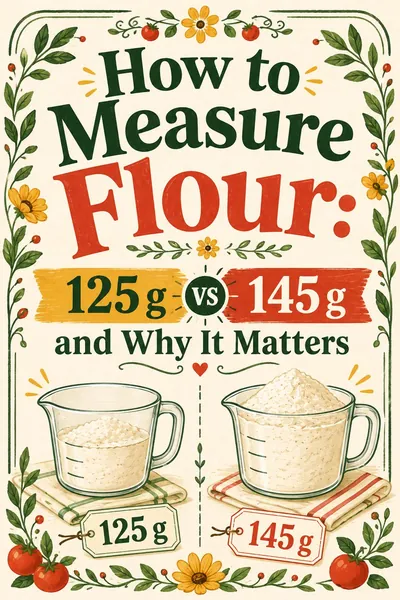
Here's the problem. Flour compacts. When you push a dry measuring cup down into the bag or the canister, you pack it. When you spoon flour into the cup and level it off with a knife, you don't. Same cup, two very different amounts.
Our own tool numbers: all-purpose flour spooned and leveled is 125 g per cup. Scooped straight from the bag it runs about 145 g. That's 16 percent more flour in every single cup, and it's invisible.
Now scale that up. A two layer cake using 2 cups of flour should get 250 g. Scooped, it gets 290 g. You just added 40 g of flour, roughly a third of an extra cup, without changing a word of the recipe. The liquid stayed the same, the fat stayed the same, and the batter has to stretch to cover more starch. It bakes tight, dry, and heavy.
The two fixes
Weigh it. A kitchen scale ends this problem permanently. Set the bowl on the scale, hit tare, pour to 250 g. No cups, no packing, no argument. This is the single highest value change a home baker can make, and once you own a scale it takes no extra effort at all.
Or spoon and level. No scale? Fluff the flour in the bag with a fork first, spoon it loosely into the cup, and sweep the top flat with the back of a knife. Never tap the cup on the counter, and never shake it to settle the top. Both of those pack it back down.
Our full walkthrough on how to measure flour shows the difference between the methods with real gram counts, and the same trap catches quick breads too, which is why dense banana bread usually traces back to the same scoop.
What about the other dry ingredients?
They matter less than you'd think. Granulated sugar is 200 g per cup no matter how you scoop it, because the crystals don't compress. Cocoa powder is 85 g per cup and it does compact, so a heavily chocolate cake can pick up the same problem through the cocoa. Powdered sugar is 120 g unsifted and about 100 g sifted, which is a real difference for frosting but rarely for cake.
Flour is the one that decides your crumb. Fix flour first.
Cause 2: the butter and sugar never got creamed
Creaming isn't stirring. It's a mechanical leavening step, and skipping it produces a heavy cake even when everything else is perfect.
When you beat softened butter with sugar, the hard sugar crystals cut thousands of tiny air pockets into the fat. Those pockets are where your cake's lift starts. Baking powder can only expand air that already exists. It doesn't create bubbles from nothing.
The right creaming looks like this: 4 to 5 minutes on medium speed with a stand mixer, 6 to 7 with a hand mixer. The mixture goes from yellow to nearly white, from dense to visibly fluffy, and it roughly doubles in bulk. Scrape the bowl twice on the way.
The wrong creaming takes 45 seconds and leaves the mixture yellow and pasty. That cake will be dense no matter what you do next.
Butter temperature is half the battle
Butter needs to be about 65 to 67°F for creaming. That's cool room temperature, not warm.
- Too cold, under 60°F: the butter won't hold air. It stays in stubborn chunks and the sugar just grinds against them.
- Too warm, over 70°F: the butter is too soft to hold structure. Air pockets collapse as fast as you beat them in.
- Melted: creaming is now impossible. Melted butter makes a fudgy, dense bake, which is lovely in a brownie and wrong in a layer cake.
The press test: a properly softened stick dents under your finger but holds the dent's edges. If your finger sinks straight through, it's too warm. Our guide to creaming butter and sugar has the visual stages, and how to soften butter covers the fast methods that don't accidentally melt it.
Cause 3: you mixed after the flour went in
Flour plus liquid plus agitation equals gluten. In bread that's the goal. In cake it's a wrecking ball.
Every extra turn of the mixer after the flour joins the batter builds more gluten strands. Those strands make the crumb chewy and tight, and they trap the leavening gas in long tunnels instead of fine even bubbles. The cake comes out rubbery and heavy with a slightly springy, bready bite.
The rule: mix on the lowest speed only until the last streak of flour disappears, then stop. If you're adding flour and milk alternately, that's usually 15 to 20 seconds per addition.
The safer rule: stop while a few faint streaks remain and finish by hand with a spatula, 8 or 10 folds. Hand folding cannot build gluten at mixer speed, so it's very hard to overdo.
There's one exception worth knowing. Reverse creaming, where the butter is rubbed into the flour before any liquid arrives, coats the flour in fat and blocks gluten development on purpose. Cakes made that way tolerate more mixing and come out velvety. Our piece on what overmixing does breaks down the chemistry across cakes, muffins and cookies.
Cause 4: your baking powder is tired
Baking powder loses strength on the shelf. An open can is usually reliable for 6 to 9 months and questionable after 12, even when the printed date says otherwise, because humidity in the kitchen slowly starts the reaction inside the can.
Test it in 30 seconds. Drop 1/2 teaspoon of baking powder into 1/4 cup of hot tap water. It should erupt into vigorous foam right away. A lazy fizz or a few sad bubbles means it goes in the trash.
Test baking soda the same way using 1/4 teaspoon in 2 tablespoons of vinegar. It should react immediately and hard.
Two things people get wrong here. First, more baking powder does not mean more lift. Past about 1 to 1 1/4 teaspoons per cup of flour, the bubbles grow too large, merge, rise to the surface and pop, and the cake collapses into a dense layer. Second, baking soda needs an acid in the recipe to do anything at all, so soda in a batter with no buttermilk, yogurt, sour cream, brown sugar, or natural cocoa is just sitting there tasting soapy.
Our guides on how long baking powder lasts and baking soda versus baking powder cover the storage and swap math.
Cause 5: cold eggs and cold milk broke the batter
You creamed the butter, you added eggs straight from the refrigerator, and the whole thing went from fluffy to curdled and speckled. That's the fat seizing around the cold liquid, and every air pocket you built just collapsed.
A broken emulsion bakes into a coarse, greasy, heavy crumb. It's a real cause and an easy one to remove.
Target about 68°F for eggs, milk, buttermilk, sour cream and yogurt. Set them on the counter 30 to 45 minutes ahead. In a hurry, sit whole eggs in a bowl of warm tap water for 5 minutes, and microwave milk in 8 second bursts until it loses its chill.
If the batter does break, it's often recoverable. Add 2 tablespoons of the recipe's flour and beat for 20 seconds. The starch usually pulls it back together. More on the timing and the why in why room temperature ingredients matter.
Cause 6: the wrong flour for that cake
Protein content decides how much gluten a flour can build, and the three common flours are genuinely different tools.
| Flour | Grams per cup (spooned) | Typical protein | Best for |
|---|---|---|---|
| Cake flour | 114 g | About 7 to 9 percent | Layer cakes, chiffon, angel food |
| All-purpose flour | 125 g | About 10 to 12 percent | Pound cake, coffee cake, most bakes |
| Bread flour | 127 g | About 12 to 14 percent | Bread, pizza, never a tender cake |
Notice that cake flour is not just lower in protein, it's lighter per cup. Swapping bread flour into a cake recipe cup for cup gives you both more protein and more grams. That cake will be tough and dense.
No cake flour on hand? For each cup, measure 1 cup all-purpose flour, remove 2 tablespoons, and replace them with 2 tablespoons of cornstarch. Whisk it or sift it three times so the starch distributes. It gets you most of the way there. Full method and ratios in our cake flour substitute guide.
Cause 7: oven and pan problems that read as dense
Sometimes the batter was fine and the bake let you down.
A cool oven. Home ovens routinely run 15 to 40°F off their dial. A cake baking at a true 320°F when the recipe wanted 350°F sets slowly, and the leavening gas escapes before the structure firms. You get a low, close crumb. A separate oven thermometer sitting on the middle rack is the fix, and it takes one minute to check.
Overfilled pans. A cake pan should be filled between half and two thirds. A 9 inch round pan 2 inches deep holds about 8 cups filled to the rim, so it takes 4 to 5 cups of batter in real use. Pour in 7 cups and the middle never gets hot enough to set, leaving a dense, wet seam through the center. Our cake pan converter does that capacity math for any pan you own.
Opening the door too early. A blast of cold air before the structure sets drops the whole cake. Wait until at least two thirds of the bake time has passed before you look, and keep the door open under 5 seconds.
Pulling it out too soon. An underbaked cake is dense at the bottom and gummy in the middle. A finished butter cake reads 205 to 210°F on an instant read thermometer in the center. A skewer should come out with a few dry crumbs, not wet batter.
A worked example: the same cake, measured two ways
Take a standard two layer vanilla cake: 2 cups all-purpose flour, 1 cup butter, 1 3/4 cups sugar, 4 eggs, 1 cup milk, 2 1/2 teaspoons baking powder.
Version A, spooned and leveled or weighed: - Flour: 2 x 125 g = 250 g - Butter: 227 g - Sugar: 1.75 x 200 g = 350 g - Milk: 240 g - Flour to liquid, counting milk and eggs at roughly 50 g each: 250 g flour against 440 g of liquid.
Version B, scooped from the bag: - Flour: 2 x 145 g = 290 g - Everything else identical. - Now it's 290 g flour against the same 440 g of liquid.
That's 40 extra grams of flour and a ratio shift of about 16 percent. In practice, version B bakes a couple of minutes longer, domes harder, and cuts noticeably drier and tighter. Nothing else changed. One person spooned and one person scooped.
Run the same check on your own recipe with the grams to cups converter before you blame the oven.
Fixes ranked by how much they move the needle
- Weigh the flour. Biggest single improvement available. Needs one scale.
- Cream for the full 4 to 5 minutes. Free, and it changes the crumb immediately.
- Stop mixing at the last flour streak. Free, and it takes discipline more than skill.
- Test the leavening. 30 seconds, once a month.
- Warm the eggs and milk. 30 minutes of planning.
- Put a thermometer in the oven. One purchase, useful for everything you bake.
- Match the flour to the cake. Cake flour for layers, all-purpose for pound cakes.
Do the first three and most dense cake problems disappear.
FAQ
Does more baking powder make a lighter cake?
No, and past a point it does the opposite. Roughly 1 to 1 1/4 teaspoons of baking powder per cup of flour is the working range. More than that makes bubbles that grow too big, merge, and burst, so the cake rises fast and then falls into a dense, slightly bitter layer.
Can I fix a dense cake after it's baked?
You can't change the crumb, but you can rescue the dessert. Brush the layers with a simple syrup to add moisture, or cube the cake for a trifle, cake pops, or a pudding. Save the diagnosis for the next bake, and change only one variable so you learn something.
Why is my cake dense but the top still cracked?
Those two go together more often than you'd expect. A cracked top means the outside set before the inside finished rising, which points to an oven that's too hot, while the dense crumb usually comes from too much flour. Drop the temperature 25°F, add 8 to 10 minutes, and weigh your flour.
Does the mixer speed matter?
Yes, in both directions. Cream the butter and sugar on medium so the sugar crystals actually cut air into the fat. Then drop to the lowest speed once flour is in the bowl, because high speed at that stage builds gluten fast and produces the chewy, tunneled crumb.
Is a dense cake underbaked or overbaked?
It can be either, and the location tells you which. Dense everywhere with dry edges means overbaked or too much flour. Dense in a band across the bottom with a gummy center means underbaked. Check the center with an instant read thermometer and look for 205 to 210°F in a butter cake.
Will using oil instead of butter fix it?
Often, yes. Oil is liquid at room temperature, so an oil cake stays softer and reads moister straight from the refrigerator. What you lose is the creamed air and the butter taste, so oil cakes lean on baking powder and eggs for lift instead. It's a different cake, not a repaired one.
Does high altitude cause dense cakes?
Above about 3,000 feet, lower air pressure lets bubbles expand too fast, so cakes rise hard and then collapse into a heavy crumb. The standard corrections are to raise the oven temperature by 15 to 25°F, cut the leavening by about a quarter, and add 1 to 2 tablespoons of liquid per cup of flour.