How Long Does Baking Powder Last?

An unopened can of baking powder lasts about 18 to 24 months, and most manufacturers print a date in that range on the bottom. Once you open it, count on 6 to 12 months of full strength, less in a humid kitchen. Baking soda is the tougher one: it stays good for about 2 years unopened and stays usable almost indefinitely if it is kept dry and sealed.
Do not trust the date on the can, though. Test it. Stir 1 teaspoon of baking powder into 1/3 cup of hot water. If it foams up hard and immediately, it is fine. A weak fizz or a slow trickle of bubbles means it has lost enough power to flatten a cake.
That test takes twenty seconds and costs nothing, and it is the only answer to how long does baking powder last that accounts for your actual kitchen.
If the test fails and you are mid-recipe, our free baking substitutions tool gives you the cream of tartar and baking soda rebuild, plus the amounts for buttermilk and yogurt versions.
Updated September 2026
How long does baking powder last compared to everything else in the cupboard
| Item | Unopened | Opened, stored well | How it fails |
|---|---|---|---|
| Baking powder | 18 to 24 months | 6 to 12 months | Loses gas gradually, no smell change |
| Baking soda | 2 years or more | Effectively indefinite if dry | Absorbs odors, clumps, rarely dies outright |
| Active dry yeast | 2 years | 4 to 6 months in the fridge | Dies, dough never rises |
| Instant yeast | 2 years | 6 months in the fridge, longer frozen | Same as above |
| Cream of tartar | Indefinite | Indefinite | Clumps only, potency holds |
| All-purpose flour | 12 months | 6 to 8 months in the pantry | Goes rancid or stale, smells musty |
| Whole wheat flour | 6 months | 3 months pantry, 12 months freezer | Oil in the germ goes rancid fast |
| Cocoa powder | 2 to 3 years | 1 year for best flavor | Fades in flavor, not unsafe |
Baking powder is the sneaky one on this list because it fails silently. Rancid flour smells wrong and dead yeast never rises, but half-strength baking powder looks, smells and tastes exactly like fresh baking powder. You only find out when the muffins come out squat.
Why baking powder loses power at all
Baking powder is three things in one can: an alkali (sodium bicarbonate, which is baking soda), one or two dry acids, and a starch buffer that keeps them apart.
The starch is doing more work than people realize. Cornstarch absorbs stray moisture so the acid and the base cannot meet while they sit on the shelf. The moment enough water gets in, the reaction starts, quietly, inside the can. Every bit of carbon dioxide that escapes in the cupboard is gas that will not be lifting your cake.
That means humidity, not age, is the real killer. A can opened in a dry winter kitchen can still be strong at 14 months. The same can opened above a steaming kettle in a humid climate can be weak at 5 months.
Three things speed up the loss:
- Humidity. Steam from the stove, a damp pantry, a can left open on the counter during a bake.
- A wet spoon. Dipping a spoon that touched batter is the single most common way people kill a can early.
- Heat. Storing it above the stove or next to the oven raises the temperature inside the can and quickens the reaction.
Baking soda does not have this problem in the same way, because there is no acid in the box waiting to react with it. It needs an acid from your recipe to do anything. Our guide to baking soda vs baking powder covers which one your recipe actually needs and why.
The potency test, done properly
Two tests, one for each leavener, and both take under a minute.
Baking powder test
- Measure 1 teaspoon of baking powder, about 4 g.
- Pour 1/3 cup (about 80 mL) of hot tap water into a clear glass.
- Stir the powder in.
- Watch for 10 seconds.
Fresh baking powder foams up fast and fills a good portion of the glass. It should look energetic, not polite. If you get a fizz that fades in 3 seconds or a scatter of bubbles around the edges, replace it.
Use hot water, not cold. Most supermarket baking powder is double-acting, meaning the second acid is designed to react with heat rather than moisture. Cold water underplays it and can make a good can look tired.
Baking soda test
- Measure 1/4 teaspoon of baking soda.
- Add 2 teaspoons of white vinegar or lemon juice.
- It should erupt immediately.
Baking soda that fizzes weakly has usually absorbed moisture and partly converted. That box has been in the fridge doing odor duty for two years, which is exactly what it is for, and it should not go into a cake.
Reading the date on the can
Most cans carry a "best by" date rather than an expiration date, and it means what it sounds like: full-strength performance up to that point when unopened.
Some brands print a manufacture date code instead. A common format is a letter for the month and two digits for the year, so a code starting with a letter and ending in two numbers is worth checking against the brand's website before you throw a can away.
Practical rule: write the date you opened it on the lid with a marker. That single habit removes all the guesswork, because the opened clock is the one that matters. The USDA's FoodKeeper guidance covers pantry staples generally if you want a broader reference.
What happens when you bake with weak baking powder
The failures are specific enough to diagnose backwards. If you have seen these lately, test your can before blaming the recipe.
| Symptom | What weak leavening did |
|---|---|
| Squat, dense muffins with a tight crumb | Not enough gas to open the structure |
| Cake that rose then sank in the middle | Some lift, not enough to hold once the structure set |
| Pale, heavy biscuits or scones | Poor oven spring, less surface area to brown |
| Cookies that are cakey instead of spread | Rare, but excess soda with weak powder shifts pH |
| A soapy or metallic aftertaste | Over-correcting by doubling the dose |
That last row deserves a warning. When people suspect weak leavening, the instinct is to double it, and double baking powder tastes bitter and metallic. If you must compensate, add 25% more and no more than that. Our guide to why cakes sink covers the structural side of the same problem.
Storage rules that actually extend shelf life
- Keep the original can. The metal cans are designed with a tight friction lid for a reason. If you decant, use a genuinely airtight jar with a gasket.
- Store it away from the stove. Anywhere that gets steam or radiant heat shortens the life.
- Never dip a used spoon. Measure into the spoon over a separate bowl, not over the mixing bowl, so nothing wet can fall back in.
- Do not refrigerate it. Every time you take a cold can out into a warm kitchen, condensation forms inside it. The fridge is right for yeast and wrong for baking powder.
- Sixty to seventy degrees, low humidity. A closed pantry shelf away from the sink is the best spot most kitchens have.
Flour storage runs on similar logic and has its own quirks, which our flour storage guide walks through.
Worked example: rescuing a muffin batch with a half-strength can
You are making a batch of muffins that calls for 2 teaspoons of baking powder, and the test fizz was lazy but not dead. Here is how to think about it.
Step 1: quantify the loss. A visibly weak but active fizz is usually somewhere around half strength. You cannot measure that precisely at home, so treat it as "about half" and plan accordingly.
Step 2: decide whether to compensate or substitute. Doubling to 4 teaspoons is the wrong move. That is 16 g of powder in a batch sized for 8 g, and the leftover sodium salts will taste soapy no matter how well it rises.
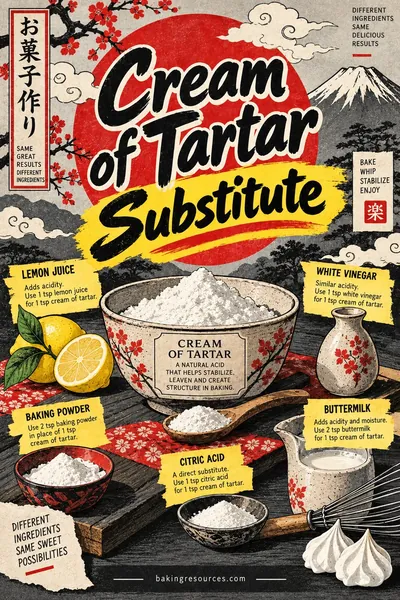
Step 3: rebuild it instead. One teaspoon of baking powder can be replaced with 1/4 teaspoon baking soda plus 1/2 teaspoon cream of tartar. For 2 teaspoons you need:
- 1/2 teaspoon baking soda
- 1 teaspoon cream of tartar
Cream of tartar keeps essentially forever, so if you have it, this is the reliable path. The catch is that this mix is single-acting: it reacts the moment it gets wet and does not hold a second charge for the oven. Get the batter into the pan and the pan into the oven inside 10 minutes, or you will lose the lift on the counter.
Step 4: check the salt. Commercial baking powder contains no added salt, and this rebuild does not either, so nothing needs adjusting there. If you are substituting self-rising flour, that is a different calculation, covered in our guide to making self-rising flour.
The full set of swaps, including the buttermilk and yogurt routes that use baking soda plus an acidic liquid, is in our baking powder substitute guide.
Can you use expired baking powder?
It is safe, just weak. Baking powder does not grow anything or turn toxic. The sodium bicarbonate and the acid salts are stable compounds, and the worst case is a flat bake.
So the real question is whether the recipe can tolerate reduced lift:
- Absolutely not: angel food, chiffon, layer cakes, popovers, biscuits, scones. Anything where height is the point.
- Maybe: muffins and quick breads, if you test first and it is close to full strength.
- Fine either way: cookies and brownies, where leavening changes texture but not structure, and where a slightly denser result is often better anyway.
If the test fizz is genuinely dead, throw it out. A new can is cheap and a wasted batch costs far more in ingredients and time.
Frequently asked questions
How can I tell if baking powder is still good without wasting it?
Use 1 teaspoon in 1/3 cup of hot water. Fresh powder foams vigorously within a second or two and keeps bubbling. Weak powder makes a brief fizz that dies quickly. The teaspoon you sacrifice is worth far less than a flat cake, and hot water matters because most baking powder is double-acting.
Does baking powder go bad if it clumps?
Clumping is a warning sign rather than a verdict. It means moisture got in, and moisture is what starts the reaction inside the can. Break up a clump, test that teaspoon, and trust the fizz. Cream of tartar and baking soda clump too, but for them it is cosmetic.
How long does baking soda last compared to baking powder?
Much longer. Sealed baking soda holds its power for years because it has no acid sitting next to it. An open box in the pantry stays usable well past 2 years if it is dry, though a box used for deodorizing the fridge picks up flavors and should never go into a bake.
Should I store baking powder in the fridge or freezer?
Neither. Every trip from cold storage into a warm kitchen condenses moisture inside the container, and moisture is what kills baking powder. A cool dry pantry shelf away from the stove is best. Yeast is the opposite case: the fridge or freezer genuinely extends its life.
Can I double the baking powder to make up for an old can?
No, or at most add 25%. Excess baking powder leaves sodium salts behind that taste soapy, bitter or metallic, and too much gas creates bubbles too large to hold, so the structure collapses and the cake sinks. Substitute with baking soda and cream of tartar instead.
Does baking powder expire faster in a humid climate?
Yes, noticeably. Humidity is the main variable, not calendar age. In a humid kitchen an opened can may be half strength at 5 or 6 months, where the same can in a dry climate holds up past a year. Buy the smaller can if your kitchen is damp.
Is there a difference between single-acting and double-acting shelf life?
Single-acting powder, which is uncommon on US shelves, tends to lose power faster because its acid reacts fully with any moisture that gets in. Double-acting powder holds part of its charge for oven heat, which also makes it slightly more forgiving of a little moisture in storage.
My recipe calls for both baking powder and baking soda. Do I test both?
Yes, since they fail differently and independently. Test the powder in hot water and the soda in vinegar. Recipes calling for both usually rely on the soda to neutralize an acidic ingredient and the powder for the bulk of the lift, so a weak can of either one shows up in the finished bake.
Related guides: Baking powder substitute | Baking soda vs baking powder | How to make self-rising flour | How to store flour | Baking substitutions tool