Sheet Cake Pan Sizes: Quarter, Half and Full Sheet Charts

There are two sets of sheet cake pan sizes, and they share the same three names. A bakery sheet cake pan is 9x13 for a quarter, 12x18 for a half and 18x24 for a full, measured inside, with straight sides 2 inches deep. A restaurant supply sheet pan is 9x13 for a quarter, 13x18 for a half and 18x26 for a full, measured across the outside of the rim, with sloped sides about 1 inch deep.
So "half sheet" means two different pans depending on who is talking. The 13x18 sounds bigger than the 12x18, and it actually holds less than half as much cake. That single fact explains most of the sheet cake questions people get stuck on, and the charts below keep the two families apart.
Planning for a headcount? Our free cake servings calculator lists both the bakery 12x18 and the kitchen 13x18 as separate pans, so you can see the serving difference before you bake.
Updated September 2026
Why the same name means two different pans
The clash is historical, not a mistake on anyone's part.
Restaurant supply sheet pans were standardized around commercial ovens and rolling racks. A full sheet pan is sized to slide into a full-size commercial oven and a standard bun pan rack, and every smaller pan is a fraction of it: two half sheets side by side make a full, and two quarter sheets make a half. These pans are named by their outside dimensions, rim included, because the rim is what has to fit the rack rails.
Bakery sheet cake pans grew up in cake decorating, where what matters is the finished cake. They are named by the inside dimensions, because that is the size of the cake you frost and cut. They have straight, square-cornered sides 2 inches deep (sometimes 3), so the cake comes out tall and even to the edge.
Our own pages use both, for good reason. The cake servings calculator counts bakery sheet cakes, so it uses 12x18 and 18x24. The cake pan converter and the guide to how many cake mixes per pan size work with the 13x18 and 18x26 rimmed pans most home kitchens actually own. Neither is wrong. They are describing different pans that happen to share a nickname.
Sheet cake pan sizes chart: both families side by side
| Name | Family | Size on the label | How it is measured | Usable floor | Depth |
|---|---|---|---|---|---|
| Quarter sheet | Bakery cake pan | 9 x 13 | Inside, top edge | About 9 x 13 | 2 in, straight sides |
| Quarter sheet | Restaurant sheet pan | 9 x 13 | Outside, over the rim | About 8 x 11 1/2 | About 1 in, sloped |
| Half sheet | Bakery cake pan | 12 x 18 | Inside, top edge | About 12 x 18 | 2 in, straight sides |
| Half sheet | Restaurant sheet pan | 13 x 18 | Outside, over the rim | About 11 1/2 x 16 1/2 | About 1 in, sloped |
| Full sheet | Bakery cake pan | 18 x 24 | Inside, top edge | About 18 x 24 | 2 in, straight sides |
| Full sheet | Restaurant sheet pan | 18 x 26 | Outside, over the rim | About 16 1/2 x 24 1/2 | About 1 in, sloped |
Look at the two half sheet rows together. The restaurant pan wins on the label, 13x18 against 12x18, and loses on the floor, roughly 190 square inches against 216. Then it loses again on depth, 1 inch against 2. The name tells you the footprint on the counter, not the size of the cake.
Usable floor figures for the rimmed pans are typical, not exact. The rolled rim and the slope of the walls vary a little from one maker to the next, which is why the next section matters.
Inside versus outside: how to measure your own pan
Measure once, write the numbers on a strip of tape under the pan, and you never have to guess again.
- Measure the inside at the top. Run the tape from the inside of one wall to the inside of the opposite wall, just below the rim. Do not include the rolled edge or the lip.
- Measure the floor. On a sloped pan, measure again along the bottom. The difference between the top and floor figures tells you how much the walls slope.
- Measure the depth inside. Stand a ruler on the floor of the pan and read it at the rim, not the outside height from the counter.
- Check the corners. Square, sharp corners and straight walls mean a cake pan. Rounded corners, a rolled rim and walls that lean outward mean a sheet pan.
If your tape reads roughly 13 by 18 over the outside and about 12 by 17 inside the rim, you have a restaurant half sheet pan. If it reads 12 by 18 inside with 2 inch walls, you have a bakery half sheet cake pan. Anything else is one of the in-between sizes covered in our guide to uncommon baking pan sizes.
Depth deserves its own check. Plenty of pans sold as cake pans are 1 1/2 inches deep rather than 2, and a few bakery pans are 3. Half an inch of depth on a 12x18 pan is about 7 1/2 cups of capacity, which is far too much to be wrong about.
Cup capacity for every sheet size
Capacity here means water poured in level to the rim. Charts that calculate from the name, including our converter, list the rimmed pans at 8, 16 and 32 cups. Filled with water, most of them come in a little lower, because the name includes the rim and the walls slope in toward the floor.
| Pan | Depth | Level capacity by the name | Level capacity measured |
|---|---|---|---|
| Bakery quarter, 9 x 13 | 2 in | 16 cups | 14 1/2 to 16 cups |
| Bakery half, 12 x 18 | 2 in | 30 cups | About 30 cups |
| Bakery full, 18 x 24 | 2 in | 60 cups | About 60 cups |
| Restaurant quarter, 9 x 13 | 1 in | 8 cups | About 6 to 7 cups |
| Restaurant half, 13 x 18 | 1 in | 16 cups | About 13 to 14 cups |
| Restaurant full, 18 x 26 | 1 in | 32 cups | About 27 to 29 cups |
The arithmetic is simple enough to run for any pan: length x width x depth in inches, divided by 14.44, since one US cup is 14.44 cubic inches. A 12x18x2 pan is 432 cubic inches, which is 29.9 cups.
The bakery quarter sheet is the one straight-sided pan that often measures under its name, because many 9x13 pans sold for home use have gently sloped sides. Our 9x13 pan substitutes guide works from the 14 1/2 cup figure for that reason.
How much of that capacity to fill. A sheet cake bakes best with the batter about halfway up the wall. In a 2 inch bakery pan that is roughly 1 inch of batter, which rises to just under the rim. In a 1 inch rimmed pan it is about 1/2 to 2/3 of an inch, which bakes into a thin, single layer cake. How many boxes of mix that works out to is already charted in how many cake mixes per pan size, so it is not repeated here.
Servings for quarter, half and full sheets
Two standard cuts cover almost every event. A party piece is about 3 inches square off a single layer sheet. A wedding serving is 1 by 2 inches and assumes a tall cake. Both are explained in full on the cake servings calculator, which also draws the cutting grid.
| Pan | Party pieces, about 3 in square | Wedding servings, 1 x 2 in |
|---|---|---|
| Bakery quarter, 9 x 13 x 2 | About 12 | About 54 |
| Bakery half, 12 x 18 x 2 | About 24 | About 108 |
| Bakery full, 18 x 24 x 2 | About 42 to 48 | About 216 |
| Restaurant quarter, 9 x 13 x 1 | About 12, cut slightly under 3 in | Not recommended |
| Restaurant half, 13 x 18 x 1 | About 24, cut slightly under 3 in | Not recommended |
| Restaurant full, 18 x 26 x 1 | About 48, cut slightly under 3 in | Not recommended |
The piece counts look the same across the two families, and that is exactly the trap. A party piece cut from a 2 inch bakery sheet is a proper slab of cake. The same 3 inch square cut from a 1 inch rimmed pan is a thin bar, about half the cake per person. If you are feeding a crowd from rimmed pans, either plan on smaller appetites or bake two sheets and stack them with a layer of filling, which brings the pieces back to bakery height.
Wedding cuts do not suit a 1 inch cake at all. A 1 by 2 inch serving off a cake that short is a mouthful, not a portion.
Will it fit in a home oven?
Oven fit is where the full sheet sizes run into trouble. You need the pan itself plus about an inch of clear space on each side and at the back, or hot air cannot circulate and the edges scorch while the middle lags.
Typical interior sizes, measured with the door closed:
- 30 inch freestanding range: about 24 to 25 inches wide and 16 to 19 inches front to back.
- 24 inch range or wall oven: about 18 to 21 inches wide and 15 to 17 inches front to back.
- 36 inch range: about 28 to 30 inches wide.
| Pan | Outside footprint | 24 inch oven | 30 inch oven | 36 inch oven |
|---|---|---|---|---|
| Quarter, either family | About 9 1/2 x 13 1/2 | Yes | Yes | Yes |
| Bakery half, 12 x 18 | About 12 1/2 x 18 1/2 | Tight, measure first | Yes | Yes |
| Restaurant half, 13 x 18 | 13 x 18 | Tight, measure first | Yes | Yes |
| Bakery full, 18 x 24 | About 18 1/2 x 24 1/2 | No | Usually no | Often yes |
| Restaurant full, 18 x 26 | 18 x 26 | No | No | Only the widest |
Load a half sheet with the long side running left to right. It needs about 20 inches of interior width and 15 inches of depth to leave that inch of air all around.
The full sheet workaround works in both families. A restaurant full sheet is exactly two restaurant half sheets side by side, and a bakery full sheet is exactly two bakery half sheets. Bake two halves, level them, trim the two edges that will meet, and join them on a cake board with a stripe of frosting. Once the cake is coated, nobody can see the seam, and your oven never had to hold a pan it was not built for.
Bake the two halves on the same rack one at a time if your oven is narrow, or on two racks with a swap halfway through. Our guide to which oven rack to use explains why the swap matters, and the baking time calculator handles the timing if you change the batter depth.
Which sheet size to own
For a home kitchen that bakes a sheet cake a few times a year, a 13x18 restaurant half sheet pan is the more useful purchase. It does cookies, roasting and bar cookies the rest of the year, and it bakes a perfectly good thin sheet cake.
For anyone who bakes frosted sheet cakes for events, a 12x18 bakery pan with 2 inch straight sides is the one to buy. It gives you a tall cake, clean corners and the serving counts party planners expect.
Skip a full sheet pan of either kind unless you have measured your oven and confirmed the fit. Two half sheets cover the same job in almost any kitchen.
If you only own a 9x13, both families agree on the quarter sheet footprint, so it is the safest size to bake from any recipe. Check the depth first, because a 2 inch 9x13 holds more than twice the batter of a 1 inch quarter sheet pan. And if the recipe calls for a pan you do not have, the 9x13 pan substitutes chart lists what works in its place.
Rimmed 1 inch pans are also the family that thin rolled sponges come from. The measurements that matter for a rolled cake are a different question, handled in our swiss roll pan size guide.
Worked example: a "half sheet" recipe in a 13x18 pan
A sheet cake recipe from a cake decorating book says it fills a half sheet pan and makes about 15 cups of batter. You own a 13x18 rimmed half sheet pan.
Step 1. Work out which half sheet the recipe means. Fifteen cups is a clue. In a 12x18x2 bakery pan, 15 cups sits 15 x 14.44 / 216 = 1.0 inch deep, which is the halfway fill a 2 inch pan wants. In your pan it would not fit at all, since the whole pan holds about 13 to 14 cups to the rim. The recipe was written for the bakery pan.
Step 2. Find your pan's working limit. Your pan's floor is about 11 1/2 x 16 1/2, or 190 square inches. A thin sheet cake wants about 2/3 of an inch of batter, so 190 x 0.67 / 14.44 = about 9 cups. That is the most batter this pan can bake cleanly.
Step 3. Decide what to do with the rest. You have about 6 cups left over. Two choices:
- Bake 9 cups in the half sheet pan and the other 6 cups in a 9x13 with 2 inch sides, where it sits about 0.74 inches deep. You get two cakes.
- Or scale the whole recipe to 60 percent, which is 9 divided by 15, and bake one thin half sheet. Our recipe scaler does the ingredient math.
Step 4. Adjust the bake. The bakery version at 1 inch deep would bake in about 35 to 40 minutes at 350°F. At 2/3 of an inch, start checking at 20 to 22 minutes. The cake is done when the center springs back and a skewer comes out with a few moist crumbs.
Step 5. Recount the servings. The recipe promised 24 party pieces. You still get about 24 from the thin half sheet, but each one carries roughly 60 percent of the cake, so the 9x13 you baked alongside is not wasted.
Worked example: a sheet cake for 60 guests
You need a single frosted sheet cake for about 60 people, cut as 3 inch party pieces, and you have a standard 30 inch range.
Step 1. Find the size. From the servings chart, a bakery full sheet at 18x24x2 gives 42 to 48 party pieces. That is short of 60, and the pan will not fit a 30 inch oven anyway.
Step 2. Change the cut, not the pan. Party pieces of 2 1/2 inches are still generous on a 2 inch tall cake. An 18x24 area cut at 2 1/2 inches gives 7 across by 9 down, trimmed, which is 63 pieces.
Step 3. Build the full sheet from halves. Bake two 12x18x2 bakery half sheets, one at a time, each with about 15 cups of batter. Level the tops, trim one long edge on each, and set them side by side on a board to make an 18 by 24 inch cake.
Step 4. Plan the frosting. Covering an 18x24 cake with a top, sides and a filled seam is a lot of frosting. Our frosting calculator handles sheet shapes and counts the seam as filling.
Step 5. Confirm with the calculator. Enter two 12x18 pans in the cake servings calculator and set the piece size, and it will draw the grid so the person cutting the cake can follow it.
Frequently asked questions
What size is a half sheet cake pan?
A bakery half sheet cake pan is 12 by 18 inches measured inside, with straight sides 2 inches deep, and it holds about 30 cups to the rim. A restaurant supply half sheet pan is 13 by 18 inches measured over the outside of the rim, only about 1 inch deep, and holds about 13 to 14 cups. Both are sold as a half sheet.
What size is a full sheet cake?
A bakery full sheet cake is 18 by 24 inches and 2 inches deep, giving about 42 to 48 party pieces or 216 wedding servings. A restaurant full sheet pan is 18 by 26 inches outside and about 1 inch deep. Neither fits most home ovens, so home bakers make a full sheet by joining two half sheets.
Is a quarter sheet cake 9x13?
Yes, in both systems the quarter sheet is 9 by 13 inches. The difference is depth and how it is measured. A bakery quarter sheet cake pan is 9x13 inside with 2 inch sides, while a restaurant quarter sheet pan is 9x13 across the outside rim and about 1 inch deep, so it holds less than half the batter.
Why is a 13x18 pan called a half sheet if a half sheet cake is 12x18?
Because the names come from two different industries. Restaurant sheet pans are named by outside dimensions and sized as fractions of a commercial full sheet pan, which is 18 by 26. Bakery cake pans are named by the inside size of the finished cake. The 13x18 figure includes the rim, and inside it is actually smaller than a 12x18 cake pan.
How many people does a half sheet cake feed?
A bakery 12x18 half sheet feeds about 24 people with 3 inch party pieces, or about 108 with 1 by 2 inch wedding servings. A 13x18 rimmed half sheet pan also cuts into about 24 party pieces, but the cake is half as tall, so each piece is roughly half the cake. Cut smaller pieces from a bakery sheet to stretch it.
Will a half sheet pan fit in my oven?
Most likely, if you have a standard 30 inch range, which is about 24 inches wide inside. A half sheet needs about 20 inches of width and 15 inches of depth with an inch of air around it. Many 24 inch ovens and wall ovens are too tight, so measure the interior with the door closed before you buy.
How deep is a sheet cake pan?
Bakery sheet cake pans are 2 inches deep as standard, with 3 inch versions for taller cakes. Restaurant sheet pans are about 1 inch deep, and some run closer to 3/4 of an inch. Measure the depth inside the pan from the floor to the rim, since the outside height includes the thickness of the base.
Can I bake a sheet cake in a rimmed cookie sheet pan?
Yes, if the rim is at least 3/4 of an inch all the way around. Fill it no more than about 2/3 of an inch deep, which is about 9 cups of batter in a 13x18 half sheet pan, and expect a thin single layer cake that bakes in 20 to 25 minutes at 350°F. For a taller cake, bake two and stack them.
Related guides
- How Many Cake Mixes per Pan Size for box counts and batter per sheet pan
- Swiss Roll Pan Size for the thin rimmed pans used for rolled sponges
- Uncommon Baking Pan Sizes for the 8x12 and 7x11 in-between rectangles
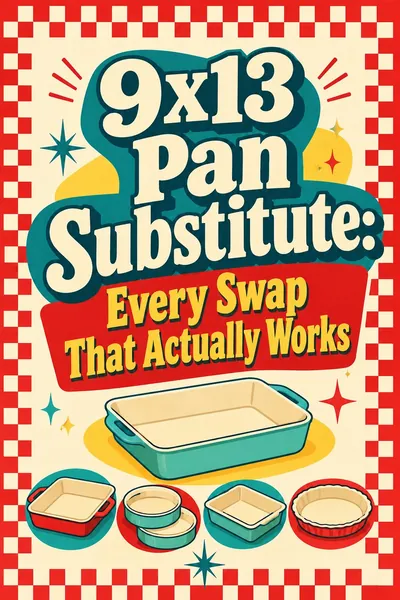
- 9x13 Pan Substitutes for every swap that replaces a quarter sheet
- Cake Pan Converter for capacity and depth math on any two pans
- Cake Servings Calculator for party and wedding counts on bakery and kitchen sheets