Swiss Roll and Jelly Roll Pan Sizes

The US jelly roll pan is 10 x 15 x 1 inches, which is 150 square inches of floor and about 10 cups to the rim. The British Swiss roll tin is usually 23 x 33 cm, which is a 9 x 13 pan at 117 square inches. Both are rimmed, both are exactly 1 inch deep, and that 1 inch is the whole point.
Swiss roll and jelly roll pan sizes matter more than most pan sizes because a rolled sponge only works in a narrow depth band: 1/4 to 3/8 of an inch of baked batter. Thicker cracks when you roll it. Thinner tears.
Our free cake pan converter does the area math for any two pans, so you can move a recipe between a 9x13 and a 10x15 without guessing.
Updated September 2026
Swiss roll and jelly roll pan sizes at a glance
Every pan below is 1 inch deep. The "batter for a roll" column is the amount that lands you at roughly 0.30 inches deep, which is the middle of the safe band.
| Pan | Metric | Floor area | Cups to the rim | Batter for a roll | Depth at that fill |
|---|---|---|---|---|---|
| 8 x 12 | 20 x 30 cm | 96 sq in | 6 1/2 | 2 cups | 0.30 in |
| 9 x 13 (Swiss roll tin, quarter sheet) | 23 x 33 cm | 117 sq in | 8 | 2 1/2 cups | 0.31 in |
| 10 x 15 (US jelly roll) | 25 x 38 cm | 150 sq in | 10 | 3 1/4 cups | 0.31 in |
| 11 x 17 | 28 x 43 cm | 187 sq in | 13 | 4 cups | 0.31 in |
| 12 x 17 | 30 x 43 cm | 204 sq in | 14 | 4 1/4 cups | 0.30 in |
| 13 x 18 (half sheet) | 33 x 46 cm | 234 sq in | 16 | 5 cups | 0.31 in |
Two naming notes that cause most of the confusion.
"Jelly roll pan" and "quarter sheet pan" are not the same thing, even though people use them interchangeably. A quarter sheet is 9 x 13 x 1. A jelly roll pan is 10 x 15 x 1. They differ by 33 square inches, which is 28 percent, and that is enough to change the depth of a sponge noticeably.
"Swiss roll tin" is a British and Australian term and it usually means 23 x 33 cm, which converts to 9 x 13 inches. Some brands sell a 20 x 30 cm version, which is 8 x 12. If a recipe gives you centimeters, match the centimeters, not the word.
Why the 1 inch rim is non-negotiable
A rolled sponge needs a pan that does three jobs at once, and a flat cookie sheet fails all three.
It contains a thin liquid batter. Sponge batter for a roll is loose and pourable. Without a rim it runs straight off the edge.
It keeps the depth even. Batter finds its own level inside a rimmed rectangle. On an open sheet it spreads unevenly and the thin edges overbake into brittle strips that crack the moment you roll.
It stops the edges drying out. The rim shields the outer inch of batter from direct radiant heat. Those edges are the part of the sponge that has to bend the hardest, so they need to stay flexible.
A rim taller than 1 inch causes its own problem. Deep sides shade the batter and slow the bake, which dries the sponge while the middle catches up. That is why a full-depth 9x13 cake pan is a worse choice for a roll than a 1 inch quarter sheet of the same footprint, even though the floor area is identical.
Batter depth is the number that decides everything
Bake time and rollability both follow depth, not pan size. The formula is simple.
Depth in inches = cups of batter x 14.44 ÷ floor area in square inches.
One cup is 14.4375 cubic inches, which is where the 14.44 comes from. For the two common pans that reduces to a shortcut worth writing on a sticky note:
- 10 x 15 jelly roll: cups x 0.096 = inches deep
- 9 x 13 Swiss roll tin: cups x 0.123 = inches deep
So 3 cups of batter sits 0.29 inches deep in a jelly roll pan and 0.37 inches deep in a Swiss roll tin. Same batter, same oven, two different cakes.
| Baked depth | What happens |
|---|---|
| Under 1/4 in | Dries out in the oven, tears rather than rolls, no crumb to speak of |
| 1/4 to 3/8 in | The working range. Flexible, moist, rolls without cracking |
| 3/8 to 1/2 in | Rollable if you roll it warm, but the outer curve stretches hard |
| Over 1/2 in | Cracks almost every time. Bake it as a sheet cake instead |
Our baking time calculator runs the same depth arithmetic and adds the temperature adjustment when you change pans.
Bake times and temperatures for thin sponges
Thin sponges bake hot and fast. The goal is to set the structure before the sheet dries, because a dry sponge is a sponge that cracks.
| Pan | Batter | Depth | At 375°F | At 400°F |
|---|---|---|---|---|
| 9 x 13 | 2 1/2 cups | 0.31 in | 10 to 13 min | 8 to 10 min |
| 10 x 15 | 3 1/4 cups | 0.31 in | 11 to 14 min | 9 to 11 min |
| 12 x 17 | 4 1/4 cups | 0.30 in | 12 to 15 min | 10 to 12 min |
| 13 x 18 | 5 cups | 0.31 in | 12 to 16 min | 10 to 13 min |
Doneness signs, in order of reliability: the surface springs back fully when you press it lightly in the center, the sponge has pulled very slightly from the long sides, and the top has gone from wet-looking to matte with a pale gold cast.
Do not use a toothpick here. A quarter-inch sponge is barely thicker than the pick, so the test tells you almost nothing, and the hole it leaves is a crack waiting to happen.
Sixty seconds of overbaking is a real risk at this thickness. A sheet that spends 14 minutes in the oven instead of 12 loses enough water to go from flexible to brittle. Set a timer for the low end of the range and check from there.
If you're converting temperatures from a metric recipe, our oven temperature converter handles Fahrenheit, Celsius and gas mark.
Swapping between pan sizes
The scaling factor is just one floor area divided by the other.
| From | To | Multiply the batter by | Time change |
|---|---|---|---|
| 10 x 15 | 9 x 13 | 0.78 | 1 to 2 min less |
| 9 x 13 | 10 x 15 | 1.28 | 1 to 2 min more |
| 10 x 15 | 13 x 18 half sheet | 1.56 | 1 to 2 min more |
| 13 x 18 | 10 x 15 | 0.64 | 1 to 2 min less |
| 9 x 13 | 8 x 12 | 0.82 | About the same |
| 10 x 15 | 12 x 17 | 1.36 | 1 to 2 min more |
Because you are holding the depth constant, the time barely moves. That is the useful part. When you keep a sponge at 0.30 inches, a half sheet and a quarter sheet bake in almost the same number of minutes even though one holds twice the batter.
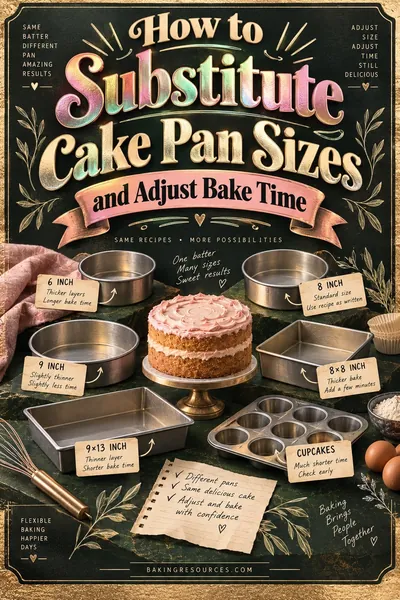
The alternative is to keep the batter and change the depth, which is what happens when you pour a 10x15 batch into a 9x13. Depth goes from 0.31 to 0.40 inches, a 28 percent jump. Add 3 to 4 minutes, and accept that the roll will want a gentler curve. Our guide to substituting cake pan sizes covers the general method for any two pans, and the 9x13 pan substitute chart has the deeper swaps.
If you only own a full-depth 9x13, it works. Line it, expect a slightly slower bake, and add 2 to 3 minutes. Just don't use a springform or anything with a removable base, since the seams let thin batter escape.
Worked example: a 10x15 recipe in a 9x13 tin
What you have: a sponge sheet written for a 10 x 15 jelly roll pan, and a 23 x 33 cm Swiss roll tin.
Step 1. The ratio. 117 ÷ 150 = 0.78. The Swiss roll tin has 22 percent less floor.
Step 2. Scale the ingredients. Say the sheet calls for 4 large eggs, 100 g sugar, 90 g cake flour and 30 g melted butter.
- Sugar: 100 x 0.78 = 78 g
- Flour: 90 x 0.78 = 70 g
- Butter: 30 x 0.78 = 23 g
- Eggs: 4 large eggs are about 200 g shelled, so 200 x 0.78 = 156 g of beaten egg, which is a bit over 3 eggs
Whisk all four eggs, weigh out 156 g, and save the rest. "Three and a bit eggs" is how a sponge ends up either rubbery or too loose to hold air.
Step 3. Check the depth. The full batch makes about 3 1/4 cups of aerated batter. At 78 percent that's 2.5 cups. In the 9x13: 2.5 x 14.44 ÷ 117 = 0.31 inches. Right in the band.
Step 4. Or don't scale it at all. Pour the whole 3 1/4 cups into the 9x13 and you get 3.25 x 14.44 ÷ 117 = 0.40 inches. That is still rollable, but you are at the top of the range. Add 3 minutes, roll it while it is genuinely hot, and use a slightly thinner layer of filling.
Step 5. The yield difference. The scaled version gives you a 13 inch log. The unscaled version gives you a shorter, fatter 13 inch log with a thicker spiral. Both cut into about 12 slices at 1 inch each once you trim the ends.
Our recipe scaler does step 2 for you if you would rather not do the arithmetic by hand.
Which edge you roll from changes the cake
This is pure geometry and it's worth understanding before you commit.
Take a 10 x 15 sheet. You can roll it two ways.
Roll along the 10 inch side and you get a log 15 inches long with 10 inches of sponge wrapped around it. Estimated finished diameter: about 2 1/4 inches. More slices, tighter spiral, the classic look.
Roll along the 15 inch side and you get a log 10 inches long with 15 inches of sponge wrapped around it. Estimated diameter: about 2 3/4 inches. Fatter slices, more visible spirals per slice, fewer of them.
The math behind those numbers: for a spiral, the outer radius is roughly the square root of (sponge length x layer thickness ÷ pi). With a combined sponge-plus-filling thickness of 0.4 inches, 10 inches of length gives a radius of 1.13 inches, and 15 inches gives 1.38 inches.
Slice count at 1 inch thick, after trimming both ends:
| Sheet | Rolled from | Log length | Slices |
|---|---|---|---|
| 9 x 13 | 9 in side | 13 in | 11 |
| 9 x 13 | 13 in side | 9 in | 7 |
| 10 x 15 | 10 in side | 15 in | 13 |
| 10 x 15 | 15 in side | 10 in | 8 |
| 13 x 18 | 13 in side | 18 in | 16 |
Longer logs also crack less, because the sponge only has to bend around a smaller radius once rather than being stretched around a fatter core. If cracking is your problem, roll from the short side.
Lining, and why parchment beats everything else
A rolled sponge has to leave the pan in one flexible piece within a minute of coming out of the oven. There is no time to coax it.
Line the whole floor plus an overhang on both long sides. Cut the parchment to the width of the pan and long enough to hang 2 inches past each end. Butter the pan lightly first so the paper stays put, then butter the paper too.
Do not flour the paper. Flour on a thin sponge makes a dry skin that cracks.
Skip silicone mats for rolls. They insulate the base, which slows the bake and dries the top while the bottom catches up. They also don't give you an overhang to lift by.
The full method for every pan shape is in our guide to lining a cake pan.
Preventing the crack, in numbers
Cracking is a moisture and timing problem, not a talent problem.
- Roll it within 60 to 90 seconds of leaving the oven. The sponge is at its most flexible while the starches are still hot and soft. Every minute after that costs you.
- Roll it warm inside a clean kitchen towel, then leave it rolled for 30 to 40 minutes while it cools. It sets in the curved shape and unrolls without fighting you.
- Keep the bake at the low end. Two extra minutes is the most common cause of a cracked roll.
- Use a lower-protein flour. Cake flour at 7 to 9 percent protein gives a more extensible crumb than all-purpose at 10 to 12. If you only have all-purpose, our cake flour substitute has the cornstarch swap.
- Whip the eggs properly. An egg foam sponge gets nearly all its lift from air, and a short whip means a dense sheet that won't bend. How to whip egg whites covers the stages, and how to fold ingredients covers keeping that air in when the flour goes in.
A hairline crack on the outer curve is normal and disappears under a dusting of powdered sugar. A crack that goes through to the filling means the sheet was too dry, too thick, or too cool when you rolled it.
Buying one: which size to own
If you own nothing yet, buy the 13 x 18 half sheet. It is the most useful pan in a home kitchen by a wide margin, it handles a roll at 5 cups of batter, and it doubles for roasting, cookies and traybakes.
If you bake rolls often, add the 10 x 15. It fits every US jelly roll recipe without conversion and it slides into ovens too narrow for a half sheet. Measure your oven interior first, since a 13 x 18 pan needs about 15 inches of clear width to load and unload safely.
If you bake from British or Australian recipes, buy the 23 x 33 cm. That is the default Swiss roll tin and it saves you the conversion every time.
What to look for: light aluminum, not dark nonstick, since dark metal browns a thin sponge before it sets. Rolled rims rather than raw edges, so the pan doesn't warp. And straight sides, because sloped sides give you a sponge with thin, dry edges. Full round pan dimensions, if you're building out a set, are in our round cake pan chart, and the odd rectangles are covered in uncommon baking pan sizes.
Frequently asked questions
What size is a jelly roll pan?
Ten by fifteen inches with a 1 inch rim, which is 150 square inches of floor and about 10 cups to the rim. In metric that is 25 x 38 cm. Some brands sell a 10 1/2 x 15 1/2 version, which is close enough to swap with no changes.
What size is a Swiss roll tin?
Usually 23 x 33 cm, which is a 9 x 13 inch pan with a 1 inch rim and 117 square inches of floor. A 20 x 30 cm version also exists and is an 8 x 12. Match the centimeters printed in the recipe rather than assuming, since the two differ by 22 percent in floor area.
Can I use a half sheet pan instead of a jelly roll pan?
Yes, with a scaling factor. A 13 x 18 half sheet has 234 square inches against 150, so multiply the batter by 1.56 to keep the same depth. If you bake the original amount in the bigger pan, the sponge lands at only 0.20 inches, which dries out and tears. Cut 2 minutes off the bake if you go that route anyway.
How deep should sponge batter be for a rolled cake?
Between 1/4 and 3/8 of an inch, with 0.30 inches as the target. Multiply your cups of batter by 14.44 and divide by the pan's floor area to check. Over 1/2 an inch, the outer curve has to stretch too far and the sponge cracks no matter how warm you roll it.
Is a jelly roll pan the same as a quarter sheet pan?
No. A quarter sheet is 9 x 13 x 1 inches, and a jelly roll pan is 10 x 15 x 1. The jelly roll pan has 28 percent more floor. Retailers use the names loosely, so check the printed dimensions on the underside of the pan rather than the label.
How many slices does a Swiss roll make?
A 9 x 13 sheet rolled from the short side gives a 13 inch log, which is about 11 slices at 1 inch thick after trimming the ends. A 10 x 15 rolled the same way gives 13 slices. Rolling from the long side gives a shorter, fatter log with fewer, wider slices.
Why does my sponge crack when I roll it?
Almost always overbaking or waiting too long. Pull the sheet at the low end of the time range, and roll it inside a towel within 60 to 90 seconds of it leaving the oven while the starches are still soft. A batter deeper than 3/8 of an inch cracks even when your timing is perfect.
Can I use a rimmed cookie sheet for a jelly roll?
Only if the rim is at least 3/4 of an inch all the way around and the floor is truly flat. A shallow lip lets thin batter run to one side as you slide the pan in, and a warped floor pools the batter, so half the sheet ends up dry while the other half is still wet.
Related guides: How to substitute cake pan sizes | Uncommon baking pan sizes | How to line a cake pan | How to whip egg whites | Cake pan converter