What Size Cake Pan Fits an Instant Pot?

A 7 inch round pan fits a 6 quart Instant Pot, and an 8 inch round pan fits an 8 quart. The 3 quart Mini takes a 6 inch pan and nothing larger. That is the whole answer for 95 percent of kitchens, and the reason is simple: your pan has to clear the inside wall of the inner pot with enough room left over for your fingers or a sling.
So what size cake pan fits an Instant Pot really comes down to one measurement, the inside diameter of the stainless steel inner pot, minus about an inch of working clearance. Depth matters too, and it is the part people forget until the lid will not lock.
Not sure how much batter your pan actually holds? Our free cake pan converter gives the capacity of every common pan and tells you how much batter to move when you swap one for another.
Updated September 2026
What size cake pan fits an Instant Pot: the fit chart
Every number below is the inside measurement, taken across the top rim of the inner pot. Manufacturers print outside dimensions on boxes, and outside is always bigger.
| Instant Pot size | Inner pot inside diameter | Usable depth above a trivet | Largest pan that fits | The pan to buy | Pan capacity |
|---|---|---|---|---|---|
| 3 quart Mini | About 6 1/2 in | About 3 1/4 in | 6 in round, 2 in deep | 6 in round | 4 cups |
| 6 quart | About 8 5/8 in | About 4 1/2 in | 7 1/2 in round | 7 in round, 3 in deep | About 7 1/2 cups |
| 8 quart | About 9 1/2 in | About 5 in | 8 1/2 in round | 8 in round, 3 in deep | About 9 cups |
| 10 quart | About 10 1/2 in | About 5 1/2 in | 9 1/2 in round | 9 in round, 3 in deep | About 12 cups |
Two things fall out of that chart right away.
First, a 6 quart cannot take an 8 inch pan. An 8 inch pan is 8 inches of metal going into 8 5/8 inches of pot. On paper it clears by a third of an inch. In practice you cannot get your hands, a sling, or a lifting handle down the side, and a hot pan you cannot lift out is a real problem. Stop at 7 1/2 inches, and 7 inches is the comfortable choice.
Second, an 8 quart is not automatically better for baking. It takes a bigger pan, yes, but it also needs more water underneath and takes longer to come to pressure. A 7 inch pan works perfectly well in an 8 quart, so if you already own one, you do not need a second pan.
Measure your inner pot before you buy anything
Instant Pot has made a lot of models, and the Duo, Duo Plus, Ultra, Pro and Duo Crisp inner pots are not all identical. Off brand multicookers vary more. Two minutes with a ruler beats any chart, including this one.
- Lift the inner pot out and set it on the counter empty and dry.
- Lay a ruler across the top rim, inside edge to inside edge. That is your inside diameter.
- Subtract 1 inch. That is the biggest pan diameter you should use.
- Stand the ruler inside the pot and note the depth from the base to the rim.
- Subtract the height of your trivet, then subtract another 1/2 inch of headroom for the lid. What is left is your pan depth limit.
The 1 inch subtraction is not fussiness. You need that gap for a foil sling to pass down both sides, for steam to circulate around the pan, and for the moment when the cycle finishes and you are lifting out something hot and wobbly.
Pan depth: the limit nobody checks
Diameter gets all the attention and depth is what actually stops the lid from locking.
Here is the stack you are building inside the pot, from the bottom up:
| Layer | Typical height |
|---|---|
| Water in the base | About 1/2 in for 1 cup in a 6 quart |
| Trivet with legs | 1 3/4 to 2 in |
| Low profile trivet or silicone ring | 3/4 to 1 in |
| Your pan | 2 to 4 in |
| Foil cover, domed slightly | 1/4 in |
| Clearance under the lid | 1/2 in minimum |
Run the numbers for a 6 quart. The pot is roughly 6 1/2 inches deep inside. Take off 2 inches for a legged trivet and 1/2 inch of headroom and you have about 4 inches left. A 7 x 3 pan fits with room to spare. A 4 inch deep pan with a foil cover on top is right at the ceiling, and it will not fit at all on a tall trivet.
The fix, if you are close: swap the legged trivet for a low profile one or a silicone sling that sits flat. That buys you a full inch, which is usually the difference between "will not close" and "fine."
Push pan, springform or a solid round
All three work. They fail in different ways, so pick for the batter you are baking.
Push pan. A loose bottom that pushes up from below, with a solid seam. This is the best all around choice for a pressure cooker. The seam is tight enough that a thin batter will not run out, and you release the cake by standing the pan on a can and pushing the ring down. A 7 x 3 push pan is the single most useful pan to own for a 6 quart.
Springform. The clamp makes release easy and the seam leaks more than a push pan does. Any batter thinner than pancake batter will find its way out. Wrap the base and lower sides in foil if you use one, and keep in mind that a 7 inch springform is usually 3 inches deep, which is taller than a 7 inch cake pan. Our springform pan sizes guide has the capacity of each one.
Solid round cake pan. Cheapest and most reliable seal, hardest release. Line the bottom with a parchment circle and grease the sides, or you will be serving the cake with a spoon. Our walkthrough on how to line a cake pan covers the parchment fold that makes this quick.
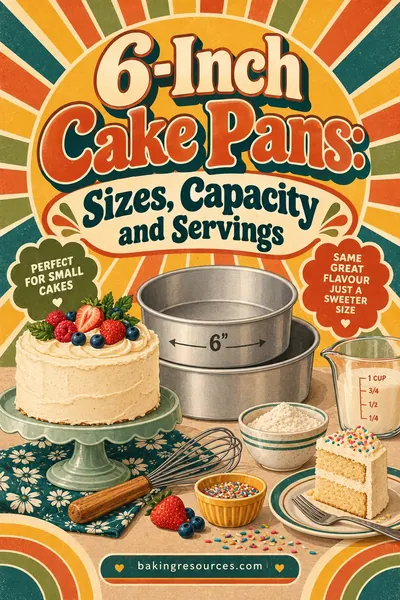
What about a 6 inch pan in a 6 quart? It works and it is a good choice for small batches. A 6 inch round 2 inches deep holds 4 cups, which is roughly a third less than a 7 inch. Our 6 inch cake pan guide has the scaling math.
How much batter each pan holds
This is where most pot in pot baking goes wrong. The pan fits, so people pour in the whole batch, and then it domes into the foil or spills into the water.
A cake pan should never go past two thirds full. In a pressure cooker that rule is stricter, not looser, because the batter has nowhere for excess steam to go and the top of the cake presses against whatever is covering it.
| Pan | Capacity to the rim | Batter at two thirds full |
|---|---|---|
| 6 in round, 2 in deep | 4 cups | 2 2/3 cups |
| 6 in round, 3 in deep | 6 cups | 4 cups |
| 7 in round, 2 in deep | About 5 cups | About 3 1/3 cups |
| 7 in round, 3 in deep | About 7 1/2 cups | 5 cups |
| 7 in springform, 3 in deep | About 7 1/2 cups | 5 cups |
| 8 in round, 2 in deep | 6 cups | 4 cups |
| 8 in round, 3 in deep | About 9 cups | 6 cups |
| 8 in springform, 3 in deep | 10 cups | 6 2/3 cups |
Read that table next to whatever your recipe was written for. A standard 9 inch round cake pan 2 inches deep holds 8 cups and takes about 5 1/3 cups of batter. A 7 inch round 2 inches deep takes 3 1/3 cups. That is a 37 percent cut, and pouring the full batch in anyway is the number one cause of a pressure cooker cake that overflows.
Worked example: a 9 inch recipe in a 7 inch pan
Say you have a cake written for one 9 inch round, and you want to bake it in the 7 x 2 inch pan that came with your accessory set.
Step 1. Compare capacities. The 9 inch round holds 8 cups. The 7 inch round holds about 5 cups. So 5 divided by 8 is 0.625.
Step 2. Compare working fills. At two thirds, the 9 inch takes 5 1/3 cups of batter and the 7 inch takes 3 1/3 cups. Same answer: 3.33 divided by 5.33 is 0.625 again.
Step 3. Scale to about five eighths. In round numbers, make 5/8 of the recipe, or two thirds if you would rather work with an easier fraction and accept a slightly fuller pan.
Step 4. Do it by weight. If the recipe uses 2 cups of all purpose flour, that is 250 g at our chart weight of 125 g per cup. Five eighths of 250 g is 156 g, so weigh out 155 g and scale every other ingredient by the same 0.625. Weighing beats measuring odd fractions of cups every time.
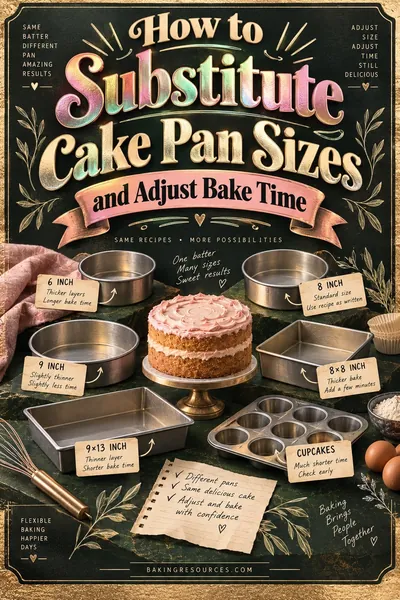
Step 5. Expect a deeper cake and a longer cook. The 7 inch pan puts the same depth of batter as the 9 inch if you scale properly, so timing stays close. Fill it deeper than two thirds and you add both time and risk. Our full guide on how to substitute cake pan sizes covers what changes when depth changes.
Step 6. Bake the spare. If you cannot face the fractions, make the full batch, fill the 7 inch pan to two thirds, and put the rest into a couple of ramekins or muffin cups alongside. Nothing wasted, no math.
Materials: metal, ceramic, silicone and glass
Steam heat behaves differently from oven heat, and the pan material matters more than it does in a conventional oven.
| Material | How it behaves under pressure | Verdict |
|---|---|---|
| Light aluminum | Heats fast and evenly, releases well | Best all around |
| Anodized or nonstick aluminum | Same, plus easier release | Excellent, avoid scratching it |
| Stainless steel | Heats slower, sticks more | Works, line it |
| Ceramic or stoneware | Slow to heat, holds heat afterward | Add time, good for custards |
| Tempered glass | Slowest of all, and thermal shock is a real risk | Avoid, especially with a quick release |
| Silicone | Heats fine, has no structure at all | Only with a rigid support underneath |
Silicone deserves a warning. A silicone pan full of batter has no rigidity, so lifting it into or out of the pot by hand will fold it. Set it on a small metal trivet or a tart pan base first and lift that.
The sling, the foil lid and the trivet
Three small pieces of technique that make the pan size question moot.
The sling. Tear a length of heavy foil about 24 inches long and fold it into a strip 2 to 3 inches wide. Center the pan on it, lift both ends, and lower the pan in. Fold the ends down over the top so the lid closes. That strip is the reason you need an inch of clearance around the pan.
The foil lid. Condensation drips off the inside of an Instant Pot lid the entire time it is under pressure. Cover the pan loosely with foil, domed slightly in the center so it does not touch the batter, and crimp it around the rim. Skip this and you get a wet, pockmarked top. A silicone lid or a plate that fits works too.
The trivet. The pan must never sit in the water. A trivet with legs keeps it clear, and the water underneath is what makes the steam. Most 6 quart cooking calls for 1 to 1 1/2 cups of water in the base, and an 8 quart wants closer to 2 cups because it has more volume to fill with steam.
Pans that do not work in an Instant Pot
- Anything square or rectangular. A round pot wastes the corners, and a 7 inch square will not go in a 6 quart at all because the diagonal is nearly 10 inches.
- Standard loaf pans. An 8.5 x 4.5 loaf pan measures over 9 1/2 inches on the diagonal. Only the small mini loaf pans fit, and only in an 8 quart.
- Bundt pans of normal size. A 10 cup bundt is 9 1/2 to 10 inches across. Look for a 6 or 7 inch bundtlette pan instead.
- Anything taller than your headroom. Measure before you buy, not after.
- Thin disposable foil pans. They buckle when you lift them and dump the batter into the water.
If you want to compare a pan you already own against the round shapes that fit your pot, the cake pan converter will do the capacity math for you, and our round cake pan sizes chart lists what each diameter holds.
FAQ
Will an 8 inch pan fit in a 6 quart Instant Pot?
No, not usefully. The inner pot is about 8 5/8 inches across inside, so an 8 inch pan leaves roughly a third of an inch of gap. You cannot fit a sling down the side, and you will not be able to lift the pan out when it is hot. Use 7 inches, or 7 1/2 at the absolute maximum.
What size springform pan fits a 6 quart Instant Pot?
A 7 inch springform, usually 3 inches deep, which holds about 7 1/2 cups and takes 5 cups of batter at a safe two thirds fill. Wrap the base in foil because springform seams leak thin batters. A push pan of the same size seals better and is easier to store.
Can I use a 6 inch pan instead of a 7 inch?
Yes, and it is the right call for small batches or for a 3 quart Mini. A 6 inch round 2 inches deep holds 4 cups against about 5 cups for a 7 inch, so scale the recipe to about 80 percent. The batter depth stays the same, so the cook time barely moves.
How deep can the pan be in a 6 quart Instant Pot?
About 4 inches, and that is with a standard legged trivet and a foil cover. Swap to a low profile trivet or a silicone sling and you gain roughly an inch. Measure your own pot from base to rim, then subtract the trivet height and half an inch for lid clearance.
Do I need a special Instant Pot cake pan?
No. Any 7 inch round pan works in a 6 quart, whether it was sold as a pressure cooker accessory or as a standard bakeware. What matters is diameter, depth and a seam that does not leak. A plain 7 x 3 push pan covers almost every job.
Why did my pressure cooker cake overflow?
Almost always because the pan was filled past two thirds. A 7 inch round 2 inches deep takes 3 1/3 cups of batter, and a recipe written for a 9 inch round makes about 5 1/3 cups. Pour the whole batch in and you are half again over capacity. Scale the recipe or bake the spare batter separately.
Can I stack two pans in an Instant Pot?
In an 8 or 10 quart, yes, with a stacking trivet between them and shallow pans on each level. In a 6 quart the headroom runs out fast. Two 2 inch deep 7 inch pans plus two trivets is about 6 inches of stack, which leaves you nothing. Stick to one pan in a 6 quart.
Does pan size change the cook time under pressure?
Depth changes it, diameter barely does. Steam surrounds the pan on every side, so a wider pan of the same depth cooks in about the same time. Pour the same batter twice as deep and you need noticeably longer, which is the same rule that applies in an oven.