How to Tell If Banana Bread Is Done

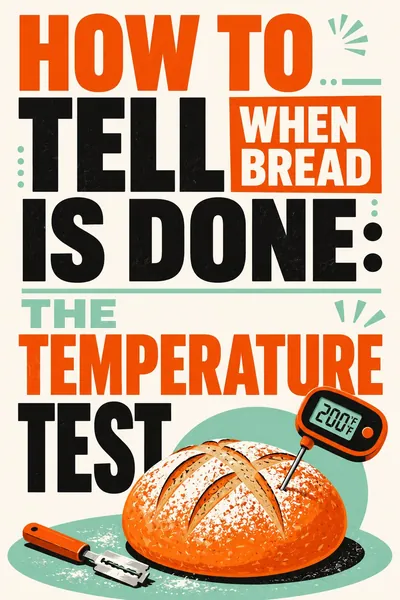
The loaf is done when an instant read thermometer pushed into the true center reads 200 to 205°F. That single number settles it. Everything else you have been told, the toothpick, the spring, the crack down the top, is a supporting check that helps you decide where to put the thermometer.
If you don't own a thermometer, use the skewer test correctly instead: push it in through the crack at the highest point of the dome, all the way down to about half an inch above the pan base, and pull it straight out. A few moist crumbs clinging to it means done. Wet batter means keep going. A bone dry skewer means you went a few minutes too far.
That is the short version of how to tell if banana bread is done. The rest of this page is about the part that trips people up: banana bread hides its raw center better than almost anything else you bake, because the crust is dark and set long before the middle is.
Changed pan size and lost your timing? Our free baking time adjuster works out a new time window from the change in batter depth and shows the doneness temperatures next to it.
Updated September 2026
How to tell if banana bread is done: the 4 checks in order
Run them in this order. The first one that gives you a clear answer is the answer.
| # | Check | What "done" looks like | How much you can trust it |
|---|---|---|---|
| 1 | Internal temperature | 200 to 205°F in the middle of the loaf, taken from the top through the crack | Very high. This is the only test that measures the part you cannot see |
| 2 | Skewer through the crack | Comes out with a few moist crumbs, no wet batter | High, if you push it deep enough and in the right spot |
| 3 | Spring back | Press the top gently. It rises back rather than holding a dent | Medium. Tells you the crust set, not the center |
| 4 | The pull away | The loaf has shrunk a hair from the long sides of the pan | Medium. A good confirming sign, useless on its own |
Notice how the trust column falls off fast. Checks 3 and 4 are about the outside of the loaf. Banana bread is a wet, sugary, fruit heavy batter in a deep narrow pan, which is the exact combination that sets an outside long before the inside catches up.
Why 200 to 205°F and not higher
Banana bread is a quick bread, and quick breads finish lower than yeast bread. A lean sourdough wants 205 to 210°F. A butter cake wants 200 to 210°F. Quick breads and muffins land at 200 to 205°F, and that number holds for cornbread and zucchini bread too.
Push much past 205 and the starch has finished setting but the loaf keeps losing water, so you get a dry crumb and a hard crust. That is the most common way a home loaf goes wrong, and it happens to people who are being careful, because "bake five more minutes to be safe" feels like the responsible move.
Where to put the thermometer (this is the whole trick)
A banana bread loaf is not evenly baked. The ends and the sides finish first. The slowest point sits in the middle of the loaf, roughly halfway down, right under the crack.
Do this:
- Pull the pan out and set it on a rack. Don't test it inside the oven, because you will burn your knuckles and rush the reading.
- Find the crack running down the dome. That crack is the last part of the crust to seal, so it is the natural entry point and it hides the hole.
- Push the probe straight down through the crack until the tip sits about half an inch above the pan base, then stop. If the tip touches metal you are reading the pan, not the bread, and the pan is hotter.
- Wait for the number to settle. An instant read takes 2 to 4 seconds. A cheap dial thermometer takes 15 to 20 and drifts, so give it time.
- Take a second reading an inch to one side. If the two readings differ by more than about 5 degrees, the loaf needs a few more minutes.
If the reading is 190 to 198°F, put it back for 5 minutes and check again. That is close, not done.
If the reading is under 185°F, give it 10 more minutes. Tent the top loosely with foil if the crust is already deep brown.
If the reading is 206 to 210°F, take it out now. It is slightly over but perfectly good, and it will still be lovely once cooled.
A worked example: one loaf, start to finish
Here is a standard loaf and what the numbers actually do.
Say you have a batter built on 2 cups of all purpose flour. Using the weights our ingredient weight chart runs on, that is 250 g of flour, spooned and leveled. Add 200 g of sugar, about 340 g of mashed banana, two eggs and half a cup of fat and you land around 4 1/4 cups of batter. It goes into a 9 x 5 loaf pan, which holds 8 cups to the rim, so the pan sits a little over half full. Oven at 350°F.
| Time in the oven | What you see | Center temperature |
|---|---|---|
| 25 minutes | Edges have set, top still wet and shiny | About 150°F |
| 40 minutes | Dome rising, crack starting to open | About 175°F |
| 50 minutes | Crack fully open, top browning, edges pulling in | About 190°F |
| 55 minutes | Top looks completely done, springs back | 196 to 200°F |
| 60 minutes | No visible change on top | 202 to 205°F, done |
| 70 minutes | Crust hardening, edges dark | 210°F and climbing, drying out |
Look at the gap between minute 55 and minute 60. The loaf looks identical. The top has sprung back for five minutes already. That five minute window is where nearly every gummy center comes from, and it is why the visual tests alone will fail you on a deep loaf.
Now change one thing. Pour the same batter into an 8.5 x 4.5 pan, which holds 6 cups. Same batter, less floor, so it sits deeper. The whole table above shifts later, and the loaf finishes closer to 65 to 75 minutes. Depth sets time, not pan size, and that relationship is the whole basis of our cake pan converter.
The skewer test, done properly
Most people do this wrong in a small way that matters.
Push it deep. A skewer stopped an inch into the dome tells you the dome is baked. The wet band is lower. Go down until you are close to the base.
Use something thin. A wooden skewer or a cake tester picks up crumbs. A butter knife makes a wide hole and slides out clean even through wet batter, which is a false pass.
Read the crumbs, not the shine. Banana bread is moist and sugary, so the skewer will look slightly damp even when the loaf is done. What matters is whether the material on it is crumbs or batter. Crumbs are separate little pieces. Batter is a smear.
Test twice, in two spots. Chocolate chips and melted banana pockets both give a wet looking skewer in an otherwise finished loaf. If your first pull looks wet, try again an inch away before adding time.
| What the skewer shows | Verdict | Do this |
|---|---|---|
| Thin wet smear that pools | Underbaked | 10 more minutes |
| Thick sticky batter | Underbaked | 8 to 10 more minutes |
| Damp clumps that hold together | Nearly there | 5 more minutes |
| A few loose moist crumbs | Done | Take it out |
| Completely clean and dry | Slightly overbaked | Take it out now, cool it covered |
| Melted chocolate or fruit only | Inconclusive | Retest an inch away |
Underbaked or just dense? Telling them apart
These two problems look similar in a slice and have opposite fixes, so people fix the wrong one and get a second bad loaf.
Underbaked looks wet and glossy in a band through the middle, usually near the base. Press it and it stays compressed, almost like raw batter. The line between the wet part and the baked part is fairly sharp. It happens on the day, from time and temperature.
Dense is uniform. The whole crumb is heavy and tight, top to bottom, with no wet band. It is dry to the touch, not glossy. That is a mixing or measuring problem, and we walk through the six causes in why is my banana bread dense.
You can also get both at once, which is what happens when a batter with too much flour goes into a pan that is too small. The extra flour makes it heavy and the extra depth stops the center cooking. Getting the pan right first is covered in what size pan for banana bread.
Bake time by pan, at 350°F
Use these as starting windows, then confirm with the thermometer. Every one of these assumes the pan is no more than two thirds full.
| Pan | Capacity to rim | Time window | Start checking at |
|---|---|---|---|
| 8.5 x 4.5 loaf | 6 cups | 60 to 75 min | 55 min |
| 9 x 5 loaf | 8 cups | 55 to 70 min | 50 min |
| 9 x 5 x 3 deep loaf | 9 cups | 60 to 75 min | 55 min |
| Four mini loaves | 2 cups each | 25 to 35 min | 22 min |
| 8 x 8 square | 8 cups | 30 to 40 min | 28 min |
| 12 well muffin pan | 5 cups total | 18 to 22 min | 16 min |
| 10 cup bundt | 10 cups | 40 to 50 min | 38 min |
The shallower the batter, the shorter and the more forgiving the bake. Muffins are done in a fifth of the time a deep loaf takes, because heat only has to travel about an inch.
What happens after it leaves the oven
The loaf is not finished baking when you take it out. A deep hot loaf carries residual heat inward for several minutes, and the center climbs another 2 to 5 degrees while it sits on the rack. That is called carryover, and it is the reason to pull at 202°F rather than waiting for 208°F.
Cooling matters for texture too:
- Rest in the pan for 10 to 15 minutes. The crumb is fragile straight out of the oven and the loaf will tear if you turn it out immediately.
- Then get it onto a wire rack. Left in the pan, steam condenses against the metal and the sides go soggy.
- Wait at least an hour before slicing. Starch is still setting. Slice a hot loaf and the knife drags the crumb into a gummy paste, which people then blame on underbaking.
That last point catches more bakers than any temperature error. If your loaf reads 203°F and still slices gummy 20 minutes later, the loaf is fine and the timing of your knife is not. The same cooling logic applies across the site in how to cool a cake.
Five things that make the timer wrong
Recipe times are written for one oven, one pan and one batter. Change any of them and the clock drifts.
- Your oven runs cool or hot. Most home ovens are off by 15 to 25 degrees, and many swing wider than that during a cycle. An oven thermometer left on the middle rack settles the argument.
- The pan is dark or glass. Dark nonstick metal browns the crust fast and can leave the center behind. Glass heats slowly but keeps cooking after it leaves the oven. Drop the oven 25°F for either.
- Add ins. A cup of nuts and a cup of chocolate chips add roughly a cup of batter volume between them, which makes the loaf deeper and pushes the time out by 5 to 10 minutes.
- Very ripe bananas. Blacker bananas are wetter and sweeter. More water means longer to bake, more sugar means faster browning, so the loaf looks done sooner and is done later.
- Cold ingredients. Batter that starts at refrigerator temperature needs a few extra minutes to reach the same finish point.
None of these matter if you measure temperature. That is the entire argument for owning a thermometer: it turns five variables into one reading.
FAQ
What temperature should banana bread be inside?
200 to 205°F, measured in the middle of the loaf with an instant read thermometer pushed in from the top through the crack. That is the standard finish range for quick breads and muffins. Below 195°F it needs more time, and above about 210°F it starts drying out.
Can banana bread be gummy in the middle even if the toothpick was clean?
Yes, and it usually means one of two things. Either you tested the dome rather than the deep center, so the toothpick never reached the wet band, or the loaf was sliced before it cooled and the starch had not finished setting. Wait a full hour before cutting and retest deeper next time.
How long does banana bread take to bake at 350°F?
About 55 to 70 minutes in a 9 x 5 loaf pan, 60 to 75 minutes in a smaller 8.5 x 4.5 pan because the batter is deeper, and 18 to 22 minutes as muffins. Start checking 5 minutes before the low end of the window, since ovens vary more than recipes admit.
Should I cover banana bread with foil while it bakes?
Only if the top is browning faster than the middle is cooking. Tent a loose sheet of foil over the pan once the crust hits the color you want, usually around the 40 minute mark on a dark pan, and leave it there until the center reads 200°F. Don't seal it around the pan or you will steam the crust soft.
Why is my banana bread wet in the center but burnt on the outside?
The batter was too deep for the oven temperature. Deep batter needs a cooler oven and a longer bake so the middle can catch up. Drop the oven 25°F, add 10 to 15 minutes, and consider splitting the batter between two smaller pans if it is filling one pan past two thirds.
Does the crack down the top mean it's done?
No, only that the crust set before the loaf finished rising, which is normal for quick breads and happens well before the center is baked. The crack is useful as a landmark for where to put the thermometer, not as a doneness signal on its own.
Can I put a partly baked banana bread back in the oven?
Yes, if you catch it quickly. Return it to the pan, put it back at the same temperature, and give it 10 to 15 minutes with foil over the top. A loaf that has fully cooled will never fully recover, because the crumb has set around the wet band, but a warm one usually will.
Is the doneness test different for banana muffins?
The target temperature is the same, 200 to 205°F, but muffins are shallow enough that the skewer test is reliable on its own. Check at 16 minutes and expect 18 to 22 minutes in a standard 12 well pan. They also carry over less heat after baking, so pull them right at the finish rather than a few degrees early.
How is this different from testing a yeast loaf?
Yeast bread finishes hotter. Lean loaves like sourdough and baguettes want 205 to 210°F, and enriched loaves with egg and butter read done at 190 to 200°F. The tap and hollow sound test works on those crusts and does not work on a soft quick bread crust, which is why we cover them separately in how to tell when bread is done.