Baking a Cake in a Loaf Pan

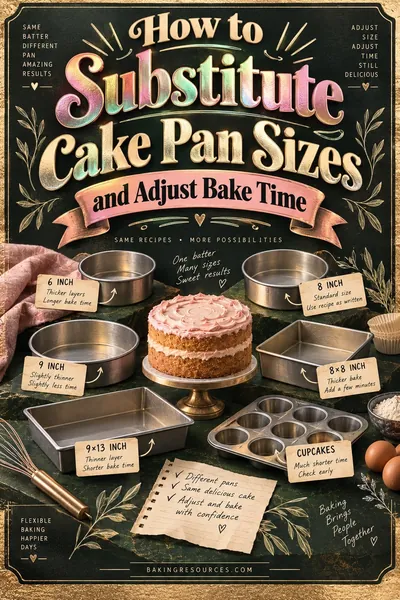
Yes, and the volume math is easier than you'd think. A 9x5 loaf pan holds 8 cups to the rim, which is exactly what a 9 inch round layer holds, so one round layer's worth of batter goes straight into one 9x5 loaf with no scaling at all. An 8.5 x 4.5 loaf holds 6 cups, the same as an 8 inch round.
What does change is the shape of the batter. A 9 inch round spreads across 63.6 square inches of floor. A 9x5 loaf gives it only 45. Same batter, 41 percent deeper, which means the outside sets long before the middle does.
So baking a cake in a loaf pan comes down to two adjustments: drop the oven 25°F, and add a lot of time. A 30 minute layer becomes roughly a 35 to 60 minute loaf, and you finish by temperature, not by clock.
Comparing your exact pans? Our free cake pan converter gives you the capacity difference and how much batter to pour.
Updated September 2026
Which pan equals which: the swap chart
Capacities are the pan filled level to the rim. Batter is the two thirds fill line, which is what you actually pour.
| Loaf pan | Capacity | Batter | Equal to |
|---|---|---|---|
| 8 x 4 x 2.5 in | 5 1/2 cups | 3 2/3 cups | a little under an 8 in round |
| 8.5 x 4.5 x 2.5 in | 6 cups | 4 cups | one 8 in round layer |
| 9 x 5 x 2.75 in | 8 cups | 5 1/3 cups | one 9 in round layer, or one 8x8 square |
| 9 x 5 x 3 in | 9 cups | 6 cups | one 9 in round plus a little |
| 10 x 5 x 3 in | 10 cups | 6 2/3 cups | one 9 in square |
| Two 9 x 5 loaves | 16 cups | 10 2/3 cups | a full 9x13, with a cup to spare |
Read that last row twice, because it's the one people need most. A 9x13 sheet cake recipe makes about 9 2/3 cups of batter and fills two 9x5 loaf pans with a little room left. That's the standard way to turn a sheet cake recipe into two loaves, one to eat and one to freeze.
Going the other direction, a two-layer 8 inch round recipe makes about 8 cups of batter. That's one and a half 9x5 loaves. Fill one loaf to 5 1/3 cups and bake the remaining 2 2/3 cups as about 10 cupcakes at a quarter cup each, rather than trying to cram it all in.
Full dimensions for every tin on the shelf, including Pullman and 1 lb bread tins, live in loaf pan sizes.
Baking a cake in a loaf pan: the time and temperature adjustment
Bake time follows the depth of the batter, not the size of the pan and not how much batter there is. Deeper batter takes longer, full stop.
Here's the arithmetic. Divide the old pan's floor area by the new pan's floor area, and that ratio is how much deeper the batter now sits.
Worked example: a 9 inch round recipe going into a 9x5 loaf.
- 9 inch round floor area: 3.1416 x 4.5 x 4.5 = 63.6 square inches
- 9x5 loaf floor area: 9 x 5 = 45 square inches
- Depth multiplier: 63.6 divided by 45 = 1.41
The recipe said 350°F for 30 to 35 minutes. Time does not track depth one for one, so the honest answer is a range: roughly 35 to 60 minutes. And because the batter got 41 percent deeper, drop the oven to 325°F so the crust doesn't set before the center cooks.
Here's the same calculation for the common swaps:
| Moving from | Into | Batter gets | New time from a 30 to 35 min recipe |
|---|---|---|---|
| 9 in round | 9 x 5 loaf | 41% deeper | 35 to 60 min at 325°F |
| 9 in round | 8.5 x 4.5 loaf | 66% deeper | 40 to 75 min at 325°F |
| 8 in round | 8.5 x 4.5 loaf | 31% deeper | 35 to 55 min at 325°F |
| 8 x 8 square | 9 x 5 loaf | 42% deeper | 40 to 70 min at 325°F |
| 9 x 13 | two 9 x 5 loaves | 30% deeper | 40 to 60 min at 325°F |
Those ranges are wide on purpose. A dense pound batter and a light butter cake behave differently at the same depth, and every oven runs its own way. Put your two actual pans into the baking time adjuster for a number, then ignore the number when the cake tells you otherwise.
The rule that beats every timer: a butter cake is done at 200 to 210°F in the middle, and a quick bread style loaf at 200 to 205°F. An instant read thermometer pushed into the center of the loaf, not touching the pan, is the only test that works in a pan this deep. A skewer can come out clean from a 1 inch band of cooked cake while there's still raw batter half an inch below it.
Which cakes work in a loaf pan, and which don't
Loaf pans favor cakes with structure. The batter has to hold itself up through a long bake, and a tall column of it puts real strain on a delicate crumb.
Excellent in a loaf pan:
- Pound cake. It was designed for this shape. Dense, buttery, and it wants the long slow bake a loaf pan forces.
- Butter cakes. Vanilla, chocolate, marble, lemon. Anything creamed with butter and sugar has enough backbone.
- Carrot and spice cakes. Sturdy, moist, and they suit the slab shape.
- Coffee cakes with a streusel top. The narrow top means the streusel layer stays thick.
- Cheesecake. Works well, and a loaf pan cheesecake is much easier to move than a springform. Still wants a water bath.
- Boxed mixes. One standard box makes about 4 1/2 cups of batter, which sits comfortably below the 5 1/3 cup line in a 9x5. It'll be a slightly shorter loaf. See how many boxes of cake mix per pan size for the rest.
Poor in a loaf pan:
- Angel food cake. It climbs the ungreased walls of a tube pan to rise, and there's no center tube in a loaf pan to support the middle. It collapses. Angel food cake pan sizes explains why that pan is not optional.
- Chiffon cake. Same problem, for the same reason.
- Genoise and other foam sponges. The foam structure can't hold a 2 1/2 inch column through a 50 minute bake. The center falls.
- Anything with heavy fruit or chunks. Chocolate chips, fresh berries and chopped fruit all sink further in a deep pan than a shallow one. Toss them in a tablespoon of the recipe's flour first, and expect a band at the bottom anyway.
- Very thin batters. A pourable batter in a deep narrow pan is a tunneling risk.
A note on layer cakes. You can absolutely make a layer cake in a loaf pan. Bake one loaf, cool it completely, then slice it horizontally into three thin slabs and fill them. You get a long rectangular layer cake that slices into neat portions, and you only washed one pan.
Lining, filling and the crack down the middle
Line it with a parchment sling. Cut a strip of parchment as wide as the base of the pan and long enough to hang over both long ends. Grease the pan, lay the sling in, grease the sling. The overhang gives you two handles to lift a deep, heavy cake straight out without turning it upside down. This one trick prevents most loaf cake disasters, and how to line a cake pan covers the fitted versions.
Fill to two thirds and no further. That's about 5 1/3 cups in a 9x5. A loaf pan filled higher will rise over the long edges and the overflow burns onto the oven floor, and the cake left behind bakes unevenly with a sunken middle.
Level the top before it goes in. Push the batter slightly higher at the two short ends than in the middle. Loaf cakes rise most in the center, so starting a little low there gets you closer to flat.
The crack down the middle is normal. Expected, even. The top surface sets into a skin, the middle keeps rising, and the skin splits. On a pound cake that split is the traditional look. If you want it in a neat straight line rather than a random one, run a knife down the length of the batter about a quarter inch deep before baking, or pipe a thin line of softened butter along the top. Full explanation in why did my cake crack on top.
A sunken middle is not normal. That's a different problem: usually underbaked, sometimes too much leavening, sometimes the oven door opened too early. Loaf pans are unforgiving here because the middle is so far from the heat. Why did my cake sink walks through the causes.
Cooling and turning out a loaf cake
Deep cakes need a two stage cool, and rushing it is where they break.
Stage one: 15 minutes in the pan on a rack. The cake is still structurally soft straight out of the oven. Fifteen minutes lets the crumb set and lets the edges pull away from the sides.
Stage two: out and onto a rack, right way up. Lift by the parchment sling, or run a thin knife around the two long sides and tip it out into your hand. Set it upright so the domed top doesn't flatten, and leave it until it's completely cool to the touch, which takes about 90 minutes for a full 9x5.
Do not leave it in the pan to cool completely. Steam gets trapped between the cake and the metal and the bottom goes gummy. How to cool a cake has the timings for every pan shape.
If it's stuck, don't force it. Set the pan on a warm damp towel for a couple of minutes, which loosens the sugar that's welded to the metal, then try again. Why is my cake stuck to the pan has the rest of the rescue.
Frosting and serving a loaf cake
A loaf cake has a much smaller surface than a round cake of the same volume, which is one of the quiet advantages of the shape.
- Top only, with a simple border: about 1 cup of frosting.
- All over, sides included, with a border: about 2 1/2 cups.
- Torted into 3 slabs, filling only: about 1 1/3 cups for both joins.
Compare that to a 9 inch two-layer round, which needs about 4 1/2 cups for the same job. A glaze poured over the top of a loaf is often the better call anyway, because it settles into the crack and looks deliberate. Run your own numbers in the frosting calculator, or read the technique in how to frost a cake.
Servings. A 9x5 loaf cut into 1/2 inch slices gives about 16 slices, or 10 to 12 generous ones at 3/4 inch. Cut across the short way, not lengthwise, and use a serrated knife wiped clean between cuts.
Storing. A loaf cake keeps better than a round one because you're only exposing one cut face at a time. Press a piece of plastic wrap against the cut end, wrap the whole thing, and it holds for 3 to 4 days at room temperature.
Frequently asked questions
Can you bake a cake in a bread pan?
Yes. A 9x5 bread pan holds the same 8 cups as a 9 inch round cake pan, so one round layer's worth of batter fits with no scaling. Drop the oven 25°F because the batter sits deeper, and expect the bake to run significantly longer.
How long do you bake a cake in a 9x5 loaf pan?
A recipe written for 30 to 35 minutes in a 9 inch round runs roughly 35 to 60 minutes in a 9x5 loaf at 325°F. That's a wide range because batter type and oven both matter, so check the center with an instant read thermometer and pull it at 200 to 210°F.
Do I need to change the oven temperature for a loaf pan?
Almost always yes, down by 25°F, because moving from a round or square pan into a loaf makes the batter deeper. Deep batter needs a gentler oven or the outside sets into a hard crust before the middle finishes. Dark and nonstick loaf pans get that 25 degree drop regardless.
Can I bake a box cake mix in a loaf pan?
Yes. One box makes about 4 1/2 cups of prepared batter, which sits just under the 5 1/3 cup fill line of a 9x5. Bake it at 325°F and start checking at 40 minutes. You'll get a slightly shorter loaf than a full fill would give.
Why is my loaf cake raw in the middle?
Because the center of a loaf pan is the furthest point from any heat source in your kitchen, and a skewer can come out clean from cooked cake sitting above raw batter. Lower the oven another 25°F, tent the top with foil once it's browned, and keep baking until the middle reads 200°F.
Can I split a two-layer cake recipe into loaf pans?
Yes. A two-layer 8 inch round recipe makes about 8 cups of batter, which fills one 9x5 loaf to its 5 1/3 cup line with about 2 2/3 cups left over. Bake that leftover as roughly 10 cupcakes for 18 to 22 minutes at the recipe's own temperature.
What about mini loaf pans?
They're much shallower relative to their footprint, so they go the other way: same temperature or slightly higher, and a much shorter bake, usually 20 to 30 minutes. A standard mini loaf holds about 1 cup of batter. Mini loaf pan sizes has the full chart and the yields per recipe.
Is a loaf pan the same as a banana bread pan?
Yes, they're the same thing. Most banana bread recipes are written for a 9x5, and putting one in an 8.5 x 4.5 is the reason so many loaves overflow. Banana bread pan size covers that swap and the batter amounts for each.