Angel Food and Tube Pan Sizes

The standard angel food pan is 10 inches across and 4 inches deep, and it holds 16 cups of water filled level to the rim. The other size you'll meet is the 9 x 3 inch tube pan at 12 cups. Bundt pans are sold by capacity instead of dimensions, and the two common ones are 10 cup and 12 cup, so neither of them holds an angel food recipe written for a full-size tube pan.
That gap is where cakes go wrong. Pour 16 cups of batter into a 12 cup bundt and you lose the difference onto the oven floor.
Checking whether your batter will fit before you pour? Our free cake pan converter does the capacity and area math for any two pans, including ring shapes.
Updated September 2026
Angel food and tube pan sizes: the capacity chart
Every capacity below is level-to-the-rim volume, measured by filling the pan with water from a measuring cup. That's the honest way to compare pans, since the sloped sides and fluting make eyeball estimates useless.
| Pan | Dimensions | Capacity to rim | Baking surface | Party servings |
|---|---|---|---|---|
| 10 x 4 tube (angel food) | 10 in wide, 4 in deep, 3.5 in hole | 16 cups | 68.9 sq in | 14 |
| 9 x 3 tube | 9 in wide, 3 in deep, 3.2 in hole | 12 cups | 55.6 sq in | 12 |
| 12 cup bundt | 10 in wide, 3.75 in deep, 3.2 in hole | 12 cups | 70.5 sq in | 14 |
| 10 cup bundt | 9.5 in wide, 3.5 in deep, 3 in hole | 10 cups | 63.8 sq in | 12 |
Baking surface is the ring area, which is the outer circle minus the hole: pi times the outer radius squared, minus pi times the hole radius squared. For the 10 x 4 tube that's 78.5 minus 9.6, so 68.9 square inches. It matters because area, not diameter, sets how deep your batter sits and therefore how long it bakes.
In metric, 16 cups is about 3.8 liters and 12 cups is about 2.8 liters. One cup is 14.44 cubic inches, so a 16 cup pan is holding 231 cubic inches of space.
Fill rule for tube pans: two thirds full for a batter with chemical leavening, but angel food and chiffon are the exception. They're poured to about two thirds and then climb the ungreased walls under their own steam, so a 10 x 4 pan takes roughly 10 to 11 cups of angel food batter and finishes near the rim.
Why the hole in the middle changes the math
A tube pan is not a round cake pan with a decoration. The center tube is structural.
Heat comes in from the outside wall, the base and the tube all at once. A deep 4 inch cake would take forever to cook through in a solid pan, and the outside would be dry long before the middle set. With the tube, no part of the batter is more than about 3 inches from a hot surface.
That's also why our pan converter flags a warning when you move a bundt or tube recipe into a solid pan. Without the hole, the center has to cook the hard way, so expect a longer bake and check the middle carefully.
The second job of the tube is grip. Angel food and chiffon batters are foams with almost no fat, and they need to cling to the walls to climb. A greased or nonstick pan defeats that completely. The batter slides back down and you get a dense, short cake with a sunken top.
So: never grease an angel food or chiffon pan. Grease a bundt thoroughly, into every groove, because a butter batter needs to release. Two opposite rules for two pans that look similar on the shelf.
Tube pan versus bundt pan versus chiffon pan
| Tube pan | Bundt pan | Chiffon pan | |
|---|---|---|---|
| Shape | Straight sides, plain tube | Fluted, curved, decorative | Same as a tube pan |
| Base | Usually removable, two pieces | One piece | Removable |
| Feet | Often has three cooling feet | No | Often has feet |
| Grease it? | No, for foam cakes | Yes, thoroughly | No |
| Best for | Angel food, chiffon | Pound cake, butter cake, coffee cake | Chiffon, angel food |
| Sold by | Dimensions | Cup capacity | Dimensions |
A chiffon pan and a tube pan are the same thing under two names. If a recipe asks for a chiffon pan, a 10 x 4 tube pan is what you want.
The removable base is worth insisting on for foam cakes. You cannot turn an angel food cake out of a solid pan while it's warm, because it would tear itself apart, and you cannot leave it in a pan you can't get a knife around. Two-piece pans let you lift the cake out on the base once it's cool.
The little feet on the rim are for cooling upside down, which is not optional for angel food. The cake's structure sets as it cools, and if it cools right side up it compresses under its own weight and turns rubbery. No feet? Invert the pan over the neck of a sturdy bottle. Our guide to cooling a cake covers the timings for both.
How to measure a tube pan you already own
Manufacturers are inconsistent, so measure yours once and write it on a piece of tape underneath.
- Lay a ruler flat across the top and read the inside diameter, edge to edge, not across the outer rim.
- Stand the ruler inside against the wall and read the depth from base to rim.
- Measure the tube itself across the top.
- Fill the pan with water, one measured cup at a time, until it reaches the rim. Count the cups.
Step 4 is the one that matters. Bundt pans in particular can be off by a cup or more from their stated capacity, and vintage pans are all over the place. If your pan has a removable base, do this test over the sink, or line the seam with a strip of plastic wrap first.
Once you have that number you can use the chart above and the pan converter with confidence instead of hoping.
Worked example: an angel food recipe with no tube pan
What you have: a recipe for a 10 x 4 inch tube pan, and no tube pan.
Step 1. Work out the batter volume. A 10 x 4 tube pan holds 16 cups. Angel food goes in at roughly two thirds, so you're dealing with about 10 to 11 cups of batter.
Step 2. Find something that adds up to 16 cups. Two 9 x 5 loaf pans hold 8 cups each, so 16 cups exactly. That's the cleanest swap in this whole article. Divide the batter between them and you get two loaf-shaped angel food cakes.
Step 3. Handle the no-grease rule. Loaf pans have no tube and no feet, so line nothing and grease nothing. Cool them upside down by balancing the pans between two cans or resting them on their long edges across a wire rack.
Step 4. Adjust the bake. The loaves are shallower than a 4 inch tube and there's no tube helping from the middle. Keep the same oven temperature and start checking about 10 minutes earlier than the recipe says. The cake is done when the top springs back firmly and a skewer comes out clean.
Step 5. Accept the trade-off. The rise is lower and the crumb slightly denser, because the batter had less wall to climb. It's a good cake. It isn't the same cake.
A second option: a 10 inch springform holds 15 cups, close to the 16 you need, but it's solid in the middle and it leaks. That combination makes it a poor pick for a thin foam batter. Our springform substitute guide covers when the seam is a real problem.
Worked example: a 16 cup recipe in a 12 cup bundt
The situation: a tube pan recipe, a 12 cup bundt in the cupboard, and 4 cups of missing capacity.
Step 1. Get the scaling factor. 12 divided by 16 equals 0.75. Multiply every ingredient by 0.75.
Step 2. Run the numbers. Say the recipe calls for 300 g of cake flour, 350 g of sugar and 12 large egg whites.
- Cake flour: 300 x 0.75 = 225 g
- Sugar: 350 x 0.75 = 262 g
- Egg whites: 12 large whites are about 360 g. 360 x 0.75 = 270 g of whites, which is 9 whites
Scale eggs by weight, not by count. A large white is about 30 g, but the actual eggs in your carton vary enough to matter in a foam cake. Whisk them together and weigh out the number you need. Our ingredient weights chart has the gram figures for cake flour, sugar and everything else, and the recipe converter will apply the 0.75 across a whole ingredient list for you.
Step 3. Don't scale the bake time by 0.75. The batter depth barely changes, so the time barely changes. Check at the recipe's stated time and expect it to be within about 5 minutes.
Step 4. Grease or not? If this is a butter or pound batter, grease the bundt into every groove. If it's angel food, a fluted bundt is the wrong pan and the cake will not climb it. Use two loaf pans instead.
The alternative to scaling: bake the extra 4 cups as cupcakes. A standard cupcake well takes about 1/4 cup of batter, so 4 cups is 16 cupcakes, done in 18 to 22 minutes while the big cake keeps going.
Bake time and temperature by pan
Depth drives bake time in a ring pan, but the tube pulls it back in. A 4 inch deep angel food pan bakes much faster than a 4 inch deep solid pan would.
| Pan | Typical temperature | Typical time | Watch for |
|---|---|---|---|
| 10 x 4 tube, angel food | 325 to 350°F | 35 to 45 min | Deep cracks that look dry, springy top |
| 10 x 4 tube, chiffon | 325°F | 50 to 60 min | Skewer clean, top springs back |
| 12 cup bundt, butter batter | 325 to 350°F | 45 to 60 min | 205 to 210°F in the thickest part |
| 10 cup bundt, dense pound | 325°F | 55 to 70 min | Tent with foil if the top browns early |
| Two 9 x 5 loaves | Recipe temperature | 10 min less than the tube | Same doneness tests |
Dark and nonstick pans brown harder. Drop the oven 25°F and start checking 5 minutes early, which is the same adjustment our oven temperature converter applies for dark metal. Silicone bundt pans insulate rather than conduct, so add 10 to 15 minutes and put a sheet pan underneath for support.
Doneness beats the clock. A butter or pound cake in a bundt is done at 205 to 210°F in the center. A foam cake doesn't take an internal reading well, so use the springback test: press the top gently and it should push straight back with no dent.
When a tube pan is not the answer
Swapping into a tube pan has limits too, and they run in both directions.
Don't put a solid-pan batter in a tube pan without checking the capacity. A recipe for a 9 x 13, which holds 14.5 cups, fits a 16 cup tube pan on volume, but a heavy batter in a ring shape bakes fast and dries at the edges. Drop the temperature 25°F and check early.
Don't put a tube batter in a solid pan without adjusting. The middle now has to cook from the outside in. Lower the oven 25°F and add 15 to 25 minutes.
Don't try to bake a cheesecake in a tube pan. There's no way to get it out, and a water bath would flood the removable base.
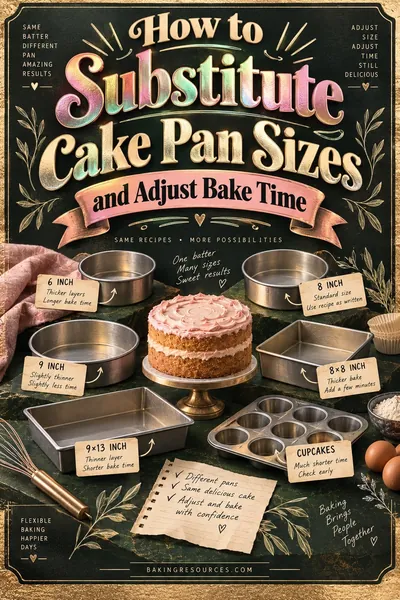
For all the other pan-to-pan questions, our guide on substituting cake pan sizes sets out the area method, and round cake pan sizes has the flat-pan capacity chart.
Storing and slicing a tube cake
A tall ring cake slices best with a serrated knife and a sawing motion, or with two forks pulled apart through the crumb for angel food. Pressing down with a straight blade compresses a foam cake into a pancake.
For servings, our data puts a 10 x 4 tube at 14 party servings and a 10 cup bundt at 12. Ring cakes are never cut into the small formal wedges used for tiered wedding cake, so those figures assume a normal dessert slice. The cake servings calculator has the numbers for every pan shape.
Angel food and chiffon stale fast because they have so little fat. Keep them under a cake dome at room temperature and eat them within two days, and see how to store baked goods for the wrapping details.
Frequently asked questions
What size is a standard angel food cake pan?
Ten inches across and 4 inches deep, with a hole around 3.5 inches wide, holding 16 cups of water to the rim. Most have a removable base and three small feet on the rim so the cake can cool upside down.
How many cups does a 9 inch tube pan hold?
Twelve cups, the same as a 12 cup bundt, though the bundt has more baking surface because it's wider and shallower. A 9 x 3 tube pan will not hold a recipe written for a 10 x 4 tube without scaling it to three quarters.
Can I use a bundt pan for angel food cake?
You can physically pour the batter in, but the cake won't be right. Angel food needs to climb ungreased straight walls, and fluted bundt sides plus a nonstick coating give it nothing to grip. You also can't cool it upside down properly. Two ungreased loaf pans are a better swap.
What can I use instead of a tube pan?
Two 9 x 5 loaf pans match a 10 x 4 tube pan's 16 cup capacity exactly. For a butter or pound batter, a 10 inch springform at 15 cups works if you're not using a water bath. Whatever you pick, expect a longer bake in the middle since you've lost the tube.
Is a tube pan the same as a bundt pan?
No. A tube pan has straight plain sides and usually a removable base. A bundt is fluted, one piece, and sold by cup capacity rather than dimensions. They're both ring pans, but only the tube pan suits foam cakes.
Why do I bake angel food cake in an ungreased pan?
The batter is a fat-free egg white foam that rises by gripping the pan walls and pulling itself up. Grease removes that grip, so the cake slides back down and bakes short and dense. It's the one pan in your kitchen you should never oil.
How full should I fill a tube pan?
About two thirds for a normal batter, which is roughly 10 to 11 cups in a 16 cup pan. Angel food and chiffon go in at two thirds and rise close to the rim on their own. Filling past three quarters at the start risks the batter cresting over the edge.
Do bundt pans really hold what the box says?
Not always. Stated capacity is a nominal figure, and older or unbranded pans can be a cup out in either direction. Fill yours with water a cup at a time and write the real number on tape under the base. It takes half a minute and it settles every future swap.
Related guides: Round cake pan sizes | How to substitute cake pan sizes | Loaf pan sizes | How to cool a cake | Cake pan converter