Bundt Pan Sizes and Capacities

A standard full size bundt pan holds 10 to 12 cups, and most recipes that just say "bundt pan" are written for the 12 cup. If you own one pan and it is about 10 inches across the top, that is almost certainly what you have.
The number stamped on the base or printed on the box is the capacity in cups, not the diameter, and that is unusual. Round and square pans are sold by width, loaf pans by length, but bundt and tube pans are sold by volume. That makes bundt pan sizes and capacities the easiest group on the whole pan shelf to get right, because the pan already tells you the one number that matters.
If yours has no marking, fill it with water one cup at a time until it reaches the brim. Whatever number you stop at is your pan.
Swapping a bundt recipe into a pan you actually own? Our free cake pan converter compares capacities, tells you how much batter to hold back, and adjusts the bake time for the new depth.
Updated September 2026
Bundt pan sizes and capacities: the full chart
| Pan | Top diameter | Depth | Capacity to the rim | Fill to two thirds | Party servings |
|---|---|---|---|---|---|
| Mini bundt, single | About 4 in | 2 in | 1 cup | 2/3 cup | 1 |
| Mini bundt tray, 6 wells | 3.5 in per well | 1.5 in | About 4 cups total | 2/3 cup per well | 6 |
| Small bundt | 7 to 8 in | 3 in | 6 cups | 4 cups | 8 |
| Bundt | 9 in | 3 in | 9 cups | 6 cups | 10 |
| 10 cup bundt | 9.5 in | 3.5 in | 10 cups | 6 2/3 cups | 12 |
| 12 cup bundt (standard) | 10 in | 3.75 in | 12 cups | 8 cups | 14 |
| Large bundt | 10.5 in | 4 in | 15 cups | 10 cups | 16 |
| 9 x 3 tube pan | 9 in | 3 in | 12 cups | 8 cups | 14 |
| 10 x 4 tube (angel food) | 10 in | 4 in | 16 cups | 10 2/3 cups | 14 |
The two rows in bold are the ones our converter carries, because they are the two that almost every recipe means. The others are real and sold, they are just less common.
Notice something odd on that chart: the 9 x 3 tube pan holds 12 cups, exactly as much as a 10 inch bundt, while measuring an inch narrower. That is because bundt pans have flutes, curves and a domed base that eat volume, while a tube pan is a plain straight sided cylinder with a post up the middle. Shape costs capacity, and a fluted pan always holds less than a smooth pan of the same width.
How to measure your own pan in two minutes
Do this once and write the answer on a piece of tape stuck to the bottom of the pan. You will never wonder again.
- Put the empty, dry pan on the counter. Not on a rack, so it sits level.
- Fill a 1 cup liquid measure with water and pour it in.
- Keep going, counting cups, until the water sits level with the rim.
- That count is the capacity. Round to the nearest half cup.
- Now pour it out and dry the pan properly, especially a cast pan, which will spot.
If you want the working number rather than the maximum, do it a second way: stop pouring at two thirds of the way up the inside wall. That figure is your safe batter fill, and it is what actually decides whether a recipe fits.
Why two thirds? A cake batter roughly doubles in the pan before the crust sets. Fill past two thirds and the batter climbs over the outer rim, runs down the flutes, and welds the cake into the pan. Bundt pans punish overfilling more than any other shape, because the batter has nowhere flat to spread and every drip lands somewhere with a groove in it.
The ring shape changes the baking, not just the volume
A bundt or tube pan has a hole up the middle, so the batter is heated from the inside wall as well as the outside wall and the base. That single feature does three useful things:
- It bakes faster than its depth suggests. A 12 cup bundt carries batter nearly 4 inches deep. A solid pan that deep would take forever and burn on the outside. The center post cuts the distance heat has to travel roughly in half.
- It bakes more evenly. No large mass of cold batter sits at the middle waiting.
- It carries a deeper batter safely. Which is exactly why rich, heavy pound cake batters were given this shape in the first place.
Going the other direction is the risky one. Take a recipe written for a bundt and put it in a solid round or loaf pan, and the center now has to cook the hard way with no inner wall to help. Expect a longer bake, drop the oven 25°F, and check the middle with a thermometer rather than trusting the crust. A butter cake finishes at 200 to 210°F in the center.
Swapping a bundt for a pan you already own
Match capacity first, then think about depth. Here is how the common swaps land.
| Recipe wants | You have | Fit | What to do |
|---|---|---|---|
| 12 cup bundt | 10 cup bundt | 83% | Hold back about 2 cups of batter and bake it as 8 cupcakes |
| 12 cup bundt | 9 x 3 tube pan | 100% | Straight swap, no changes, the easiest one on this list |
| 12 cup bundt | 10 x 4 tube pan | Pan is bigger | Fits easily but sits shallower. Check 10 minutes early |
| 12 cup bundt | Two 9 inch rounds, 16 cups | Pan is bigger | Works. Much shallower, so cut the time by about a third |
| 12 cup bundt | 9 x 13 pan, 14.5 cups | Pan is bigger | Works. Shallow bake, start checking 15 minutes early |
| 12 cup bundt | 9 inch springform, 12 cups | 100% by volume | Fits, but very deep and no center hole. Drop 25°F, add time |
| 12 cup bundt | One 9 inch round, 8 cups | 67% | Do not. It will run over the side |
| 10 cup bundt | 9 x 5 loaf pan, 8 cups | 80% | Use four fifths of the batter and expect a longer bake |
| 10 cup bundt | 10 inch round, 10.5 cups | 105% | Practically a straight swap. Shallower, so check early |
| 10 cup bundt | 8 x 8 square, 8 cups | 80% | Hold back a fifth of the batter |
| 6 cup small bundt | 8.5 x 4.5 loaf, 6 cups | 100% | Straight swap |
Two rules run underneath that entire table.
Rule one: the batter has to fit at two thirds. Compare the recipe's batter volume to two thirds of the new pan's capacity, not to the pan's full capacity. A 12 cup recipe needs a pan that holds 12 cups, because the recipe already assumed the two thirds fill.
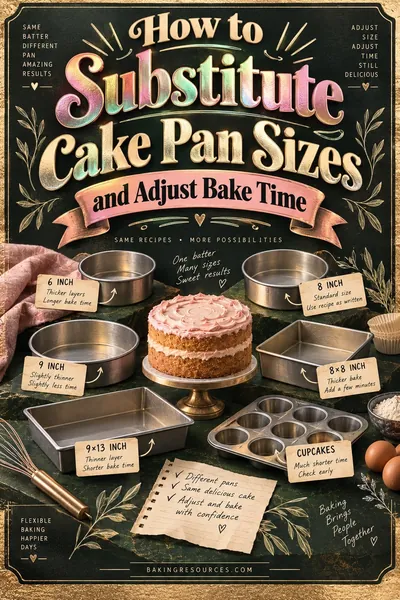
Rule two: time follows depth, not size. Spread the same batter wider and it gets shallower and finishes sooner. Pour it somewhere narrower and it gets deeper and needs both longer and cooler. Put both pans into our baking time adjuster for a revised window, and read how to substitute cake pan sizes and adjust bake time if you want the arithmetic behind it.
Worked example: a 12 cup bundt recipe, three ways
You have a pound cake written for a 12 cup bundt pan at 350°F for 55 to 65 minutes. The batter comes to about 8 cups, which is the two thirds fill for that pan.
Version 1: you own a 10 cup bundt. Two thirds of 10 cups is 6 2/3 cups, so your pan takes 6 2/3 of the 8 cups you have. Hold back about 1 1/3 cups. That leftover makes 5 or 6 cupcakes at 1/4 cup each, baked at the same temperature for 18 to 22 minutes. The bundt itself bakes at roughly the same depth as intended, so keep the time as written.
Version 2: you own a 9 x 5 loaf pan and nothing else. That pan holds 8 cups, so its safe fill is 5 1/3 cups. You would have to hold back a full third of the batter, and the loaf has no center hole to help it bake. Drop the oven to 325°F and expect 70 to 85 minutes. Bake the spare 2 2/3 cups as a second small loaf or as cupcakes. Our loaf pan sizes chart has the fill lines for every loaf pan.
Version 3: you own two 9 inch round pans. Together they hold 16 cups, so 8 cups of batter fills them to half, which is comfortably inside the safe range. The batter is now about 1 inch deep instead of nearly 3, so it bakes far faster: keep 350°F and start checking at 30 minutes. You have quietly turned a pound cake into a layer cake, which is a fine outcome. Use the round cake pan sizes chart to check the fill.
Bake times by bundt size
At 350°F, with the pan filled to two thirds. These are starting windows. The thermometer decides.
| Pan | Time window | Start checking at |
|---|---|---|
| Mini bundt tray, 6 wells | 18 to 24 min | 16 min |
| 6 cup small bundt | 35 to 45 min | 32 min |
| 9 cup bundt | 40 to 50 min | 38 min |
| 10 cup bundt | 45 to 55 min | 42 min |
| 12 cup bundt | 50 to 65 min | 45 min |
| 15 cup large bundt | 60 to 75 min | 55 min |
| 9 x 3 tube pan | 50 to 60 min | 45 min |
Dark, heavy cast pans run hotter at the surface than light aluminum ones. If yours is dark nonstick or cast aluminum, drop the oven 25°F and use the low end of the window. That is a bigger effect than most people expect, and it is the usual reason a bundt comes out with a dark, dry outer crust and a slightly wet middle.
Angel food and chiffon are a separate case
A 10 x 4 tube pan holds 16 cups and looks like a large bundt, but you cannot swap the two.
Angel food and chiffon batters climb the ungreased sides of the pan as they bake, and the pan is what holds the structure up. That is why angel food pans have a removable base, tall straight sides and often little feet for cooling upside down. Grease that pan and the cake slides back down. Bake an angel food batter in a fluted bundt and it will not climb the flutes cleanly, and it will not come out in one piece.
The reverse is a little more forgiving. A butter cake batter will bake in a tube pan fine, since it does not depend on climbing anything, as long as you grease the pan properly. Our angel food cake pan sizes page has the details for that shape.
Getting the cake back out
Capacity is only half the bundt problem. The other half is release, and the fluted shape that makes the cake look good is the same shape that grabs it.
The short version: grease every groove with softened butter or shortening on a pastry brush, dust with flour, cool the baked cake in the pan for exactly 10 minutes, then invert. Ten minutes is long enough for the crumb to firm and short enough that the crust has not cooled into glue. The full method, plus five rescues for a cake that is already stuck, is in how to get a bundt cake out of the pan.
Nonstick spray on its own is the most common failure. It pools in the base of the flutes and leaves the upper curves bare.
FAQ
How many cups does a standard bundt pan hold?
Twelve. The 12 cup bundt is the size most recipes assume, and it measures about 10 inches across the top and 3.75 inches deep. The 10 cup pan is the other common size, and it is close enough that most recipes work in it if you hold back a cup or two of batter.
How full should I fill a bundt pan?
Two thirds, which is 8 cups of batter in a 12 cup pan and 6 2/3 cups in a 10 cup pan. Cake batter roughly doubles before the crust sets, and a bundt that overflows runs down every flute and cements the cake into the pan. Bake the extra as cupcakes rather than pushing your luck.
Can I use a tube pan instead of a bundt pan?
Yes, for a butter or pound cake. A 9 x 3 tube pan holds 12 cups, the same as a standard bundt, so it is a straight swap with no changes at all. The only difference is looks: you lose the fluted shape and get a plain ring instead.
What can I use if I don't have a bundt pan?
Match the capacity. A 12 cup bundt recipe fits a 9 x 3 tube pan exactly, two 9 inch rounds comfortably, or a 9 x 13 pan with room to spare. Without the center hole, drop the oven 25°F and add time, since the middle now has to cook without help from an inner wall.
Is a 10 cup and a 12 cup bundt pan interchangeable?
Almost. A 12 cup recipe in a 10 cup pan is 83% of the volume, so hold back about 2 cups of batter and bake it as cupcakes. Going the other way, a 10 cup recipe in a 12 cup pan simply sits shallower and finishes about 10 minutes sooner, so start checking early.
How do I know what size bundt pan I have?
Fill it with water a cup at a time until the water reaches the rim, and count. Most pans also have the capacity stamped into the base or printed on the box, since bundt and tube pans are the one category sold by volume rather than by width. Write the number on tape and stick it to the bottom.
How many people does a bundt cake serve?
A 10 cup bundt gives about 12 servings and a 12 cup bundt about 14, cut in the usual wedges. Bundt cakes are not cut into the small formal portions used for tiered cakes, so those figures assume a normal slice. Our cake serving chart has the numbers for every pan shape.
Does a bundt pan bake faster than a regular cake pan?
For its depth, yes. The hole in the middle lets heat reach the batter from the inside as well as the outside, so a bundt handles a batter nearly 4 inches deep that would never bake through in a solid pan. Compared to a shallow round pan, though, it still takes longer, simply because there is more cake.