How to Separate Eggs

Separate eggs straight from the fridge, while they're cold. The yolk membrane is firmer at 40F and far less likely to split, so cold eggs separate cleanly and warm ones tear. Crack each egg over an empty bowl, move the white into your main bowl only once you can see it's clean, then let those whites sit out for 20 to 30 minutes before you whip them.
That's the whole method: separate cold, whip warm. Doing it in the other order is why most people end up fishing yolk out of a bowl of whites.
A large egg gives about 30 g of white and 18 g of yolk, so recipes scale by weight even when your eggs are the wrong size. Our free ingredient weights chart has the numbers for every egg size.
Updated September 2026
Why cold eggs separate better
The yolk is held together by a thin membrane called the vitelline membrane. Like most things made of protein and fat, it firms up when it's cold and softens when it's warm.
A cold yolk sits in your hand or in a shell half like a small water balloon that's been in the fridge. A room temperature yolk sags, spreads and splits over the edge of a shell. There's no trick that makes a warm yolk behave, which is why every professional kitchen separates eggs the moment they come out of refrigeration.
The white behaves differently. Cold whites are thicker and cling to the shell, which actually helps during separation because they don't rush past the yolk. It only becomes a problem later, at the whipping stage.
Why the whites need to warm up afterward
Cold egg whites are more viscous. A whisk has to work harder to stretch the proteins into a foam, and the bubbles you do form are larger and less stable.
Whites at room temperature, roughly 65 to 70F, whip faster and reach noticeably more volume. In practical terms, expect the same three whites to take about half as long and finish taller. For meringues, souffles and angel food cakes, that difference is the recipe.
So separate them cold, then leave the bowl of whites on the counter for 20 to 30 minutes while you get everything else ready. If you're in a hurry, set the bowl of whites in a larger bowl of warm tap water for five minutes and stir gently.
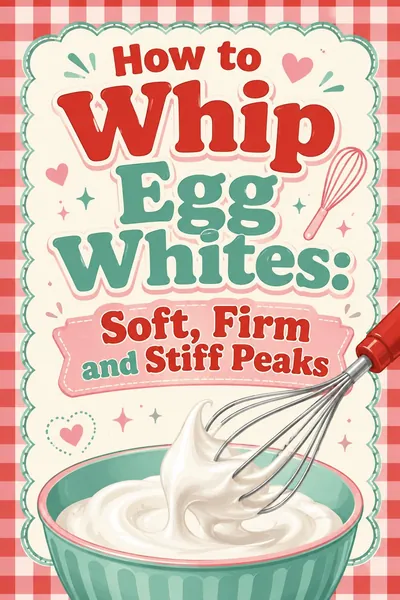
The full technique for the next step is in our guide on how to whip egg whites, including the soft peak and stiff peak stages and why an aluminum bowl is a bad idea.
The three-bowl rule
This is the single most useful habit in this article, and most home bakers skip it.
Use three bowls: one to crack over, one for the whites, one for the yolks.
- Crack the egg and separate it over the empty first bowl.
- Look at the white. If it's clean, tip it into the whites bowl.
- Drop the yolk into the yolks bowl.
- Repeat with the next egg over the same empty first bowl.
Here's why it's worth the extra dish. If you separate egg number nine directly over a bowl already holding eight perfect whites and the yolk breaks, you have just ruined eight whites. They will not whip. That's most of a carton, gone.
With the three-bowl method, a broken yolk costs you exactly one egg. Scrape that bowl into a container for scrambled eggs, rinse it, and carry on.
The rule matters more the more eggs you're separating. For two eggs, you can decide the risk is low. For a twelve-egg angel food cake, three bowls is not optional.
How to separate eggs: five methods compared
| Method | Cleanliness | Risk of breaking the yolk | Speed | Best for |
|---|---|---|---|---|
| Shell to shell | Good | Medium, shell edges are sharp | Fast | Two or three eggs, no extra gear |
| Hand method | Excellent | Very low | Fast once you're used to it | Large batches, meringue work |
| Egg separator tool | Excellent | Very low | Medium, needs rinsing between eggs | Beginners, shared kitchens |
| Water bottle trick | Excellent | Very low | Slow, one at a time | A fun method, small batches |
| Cracking into your palm through fingers | Excellent | Very low | Fast | Same as the hand method |
Shell to shell
Crack the egg on a flat surface, not the rim of a bowl. A flat crack breaks the shell cleanly, while a rim crack drives shell fragments inward and can pierce the yolk immediately.
Open the shell into two halves over your first bowl, keeping the yolk in the lower half. Tip the yolk back and forth between the halves and let the white fall away. Two or three passes usually finishes it.
The risk here is the shell edge. It's sharp, and a jagged break will cut the yolk on the third pass. If a crack looks ragged, switch to the hand method for that egg.
The hand method
Crack the egg into your clean, cupped hand over the bowl. Open your fingers slightly and let the white run through while the yolk stays in your palm.
It feels wrong the first time and it's the best method there is. Your fingers are smooth, warm and forgiving in a way shell edges aren't, and you get instant feedback if a yolk is fragile. It's also the fastest way to do a dozen.
Wash your hands first, obviously, and again afterward. Raw egg is raw egg.
The egg separator
A small plastic or metal cup with a slot that catches the yolk and lets the white run through. It works exactly as advertised and it's a genuinely good tool if you dislike handling raw egg.
Two things to watch. Rinse and dry it between eggs, because leftover white carries over. And they're sized for large eggs, so jumbo yolks can sit high and roll off.
The water bottle trick
Crack the whole egg onto a plate. Squeeze an empty plastic water bottle, hold the mouth over the yolk, and release. The suction lifts the yolk into the bottle. Squeeze again over a second bowl to release it.
It works, it's oddly satisfying, and it's slow. One egg at a time with a plate to wipe between each. Fine for three eggs, painful for twelve.
Why a trace of yolk stops whites from whipping
Egg white foam is built by proteins unfolding and linking into a mesh around air bubbles. Fat molecules get in the way of that mesh, sitting between the proteins and stopping them from bonding to each other. The foam either never forms or collapses as you watch.
Egg yolk is roughly a third fat. It doesn't take much.
The same rule covers everything else fatty in the vicinity:
- A greasy bowl. Plastic bowls hold a film of oil in their scratches even after washing, which is why plastic is the wrong bowl for meringue. Use glass, ceramic or stainless steel.
- An oily whisk or beater. Wash and dry it, even if it looks clean.
- Fingers. Skin has oil on it. If you use the hand method, don't then dip a finger into the whites to test them.
If you're worried, wipe the bowl and whisk with a paper towel dampened in white vinegar or lemon juice, then dry them. It takes 15 seconds and it removes the film.
Getting a speck of yolk out
Small speck, one that just landed: use a piece of the eggshell as a scoop. The shell edge cuts through the viscous white in a way a spoon can't, and the yolk clings to it. A cotton swab or a piece of paper towel touched to the speck also works, since the yolk is fattier and sticks to it faster than the white does.
Do this immediately. Once you've stirred the whites, the yolk disperses and the speck is unrecoverable.
Large break, yolk visibly spread through the whites: be honest with yourself. Those whites will not make a meringue, no matter how much you fish. Don't spend ten minutes proving it. Set them aside for scrambled eggs, an omelet or an egg wash, and crack a fresh egg.
The exception is a recipe where the whites aren't being whipped. If they're going into a batter, a smoothie or a frittata, a little yolk is irrelevant.
Egg weights, and scaling recipes by weight
Egg sizes are graded by the dozen, not per egg, so any two large eggs can differ by several grams. Weighing the whites is how bakers get consistent meringues.
| Part of a large egg | Approximate weight |
|---|---|
| Whole egg, out of the shell | 50 g |
| White only | 30 g |
| Yolk only | 18 g |
| Shell | about 6 g of the in-shell weight |
| US egg size | Whole egg out of shell | White | Yolk |
|---|---|---|---|
| Medium | 44 g | 26 g | 16 g |
| Large | 50 g | 30 g | 18 g |
| Extra large | 56 g | 34 g | 20 g |
| Jumbo | 63 g | 38 g | 22 g |
If a recipe was written for large eggs and yours are jumbo, four jumbo whites give you 152 g against the 120 g the recipe expected. That's a 27% overshoot, and in a meringue it means the sugar ratio is wrong and the finished meringue is soft and weepy.
Weigh instead. If you need 120 g of whites, pour from your bowl until the scale says 120 g and stop, whatever number of eggs that took.
To adjust the rest of the ingredients around a different egg count, run it through our free recipe scaler rather than doing the fractions in your head.
Worked example: a meringue built on weight
A French meringue is 2 parts sugar to 1 part egg white by weight. You have five extra large eggs.
Five extra large whites at 34 g each = 170 g of egg white.
Sugar at twice that = 340 g of granulated sugar. Granulated sugar is 200 g per cup, so 340 / 200 = 1.7 cups, which is 1 cup plus 2 tablespoons plus 2 teaspoons if you insist on cups.
Now do it the volume way. The recipe said "5 egg whites and 1 3/4 cups sugar," assuming large eggs. Large whites would have been 150 g, and 1 3/4 cups of sugar is 350 g, so the true ratio was 2.33:1. Your extra large whites at 170 g against that same 350 g gives 2.06:1.
Both are in the workable range, which is the point: the ratio is what you're actually controlling, and you can only see it when you weigh. The ingredient weights chart has sugar, butter and flour figures alongside the egg ones.
What to do with the leftovers
Separating eggs always leaves you with a bowl of something. Here's how long each part keeps.
| Item | Fridge | Freezer | Notes |
|---|---|---|---|
| Raw egg whites | 4 days, airtight | 12 months | Freeze in an ice cube tray, one white per cube |
| Raw egg yolks | 2 days, covered with water | 4 months | Must be stabilized before freezing, see below |
| Whole eggs, out of shell | 2 days | 12 months | Beat lightly first, they freeze better mixed |
| Hard cooked eggs | 7 days | Don't | Whites go rubbery and watery |
Whites freeze perfectly. They thaw and whip almost as well as fresh, and some bakers argue slightly better because freezing breaks down some of the thicker white. Freeze them in an ice cube tray, then bag the cubes and label the bag with the count. Thaw overnight in the fridge, then bring to room temperature before whipping.
Yolks need help before freezing. On their own, frozen yolks gel into a thick rubbery paste that never fully returns to liquid. The fix is to stir in a little sugar or salt before freezing, which interferes with the proteins bonding.
- For sweet uses: 1 1/2 teaspoons of sugar per 4 yolks.
- For savory uses: 1/8 teaspoon of salt per 4 yolks.
Label which one you used. Salted yolks in a custard are a bad surprise.
In the fridge, cover raw yolks with a thin layer of cold water so they don't dry out and form a skin, then drain the water off before using them. General storage rules for anything you bake with these are in how to store baked goods.
If you'd rather not deal with leftover parts at all, some recipes work fine with a replacement instead. Our guide to egg substitutes in baking covers what actually works and what doesn't, which is mostly a question of whether the egg was there for structure, moisture or lift.
Frequently asked questions
Is it easier to separate eggs cold or at room temperature?
Cold, clearly. The yolk membrane is firmer straight from the fridge and much less likely to break. Room temperature yolks sag and split. Separate them cold, then let the whites warm up for 20 to 30 minutes before whipping.
How much does an egg white weigh?
About 30 g for a large egg, with the yolk at about 18 g and the whole egg out of the shell at about 50 g. Extra large whites run around 34 g and jumbo around 38 g, which is why weighing beats counting for meringues.
Why won't my egg whites whip?
Almost always fat. A trace of yolk, a plastic bowl, or an oily whisk will stop the protein mesh from forming. Wipe the bowl and beater with vinegar and dry them, use glass or stainless steel, and start over with clean whites.
How do I get eggshell out of the whites?
Use a larger piece of eggshell as a scoop. The shell edge slides through the thick white where a spoon just pushes the fragment around. Wet fingers work too. A shell fragment is harmless, unlike yolk, so it isn't urgent.
Can I save egg whites that have a little yolk in them?
If you catch the speck right away, yes, scoop it out with a shell edge or a cotton swab. If the yolk has broken up and spread, no. Those whites won't whip. Use them for scrambled eggs and crack a fresh one.
How long do separated egg whites last in the fridge?
Four days in an airtight container. Yolks last only two days and should be covered with a thin layer of cold water so they don't skin over. Freeze whites for up to 12 months if you're not going to use them in time.
Do I need an egg separator?
No. Your hand does the same job faster, and a shell-to-shell pass costs nothing. A separator is worth having if you dislike touching raw egg or if a beginner is doing the separating, since it removes the yolk-breaking risk almost entirely.
Can I freeze egg yolks?
Yes, but stir in 1 1/2 teaspoons of sugar or 1/8 teaspoon of salt per 4 yolks first. Without it the yolks gel in the freezer and turn into a paste that won't blend back into a custard or a dough. Label the container with which one you added.