What Is Cream of Tartar and What Does It Do in Baking?

Cream of tartar is a fine white powder called potassium bitartrate, and it's left over from making wine. So what is cream of tartar doing in your spice rack? It's a dry acid, which means you can measure acidity by the teaspoon instead of pouring in lemon juice and throwing off your liquid.
It does three unrelated jobs: it stabilizes whipped egg whites, it's the acid half of baking powder, and it stops boiled sugar from turning grainy. Those three jobs have nothing in common except that an acid does them, which is why one jar covers all of them.
Updated September 2026
Out of it right now? Our free baking substitutions tool gives you the right swap for the specific job you're doing, and the swap really does change depending on the job.
What is cream of tartar made of?
Grape juice contains tartaric acid. As wine ferments and ages, that acid combines with potassium already in the juice and drops out of solution as hard crystals that stick to the inside of the barrel or tank. Winemakers call the deposit argol. Scrape it off, purify it, grind it, and you have the jar in your cabinet.
That is the entire origin story, and it explains two things people get wrong:
- There is no cream in it and no dairy of any kind. The word "cream" here is old usage, closer to "the cream of the crop," meaning the purified deposit. It's vegan, gluten free and dairy free.
- It is not the same as tartaric acid. Tartaric acid is the parent acid and it's much stronger and far more soluble. Cream of tartar is its potassium salt, which is weaker, only slightly soluble in cold water, and easy to dose by the eighth of a teaspoon. That weakness is a feature, since it means you can add a pinch to egg whites without curdling anything.
Chemically it's an acid salt, so it behaves like an acid in water while sitting in a jar as a bone-dry powder. That combination is rare and it's the whole reason cream of tartar exists as a pantry item.
The three jobs cream of tartar does
| The job | How much | What it does | What happens without it |
|---|---|---|---|
| Stabilizing whipped egg whites | 1/8 tsp per egg white | Lowers pH so the proteins bond more gently, giving a foam that resists over-whipping | Foam whips fine but breaks and weeps sooner, and over-whipping happens in seconds |
| Making baking powder | 1/2 tsp per 1/4 tsp baking soda | Supplies the acid the soda needs to release carbon dioxide | Soda has nothing to react with, so no lift and a soapy taste |
| Stopping sugar crystallizing | About 1/8 tsp per cup of sugar | Inverts a fraction of the sucrose as it boils, so crystals can't lattice cleanly | Candy, icing and syrup turn grainy, sometimes days later |
| Stabilizing boiled and royal icing | 1/8 to 1/4 tsp per batch | Keeps the surface white and smooth | Dulls and goes chalky |
| Snickerdoodle tang and chew | 1 to 2 tsp per batch | Acid flavor plus the leavening half of the pair | Tastes like a plain sugar cookie |
Those first three are the ones worth memorizing. Everything else on the jar's label is a variation of one of them.
Cream of tartar in egg whites
This is where most home bakers meet it. Add 1/8 teaspoon per egg white as soon as the whites turn frothy, before the sugar goes in.
Here's the mechanism, because it makes the amount make sense. Egg white foam is a mesh of unfolded proteins holding air bubbles. Those proteins carry electrical charges that repel each other. Lower the pH slightly and you neutralize some of that charge, so the proteins link into a stable network at a gentler pace instead of slamming together and squeezing water out.
The practical result is not more volume. It's a wider window. An unstabilized meringue goes from perfect to grainy and separated in about fifteen seconds of extra mixing. A stabilized one gives you closer to a minute. If you have ever pulled the bowl off the mixer and found curdled, weeping foam, that window is what you were missing.
It matters most for:
- Meringue cookies and pavlova, which need to hold shape for hours
- Angel food and chiffon cakes, where the foam is the only leavening
- Macaron shells, where a broken foam means no feet at all
- Seven-minute frosting and Swiss meringue buttercream
Our full walkthrough on how to whip egg whites covers the peak stages and the rescue trick for a foam you took too far. And if a speck of yolk got in, that's a fat problem, not an acid problem, and no amount of cream of tartar will fix it. Start with a clean separation using our guide to separating eggs.
Worked example: a four-white meringue
You're whipping 4 egg whites for meringue cookies.
- Cream of tartar: 4 whites x 1/8 tsp = 1/2 teaspoon
- Add it at the frothy stage, roughly 30 seconds in, before any sugar
- No liquid adjustment needed anywhere in the recipe, because it's a dry powder
Compare that with the acid alternative. Lemon juice does the same job at about 1/2 teaspoon per white, so 4 whites means 2 teaspoons of extra liquid dripping into your foam. It works, but you've just watered down the meringue slightly, and in a piped shell that shows up as more weeping.
Cream of tartar plus baking soda is homemade baking powder
Baking powder is not a mystery ingredient. It's an acid, a base, and a little cornstarch to keep them apart in the jar.
The ratio: 1/4 teaspoon baking soda plus 1/2 teaspoon cream of tartar equals 1 teaspoon of baking powder.
That's a two to one ratio of acid to base, and it's the same ratio the commercial stuff uses.
| Recipe calls for | Use instead |
|---|---|
| 1/2 tsp baking powder | 1/8 tsp baking soda + 1/4 tsp cream of tartar |
| 1 tsp baking powder | 1/4 tsp baking soda + 1/2 tsp cream of tartar |
| 1 1/2 tsp baking powder | 3/8 tsp baking soda + 3/4 tsp cream of tartar |
| 2 tsp baking powder | 1/2 tsp baking soda + 1 tsp cream of tartar |
| 1 tbsp baking powder | 3/4 tsp baking soda + 1 1/2 tsp cream of tartar |
One important catch. Store-bought baking powder is double acting: it releases some gas when it gets wet and holds the rest back until oven heat triggers it. Your homemade version is single acting, so all the gas comes at the mixing bowl.
That means the batter goes in the oven right away. Not after you preheat, not after you take a phone call. Mix the dry ingredients, add the wet, fill the pans, bake. If your muffins came out flat and you used a homemade powder, the delay is almost always the reason.
More on that whole family of leaveners in baking soda vs baking powder, and if you're out of both, our baking powder substitute page lists the other acids that work.
The same pairing is how you build self-rising flour from scratch, since self-rising flour is just flour, salt and baking powder pre-mixed.
Cream of tartar in candy, icing and syrup
This job is the one people skip, and it's the one where cream of tartar is doing something no other pantry acid does as reliably.
When you boil a sugar syrup with a small amount of acid in it, some of the sucrose splits into glucose and fructose. That split is called inversion, and the resulting mixture of three different sugars can't stack into a crystal lattice as easily. The syrup stays smooth.
Amounts run small: about 1/8 teaspoon per cup of sugar is typical, and more than 1/4 teaspoon per cup starts to taste sour and can leave the candy too soft.
Where it shows up:
- Boiled icing and seven-minute frosting
- Old-fashioned fudge and fondant
- Sugar syrup for glazing and for spun sugar
- Royal icing, for a smoother, whiter finish
That smoothness is the whole point in modeling work, and shaping fondant decorations covers the rest of the technique.
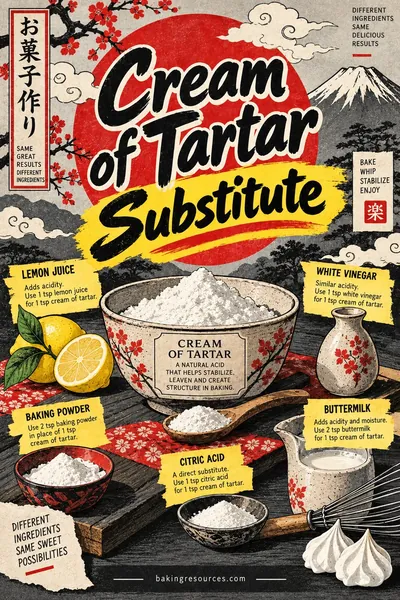
There's a trap here worth flagging. If a recipe uses cream of tartar for this job and you swap in lemon juice, you get a partial result at best, and the candy may still go grainy in a few days. For the anti-crystal job specifically, corn syrup is the reliable stand-in, not another acid. We laid out why in what is corn syrup, and the substitution ratios by job live in our cream of tartar substitute guide.
Snickerdoodles and the flavor question
Snickerdoodles use cream of tartar for both reasons at once. Paired with baking soda, it's the leavening. On its own, it contributes a faint sharpness that separates a snickerdoodle from a cinnamon sugar cookie.
If you bake them with baking powder instead, you get the rise and lose the tang. The cookie is still good. It just isn't the same cookie, and this is one of the few places where cream of tartar is a genuine flavor ingredient rather than a piece of chemistry.
Cream of tartar vs baking powder vs baking soda
They get confused constantly, so here they are side by side.
| Cream of tartar | Baking soda | Baking powder | |
|---|---|---|---|
| What it is | Potassium bitartrate, a dry acid | Sodium bicarbonate, a base | Soda plus a dry acid plus starch |
| Leavens on its own? | No | No | Yes |
| Needs a partner? | Yes, a base | Yes, an acid | No |
| Also stabilizes foam? | Yes | No | No |
| Also stops crystallization? | Yes | No | No |
| Loses power over time? | No | Very slowly | Yes, meaningfully |
| Taste if overused | Sour, sharp | Soapy, metallic | Bitter, metallic |
That "loses power over time" row is the practical difference. Baking powder dies quietly in the cupboard and ruins a batch without warning, which is why we wrote how long baking powder lasts and the test that takes ten seconds. Cream of tartar has no gas to lose, so it doesn't have that failure mode.
If the whole leavening vocabulary is new, our short explainer on what leavening means is a good starting point.
Does cream of tartar expire?
Not in any practical sense. It's a stable mineral salt with no water in it and nothing to go rancid. Kept dry and sealed, it works the same after five years as it did on day one.
Two storage notes:
- Keep it away from steam. Moisture makes it clump. Clumped cream of tartar still works, so break up the lumps with a fork and move on, but don't measure it over a simmering pot.
- A "best by" date is a quality date, not a safety date. If the powder is still white, loose and odorless, use it.
The one time to replace it is if it has absorbed a smell from something stored next to it, since you'll taste that in a meringue.
What else it's used for
Outside baking, cream of tartar earns its jar a few other ways:
- Playdough. It's in nearly every homemade playdough recipe, where it keeps the dough smooth and stretchy for weeks instead of days.
- Cleaning copper and brass. Mixed to a paste with a little water or lemon juice, it lifts tarnish.
- Stabilizing whipped cream is the exception, actually. Acid doesn't help there. Use cornstarch or a little instant pudding mix instead, and see how to make whipped cream for the amounts.
That last one catches people out. Cream of tartar stabilizes protein foams. Whipped cream is a fat foam, so a completely different fix applies.
Frequently asked questions
Is cream of tartar the same as baking powder?
No. Cream of tartar is only the acid half. Baking powder is that acid plus baking soda plus a starch buffer, ready to go. Use 1/4 teaspoon baking soda with 1/2 teaspoon cream of tartar to replace 1 teaspoon of baking powder, and get the batter into the oven right away because the homemade mix is single acting.
Does cream of tartar have dairy in it?
None at all. It's potassium bitartrate, a mineral salt recovered from wine barrels, and the word "cream" refers to a purified deposit rather than anything from a cow. It's dairy free, gluten free and vegan.
How much cream of tartar do I use per egg white?
An eighth of a teaspoon per white, added once the whites turn frothy and before any sugar. Four whites take half a teaspoon. Going heavier doesn't build more volume, it just risks a sour edge in a delicate meringue.
Can I leave cream of tartar out of snickerdoodles?
You can, but you'll lose the tang that defines the cookie. Replace it and the baking soda together with baking powder, using about 1 1/2 teaspoons of powder for every 1 teaspoon of cream of tartar plus its soda. The rise will be right and the flavor will read as a plain cinnamon sugar cookie.
Is cream of tartar the same as tartaric acid?
They're related but not interchangeable. Tartaric acid is the stronger parent acid and dissolves readily, while cream of tartar is its potassium salt, weaker and only slightly soluble in cold water. Swapping tartaric acid in at the same measurement will overwhelm a recipe.
Does cream of tartar go bad?
Practically never. With no moisture and nothing perishable in it, a sealed jar stays effective for years past any printed date. Clumping from humidity is cosmetic, so break up the lumps and use it as normal.
Will cream of tartar make my food taste sour?
Not at the amounts used for egg whites or leavening, which are far too small to detect. You'll only notice it in a candy or icing where the amount climbs past about a quarter teaspoon per cup of sugar, or in snickerdoodles, where the faint tang is the point.
Can I use cream of tartar to stabilize whipped cream?
No, and this is the most common mix-up. Acid stabilizes protein foams like egg whites, but whipped cream is a fat foam and needs a thickener instead. A teaspoon of cornstarch or a tablespoon of instant pudding mix per cup of cream does the job.