What Is Leavening in Baking? A Plain English Guide

Leavening is anything that puts gas into a dough or batter so it rises instead of baking into a brick. The gas is carbon dioxide, steam, or plain air, and it comes from one of three sources: a living organism (yeast), a chemical reaction (baking soda and baking powder), or physical work (whipping, creaming, and the water in the batter turning to steam in the oven).
That's the whole concept. Every risen thing you bake uses at least one of those three, and most good ones use two working together.
Out of a leavener, or not sure which one a recipe actually needs? Our free baking substitutions tool gives the swap and the exact ratio for every common one.
Updated September 2026
What is leavening in baking, exactly?
Here's the mechanical version, because it makes every other decision easier.
When you mix a dough or batter, you build a stretchy web. In bread that web is gluten, the protein network that forms when wheat flour meets water and gets worked. In a cake it's a softer mix of gluten, egg protein, starch, and fat.
A leavener releases gas inside that web. The gas can't escape easily, so it pushes outward and inflates thousands of tiny pockets. Heat expands those pockets further, then the starch gelatinizes and the proteins set, and the whole thing freezes in place. The holes you see in a slice of bread or the crumb of a muffin are fossilized gas bubbles.
Two things follow from that, and they explain most baking failures:
A leavener can only inflate bubbles that already exist. Baking soda doesn't create bubbles from nothing. It grows the microscopic air pockets you folded in when you creamed the butter and sugar or whisked the flour. Skip the creaming step and you get a flatter cake even with the right amount of leavener.
The web has to be strong enough to hold the gas and weak enough to stretch. Too little structure and the bubbles merge and pop, leaving a dense layer at the bottom. Too much and the gas can't expand at all.
The word itself comes from the Latin levare, to raise. Anything called an unleavened bread, like matzo or a plain flour tortilla, skips this step entirely and stays flat on purpose.
The three types of leavening agents
| Family | What makes the gas | Examples | Speed | Best for |
|---|---|---|---|---|
| Biological | Living yeast eating sugar and giving off CO2 | Active dry yeast, instant yeast, fresh yeast, sourdough starter | Slow: 1 to 72 hours | Bread, pizza, rolls, brioche, doughnuts |
| Chemical | An acid and a base reacting in water | Baking soda, baking powder, cream of tartar plus soda, buttermilk plus soda | Fast: seconds to a few minutes | Cakes, muffins, cookies, biscuits, pancakes, quick breads |
| Mechanical and physical | Air beaten in, or water turning to steam | Creaming, whipped egg whites, whipped cream, folded laminated dough, steam | Instant, then again in the oven | Angel food, chiffon, sponge, puff pastry, popovers, cream puffs |
Most recipes lean on two families at once. A butter cake creams air into the fat (mechanical), then baking powder inflates those air cells (chemical), then steam expands everything further in the oven (physical). A croissant is yeast plus steam from the butter layers. Pull one leg out and the whole thing sags.
Biological leavening: yeast and wild cultures
Yeast is a single-celled fungus, Saccharomyces cerevisiae. Feed it the sugars in flour, and it produces carbon dioxide and ethanol as waste. The CO2 raises the dough. The ethanol mostly bakes off, but the flavor compounds that come along with it are the reason bread tastes like bread instead of like flour paste.
The tradeoff is time. Yeast works over hours, not seconds, and that time is a feature. While the yeast is making gas, enzymes in the flour are breaking starch into simple sugars and protein into amino acids. Those are the raw material for flavor and for browning. A two-hour dough and a two-day dough can use identical ingredients and taste nothing alike.
Sourdough starter is the same idea with a wider cast. It's wild yeast plus lactic and acetic acid bacteria living in a flour and water paste. The yeast makes the gas, the bacteria make the sour notes and the keeping quality. It's slower and less predictable than commercial yeast, and there's no clean teaspoon-for-teaspoon swap between the two, because a starter also brings flour and water into the recipe.
The practical differences between yeast products, and the 25% conversion between the two common ones, live in our guide to active dry vs instant yeast.
When yeast is the right choice: anything you want chewy, open-crumbed, and savory. Bread, pizza, bagels, rolls, doughnuts, enriched loaves. Yeast can also handle heavy doughs that chemical leavening simply can't lift.
When it isn't: anything you want to make in under an hour, and anything tender. Yeast builds gluten as a side effect of the long mix and rise, and gluten is the enemy of a delicate crumb.
Chemical leavening: baking soda and baking powder
Chemical leavening is an acid and a base meeting in the presence of water. The reaction makes carbon dioxide immediately. No waiting, no feeding, no flavor development.
Baking soda is pure sodium bicarbonate, a base. On its own in a dry can, nothing happens. Add moisture and an acid and it fizzes. Without enough acid in the batter, some of it stays unreacted, and unreacted soda tastes soapy and metallic.
Acids that activate it include buttermilk, yogurt, sour cream, lemon juice, vinegar, molasses, brown sugar, honey, natural cocoa powder, and cream of tartar.
Baking powder is baking soda that ships with its own acid already mixed in, plus cornstarch as a spacer to keep the two apart in the can. Most supermarket baking powder is double-acting: one acid reacts in the bowl, a second waits for oven heat. That second stage is why a muffin batter can sit for ten minutes and still rise.
The dose ceilings worth memorizing, per cup of flour:
| Leavener | Typical dose per cup of flour | Over that, you get |
|---|---|---|
| Baking soda | About 1/4 tsp | A soapy, metallic taste and heavy browning |
| Baking powder | About 1 to 1 1/4 tsp | A bitter metallic edge, then a fast rise and collapse |
Baking soda is roughly three to four times stronger than baking powder by volume, which is why the numbers differ so much. If your substitution math puts you well over those ceilings, the math is wrong, not the ceiling.
We cover the full comparison in baking soda vs baking powder, and every emergency swap in the baking powder substitute chart.
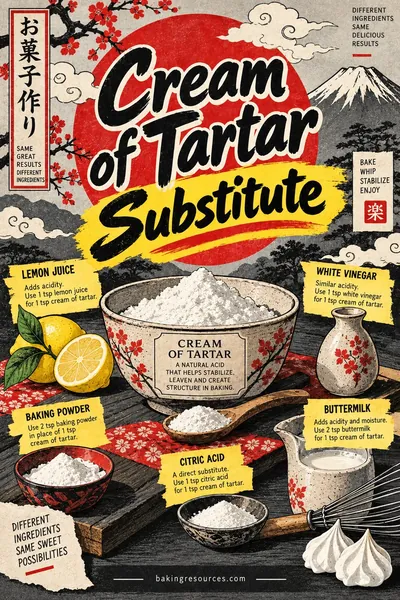
Cream of tartar is worth naming here because it confuses people. It isn't a leavener by itself. It's a dry powdered acid (potassium bitartrate), and its job is to be the acid half of a soda reaction. One part baking soda to two parts cream of tartar is homemade baking powder. If you're out of it, our cream of tartar substitute guide sorts the swaps by which job you need done.
Self-rising flour is the same chemistry sold pre-mixed: soft wheat flour with baking powder and salt already blended in. The ratio and how to scale it are in how to make self rising flour.
When chemical leavening is the right choice: anything tender and fast. Cakes, muffins, cookies, biscuits, scones, pancakes, waffles, cornbread, banana bread.
When it isn't: bread. Chemical leavening makes gas once and stops. It can't sustain a long rise, and it contributes zero flavor development.
Mechanical and physical leavening: air and steam
This is the family people forget, and it does more work than it gets credit for.
Creaming. Beating solid butter with granulated sugar drives the sharp sugar crystals through the fat, and each crystal cuts a tiny air pocket. Five minutes of creaming can add 20 to 30% to a batter's volume before any leavener joins the party. Those pockets are what your baking powder later inflates. Our guide on how to cream butter and sugar has the timing and the temperature.
Whipped egg whites. Egg white protein unfolds under a whisk and wraps around air bubbles, forming a foam that can hold eight times its original volume. Angel food cake, chiffon, souffle, and genoise get most or all of their lift this way. Cream of tartar shows up again here, doing a completely different job: stabilizing the foam. See how to whip egg whites for the stages.
Steam. Every batter is mostly water, and water expands about 1,600 times in volume when it turns to steam. In a hot enough oven, steam alone can lift a batter dramatically. Popovers, Yorkshire pudding, cream puffs, and puff pastry contain no yeast and no baking powder at all. They rise on steam and set before they collapse.
Lamination. Folding butter into dough in thin sheets makes dozens of layers. In the oven the butter's water flashes to steam and pushes each layer apart. That's a croissant, a puff pastry, and a flaky biscuit.
When mechanical leavening is the right choice: anything that needs to be light without tasting of leavener. It's also the only option in recipes with no chemical leavener at all, like a classic pound cake or a genoise.
When it isn't: on its own in a heavy, wet batter. Air folded into a dense mix escapes before the structure sets.
Worked example: three ways to raise 2 cups of flour
Same flour, three different jobs. Two cups of all-purpose flour is 250 g if you spoon and level, per our ingredient weights chart.
Route 1, yeast, for a small sandwich loaf. Yeast is dosed as a percentage of flour weight. At 1% instant yeast, 250 g of flour needs 2.5 g, which is a scant 3/4 teaspoon. Rise time at room temperature: 1 1/2 to 2 hours. Drop the yeast to 0.25 g (about 1/16 teaspoon, which needs a 0.1 g scale) and ferment cold overnight instead, and you get the same volume with far more flavor.
Route 2, baking powder, for muffins. The dose is 1 to 1 1/4 teaspoons per cup of flour, so 2 cups takes 2 to 2 1/2 teaspoons. At 4 g per teaspoon, that's 8 to 10 g of baking powder. Total rest time: zero. The batter goes in the pan and straight into the oven, because half the gas is already leaving.
Route 3, baking soda plus buttermilk, for a soda bread. The soda ceiling is 1/4 teaspoon per cup, so 2 cups takes 1/2 teaspoon of baking soda. To react fully, that needs roughly 1 cup of buttermilk, which also serves as most of the recipe's liquid. Total rest time: zero again, and this one is genuinely urgent, since single-acting reactions start losing gas within a minute or two.
Notice what changed. The flour is identical. The yeast route needs 2.5 g of leavener and two hours. The chemical routes need 8 g or less and no time at all. That gap is the entire reason both families exist. When you want the chemical clock in a recipe written for the biological one, baking powder instead of yeast sets out the dose and what it costs you in crumb.
Which leavener does a given bake need?
| What you're baking | Primary leavening | Secondary | Why |
|---|---|---|---|
| Sandwich bread, pizza, bagels | Yeast | Steam | Needs a long rise and chewy gluten structure |
| Sourdough loaf | Wild yeast plus bacteria | Steam | Same, with acid for flavor and shelf life |
| Butter cake, cupcakes | Baking powder | Creamed air, steam | Tender crumb, no gluten development wanted |
| Chocolate cake with natural cocoa | Baking soda | Baking powder, steam | The cocoa supplies the acid |
| Buttermilk biscuits, scones | Baking powder plus soda | Steam from cold butter | Fast lift plus flaky layers |
| Cookies | Baking soda | Creamed air | Soda raises pH, which spreads and browns them |
| Pancakes, waffles | Baking powder | Steam | Cooked immediately, so single-stage lift is fine |
| Angel food, chiffon | Whipped egg whites | Steam | No fat to weigh the foam down |
| Popovers, cream puffs | Steam only | Egg protein | High heat, wet batter, strong protein cage |
| Croissants, puff pastry | Steam from butter layers | Yeast in croissants | Lamination separates the layers |
| Matzo, plain tortillas | None | None | Unleavened by design |
What goes wrong, and which leavener is to blame
It rose fast, then sank in the middle. Too much leavener. The bubbles grew faster than the structure could set, merged into large ones, and popped. Check your dose against the per-cup ceilings above. Our guide on why did my cake sink walks through the other causes.
It never rose at all. Dead leavener is the first suspect. Baking powder loses strength in about six months after opening; baking soda lasts longer but still fades. Test powder by dropping 1/2 teaspoon into hot water, and soda with a splash of vinegar. Both should fizz visibly and immediately.
It tastes soapy or metallic. Unreacted baking soda, almost always. Either the recipe had more soda than its acid could handle, or a substitution shorted the acid.
It's dense and tight. With yeast, usually underproofing or a kitchen too cold. With chemical leavening, usually a batter that sat too long before baking, or a heavy hand with the flour. Weigh your flour rather than scooping it, since scoop-and-sweep can add 20 g per cup.
It tastes yeasty and boozy. Too much yeast, a kitchen that's too warm, or a dough left to rise past its peak.
Frequently asked questions
What does leavening mean in simple terms?
Leavening means making something rise by filling it with gas. In baking, that gas is carbon dioxide from yeast or a chemical reaction, or air and steam trapped in the batter. A leavening agent is whatever supplies that gas.
Is baking powder a leavening agent?
Yes, and it's the most common one in home baking. Baking powder is a complete chemical leavener in a can: baking soda plus one or two powdered acids plus cornstarch. Add moisture and it starts making carbon dioxide on its own, with no acidic ingredient needed in the recipe.
Is yeast a leavening agent?
Yes. Yeast is the biological leavener, a living fungus that eats sugars in the flour and gives off carbon dioxide. It works over hours instead of seconds, and unlike chemical leaveners it also builds flavor while it works.
Are eggs a leavening agent?
They can be. Whipped egg whites hold air and act as a mechanical leavener, and that's the entire lift in angel food and chiffon cakes. Whole eggs also set into a strong protein cage that traps steam, which is what makes popovers and cream puffs balloon.
What are the three types of leavening agents?
Biological (yeast and sourdough starter), chemical (baking soda, baking powder, and acid plus base combinations), and mechanical or physical (creamed air, whipped foams, lamination, and steam). Most recipes use at least two of the three at once.
Can I use yeast instead of baking powder?
Not as a straight swap. Yeast needs 1 to 3 hours and a dough that can hold gas that long, while baking powder works in minutes in a loose batter. Substituting one for the other means rewriting the recipe's method and timing, not just the leavening line.
What is an unleavened bread?
Bread made with no leavening agent at all, so it stays flat and dense. Matzo, plain flour tortillas, chapati, and crackers are the everyday examples. Some flatbreads that look unleavened, like pita and naan, actually are leavened and puff dramatically in a hot oven.
How long do leavening agents last?
Baking powder is reliable for about 6 months after opening, baking soda for around 2 years in a sealed container, and dry yeast for 4 to 6 months opened in the refrigerator or a year or more frozen. Test rather than trust the date, since heat above the stove kills all three early.
Related guides: Baking soda vs baking powder | Cream of tartar substitute | How to make self rising flour | Active dry vs instant yeast | Types of bread | Baking substitutions tool