How Much Fondant to Cover a Cake

A two-layer 8 inch round cake, 4 inches tall, takes about 670 g of fondant. A 9 inch takes about 780 g, a 10 inch about 905 g, and an 8 inch square takes 850 g because a square has more surface than a round of the same name. Those figures already include the skirt you trim off and can't reuse.
That's how much fondant to cover a cake in one line. The reason published numbers for a 9 inch cake range from 600 g to a full kilogram is that nobody agrees on how much trim waste to count, and trim waste depends entirely on how neatly you roll.
Want the number for your exact tin and height? Our free frosting calculator has rolled fondant as a covering type and gives you the grams, and the cake pan converter has the dimensions to feed it.
Updated September 2026
The formula behind every number on this page
Fondant is not measured by cake weight or by servings. It's a sheet draped over a surface, so it's a surface area problem, and the math is four short steps.
- Top area. For a round, that's pi times the radius squared. For a square or rectangle, length times width.
- Side area. Perimeter times the finished cake height.
- Volume. Add top and side together, then multiply by 0.20 inches.
- Weight. Divide the cubic inches by 14.44 to get cups, then multiply by 320 g per cup.
The step that looks wrong is the 0.20. You roll fondant to an eighth of an inch, which is 0.125, so why budget 0.20?
Because you roll a disc far bigger than the cake. It has to reach across the top, down every side, and still have enough overhang to smooth and trim. Everything past the trim line is gone, and re-rolling scraps gives you a dry, cracked sheet that isn't fit for a top coat.
Here's the proof that 0.20 is the right number. A 9 inch round, 4 inches tall, needs a rolled disc of 9 plus twice the height plus about 2 inches of handling margin, so 19 inches across. A 19 inch disc has an area of 283 square inches. At an eighth of an inch thick that's 35.4 cubic inches of fondant.
The surface area budget gives 176.7 square inches times 0.20, which is 35.3 cubic inches.
Same number, from two directions. That's the whole reason the chart works.
How much fondant to cover a cake: round pans
Every row assumes a two-layer cake, 4 inches finished height, rolled to an eighth of an inch.
| Round cake | Top area | Side area | Total surface | Fondant | Roll a disc |
|---|---|---|---|---|---|
| 6 inch | 28.3 sq in | 75.4 sq in | 104 sq in | 460 g | 16 in |
| 8 inch | 50.3 sq in | 100.5 sq in | 151 sq in | 670 g | 18 in |
| 9 inch | 63.6 sq in | 113.1 sq in | 177 sq in | 780 g | 19 in |
| 10 inch | 78.5 sq in | 125.7 sq in | 204 sq in | 905 g | 20 in |
| 12 inch | 113.1 sq in | 150.8 sq in | 264 sq in | 1,170 g | 22 in |
| 14 inch | 153.9 sq in | 175.9 sq in | 330 sq in | 1,460 g | 24 in |
| 16 inch | 201.1 sq in | 201.1 sq in | 402 sq in | 1,785 g | 26 in |
Two things jump out of that table.
The side area catches up with the top. On a 6 inch cake the sides are nearly three times the top. On a 16 inch cake they're equal. Height matters far more on small cakes than on big ones, which is exactly backwards from how most people guess.
The jumps are bigger than the names suggest. Going from 8 to 9 inches sounds like a small step, but it's 110 g more fondant. Going from 9 to 10 is another 125 g. Diameters lie about size, which is the same trap our round cake pan sizes chart exists to fix.
Square and rectangular cakes
A square has four flat sides and sharp corners, so it carries more surface than the round it shares a name with. Same 4 inch height.
| Square cake | Total surface | Fondant | Roll a sheet |
|---|---|---|---|
| 6 x 6 | 132 sq in | 585 g | 16 in |
| 8 x 8 | 192 sq in | 850 g | 18 in |
| 9 x 9 | 225 sq in | 1,000 g | 19 in |
| 10 x 10 | 260 sq in | 1,155 g | 20 in |
| 12 x 12 | 336 sq in | 1,490 g | 22 in |
| 14 x 14 | 420 sq in | 1,860 g | 24 in |
An 8 inch square takes 27 percent more fondant than an 8 inch round. A 9 inch square takes 28 percent more than a 9 inch round. That gap holds all the way up the chart, so add roughly a quarter to any round figure to get its square.
Sheet cakes are usually shallower, so they're listed separately at 2 inches tall:
| Sheet cake | Height | Total surface | Fondant | Roll a sheet |
|---|---|---|---|---|
| 9 x 13 | 2 in | 205 sq in | 910 g | 19 x 15 in |
| 11 x 7 | 2 in | 149 sq in | 660 g | 17 x 13 in |
| 13 x 18 half sheet | 2 in | 358 sq in | 1,590 g | 24 x 19 in |
Corners are where square and sheet cakes go wrong, and it isn't a quantity problem. Fondant tears at a sharp corner because the sheet has to stretch there while it's hanging under its own weight. Smooth the top first, then work the corners with your palm before you touch the flat sides, and keep the overhang supported with your other hand the whole time.
How height changes the number
Height only touches the side area, and side area is perimeter times height, so the increase per inch is fixed for any given pan.
| Cake | Fondant per extra inch of height |
|---|---|
| 6 inch round | 84 g |
| 8 inch round | 112 g |
| 9 inch round | 125 g |
| 10 inch round | 139 g |
| 12 inch round | 167 g |
| 8 inch square | 142 g |
| 9 inch square | 160 g |
So a 9 inch round built as a tall three-layer at 6 inches instead of 4 needs 780 plus two lots of 125, which is 1,030 g. That's a 32 percent jump for two inches of height, and it's the single most common reason a decorator runs short.
Rolling diameter grows too. Add twice the extra height to the disc: that same 6 inch tall 9 inch cake needs a 23 inch disc, not a 19 inch one, and a 23 inch disc will not fit on most home counters without a mat.
Thickness changes everything, proportionally
Every figure here is for an eighth of an inch, which is the standard for a smooth covering. Thinner shows every flaw underneath. Thicker gets doughy to eat and heavy enough to slump on a tall cake.
| Rolled thickness | Multiplier | 9 inch round needs |
|---|---|---|
| 1/16 in | 0.5x | 390 g |
| 1/8 in (standard) | 1.0x | 780 g |
| 3/16 in | 1.5x | 1,170 g |
| 1/4 in | 2.0x | 1,560 g |
Thickness is linear, so this is the easiest adjustment in the whole article: double the thickness, double the fondant.
A useful rolling check is the ruler-free one. Roll until you can just see the shadow of your hand through the sheet when you lift the edge. That's about an eighth. If it's opaque and stiff, you're closer to a quarter and you've doubled your quantity without meaning to.
Tiered cakes: cover every tier, including the tops
Each tier gets covered on its own, top included, before it's stacked. The tier above sits on a board, so covering the top of the tier below isn't wasted, it's structural.
Worked example: a three-tier 6, 8 and 10 inch round, each 4 inches tall.
| Tier | Surface | Fondant |
|---|---|---|
| 10 inch | 204 sq in | 905 g |
| 8 inch | 151 sq in | 670 g |
| 6 inch | 104 sq in | 460 g |
| Total | 459 sq in | 2,035 g |
So a classic three-tier takes just over 2 kg of fondant. Buy 2.5 kg. The extra half kilogram covers a re-roll when one sheet dries out, plus whatever you color separately for decoration, and leftover fondant keeps for months wrapped airtight.
A four-tier adding a 12 inch base is 2,035 plus 1,170, which is 3,205 g. That's the point where you're buying by the tub rather than the packet.
Cupcakes and cookies
Fondant on cupcakes is a flat disc, not a drape, so the math is simpler and much smaller.
A 2.5 inch disc at an eighth of an inch is 4.9 square inches of surface, which is 0.61 cubic inches, or about 14 g per cupcake.
| Cupcakes | Fondant on the discs | Buy |
|---|---|---|
| 12 | 165 g | 250 g |
| 24 | 330 g | 450 g |
| 48 | 660 g | 900 g |
The gap between the two columns is cutter waste. You're punching circles out of a rolled sheet, and the lattice between them is scrap. Re-roll it once and it's still fine for cupcake toppers, since nobody sees a hairline crack on a 2.5 inch disc the way they would on a cake side.
Fondant needs something underneath it
This is the part quantity charts leave out. Fondant will not stick to bare cake, and it will not hide a lumpy shape. It needs a layer of buttercream or set ganache under it doing two jobs: gluing the sheet on, and making the cake a smooth shape for the sheet to lie against.
That under-layer is separate from the fondant figures above, and here's how much of it you need:
| Cake (4 in tall, two layers) | Filling | Crumb coat | Buttercream total |
|---|---|---|---|
| 6 inch round | 0.43 cups | 0.36 cups | 0.8 cups (190 g) |
| 8 inch round | 0.77 cups | 0.52 cups | 1.3 cups (320 g) |
| 9 inch round | 0.97 cups | 0.61 cups | 1.6 cups (390 g) |
| 10 inch round | 1.20 cups | 0.71 cups | 1.9 cups (470 g) |
| 12 inch round | 1.72 cups | 0.91 cups | 2.6 cups (650 g) |
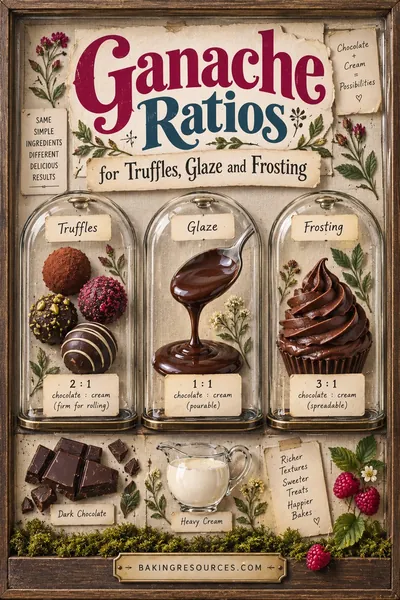
Ganache is the better choice under fondant if you want sharp edges, because it sets firm rather than soft and it doesn't move under the sheet in a warm room. A 2:1 chocolate to cream ratio is the spreadable one, and our ganache ratio guide covers all three. The crumb coat method itself is in how to frost a cake, and the chill step in it matters even more under fondant than it does on a plain buttercream cake.
Chill the coated cake until the buttercream is firm to a fingertip, then bring it back to cool room temperature before the fondant goes on. Draping a sheet onto a fridge-cold cake makes it sweat, and sweating fondant goes sticky and shiny and never quite recovers.
Worked example: buying for a 9 inch birthday cake
You're covering a 9 inch round, two layers, 4 inches tall, in white fondant with a colored band around the base.
Step 1. The cake covering. 780 g from the chart.
Step 2. The band. A band 1.5 inches tall around a 9 inch cake is 28.3 inches of perimeter times 1.5, which is 42 square inches. Times 0.20 and divided by 14.44 is 0.58 cups, so about 190 g of colored fondant.
Step 3. Round up for trim and color. Coloring fondant means kneading, and kneading dries it, so add 25 percent to the colored portion. 190 becomes 240 g.
Step 4. Buy. 780 plus 240 is 1,020 g. Fondant sells in 680 g (24 oz) packets, so two packets of white covers the main sheet with enough left to tint the band, or one white packet plus a small colored one.
Step 5. The buttercream underneath. 1.6 cups, about 390 g, from the under-layer table.
Total plan, no guessing: two packets of fondant, 1.6 cups of buttercream, a 19 inch rolling area.
Storing what's left
Fondant does not go off quickly. Wrap it tight in plastic, press out all the air, then put it in a sealed bag or tub at cool room temperature. It keeps for months that way.
Do not refrigerate it. Cold fondant pulls moisture from the air the moment it comes out, and you get a sticky surface that will not take a smooth finish. The same rule applies to a finished fondant cake, which is why cake storage gets awkward once fondant is involved: the cake wants the fridge and the fondant does not.
Scraps of different colors can be kneaded together into a marbled gray-brown mass that's genuinely useful for making figures and internal supports, so don't throw them out.
FAQ
How much fondant do I need for a 9 inch cake?
About 780 g for a two-layer 9 inch round, 4 inches tall, rolled to an eighth of an inch. That already includes the skirt you trim off. If your cake is 6 inches tall instead of 4, add 125 g per extra inch of height, which takes it to about 1,030 g.
How big should I roll the fondant?
Cake diameter plus twice the cake height plus about 2 inches of handling margin. For a 9 inch round that's 4 inches tall, that's 19 inches across. Short-rolling is the most common failure, because you find out the sheet doesn't reach only after it's already draped and stretching.
Does a square cake need more fondant than a round?
Yes, about 27 percent more at the same nominal size. An 8 inch square takes 850 g against 670 g for an 8 inch round, because a square of side 8 has more surface than a circle of diameter 8. Add a quarter to any round figure to get its square.
How thick should fondant be on a cake?
An eighth of an inch. Thinner and every crumb and dent underneath shows through. Thicker and it eats doughy and gets heavy enough to slide on a tall cake. Lift an edge and check that you can just see the shadow of your hand through it.
Do I need buttercream under fondant?
Yes. Fondant won't stick to bare cake and it won't smooth out a lumpy shape on its own. A 9 inch round needs about 1.6 cups of buttercream underneath, filling and crumb coat together. Set ganache is the better choice if you want sharp, square edges.
How much fondant do I need for cupcakes?
About 14 g per 2.5 inch disc, so 165 g for a dozen. Buy closer to 250 g, because cutting circles from a rolled sheet leaves a lattice of scrap. That scrap re-rolls fine for more toppers, unlike the trim from a cake covering.
Why do published fondant amounts vary so much?
Because trim waste is the biggest single variable and nobody rolls the same way. A neat roller gets close to the surface area figure; a cautious one rolls a much wider disc and throws away a third of it. Figures for a 9 inch cake run anywhere from 600 g to a kilogram for that reason alone, so buy the next packet size up.