Large Number Cake Tins 0-9: What Each Size Holds

Large number cake tins 0-9 are sold in two common heights: about 10 inches (25 cm) and about 14 inches (35 cm), both usually 1.5 to 2 inches deep. A 10 inch digit takes roughly 1.5 to 3 cups of batter and a 14 inch digit takes roughly 3 to 6 cups, and the exact figure depends entirely on which digit it is. A 1 holds less than half what an 8 holds.
That is the part no chart on a box ever tells you, and it is why people either run out of batter or lose a cup of it over the side.
And you do not need the pan at all. A number cake cut from a sheet with a paper template gives you the same shape, sharper corners, and a pan you already own.
Work out how much batter your recipe actually makes with our free cake pan converter, then match it to the numbers below.
Updated September 2026
Large number cake tins 0-9: the capacity chart
There is no standard for how a manufacturer draws a digit, so treat this as a very good starting point rather than gospel. The numbers come from the geometry, not from a guess: a digit fills a predictable share of its bounding rectangle, and the rest is depth.
Both columns assume you fill to 1.2 inches deep, which is a sensible working depth for a number cake and leaves the rim clear.
| Digit | Share of its bounding box | 10 inch tin | 14 inch tin |
|---|---|---|---|
| 0 | 52% | 2.8 cups | 5.4 cups |
| 1 | 26% | 1.4 cups | 2.7 cups |
| 2 | 46% | 2.5 cups | 4.8 cups |
| 3 | 46% | 2.5 cups | 4.8 cups |
| 4 | 42% | 2.3 cups | 4.4 cups |
| 5 | 46% | 2.5 cups | 4.8 cups |
| 6 | 49% | 2.6 cups | 5.1 cups |
| 7 | 33% | 1.8 cups | 3.5 cups |
| 8 | 55% | 3.0 cups | 5.8 cups |
| 9 | 49% | 2.6 cups | 5.1 cups |
The spread from a 1 to an 8 is more than double. If you are baking an 18th birthday cake, the 1 and the 8 are not going to want the same amount of batter, and pouring half the bowl into each is how one comes out thin and dry while the other overflows.
Where those numbers come from
Here is the arithmetic, so you can redo it for a tin that is a different height or a different depth.
A 10 inch tall digit sits in a bounding box about 10 inches tall and 6.5 inches wide, so 65 square inches. A 14 inch digit sits in a box about 14 by 9, so 126 square inches. Multiply the box by the digit's share to get the floor area, multiply that by your fill depth to get cubic inches, then divide by 14.44 cubic inches per US cup.
For a large number 5 cake tin at 14 inches:
126 sq in × 0.46 = 58 sq in of floor 58 × 1.2 in deep = 70 cubic inches 70 ÷ 14.44 = 4.8 cups
That 14.44 figure is the same conversion our frosting calculator runs on, so the two tools will never argue with each other.
The only measurement that is exactly right: the water test
Charts get you close. Your actual pan gets you exact, and it takes ninety seconds.
Set the empty tin on the counter, and pour water into it from a liquid measuring cup, counting the cups as you go, until the water sits about a quarter inch below the rim. That total is the pan's brim capacity.
Then use two thirds of it. A cake pan filled past two thirds domes, splits, and in a shape with tight inside corners it will crawl over the edge before the crumb has set.
So a 14 inch large number 4 cake pan that brims at 6.5 cups is a 4.3 cup pan in practice. Write the number on a piece of masking tape and stick it inside the pan. You will thank yourself next birthday.
Why every digit behaves differently in the oven, not just in the bowl
Capacity is only half the story. The other half is edge.
A digit is a long, narrow ribbon of cake folded into a shape. A 14 inch number 1 is essentially a thick stick: almost all of it is within an inch of a hot metal wall. An 8 has two enclosed loops and a lot more middle.
That difference shows up as bake time and as dryness.
| Digit group | Character | What to do |
|---|---|---|
| 1, 7 | Mostly edge, very little middle | Check 8 to 10 minutes early, they overbake fast |
| 4, 2 | Long strokes, sharp corners | Watch the corners, they set first and can scorch |
| 3, 5, 6, 9 | Curved, moderate middle | Roughly as written for the batter depth |
| 0, 8 | Enclosed loops, most interior | The slowest of the set, check the loop centers |
If you are baking a two-digit number, bake them separately and pull each when it is done. Baking a 2 and a 1 side by side to the same timer gives you one good cake and one dry one.
Bake time follows batter depth, not the number on the pan
This is the rule that saves number cakes, and it is the same rule that governs every pan swap.
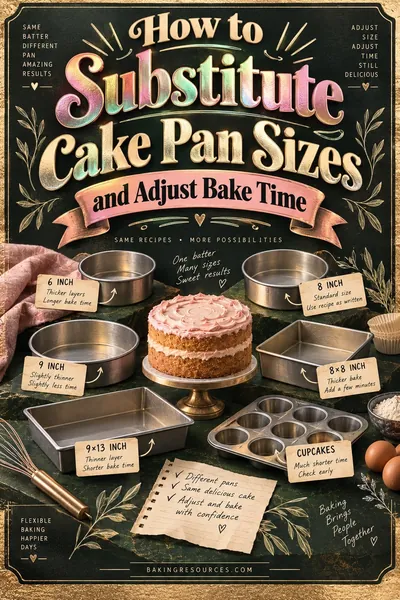
Most number tins are shallow. If your recipe was written for two 9 inch rounds with the batter about 1.5 inches deep, and you have spread it 1.2 inches deep in a number, you are a little shallower than the recipe expects, so start checking 5 to 10 minutes early and keep the oven temperature the same.
Go much shallower than that, say a 0.75 inch layer, and the time can drop by 30 to 40%. The risk in a shallow pan is never underbaking. It is walking away.
Feed both pans into our baking time adjuster for a revised window in minutes, and use the skewer to make the final call. The round cake pan sizes chart has the depth figures for the pan your recipe was probably written for.
How to make a number cake without buying big number cake pans
Here is the honest truth about number tins: most people use them once. They are awkward to store, hard to line, and a set of ten costs real money for a shape you can cut in four minutes.
The template method gives you a crisper number anyway, because you cut the shape after the cake has cooled and set.
- Print the digit at the size you want. Any word processor works. Set a text box to a bold, blocky font, type the digit, and blow it up until it measures the height you want on paper. Tape sheets together if it spans more than one.
- Cut the paper out and lay it on a piece of cardboard to make a stiff template. Cardboard holds its line against a knife far better than paper.
- Bake a sheet cake in a pan big enough for the digit's bounding box. See the sizing math below.
- Cool it completely, then chill it for 30 minutes. A cold cake cuts clean. A warm one tears. Our guide on how to cool a cake covers why the middle stays warm long after the edges feel cool.
- Lay the template on top and cut straight down with a long serrated knife, wiping the blade between cuts.
- Frost the sides last, after a crumb coat, so the cut edge does not shed into the finish. The crumb coat method matters more on a cut shape than on a round cake, because you have exposed crumb on every edge.
Which sheet pan you need
Your digit's bounding box has to fit inside the pan, with about half an inch of margin on each side.
| Digit height | Bounding box | Smallest pan that works | Cups of batter for a 1 inch layer |
|---|---|---|---|
| 8 inches | 8 x 5.2 in | 9 x 13 (14.5 cups brim) | About 3 cups |
| 10 inches | 10 x 6.5 in | 9 x 13 (14.5 cups brim) | About 4.5 cups |
| 12 inches | 12 x 7.8 in | 9 x 13, barely | About 6.5 cups |
| 14 inches | 14 x 9 in | Half sheet, 13 x 18 | About 9 cups |
| Two 12 inch digits | 15.6 x 12 in | Half sheet, 13 x 18 | About 13 cups |
A 9 x 13 pan gives you 117 square inches of cake. A 12 inch digit needs a 94 square inch box, so it fits with almost nothing to spare, and you cannot get two out of one sheet. A half sheet at 13 x 18 gives you 234 square inches, which comfortably holds two 12 inch digits side by side.
If you are short a pan, our 9x13 pan substitutes guide lists what else holds that same 14.5 cups.
Worked example: a large number 5 cake tin versus a 9 x 13 sheet
Say you want a number 5 that stands 12 inches tall, and your recipe is a standard two-layer 9 inch round cake. That recipe makes about 8 to 10 cups of batter, since a 9 inch round takes 4 to 5 cups per layer.
Option A, the tin. A 12 inch number 5 tin: the bounding box is 12 × 7.8 = 94 sq in, times 46% for the digit 5 gives 43 sq in of floor. At 1.2 inches deep that is 52 cubic inches, or 3.6 cups.
You have 8 to 10 cups of batter and a pan that wants 3.6. You need about 40% of the recipe, and the rest goes into cupcakes. A standard cupcake takes 1/4 cup of batter, so your 5 cups of leftover batter is 20 cupcakes.
Option B, the sheet. Bake the full recipe in a 9 x 13 as a single layer. 9 cups of batter in a 117 square inch pan gives a layer about 1.1 inches deep. Cool, chill, cut the 5 with a template.
The cut version loses the offcuts, roughly 55% of the sheet, which is about 4 cups of cake. That is not waste: it is trifle, it is cake pops, it is a snack for whoever is helping. Cake pop yield from one cake mix turns those offcuts into an actual number.
Which is better? The sheet, most of the time. You get straighter strokes, you control the height by adding a second sheet and stacking, and you never had to buy a pan shaped like a single digit.
Two-digit numbers, and how to plan them
Ages that need two digits are where the batter math gets interesting, because the two digits are almost never the same size.
A number 21 in 14 inch tins: the 2 wants 4.8 cups and the 1 wants 2.7 cups, so 7.5 cups total, split 64/36. Not 50/50.
A number 40: the 4 wants 4.4 and the 0 wants 5.4, so 9.8 cups, split 45/55.
A number 18: the 1 wants 2.7 and the 8 wants 5.8, so 8.5 cups, split 32/68. That is the most lopsided pair in the whole set.
Weigh the batter instead of eyeballing it. Put the bowl on a scale, note the total weight, and pour the correct percentage into each pan. If your batter weighs 1,800 g and you need a 32/68 split, that is 576 g into the 1 and 1,224 g into the 8. Our recipe converter will scale the whole recipe up or down to hit the total you actually need.
Frosting a number cake takes more than you think
Number cakes have an enormous amount of side surface for the amount of cake they contain. Every stroke of the digit has two long sides, and a 0 or an 8 has interior sides too.
A 14 inch number, single layer, needs roughly 2.5 to 3.5 cups of buttercream for a crumb coat, a full outside coat and a simple border. Two stacked layers with filling pushes that toward 4 to 5 cups, which is the same as a whole 9 inch two-layer round cake.
Run your actual dimensions through the frosting calculator rather than guessing. Running out with one bare stroke to go is a miserable place to be, and the fix, making a rushed half batch of buttercream, never quite matches the color of the first one.
For the piped-dot style number cake, the one built from two thin cut layers with rosettes covering the top, budget more like 5 to 6 cups for a 14 inch digit. Those dots eat frosting.
How many people does a number cake feed?
Fewer than the size suggests, because so much of the bounding box is empty air.
A 14 inch digit at 1.2 inches deep holds 3 to 6 cups of batter. A 9 inch round layer holds 4 to 5. So a single 14 inch digit is roughly one 9 inch layer, which serves about 8 to 12 people as dessert portions.
A two-digit number in 14 inch tins is closer to a full two-layer 9 inch cake, so 16 to 24 servings.
Our cake servings chart has the party versus wedding portion split, which changes the answer by nearly double.
Lining a number pan, which is the actual hard part
Number tins have inside corners, and parchment does not like inside corners.
The trick is to stop trying to line them with one piece. Grease the pan thoroughly with softened butter or shortening, dust it with flour, tap out the excess, and then lay a rough strip of parchment along the bottom of the widest stroke only. That strip gives you something to lift against; the greased and floured corners release on their own.
Cake release paste, the homemade equal-parts blend of flour, oil and shortening, is genuinely better than butter and flour for shaped pans because it flows into the corners. Our guide on how to line a cake pan has the parchment folding method for square corners and the sling trick for lifting a shaped cake out in one piece.
Let a shaped cake sit in the pan for a full 10 minutes before you turn it out. Turn it out too early and a thin stroke, the crossbar of a 4, say, snaps under its own weight.
Frequently asked questions
What size are large number cake tins 0-9?
The two common sets are about 10 inches (25 cm) tall and about 14 inches (35 cm) tall, both usually 1.5 to 2 inches deep. Width varies by digit, but most sit around 65% of their height. Capacity ranges from roughly 1.4 cups for a 10 inch 1 to about 5.8 cups for a 14 inch 8.
How much batter goes in a large number 5 cake pan?
About 2.5 cups for a 10 inch tin and about 4.8 cups for a 14 inch one, filled to 1.2 inches deep. Fill the empty pan with water to a quarter inch below the rim to get your own exact brim capacity, then use two thirds of it.
Can I use a normal cake recipe in a number tin?
Yes, but scale it to the pan rather than pouring the whole thing in. A standard two-layer 9 inch recipe makes 8 to 10 cups of batter, and a single 14 inch digit only wants 3 to 6. Bake the remainder as cupcakes at 1/4 cup each.
Is a big number cake pan worth buying?
Only if you will use it more than once or twice. Cutting the digit from a cooled, chilled sheet cake with a cardboard template gives a sharper shape, costs nothing, and works for any size or font you like. The tins do save you the offcuts, which is their real advantage.
Why did my number cake break when I turned it out?
Almost always a thin stroke that was still too warm, or a pan that was not greased into the inside corners. Rest the cake in the pan for 10 minutes, then turn it onto a rack. For a large number 4 cake pan or a 7, support the long diagonal stroke with your hand as it comes free.
How do I stack a number cake into two layers?
Bake two identical sheets, cut both with the same template, and chill them before stacking. Pipe a dam of stiff buttercream just inside the edge of every stroke before you add filling, or the filling squeezes out along the sides. Keep the total height under about 3 inches or the narrow strokes get unstable.
How far ahead can I bake a number cake?
Bake and cut the shape up to two days ahead, wrap each digit tightly and keep it at cool room temperature, or freeze it wrapped for up to a month. Cutting is easier from a partly frozen cake anyway. See how to store baked goods for the wrapping details.
Do number tins need a different oven temperature?
Not usually. Keep the recipe's temperature and adjust the time, because the batter in a number tin is shallower than in a round layer. If yours is deeper than 1.5 inches, drop the oven by 25°F so the outside does not set before the middle catches up.
Related guides: Cake pan converter | Round cake pan sizes | 9x13 pan substitutes | Cake servings chart | How to line a cake pan