Why Are My Cookies Not Spreading?

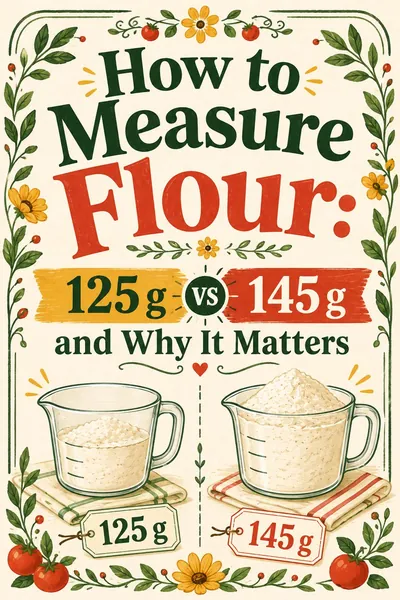
Nine times out of ten it's flour. You put in more than the recipe writer did, and a stiff dough has nothing to flow with. A cup of all-purpose flour weighs 125 g if you spoon it into the cup and level it, and 145 g if you dip the cup straight into the bag. Over three cups, that gap is a full extra half cup of flour.
The second most common cause is leavening. Baking powder makes cookies rise up rather than out, so a recipe using powder (or too much of it) gives you a tall, cakey dome instead of a spread cookie.
Everything else on this list is real, but those two explain most cookies that come out of the oven looking almost exactly like the ball you put in.
Stop guessing at your flour: our free grams to cups converter turns any cup measurement into a weight, so the same recipe behaves the same way every time you bake it.
Updated September 2026
Why are my cookies not spreading? The 7 causes, ranked
| # | Cause | How common | The fix in one line |
|---|---|---|---|
| 1 | Too much flour | Very common | Weigh it at 125 g per cup |
| 2 | Too much leavening, or powder instead of soda | Very common | Match the recipe exactly, level the spoon |
| 3 | Butter too cold, or barely creamed | Common | Cream at 65 to 67°F for 3 to 4 minutes |
| 4 | Not enough sugar, or the wrong sugar | Common | Weigh: 200 g granulated per cup |
| 5 | High-protein flour or thirsty add-ins | Occasional | Use all-purpose, hold back the cocoa and oats |
| 6 | Rock-hard dough plus a hot oven | Occasional | Temper 15 minutes, bake at 350 to 375°F |
| 7 | Overmixed dough with too much gluten | Occasional | Mix to just-combined, flour last |
Work down that list in order. The top two account for the large majority of stubborn cookies, and they compound: a baker who over-measures flour is often the same baker who rounds the baking powder up.
Cause 1: too much flour, which is really a measuring mismatch
Nobody measures a cup of flour the same way, and there's no rule that says they have to. Here is what the same cup weighs by the three common methods, straight from our ingredient weights chart:
| Method | What you do | Weight per cup |
|---|---|---|
| Sifted, then spooned | Sift, spoon into the cup, level | 115 g |
| Spoon and level | Spoon flour in, level with a knife | 125 g |
| Scoop and sweep | Dip the cup in the bag, sweep the top | 145 g |
Scoop and sweep packs about 20 g more per cup, which is 16 percent. Against sifted flour, the gap is 26 percent.
Now put that in a real recipe. If the author spooned and leveled and you scooped, a three-cup cookie dough gets 435 g of flour instead of 375 g. That extra 60 g has to absorb liquid from somewhere, and the only liquid in the bowl belongs to the eggs and the butter. The dough tightens. In the oven, there's simply not enough free moisture and melted fat for the cookie to flow.
The tell is a cookie that keeps the exact shape of the scoop, with a matte, slightly dry surface and a crumb closer to a scone than a cookie.
Weighing ends this argument permanently. Run your recipe through the grams to cups converter once, write the grams in the margin, and the problem never comes back. Our guide on how to measure flour covers the technique if you don't own a scale yet.
One more trap: "add flour until the dough isn't sticky." Cookie dough is supposed to be a little tacky when it's warm. It firms up in the fridge, not in the mixer. Adding flour to fix stickiness is how a good dough becomes a stiff one.
Cause 2: your leavening is pushing the cookie up instead of out
Baking soda and baking powder are not interchangeable here, and the difference is exactly the difference between a spread cookie and a domed one.
Baking soda is a base. It raises the pH of the dough, and that does three useful things for spread: it weakens gluten so the dough relaxes, it speeds up browning, and it produces its gas early, while the dough is still soft enough to flow.
Baking powder carries its own acid, so it doesn't raise pH. Double-acting powder holds most of its gas until the dough heats up, which means the lift arrives when the cookie is already setting. The gas pushes vertically into a structure that's firming. That's a dome.
So a recipe written for soda, made with powder, gives you a taller and cakier cookie almost every time. Even the correct leavening in too large an amount does it, because more gas means more vertical pressure and a faster set.
Measure with a level spoon, not a heaped one. 1 tsp of baking powder is about 4 g, and baking soda is a little denser at roughly 4.6 g per teaspoon. A heaped teaspoon can be half again as much, which is enough to change the cookie. Our baking soda vs baking powder guide has the full comparison, including the conversion ratio if you only have one of them.
Cause 3: butter that was too cold, or never really creamed
This is the mirror image of the flat-cookie problem. In flat cookies, the butter was too warm to hold any air. Here, it's often too cold to take any in.
Creaming is mechanical aeration. Sugar crystals cut through semi-solid butter and drag air pockets in behind them. That only works in a fairly narrow window: 65 to 67°F. Below about 60°F, the butter is too firm for the sugar to cut through, so the mixture stays dense and grainy no matter how long the mixer runs. A dense, cold, under-aerated dough has less internal steam pressure and takes longer to soften in the oven, so it sets before it flows.
Check the butter properly. A stick at the right temperature bends without cracking, and a thumbprint leaves a clean dent with a defined edge. If it cracks or your thumb barely marks it, it's too cold. Our guide on how to soften butter ranks seven methods by speed and by how likely each one is to overshoot.
There's an opposite failure worth naming. Over-creaming whips in so much air that the cookie inflates fast, sets in that inflated shape, and then sinks a little in the middle when the air cools. That gives you a puffy cookie with a crater, which reads as "didn't spread" but is really "rose too fast." Three to four minutes on medium is plenty. How to cream butter and sugar covers what the mixture should look like at each stage.
Shortening is the other version of this. It melts around 117°F, well above butter's 90 to 95°F, so a shortening cookie holds its shape by design. If you swapped shortening for butter, less spread is the expected result, not a mistake.
Cause 4: sugar, both the amount and the type
Sugar is a liquid in disguise. Once it melts, it thins the dough and lets it flow. Cut the sugar and you cut the spread, which is why "I reduced the sugar to make them healthier" is such a common lead-in to a puffy cookie.
The weights that matter: granulated sugar is 200 g per cup, packed brown sugar is 213 g per cup, and powdered sugar is 120 g per cup unsifted.
Type matters as much as amount:
- Granulated sugar melts cleanly and promotes the most spread.
- Brown sugar is slightly acidic and holds moisture, so it sets faster and spreads a bit less. An all-brown-sugar cookie is thicker than an all-white one.
- Powdered sugar contains 3 percent or so cornstarch and does not behave like granulated at all. Cookies made with it stay pale, tender and puffy. That's why shortbread and Mexican wedding cookies use it.
If you swapped in a granulated sugar substitute, expect less spread too. Most of them don't melt the way sucrose does. The sweetener substitutes guide explains which ones behave and which ones need a texture adjustment.
Cause 5: high-protein flour, or add-ins that drink
Flour protein sets how much gluten your dough can build and how much water it holds.
| Flour | Protein | Weight per cup | Effect on spread |
|---|---|---|---|
| Cake flour | 7 to 9% | 114 g | Most spread, tender and fragile |
| All-purpose | 10 to 11.7% | 125 g | The baseline most recipes assume |
| Bread flour | 12 to 13% | 127 g | Noticeably less spread, chewier |
| Whole wheat | 13 to 14% | 120 g | Least spread, bran cuts the gluten |
Bread flour absorbs roughly 5 to 8 percent more water than all-purpose and builds a stronger, more elastic network. Some bakers use it deliberately for a thick, chewy cookie, which is covered in chewy vs crispy cookies. If you used it by accident, that's your answer. Bread flour vs all-purpose has the full swap math.
Thirsty add-ins do the same thing quietly:
- Cocoa powder is very absorbent at only 85 g per cup. A quarter cup of cocoa added without pulling any flour out will stiffen the dough.
- Rolled oats soak up free moisture as they sit, which is why oatmeal cookie dough gets noticeably tighter after an hour in the fridge.
- Milk powder, protein powder and almond flour all bind water without contributing any gluten or sugar.
The rule: if you add a dry ingredient by volume, take out roughly the same volume of flour.
Cause 6: dough straight from the freezer into a hot oven
Chilling is normally the fix for spreading, not the cause of the reverse. But there is a point where it flips.
Dough at 32°F takes so long to soften in the oven that the outside sets before the middle ever gets loose. You get a cookie with a set rim and a domed, undercooked center that never flattened out. A high oven temperature makes it worse, because the surface sets faster still.
Two adjustments:
- Let frozen dough balls sit out 15 to 20 minutes before baking, or add 2 minutes to the bake and accept a thicker cookie.
- Bake at 350 to 375°F, not 400°F. A lower temperature gives the dough more time in the soft phase, which is when all spreading happens.
Chilling for a normal 30 to 60 minutes does not stop a healthy dough from spreading. It slows the melt so the cookie spreads less messily. Why rest cookie dough explains what changes during that rest and why an overnight dough tastes different.
Cause 7: overmixed dough
Once flour meets liquid, gluten starts forming, and beating speeds it up. An overmixed cookie dough is elastic: it pulls back on itself instead of relaxing outward, in the same way a rested pie crust behaves differently from a freshly worked one.
Mix on low after the flour goes in, and stop the second the dry streaks disappear. Fold chips or nuts in by hand. Thirty seconds too long here can undo four minutes of careful creaming.
Diagnostic table: match what you see to the cause
| What you're seeing | Most likely cause | The fix |
|---|---|---|
| Cookie is the exact shape of the scoop, dry and matte | Too much flour | Weigh at 125 g per cup |
| Tall, soft, cakey, pale | Too much baking powder, or powder used for soda | Level the spoon, check which leavener the recipe wants |
| Puffed up, then sank into a crater | Over-creamed | Cream 3 to 4 minutes, no longer |
| Thick and dense, never puffed at all | Butter too cold to aerate | Cream at 65 to 67°F |
| Pale, tender, no browning, no spread | Powdered sugar or reduced sugar | Use granulated at 200 g per cup |
| Chewy and thick, good flavor, no spread | Bread flour | Switch to all-purpose |
| Set rim, raw dome in the middle | Frozen dough plus a hot oven | Temper 15 min, drop to 350 to 375°F |
| Tough and springy | Overmixed | Mix to just-combined |
Worked example: how a recipe drifts 22 percent
Take a standard drop cookie: 2 1/4 cups all-purpose flour, 1 cup butter, 3/4 cup granulated sugar, 3/4 cup packed brown sugar, 1 tsp baking soda.
What the author intended, spooning and leveling:
- 2.25 cups × 125 g = 281 g flour
- Butter: 227 g (1 cup, or 2 sticks at 113 g each)
- Granulated: 150 g, brown: 160 g. Total sugar 310 g
- Flour to sugar ratio: 281 to 310, or 0.91 to 1
What actually went in the bowl on a bad day:
- Scoop and sweep: 2.25 × 145 g = 326 g
- Plus 2 tbsp extra "because the dough looked sticky": 16 g, giving 342 g
- Baking soda swapped for a heaped teaspoon of baking powder: about 6 g of powder instead of 4.6 g of soda
- Flour to sugar ratio: 342 to 310, or 1.10 to 1
That's 61 g more flour, a 22 percent increase, and the ratio has flipped from sugar-dominant to flour-dominant. On top of it, the leavening now pushes up rather than out and the pH never rises, so browning is slow and the set arrives late in the wrong shape.
The result is a pale, domed, cakey cookie. Not burnt, not raw, just wrong. And nothing in the recipe told you it would happen.
The corrected version:
- Flour: 281 g, weighed, no extras
- Butter: 227 g at 66°F, creamed 3 to 4 minutes
- Sugars: 150 g granulated + 160 g packed brown
- Baking soda: 1 level tsp
- Chill 45 minutes, portion at 45 g per ball
- Bake at 375°F on parchment, light aluminum pan, 10 to 11 minutes
Same recipe. Same oven. A cookie that spreads.
How to rescue dough that won't spread
Don't throw it out. Test first, then adjust in small steps.
- Bake one test cookie. One. Thirty seconds of dough buys you all the information.
- Let the dough warm to about 65°F and try again. Cold alone is sometimes the whole story.
- Flatten the balls to about 3/4 inch with the bottom of a glass before they go in. This is not cheating. It works, and it's what most bakery cookies get.
- Add fat, not liquid. One tablespoon of softened butter (about 14 g) worked into a standard batch loosens the dough without making it cakey. Water and milk push it the other way.
- Add 2 tbsp of granulated sugar (25 g) if the dough is dry and pale. More sugar means more melt and more browning.
- Drop the oven 25°F and add a minute or two. A slower set gives the cookie longer to flow.
- Skip the silicone mat and use parchment on a light aluminum pan. Mats insulate and slow the bottom heat, which slows the melt.
Fix one variable per test batch, not three. Otherwise you learn nothing.
When a cookie is supposed to hold its shape
Not every unspread cookie is a failure. Several styles depend on staying exactly where you put them.
Cut-out and decorated sugar cookies must hold their edges or the shapes blur. Those recipes deliberately use less sugar, more flour and often no leavening at all. If yours are spreading, our guide on how to stop cookies from spreading works the same physics in reverse.
Shortbread is flour, butter and a little powdered sugar, with no eggs and no leavening. It bakes almost exactly as pressed.
Thumbprints, crinkles, snickerdoodles and molasses cookies are all built to puff. Crinkle cookies rely on a surface that sets fast while the inside expands, which is what cracks the powdered sugar coating.
Filled or stuffed cookies need a stiff dough to hold the filling. Spread would let it leak.
The tell is in the recipe itself. Melted butter, a high sugar-to-flour ratio and instructions to space the portions three inches apart mean spread is the plan. Creamed butter, chilling and a rolling pin mean it isn't.
Frequently asked questions
Why are my cookies puffy instead of flat?
Usually too much flour or too much baking powder. Flour stiffens the dough so it can't flow, and powder releases its gas late, pushing the cookie up while it sets. Weigh your flour at 125 g per cup and use a level teaspoon of leavening rather than a heaped one.
Should I flatten cookie dough balls before baking?
Yes, if your dough is on the stiff side or you're baking straight from the fridge. Press each ball to about 3/4 inch with the bottom of a glass. It gives the cookie a head start on the shape it would have reached on its own, and it costs nothing in texture.
Does baking powder or baking soda make cookies spread more?
Baking soda. It raises the dough's pH, which weakens gluten, speeds browning and releases gas early while the dough is still soft. Baking powder is pH neutral and holds much of its lift until the dough heats, so it pushes upward into a setting cookie and gives you height instead.
Can too much flour really stop cookies from spreading?
It's the single most common cause. Scooping the cup into the bag adds about 20 g per cup over spooning and leveling, so a three-cup recipe can pick up 60 g of extra flour with no change to the written instructions. That shifts the flour-to-sugar ratio enough to change the cookie completely.
Why didn't my cookies spread when I used bread flour?
Bread flour runs 12 to 13 percent protein against 10 to 11.7 percent for all-purpose, so it builds a stronger gluten network and absorbs more water. The dough resists flowing. Some bakers use it on purpose for a thick, chewy cookie. If you want spread, switch back to all-purpose.
Do I need to bring cookie dough to room temperature before baking?
Not for a normal 30 to 60 minute chill, which is a good thing and shouldn't stop spread. Frozen dough is different: give it 15 to 20 minutes on the counter, or add 2 minutes to the bake and expect a thicker cookie with a domed center. Cut-out doughs want longer than that, and sugar cookie dough chill times lists them.
Why did my cookies stay in a ball with no browning at all?
Two things are usually happening at once: too much flour and not enough sugar or soda. Browning needs sugar and a higher pH to get going, and both of those also drive spread. A pale, ball-shaped cookie is telling you the dough was flour-dominant and low on the ingredients that make it flow.
Does adding an extra egg stop cookies from spreading?
An extra whole egg adds water, which the flour absorbs, and adds protein that sets early. The net result is a cakier, taller cookie. An extra yolk does the opposite, adding fat and emulsifier for a chewier cookie with a little more spread. Yolks and whites are not interchangeable here.
Why don't my gluten free cookies spread?
Most gluten free blends contain rice flour and starches that absorb liquid slowly, so the dough keeps tightening as it sits. Try mixing the dough and baking a test cookie right away rather than after a long chill, and add a tablespoon of extra fat. Our gluten free baking substitutions guide covers blend behavior in more detail.
Related guides: Why are my cookies flat | How to stop cookies from spreading | How to measure flour | Baking soda vs baking powder | Grams to cups converter