What Does Sugar Do in Baking?

Sugar does six jobs at once: it sweetens, holds onto water so bakes stay soft, blocks gluten and egg proteins so the crumb is tender, browns the crust, carries the air you beat into butter, and feeds yeast. Sweetness is the one you taste and the least important of the six.
That is why cutting the sugar in a recipe by a third never just makes it less sweet. It makes it drier, paler, tougher, flatter and shorter-lived, all at the same time.
Sugar is also heavy, which is where most home errors start. One cup of granulated sugar is 200 g, packed brown sugar is 213 g and powdered sugar is 120 g. Our free ingredient weights chart has the full set, so the sugar you add is the sugar the recipe meant.
Updated September 2026
What does sugar do in baking? The six jobs at a glance
Every section below is one row of this table, opened up.
| The job | How sugar does it | What you see | What breaks it |
|---|---|---|---|
| Sweetens | Dissolves on the tongue | The obvious one | Nothing, really. Sweetness is the most forgiving property |
| Holds moisture | Sugar is hygroscopic and grabs water from the air | Cake still soft on day three | Cutting sugar, or using a sugar with no molasses |
| Tenderizes | Competes with flour for water, so less gluten forms | Soft, fine crumb instead of chew | Too little sugar, or overmixing before the sugar dissolves |
| Browns | Caramelizes above 320°F and drives the Maillard reaction with proteins | Golden crust, deeper taste | Low oven, short bake, or reduced sugar |
| Traps air | Sharp crystals cut pockets into butter during creaming | Fine, even crumb in butter cakes | Powdered sugar, liquid sweeteners, or melted butter |
| Feeds yeast | Simple sugars are what yeast eats first | Faster rise in enriched dough | Too much sugar, which slows yeast instead |
Butter and sugar together are what make most baked goods what they are. Our companion guide, what does butter do in baking, covers the other half of that pair.
Job 1: sugar holds water, and that is why bakes stay soft
Sugar is hygroscopic. It pulls water out of the air and holds onto it, and it holds onto the water already in your batter rather than letting it escape as steam.
This is the single biggest reason a low sugar cake goes stale by the next afternoon.
Not all sugars are equally thirsty. The ranking, from most water-holding to least:
- Honey, molasses, corn syrup and other invert sugars. The most hygroscopic of the lot. This is why a honey cake stays sticky-soft for days.
- Brown sugar. Its molasses coating brings both moisture and hygroscopic power. Dark brown holds more than light.
- Granulated white sugar. The middle ground and the default.
- Powdered sugar. Cut with 3 percent cornstarch, so it behaves a little differently.
The practical version: if a bake goes stale faster than you want and you are unwilling to add more sugar, swap a quarter of the white sugar for brown. You gain moisture retention without gaining sweetness, since brown and white sugar are equally sweet. Brown sugar substitute covers making your own with molasses if you are out.
This same property is why brown sugar in the bag turns into a brick. It gave its moisture to the air. How to soften brown sugar has the fixes.
Job 2: sugar tenderizes by getting between flour and water
Gluten forms when flour protein meets water. Sugar dissolves in that same water and physically gets in the way, so less protein finds enough water to link up. Less gluten means a shorter, more tender crumb.
Sugar does the same thing to eggs. It raises the temperature at which egg proteins set, which is why a sweet custard sets gently and a plain one curdles. In a cake, that delay gives the batter longer to rise before the structure locks.
The evidence you can see in your own kitchen: take the same cookie dough, split it, and drop the sugar in one half by 30 percent. The low sugar batch bakes up puffier, paler, tougher and noticeably more bready. Nothing else changed.
Where this matters most:
- Butter cakes and pound cakes rely on sugar for tenderness, not just taste. Cutting sugar hard turns them into muffins.
- Cookies get their chew from the balance of sugar to flour. See chewy vs crispy cookies for the full set of levers.
- Bread uses small amounts of sugar on purpose, because it needs the gluten sugar would weaken.
- Pie crust usually carries only a spoonful, enough to brown and tenderize slightly without making the dough sticky.
Job 3: sugar is why cookies spread
At room temperature sugar is a solid crystal doing nothing. In the oven it dissolves in the dough's water and turns the whole thing into a syrup, and syrup flows.
That is the entire mechanism of cookie spread. More sugar means more syrup means more spread.
The type of sugar changes the spread as much as the amount.
| Sugar in a cookie dough | What happens to spread | Why |
|---|---|---|
| Granulated white | Most spread, crisp edges | Dissolves fully, low moisture, slightly acidic pH |
| Light brown (packed) | Moderate spread, chewier | Molasses is acidic and holds water, and the dough sets sooner |
| Dark brown (packed) | Least spread of the three, softest | More molasses, more acid, faster set |
| Powdered | Very little spread, sandy texture | Cornstarch absorbs liquid and the crystals never cut air |
| Turbinado or raw | Uneven spread, crunchy top | Large crystals dissolve slowly and never fully |
A useful thing to know about brown sugar: the acid in molasses reacts with baking soda, so a dough heavy in brown sugar sets earlier in the bake and stops spreading sooner. That is a chemistry difference, not just a moisture one.
If your cookies are pooling into one sheet, sugar is only one of five likely causes. Why are my cookies flat works through all of them, and how to stop cookies spreading has the fixes ranked by how much they actually help.
Job 4: browning, and the two different reactions behind it
Two separate things brown your bakes, and sugar drives both.
Caramelization is sugar breaking down on its own from heat. Table sugar starts melting around 320°F and browns from there through about 350°F. It needs nothing but sugar and heat. Getting that caramel to stay put on something is a separate problem, and keeping caramel on apples works through it.
The Maillard reaction is sugar reacting with protein, and it starts lower, from roughly 250 to 300°F on a dry surface. It needs a reducing sugar, which is where honey, molasses, brown sugar and corn syrup do better than plain white sugar. This is what makes crusts smell like bread and cookies smell like cookies rather than like burned candy.
What this means at the oven dial:
- A cake baked at 325°F browns mostly through Maillard. It goes golden, not deep brown.
- A cookie at 375°F gets both, which is why the edges taste different from the center.
- Cut the sugar 30 percent and the same cookie comes out visibly paler at the same time and temperature. You have removed the fuel.
- Add a tablespoon of honey or molasses to a pale recipe and it browns faster, sometimes too fast.
The practical trap: low sugar recipes often look underbaked when they are actually done, because color is your usual doneness cue and you removed the thing that makes color. Go by time, by internal temperature or by a toothpick instead. How to tell when cookies are done covers the cues that still work.
Job 5: creaming, where sugar is a tool and not an ingredient
Beating butter and sugar together is mechanical work, not mixing. Each sharp sugar crystal is dragged through the fat and cuts a tiny hole, and every hole fills with air.
Those holes are the seed bubbles for the whole bake. Baking soda and baking powder do not create bubbles from nothing, they inflate bubbles that already exist. No creaming, no bubbles to inflate.
Which is why the sugar you cream with matters:
- Granulated sugar is the standard and works because its crystals are sharp and hard enough to cut.
- Superfine or caster sugar has smaller crystals, so it cuts more, smaller holes. Finer crumb, slightly less total lift.
- Powdered sugar cannot cream at all. The crystals are ground too fine to cut anything. It is for frosting, not for cake batter.
- Brown sugar creams, but its softness and moisture make it less efficient. Doughs creamed with all brown sugar rise a little less.
- Liquid sweeteners cream not at all. Honey, maple syrup and agave bring sweetness with zero aeration.
That last point is why a recipe rewritten with honey instead of sugar often bakes flat. You did not just change the sweetener, you deleted a leavening step. Sweetener substitutes for baking lists the adjustments that put the lift back.
For what correctly creamed butter and sugar looks and feels like, see how to cream butter and sugar.
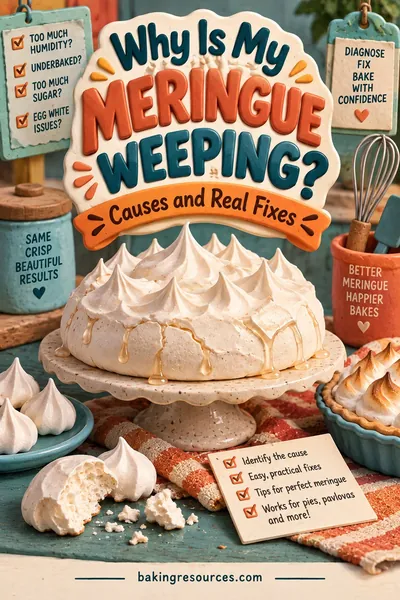
Sugar plays the same stabilizing role in egg white foams, where it dissolves into the water between the bubbles and thickens it so the foam stops draining. A meringue commonly runs about 50 g of sugar per large egg white, roughly 2 parts sugar to 1 part white by weight, and the sugar has to go in slowly after soft peaks form. Details are in how to whip egg whites.
Job 6: sugar feeds yeast, until it starts fighting it
Yeast eats simple sugars first. A small amount of sugar in a bread dough gives the yeast a fast start before it has to work at breaking down the starch in flour.
But the relationship flips. Above roughly 8 to 10 percent sugar by flour weight, sugar starts pulling water away from the yeast cells by osmosis and the rise slows down. Enriched doughs such as brioche and cinnamon rolls carry far more than that, which is why they take so much longer to rise and often use extra yeast or a special osmotolerant strain.
Working in bakers percentage makes this easy to see, since everything is stated as a share of flour weight. Our bakers percentage guide covers the math.
| Sugar as percent of flour weight | Effect on the dough |
|---|---|
| 0 to 2 percent | Lean dough. Yeast works on starch. Slow, deeply flavored, pale crust |
| 3 to 8 percent | Sandwich bread range. Faster rise, softer crumb, better browning |
| 10 to 15 percent | Sweet rolls. Rise slows noticeably, needs more yeast or more time |
| 20 percent and up | Brioche and panettone territory. Long, careful proofing required |
If your dough is sitting there doing nothing, sugar is one of the suspects. Why is my dough not rising covers the rest.
Worked example: what happens when you cut sugar by 25 percent
Take a standard drop cookie dough built on 250 g of all-purpose flour, which is 2 cups at the 125 g per cup our grams to cups converter uses, plus 200 g of sugar, which is exactly 1 cup of granulated.
You decide 200 g is too sweet and cut it to 150 g.
Step 1: work out what you removed as a ratio. Sugar to flour has gone from 200 ÷ 250 = 80 percent down to 150 ÷ 250 = 60 percent. That is a 20 point drop, which is a big move in dough terms, not a small one.
Step 2: predict each of the six jobs.
| Job | Effect of the 50 g cut |
|---|---|
| Sweetness | Noticeably less sweet, which is what you wanted |
| Moisture | Stales about a day faster |
| Tenderness | More gluten forms, so the cookie is firmer and breadier |
| Browning | Visibly paler at the same bake time |
| Spread | Less syrup, so a thicker, more domed cookie |
| Yeast | Not applicable here |
Step 3: decide which losses to buy back.
- To keep the softness without the sweetness, make 75 g of the remaining 150 g dark brown sugar. Same sweetness, more moisture retention and more acid.
- To keep the browning, raise the oven by 15°F and shorten the bake by 2 minutes.
- To keep some spread, melt the butter instead of creaming it. Melted butter loosens dough and undoes part of what removing sugar did.
- Accept the firmer texture, or add a tablespoon of milk to bring the dough hydration back up.
Step 4: cap the cut. As a rule, sugar cuts of up to 15 percent go unnoticed in most recipes. Cuts past 25 percent need at least one of the compensations above. Past a third, you are writing a different recipe, not adjusting one.
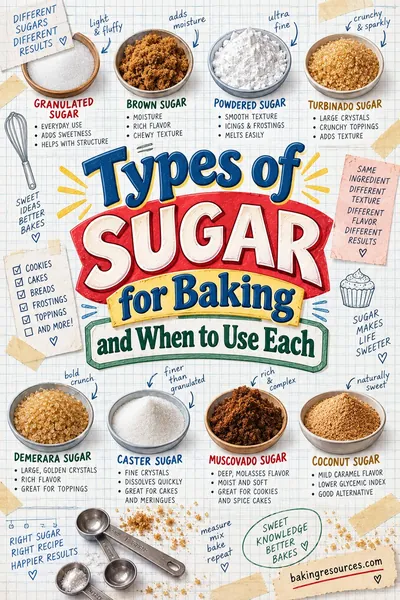
Sugar types, weights and what to reach for
Weights below match our ingredient weights chart, measured spooned and leveled unless noted.
| Sugar | Grams per US cup | Sweetness vs white | Best at |
|---|---|---|---|
| Granulated white | 200 g | Baseline | Creaming, spread, crisp edges, meringue |
| Superfine / caster | 200 g | Same | Fast dissolving. Meringue, delicate cakes |
| Light brown, packed | 213 g | Same | Chew, moisture, cookies, quick breads |
| Dark brown, packed | 213 g | Same | Deeper color, most moisture, gingerbread doughs |
| Powdered / confectioners | 120 g unsifted, about 100 g sifted | Same | Frosting, glaze, dusting. Never for creaming |
| Turbinado / raw | 180 g | Slightly less | Crunchy toppings, sprinkled not mixed |
| Coconut sugar | 154 g | Slightly less | Swaps 1 to 1 by volume, darkens the bake |
| Honey | 340 g | About 1.2 times sweeter | Moisture and browning, not lift |
| Maple syrup | 322 g | Slightly less | Moisture, distinct taste |
| Molasses | 337 g | Less sweet, more acid | Color, acid for baking soda, deep taste |
The packed brown sugar trap. A cup of brown sugar packed firmly is 213 g. Scooped loosely it lands nearer 145 g, a difference of nearly a third. If the recipe says packed and you did not pack, you removed about 68 g of sugar without realizing it. This is the most common silent sugar error in home baking, and weighing removes it entirely.
Powdered sugar is not a swap for granulated. It has cornstarch in it, its crystals cannot cream, and a cup weighs 120 g rather than 200 g. Swapping cup for cup takes 40 percent of the sugar out of the recipe.
For the underlying composition figures on sugars and syrups, the USDA's FoodData Central database is the primary source most reference charts are built on.
Frequently asked questions
Can I reduce sugar in a recipe without ruining it?
Up to about 15 percent, yes, and most people will not notice. Between 15 and 25 percent you will see paler color and a firmer, drier crumb, so raise the oven slightly and consider swapping part of the remaining sugar for brown. Past a third of the sugar, the recipe needs rebuilding rather than adjusting, because you have removed structure, moisture and browning all at once.
Does brown sugar make cookies chewier than white sugar?
Yes, for two reasons. The molasses in brown sugar holds water, which keeps the finished cookie soft, and it is acidic, so it speeds up the reaction with baking soda and sets the dough earlier in the bake. Earlier setting means less spread and a thicker, chewier cookie. All brown sugar gives the chewiest result, all white the crispest.
Why does sugar make bread rise faster?
Yeast eats simple sugars before it goes to the work of breaking down starch, so a few percent of sugar gives it an easy first meal and a faster start. The effect reverses above roughly 8 to 10 percent of the flour weight, where sugar starts drawing water out of the yeast cells and slows fermentation instead. That is why sweet doughs take longer than lean ones.
Is honey a straight substitute for sugar in baking?
No. Honey is about 1.2 times sweeter, brings water with it, browns much faster and cannot be creamed. As a starting point, use about three quarters as much honey by volume, cut the recipe's other liquid by 3 to 4 tablespoons per cup of honey replaced, and drop the oven by 25°F to stop the top from getting too dark. Expect a denser result, since you gave up the creaming step.
What does sugar do in bread dough besides sweeten it?
Four things: it feeds the yeast, tenderizes the crumb by limiting gluten, holds moisture so the loaf stays soft for longer, and browns the crust through the Maillard reaction. A sandwich loaf running 3 to 6 percent sugar on flour weight is softer and browner than a lean dough with none, which is exactly why supermarket bread is made that way.
Does the type of sugar change how much a cake rises?
Yes, through creaming. Granulated sugar has sharp crystals that cut air pockets into butter, and those pockets are what leaveners inflate. Superfine sugar makes more, smaller pockets. Brown sugar creams less efficiently because it is soft and damp. Powdered sugar and liquid sweeteners cream not at all, so a cake made with either will be denser unless you add lift another way.
Why did my low sugar cake come out pale and dry?
Because you removed the two ingredients doing that work. Sugar is the fuel for both caramelization and the Maillard reaction, so less sugar means less color, and sugar is what holds water in the crumb, so less sugar means faster staling. Add back a portion as brown sugar for moisture, and raise the oven 15 to 25°F to get the color without a longer bake.
Does sugar need to dissolve before baking?
For most batters it happens in the oven and you do not need to worry. Two exceptions matter. In meringue, undissolved sugar makes the foam weep, so rub a little between your fingers and keep beating if it feels gritty. In a cookie dough, resting the dough lets sugar dissolve into the liquid, which deepens the color and taste. That is a large part of why why rest cookie dough is worth doing.
Related guides: What does butter do in baking | Chewy vs crispy cookies | How to cream butter and sugar | Brown sugar substitute | Ingredient weights chart