How to Soften Brown Sugar

Brown sugar hardens because it loses moisture, so every fix is about putting moisture back. The fastest method takes about 20 seconds in the microwave under a damp paper towel. The slowest takes a day, with a slice of bread sealed in the container.
Pick based on when you need it. The fast methods work by heating the sugar, and heated sugar re-hardens as it cools, so they only help if you are baking right now. The slow methods actually restore the sugar and it stays soft.
There is also a hidden cost most people miss. Hard brown sugar does not pack correctly into a measuring cup, so a "packed cup" of it can be 30 to 50 g light. That is a real recipe error, not a rounding issue.
Weighing instead of scooping? Our free grams to cups converter has brown sugar at 213 g per packed cup along with every other common ingredient.
Updated September 2026
Why brown sugar hardens in the first place
Brown sugar is granulated sugar with molasses added back. Light brown sugar is roughly 3.5 percent molasses by weight, dark brown around 6.5 percent. The molasses coats each sugar crystal in a thin syrup film, and that film is what makes brown sugar soft, clumpy, and moldable.
Molasses is about 20 to 25 percent water. That water is the only thing keeping the coating pliable.
When the container is not airtight, that water evaporates into the room. The molasses film dries and the bare crystal faces come into direct contact with each other. Sugar crystals in contact will bond, and what you end up with is a single fused block of sugar with dried syrup as the glue.
That mechanism explains every remedy on this page. You are not "breaking up" the sugar, you are rehydrating the molasses film so the crystals separate again. Every method below is a different way of delivering water.
It also explains why brown sugar hardens and white sugar does not. White sugar has no syrup coating and no water to lose, so it stays loose forever unless it gets damp.
How to soften brown sugar: five methods compared
| Method | Time | Effort | How long it lasts | Best for |
|---|---|---|---|---|
| Microwave with a damp towel | 20 to 60 seconds | Low | Minutes, it re-hardens as it cools | You are baking right now |
| Oven at 250F | 5 to 10 minutes | Low | Minutes, same problem | A large amount you need immediately |
| Bread slice in the container | 8 to 24 hours | Almost none | Weeks to months | Restoring the whole bag properly |
| Apple wedge in the container | 12 to 24 hours | Almost none | Weeks, but check for mold | Same, when you have no bread |
| Terracotta sugar saver | 24 hours to soften, then indefinite | Almost none, resoak monthly | Permanent, if you resoak it | Prevention and long-term storage |
| Food processor blitz | 30 seconds | Low | Not softened, just broken up | Grinding hard lumps into usable sugar |
Microwave. Put the sugar in a microwave-safe bowl, lay a damp paper towel directly over it, cover with a plate or plastic wrap, and microwave in 20 second bursts. Break it up with a fork between bursts. Most half-pound blocks come apart in 20 to 40 seconds. Do not do a straight minute, because sugar melts at around 320F and a corner of the block will scorch before the middle warms.
Oven. Spread the sugar in a baking dish, cover with foil, and put it in a 250F oven for 5 minutes. Check and break it up with a fork. Repeat in 2 minute increments. This handles larger quantities than the microwave without hot spots.
Bread slice. Put the hard sugar in an airtight container with a slice of plain sandwich bread on top. Seal it and wait. The sugar pulls moisture out of the bread through the sealed air, and the bread goes stale and hard while the sugar goes soft. Check at 8 hours, and expect a full day for a badly fused block. Remove the bread once it is done, since a stale slice left for a week can mold.
Apple wedge. Same idea, and apples hold more water than bread so it can work slightly faster. The risk is higher too, because fruit molds faster than bread. Use it for a day, then take it out. Do not leave apple in a sugar container as a permanent solution.
Terracotta sugar saver. A small unglazed clay disc. Soak it in water for 15 to 20 minutes, pat it dry, and drop it in the container. Fired clay is porous and holds water, releasing it slowly into the sealed air. It works and it is the only method on this list that is genuinely permanent. Resoak it every 3 to 4 weeks or when the sugar starts firming up.
Food processor. This one does not soften anything, it just pulverizes. If you need the sugar right now and it is a solid rock, break it into chunks with a heavy knife and pulse it in a food processor. You end up with dry brown sugar powder, which measures differently than packed sugar. Weigh it rather than scooping it.
The caveat nobody mentions: heat is temporary
This is the part that gets left out of most articles, and it wastes a lot of people's time.
Microwaved and oven-warmed brown sugar re-hardens as it cools. Often within 15 to 30 minutes.
Heat does not add water to the sugar. It softens the dried molasses coating the same way heat softens caramel or candle wax, and once the temperature drops the coating stiffens right back. Worse, the heat drives off some of the small amount of water that was left, so the block can come back harder than it started.
The practical rule: if you use a fast method, use the sugar immediately. Scoop it, weigh it, and get it into the bowl while it is warm.
If you want it to stay soft, you have to use a slow method that actually delivers water into the sugar, and then keep the container sealed. Bread, apple, and terracotta all work because they let water vapor migrate into the sugar over hours, where it is absorbed by the molasses rather than just melted.
You can combine them. Microwave what you need for today, then put a bread slice in with the rest of the bag overnight. That gets you both.
The damp paper towel in the microwave method does add a little water, which is why it works better than microwaving alone. It is still not enough to survive cooling, so treat it as a same-day fix.
Prevention: the original bag is the worst place to store it
Brown sugar comes in a paper or thin plastic bag with a rolled-over top. That bag is not airtight and was never meant to be. It is designed to get the sugar from the factory to your kitchen, not to store it for four months.
Once you open it, moisture starts leaving. In a dry winter kitchen at 25 percent humidity, a partly used bag can go solid in two weeks.
What actually works:
- A genuinely airtight container. A glass jar with a gasket lid, a screw-top canister with a silicone seal, or a heavy zip-top bag with the air pressed out. The test is whether you can seal it and feel resistance.
- A terracotta sugar saver inside that container. Belt and suspenders, and the combination will keep sugar soft indefinitely.
- Room temperature, away from heat. Do not store brown sugar above the stove or next to the oven, where warm air pulls moisture faster.
- Do not refrigerate it. The fridge is a dehumidifier, so it dries brown sugar out. Cold also makes the block harder to break up.
If you buy brown sugar in bulk, decant it into a sealed container the day you open it rather than after the first hardening.
Freezing works if you are storing it long term, because the freezer air is cold enough that the vapor pressure difference is small. Seal it well, and let it come to room temperature before opening the container so condensation does not form on the surface.
Measuring hardened versus softened brown sugar
Here is the error that costs people cakes, and it goes unmentioned almost everywhere.
Brown sugar is measured packed. A packed cup is 213 g. That number assumes the sugar is soft enough to compress into the cup with the back of a spoon so it holds the shape of the cup when tipped out.
Hard or partly hard brown sugar will not compress. The crumbs and lumps bridge against each other and leave air gaps, and a "packed" cup of firm brown sugar routinely comes in at 165 to 185 g. That is 15 to 25 percent less sugar than the recipe wanted.
In cookies, that shortfall means less spread, less chew, less browning, and a drier result, since sugar is a tenderizer and a moisture holder as much as a sweetener. In a cake it shows up as a tighter crumb and a paler top.
Worked example. A cookie recipe calls for 1 cup packed brown sugar, which is 213 g. Your sugar is firm, and what you scoop and press in weighs 175 g. You are 38 g short, which is about 3 tablespoons of sugar missing from a batch of 24 cookies. That is enough to visibly change how they spread. Soften the sugar first, or weigh out the full 213 g and ignore the cup entirely.
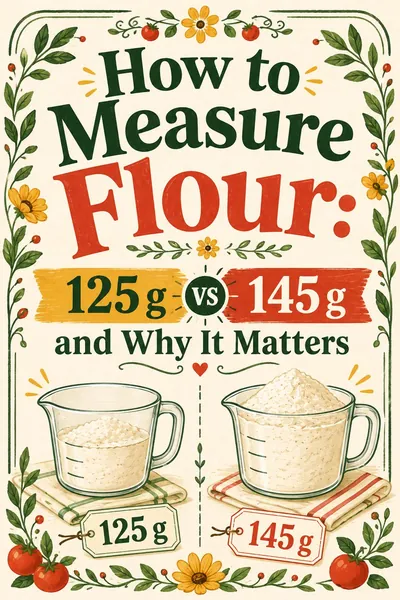
The reliable fix is a scale. Weighing sidesteps packing density completely, which is the same reason weighing matters for flour, where scoop-and-sweep gives 145 g per cup against 125 g for spoon-and-level. Our guide to measuring flour covers that gap, and the full ingredient weights chart has the reference numbers for everything else.
| Ingredient | Grams per cup | Method |
|---|---|---|
| Brown sugar, light or dark | 213 | Packed |
| Granulated sugar | 200 | Scooped and leveled |
| Powdered sugar | 120 | Spooned, unsifted |
| All-purpose flour | 125 | Spoon and level |
| All-purpose flour | 145 | Scoop and sweep |
| All-purpose flour | 115 | Sifted |
| Bread flour | 127 | Spoon and level |
| Cake flour | 114 | Spoon and level |
| Butter | 227 | 2 sticks, 1 stick is 113 g |
| Cocoa powder | 85 | Spooned, unsifted |
| Water | 236 | Filled to the line |
Light and dark brown sugar weigh the same per packed cup. The difference is molasses content and flavor, not density.
Make your own brown sugar instead
If your brown sugar is a lost cause or you ran out, you can make it from granulated sugar and molasses. It takes two minutes and the result is functionally identical, because that is literally how commercial brown sugar is produced.
| Type | Granulated sugar | Molasses | Result |
|---|---|---|---|
| Light brown | 200 g, 1 cup | 1 tbsp, about 20 g | About 220 g, roughly 1 packed cup |
| Dark brown | 200 g, 1 cup | 2 tbsp, about 40 g | About 240 g, slightly over 1 packed cup |
| Very dark, muscovado style | 200 g, 1 cup | 3 tbsp, about 60 g | Strong, slightly bitter, use in gingerbread |
Combine in a bowl and work it with a fork, then your fingers, until there are no streaks and the color is uniform. A stand mixer with the paddle does it in 60 seconds. A food processor works too, though it produces a finer texture.
Use unsulphured molasses, not blackstrap. Blackstrap is the third boil, and it is bitter and mineral-heavy rather than sweet. Regular unsulphured molasses is what commercial brown sugar uses.
Note the yield. Because you are adding weight, 1 cup of granulated sugar plus molasses gives you slightly more than 1 packed cup of brown sugar. If the recipe wants 213 g packed, weigh 213 g of the mixture rather than assuming a one-to-one cup swap.
Homemade brown sugar is softer than store-bought at first and hardens the same way over time, so store it the same way. For other options when you are out of both sugar and molasses, our guide to brown sugar substitutes covers maple syrup, coconut sugar, and the plain white sugar swap along with what each one does to the finished bake.
Frequently asked questions
How do I soften brown sugar fast?
Microwave it in a covered bowl with a damp paper towel laid on top, in 20 second bursts, breaking it up with a fork between each one. Most blocks come apart in 20 to 40 seconds. Use it immediately, because it re-hardens within about half an hour as it cools.
Does the bread trick actually work?
Yes, and it is the most reliable method for restoring a whole bag. The sugar draws water vapor out of the bread through the sealed air, softening properly rather than just warming. Give it 8 to 24 hours and take the bread out once the sugar is soft, since it will eventually mold.
Can I still use hardened brown sugar?
It is completely safe, since it is only dried out and sugar does not spoil. The problem is measuring, because hard sugar will not pack into a cup correctly and you can end up 30 to 50 g short per cup. Either soften it first or weigh out 213 g per cup called for.
Why does my brown sugar keep hardening?
The container is not airtight. Rolled-down original bags, loose-lidded canisters, and clipped bags all let water vapor escape. Move it to a jar with a gasket or a screw-top with a silicone seal, and add a soaked terracotta disc if your kitchen is dry.
Should I store brown sugar in the fridge?
No. Refrigerators actively remove humidity from the air, so the fridge dries brown sugar out faster than a sealed container on the counter. Room temperature away from the stove is correct. Freezing is fine for long-term storage in a sealed bag.
Is there a difference between softening light and dark brown sugar?
The method is identical for both. Dark brown sugar has about twice the molasses, so it holds moisture slightly longer and usually hardens a little more slowly. Once it does harden it takes the same time to fix, and both weigh 213 g per packed cup.
How much molasses do I add to make brown sugar?
One tablespoon of unsulphured molasses per cup of granulated sugar gives light brown, and two tablespoons gives dark. Mix with a fork or a stand mixer paddle until the color is even with no streaks. Weigh the result rather than measuring by cup, since you have added weight to the sugar.
Will a damp paper towel in the container keep brown sugar soft?
It works for a day or two and then becomes a problem. A wet towel sitting against sugar adds too much water in one spot, dissolving the surface into syrup, and it grows mold within a week. Use a terracotta sugar saver instead, which releases water slowly and can be resoaked indefinitely.